AKLOT’s Metal Distortion Guitar Pedal is aimed at players who want modern high gain without turning every chord into mush.
If your priority is tight riffing, clear attack, and a compact footprint, this AKLOT Metal Distortion Guitar Pedal review focuses on the practical tradeoffs that matter.
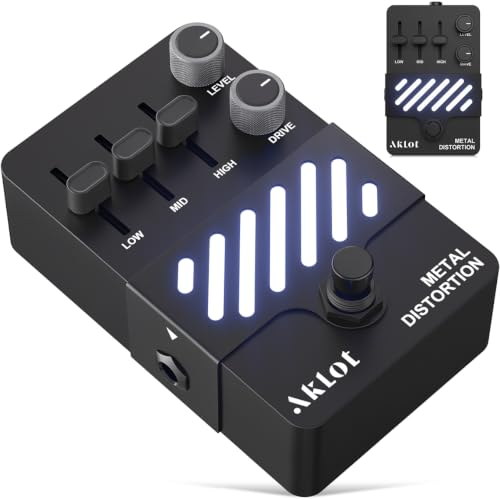
AKLOT Metal Distortion Guitar Pedal Review Summary
This pedal makes sense for guitarists who need a straightforward, aggressive distortion voice with enough control to shape rhythm and lead tones.
The listing points to a sound built around tight low end, sharp attack, strong sustain, and usable note definition, which is exactly the combination many metal and hard rock players look for in a small-format pedal.
It is especially relevant if you want one box that can cover chunky palm-muted riffs, saturated solos, and amp-pushing gain staging without a complicated control layout.
It is less compelling for players who want boutique-level nuance, extensive EQ shaping, or a wide range of non-metal textures.
Review Scorecard
| Category | Score | Why it scores this way |
|---|---|---|
| High-gain voice | 9/10 | The listing is built around modern metal saturation, sustain, and aggressive edge. |
| Low-end control | 8/10 | The Low control is explicitly designed to tighten or thicken the bottom end. |
| Note clarity | 8/10 | The product emphasizes clear riff definition even at higher gain settings. |
| Tone shaping | 7/10 | Drive, Low, Mid, High, and Level give useful control, but the format stays simple. |
| Pedalboard practicality | 8/10 | Compact metal enclosure, standard jacks, and true bypass suit real rigs well. |
| Versatility | 6/10 | Strong for metal and hard rock, but not positioned as a broad all-purpose distortion. |
| Value for focused players | 8/10 | It looks well-targeted if you want one dedicated high-gain box rather than a do-everything pedal. |
In plain terms, this is a good fit for players who care more about tight response and clarity under gain than about endless tonal variety.
If that description matches your setup, the AKLOT pedal is easy to understand and easier to justify.
Key Features and Specifications of AKLOT Metal Distortion Guitar Pedal
The core pitch here is simple: high-gain distortion with enough control to stay articulate.
The listing highlights Drive, Low, Mid, High, and Level controls, so the pedal is not just a one-knob fuzz-style box.
It is designed to let you move from tighter hard rock crunch into more saturated metal tones while keeping the output level workable in a chain.
The pedal also emphasizes true bypass, which matters for players who want the effect out of the signal path when disengaged.
The enclosure is described as metal and compact, with listed dimensions of 116.5 x 76.3 x 48.5 mm, so it should fit into a normal pedalboard layout without taking over valuable space.
The other important detail is how the company frames the voice: tight low end, sharp attack, and clear note separation at high gain.
That combination suggests a pedal that is meant to stay articulate when you are palm muting, playing fast passages, or stacking it into an already loud amp.
Key listed points:
- Aggressive high-gain distortion aimed at modern metal and hard rock
- Touch-sensitive response that reacts to picking intensity
- Drive, Low, Mid, High, and Level controls
- True bypass switching
- Compact metal enclosure for pedalboard use
- Standard 1/4-inch input and output jacks
- Positioned for electric guitar rigs, practice, rehearsal, and live use
The design is focused rather than broad.
That is a strength if you want a dedicated heavy pedal, and a limitation if you need one device to cover vintage overdrive, classic crunch, and modern metal all at once.
Pros and Cons of AKLOT Metal Distortion Guitar Pedal
Pros
- Tight, heavy voicing suited to modern riffing
- Clear note definition at higher gain settings
- Simple but useful EQ controls for shaping low end, mids, and treble
- True bypass helps preserve clean tone when off
- Compact and durable for board-friendly use
- Strong fit for lead sustain and saturated rhythm parts
Cons
- Not a wide-range distortion solution for every genre
- The control set is practical, but not deeply surgical
- Players wanting vintage warmth or softer breakup may find it too specialized
- The listing supports metal-first use, so it is less flexible than multi-voicing drives
The pros and cons of the AKLOT Metal Distortion Guitar Pedal come down to focus.
It appears to do one job with intent, and that is usually better than a generic pedal that does several jobs poorly.
The drawback is obvious: if you do not live in high gain, you may not need this much aggression.
Who Should Buy AKLOT Metal Distortion Guitar Pedal?
Buy this pedal if you play modern metal, hard rock, drop-tuned riffs, or lead-heavy parts and want a compact distortion that stays tight.
It is also a sensible choice if you prefer a pedal with standard controls instead of presets, menus, or digital voicing layers.
It should appeal to players who use a distortion pedal as either their main heavy tone or as a boostable gain source in front of a loud amp.
The listing’s emphasis on clarity and definition suggests it should work best for guitarists who hate muddy saturation.
Skip it if you need:
- A transparent low-gain overdrive
- A classic rock distortion with softer edges
- A highly flexible multi-mode drive
- A pedal intended for broad genre hopping rather than a metal-first sound
If your rig already has the heavy-end of the spectrum covered, this may be redundant.
If your current distortion sounds loose, compressed, or indistinct, this kind of pedal is exactly the sort of corrective tool that can simplify a board.
How the AKLOT Metal Distortion Guitar Pedal Shapes Heavy Tone
Tight Low End for Palm-Muted Riffs
The Low control is one of the most important parts of the design because metal distortion lives or dies on bottom-end discipline.
The listing explicitly promises a tight, punchy low end, which suggests the pedal is trying to keep chugs and muted riffs firm instead of flabby.
Mid and High Controls for Cut and Presence
The Mid and High controls give the pedal the shaping tools it needs for different rigs.
Mids can help keep leads present in a mix, while the high-end control should let players choose between sharper attack and smoother brightness, depending on the amp and pickups.
Drive and Level for Gain Staging
Drive and Level are the straightforward parts of the layout, but they matter.
Drive sets how saturated the pedal gets, while Level helps push the amp or balance rhythm and lead settings.
That makes the pedal more practical than a one-dimensional distortion box.
True Bypass and Board Integration
True bypass is a useful detail for players who care about preserving their clean signal when the pedal is off.
Combined with the compact housing and standard jacks, it makes the AKLOT pedal easy to place in a conventional pedalboard or simple plug-and-play rig.
Alternatives to AKLOT Metal Distortion Guitar Pedal
If you want a different flavor of heavy distortion, these Amazon-searchable alternatives are the obvious places to look:
The Boss and MXR options are worth checking if you want a more established name in metal distortion.
The Metal Muff is a reasonable comparison if you want a heavier, more sculpted voice.
The RAT is not a direct clone of this pedal’s intent, but it is a useful benchmark if you want aggressive gain with a different texture.
Is AKLOT Metal Distortion Guitar Pedal Worth It?
Yes, if your goal is a focused high-gain pedal for tight riffs, articulate chords, and singing sustain.
The AKLOT Metal Distortion Guitar Pedal looks worthwhile for players who want a compact, no-nonsense metal box with practical controls and true bypass.
It is not the best pick if you want one distortion pedal to cover every style, but that is not its job.
For players who want a dedicated heavy voice and care about note clarity under gain, this looks like a sensible buy.