The best desktop AV receivers bring multiple sources, speakers, and display connections together without requiring a full-size theater rack. This roundup covers compact stereo receivers, 5.2-channel models, and network-ready options for different room sizes and budgets.
Before choosing, consider whether you need surround sound, 4K or 8K video support, phono connectivity, wireless streaming, or simple two-channel amplification. The right fit depends more on your system plans than on maximum wattage claims.
Best 10 Desktop Av Receivers Picks for 2026
Best Overall

- Dolby Atmos and DTS Virtual:X support
- 4K/120 and 8K/60 HDMI video
- Automatic room correction included
Best For: Immersive home theater and gaming
Best Value

- Wide range of audio inputs
- Phono input for turntables
- Adjustable treble, midrange, and bass
Best For: Flexible, budget-friendly home audio setups
Best for Karaoke

- Two microphone inputs with echo control
- Bluetooth, USB, SD, RCA, and FM
- Five-channel amplification with subwoofer out
Best For: Karaoke nights and casual party audio
Best for Larger Systems
- Seven-channel, 7.2-channel design
- Dolby Atmos and DTS:X support
- Eight HDMI ports for source expansion
Best For: Expandable home theater systems
Best Budget Stereo
- Bluetooth streaming and FM/AM presets
- Speaker selector for two systems
- Headphone output and simple design
Best For: Straightforward two-channel music setups
Best for 8K Home Theater

- Four HDMI 2.1 inputs with 8K support
- 5.2-channel surround sound
- Bluetooth, streaming services, and app control
Best For: Compact 8K movie and gaming systems
Best for Legacy Connectivity

- Four HDMI inputs plus broad legacy connections
- 5.2-channel surround sound and 4K pass-through
- USB playback and HDMI Audio Return Channel
Best For: Mixed-source home entertainment systems
Best Stereo Value
Sony STRDH190 2-Channel Receiver

- 100 watts per channel at 8 ohms
- Phono input and Bluetooth streaming
- A/B speaker switching for up to four speakers
Best For: Vinyl listeners and everyday stereo systems
Best Budget Surround Option
Pyle PT865BT 5.2-Channel Receiver

- 5.2-channel surround sound
- 4K Ultra HD pass-through with four HDMI ports
- Bluetooth, USB/MP3, and DAC connectivity
Best For: Budget home-theater systems with 4K sources
Best for Karaoke Flexibility

- 60 watts RMS per channel with 600-watt peak power
- Bluetooth 5.3, phono, optical, coaxial, and USB
- Dual microphone inputs with Talk Over control
Best For: Karaoke and mixed-source stereo systems
Best Overall – Yamaha RX300A
For shoppers comparing desktop av receivers, the Yamaha RX300A is a versatile 5.2-channel option with immersive audio, modern video support, and straightforward setup. Its Dolby Atmos support, 4K/120 and 8K/60 HDMI capabilities, and included room-correction microphone make it a strong all-around choice for a compact home theater.
Best For: Home theater users who want immersive sound, gaming-ready HDMI features, and easy calibration.
Pros:
- Supports Dolby Atmos, DTS Virtual:X, and flexible 3.1.2-channel layouts.
- Handles 4K/120, 8K/60, Dolby Vision, HDR10+, ALLM, and VRR.
- Includes automatic room correction and Bluetooth Multipoint.
- Offers five HDMI ports, eARC/ARC, and guided setup.
Cons:
- Limited to five amplifier channels and a 5.2-channel configuration.
- Its 70-watt output may be less suitable for very large rooms.
The RX300A balances useful future-facing connectivity with accessible setup features. It is especially appealing when you want a receiver that supports both immersive movies and next-generation gaming without moving to a larger channel count.
Best Value – Donner MAMP8
The Donner MAMP8 is a flexible choice among desktop av receivers for buyers who prioritize broad input selection and adjustable sound. It supports five speakers and two active subwoofers, while adding Bluetooth 5.3, phono, USB, FM, HDMI ARC, optical, coaxial, and RCA connections.
Best For: Budget-conscious users who need many source inputs, turntable connectivity, and hands-on EQ control.
Pros:
- Supports a 5.2-channel speaker arrangement with two active subwoofers.
- Includes Bluetooth 5.3, USB, phono, FM, optical, coaxial, RCA, and HDMI ARC inputs.
- Provides independent treble, midrange, and bass adjustment.
- Automatically saves mode, volume, and EQ settings.
Cons:
- Dolby and DTS decoding are not supported.
- Only two HDMI ports are provided, including one HDMI output.
- It offers stereo audio output mode rather than immersive format decoding.
The MAMP8 stands out for versatility rather than advanced surround processing. Its extensive analog and digital inputs make it practical for mixed music and home entertainment systems, provided Dolby Atmos or DTS decoding is not a requirement.
Best for Karaoke – Pyle PDA7BU
The Pyle PDA7BU takes a different approach to desktop av receivers, combining a compact five-channel amplifier with Bluetooth streaming, FM radio, USB and SD playback, and karaoke controls. Its dual microphone inputs and adjustable echo make it especially suited to casual entertainment spaces.
Best For: Karaoke, parties, and users who want simple wired and wireless playback features.
Pros:
- Drives five channels and includes a subwoofer output.
- Supports Bluetooth, USB-A, SD cards, 3.5mm auxiliary input, and three RCA inputs.
- Offers two 6.35mm microphone inputs with adjustable echo and mic volume.
- Includes a remote, FM antenna, and detachable rack mounts.
Cons:
- Does not list HDMI video connectivity or immersive audio decoding.
- Audio output is stereo-oriented despite the five-channel configuration.
- Its feature set is more party-focused than home-theater-focused.
The PDA7BU is best viewed as a compact entertainment amplifier rather than a modern cinematic AV hub. Choose it when microphone mixing, media playback, and easy Bluetooth access matter more than HDMI switching or Dolby Atmos support.
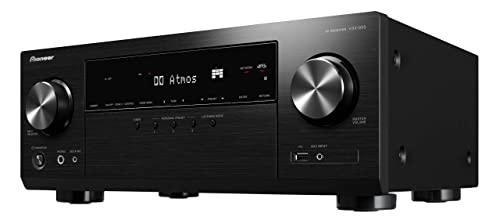
Best for Larger Systems – Pioneer VSX-935
For buyers seeking desktop av receivers with more expansion room, the Pioneer VSX-935 provides seven channels, a 7.2 configuration, and eight HDMI ports. Dolby Atmos, DTS:X, and their respective upmixers support a more advanced surround setup than the smaller five-channel models in this roundup.
Best For: Larger home theater systems that need seven-channel processing and plentiful HDMI connections.
Pros:
- Supports seven channels and a 7.2-channel configuration.
- Includes Dolby Atmos, DTS:X, Dolby Surround Upmixer, and DTS Neural:X.
- Provides eight HDMI ports for multiple source devices.
- Offers Bluetooth, Wi-Fi, USB, ARC, and TuneIn support.
Cons:
- Its larger chassis may be less convenient for tight desktop spaces.
- It weighs 20.7 pounds, making it less portable than compact receivers.
- The supplied specifications do not identify HDMI video formats such as 4K/120 or 8K.
The VSX-935 is the strongest fit here for a more expansive surround system and a crowded source lineup. Its seven-channel design and broad HDMI connectivity offer more room to grow, though buyers should verify the chassis dimensions and desired video specifications before purchasing.
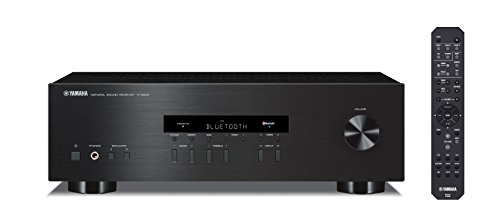
Best Budget Stereo – Yamaha R-S202BL
YAMAHA R-S202BL Stereo Receiver | Phono input, Subwoofer output, Bluetooth, AM FM Tuner
Check Price On AmazonThe Yamaha R-S202BL is a straightforward choice for shoppers seeking desktop AV receivers for two-channel music and everyday listening. It combines Bluetooth streaming, FM/AM presets, a headphone terminal, and support for two speaker systems in a simple stereo receiver.
Best For: Music listeners who want a clean, uncomplicated stereo setup with Bluetooth and dual-system speaker switching.
Pros:
- Bluetooth supports wireless music streaming from compatible devices.
- Speaker selector and terminals support two speaker systems.
- Includes a headphone terminal and 40 FM/AM station presets.
- Brushed aluminum finish and simple design suit traditional setups.
Cons:
- Two-channel stereo design is not intended for surround sound home theater.
- Its listed feature set is more focused on music than modern video connectivity.
Choose the R-S202BL when dependable stereo playback matters more than multichannel cinema features. Its simple controls and flexible speaker selection make it a practical fit for a basic desktop or room audio system.
Best for 8K Home Theater – Denon AVR-S570BT
The Denon AVR-S570BT is a strong desktop AV receivers option for compact home theaters that need current video support. It provides four 8K HDMI 2.1 inputs, eARC, 5.2-channel surround sound, Bluetooth, and gaming-oriented features such as VRR and QFT.
Best For: Home theater and gaming setups needing 8K connectivity, immersive surround formats, and easy app or remote control.
Pros:
- Four HDMI 2.1 inputs support 8K video, with eARC on the HDMI output.
- Supports Dolby Vision, HDR10+, HLG, Dynamic HDR, and HDR10.
- 5.2-channel configuration supports Dolby TrueHD, DTS-HD Master Audio, and surround playback.
- Built-in Bluetooth and support for Spotify, TIDAL, Pandora, Deezer, and TuneIn expand music options.
Cons:
- Its five-channel design is less suited to larger, more elaborate speaker systems.
- It requires external speakers for complete home theater playback.
The AVR-S570BT is the most forward-looking option here for video-focused systems. Its HDMI 2.1 features and setup assistance are especially useful if you want one receiver for movies, television, and gaming.
Best for Legacy Connectivity – Sony STR-DH550
The Sony STR-DH550 is a practical pick among desktop AV receivers for users with a mix of HDMI, analog, optical, coaxial, USB, and composite sources. Its 5.2-channel layout, 4K pass-through, and front USB connection make it flexible for older and newer components.
Best For: Home entertainment systems that need several connection types, 5.2-channel playback, and straightforward remote control.
Pros:
- Offers four HDMI inputs and one output, plus optical, coaxial, analog, USB, and composite connections.
- Supports 4K pass-through and HDMI Audio Return Channel for TV audio.
- 5.2-channel configuration provides a foundation for surround sound.
- Front USB supports high-resolution file playback and compatible iPhone/WM devices.
Cons:
- Its feature set is older than the Denon’s HDMI 2.1 and 8K capabilities.
- Wireless functionality and supported services may not match newer receivers.
The STR-DH550 makes sense when connection flexibility is the priority, particularly in systems that still use composite, optical, coaxial, or USB sources. It is less compelling for buyers specifically seeking the latest 8K and gaming standards.
Best Stereo Value – Sony STRDH190 2-Channel Receiver
For shoppers comparing desktop av receivers for music-focused listening, the Sony STRDH190 is a straightforward 2-channel option with Bluetooth, a phono input, and multiple analog connections. Its 100 watts per channel at 8 ohms, low-profile design, and A/B speaker switching make it practical for a conventional stereo setup.
Best For: Vinyl listeners and everyday stereo music systems that need Bluetooth and flexible speaker connections.
Pros:
- Includes a phono input for connecting a turntable.
- Bluetooth supports wireless streaming from compatible devices.
- A/B switching supports up to four speakers, with a slim 5.2-inch-tall design.
Cons:
- Uses a 2-channel stereo configuration rather than surround sound.
- Connectivity is centered on analog audio, with no HDMI listed.
The STRDH190 is a sensible choice when music playback matters more than home-theater features. It offers useful inputs and speaker flexibility without the complexity of a multichannel AV receiver.
Best Budget Surround Option – Pyle PT865BT 5.2-Channel Receiver
Among desktop av receivers, the Pyle PT865BT is aimed at buyers building a compact home-theater setup around 5.2-channel surround sound. It provides four HDMI ports with 4K Ultra HD pass-through, Bluetooth streaming, USB/MP3 support, and a DAC digital interface for compatible sources.
Best For: Budget-conscious home-theater setups that need 4K pass-through and surround-sound capability.
Pros:
- 5.2-channel surround configuration supports immersive home audio.
- Passes through 4K Ultra HD content and includes four HDMI ports.
- Offers Bluetooth, USB/MP3 playback, and digital audio connectivity.
Cons:
- The listed 1,000-watt output is a maximum rating, so real-world performance may vary.
- The supplied specifications identify five channels despite the 5.2 designation.
The PT865BT fits shoppers who want a feature-heavy home-theater receiver at a budget-oriented level. Its HDMI and 4K support make it more suitable for TV-based systems than a basic stereo receiver.
Best for Karaoke Flexibility – Donner MAMP2 Stereo Receiver
The Donner MAMP2 stands out among desktop av receivers for its broad input selection and karaoke-friendly design. This 2-channel receiver delivers 60 watts RMS per channel, Bluetooth 5.3, phono, optical, coaxial, USB, FM, and two microphone inputs, though it does not include HDMI.
Best For: Home stereo, karaoke, and mixed-source setups needing microphone inputs and digital TV connections.
Pros:
- Includes Bluetooth 5.3, phono, optical, coaxial, USB, RCA, AUX, and FM inputs.
- Two 1/4-inch microphone inputs support karaoke, hosting, and speech use.
- Independent EQ controls and Talk Over help tailor sound for different uses.
Cons:
- No HDMI input is provided.
- The 600-watt figure is peak power; listed RMS output is 60 watts per channel.
The MAMP2 is a versatile stereo amplifier rather than a surround AV receiver. Choose it when flexible source support and microphone functionality are more important than HDMI-based home-theater integration.
How We Picked These Desktop Av Receivers
We selected these Desktop Av Receivers based on useful feature coverage across several setups: compact stereo systems, entry-level home theaters, gaming and streaming rooms, and higher-channel surround installations. We compared channel configuration, HDMI and video support, wireless connectivity, analog and digital inputs, phono compatibility, microphone features, and the practical needs of small to medium rooms.
Specifications such as peak power are treated cautiously because amplifier output varies by measurement method, speaker impedance, and the number of channels driven. A receiver with fewer advertised watts can still be the better choice when it offers cleaner connectivity, easier setup, or better compatibility with your speakers.
Quick Comparison
| Best For | What to Look For | Suitable Receiver Type |
|---|---|---|
| Movies and gaming | Multiple HDMI inputs, 4K or 8K support, surround decoding | 5.2- or 7.2-channel AV receiver |
| Music and vinyl | Phono input, Bluetooth, dependable stereo amplification | Two-channel stereo receiver |
| Compact streaming setup | Bluetooth, simple controls, flexible digital inputs | Desktop stereo receiver |
| Karaoke or announcements | Microphone inputs, USB or SD playback, subwoofer output | Feature-rich home theater amplifier |
Key Buying Factors for Desktop Av Receivers
Channels and Speaker Compatibility
A 2-channel receiver is designed for left and right speakers, while 5.2-channel models can support a center speaker, surround channels, and two subwoofers. A 7.2-channel receiver provides more room for surround expansion. Check your speakers’ impedance and sensitivity, and leave ventilation space around the receiver.
HDMI, Resolution, and Audio Formats
For a TV, console, or Blu-ray player, count the HDMI inputs you actually need and verify support for your preferred video standard. 4K support may be sufficient for many systems, while 4K at 120Hz or 8K support is more relevant to newer gaming consoles and future upgrades. Confirm that the receiver supports the audio formats and return-channel features used by your display.
Streaming and Source Connections
Bluetooth is convenient for phones and tablets, but wired optical, coaxial, RCA, USB, or network connections may better suit dedicated sources. Vinyl listeners should choose a model with a built-in phono input or plan to add a separate phono preamp.
Power, Room Size, and Everyday Usability
Match the receiver to the room and speaker load rather than relying on the largest headline wattage. Straightforward menus, a usable remote, labeled inputs, and automatic setup can matter more than extra power in a desktop or apartment system.
Who Should Buy Which Desktop Av Receivers?
Choose a 5.2-channel model if you want an accessible movie and gaming system with a center channel and subwoofer support. A 7.2-channel receiver is better for buyers planning additional surround speakers or a larger room. Select a two-channel receiver for music-first systems, turntables, or a simple pair of bookshelf speakers. Buyers who want karaoke, microphone support, or USB and SD playback should prioritize specialized amplifier features over advanced theater processing.