The right DI box can make an acoustic-electric guitar sound more natural, consistent, and stage-ready while solving common problems such as impedance mismatch, weak output, and unwanted hum.
These 10 options cover everything from dedicated acoustic preamps with tone-shaping controls to straightforward passive boxes for dependable connection to mixers, PA systems, and recording interfaces.
Best 10 Di Boxes for Acoustic Electric Guitars Picks for 2026
Feature-Rich Acoustic Control
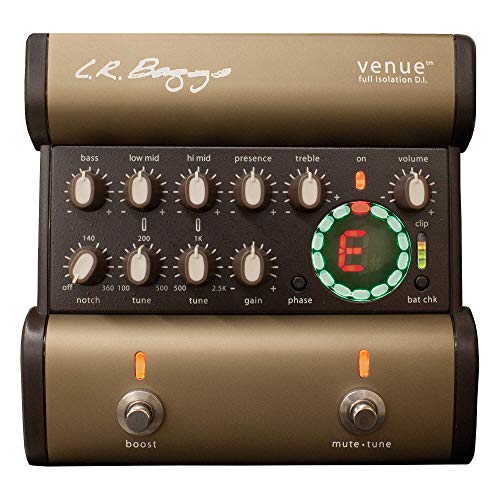
- Gain for passive or active pickups
- Five-band EQ with tunable mids
- Tuner, notch filter, and boost
Best For: Players wanting extensive acoustic stage control
Simple Passive Signal Conversion
Radial Pro DI Passive Direct Box

- Passive mono direct box
- Custom transformer and stainless enclosure
- XLR output for live or studio systems
Best For: Straightforward, durable instrument signal routing
Flexible Acoustic Preamp and DI

- Gain for passive and active pickups
- Five-band EQ with tunable bands
- Battery or 48V phantom powered
Best For: Acoustic players needing flexible tone and output control
Compact Active Connectivity
Radial StageBug SB-1 Active DI

- 800k-ohm instrument input
- 48V phantom-powered active design
- Polarity switch and 15dB pad
Best For: Compact guitar or keyboard DI setups
Warmth and Feedback Control

- Analog saturation for added warmth
- Compression, EQ, and filtering
- Mute footswitch with ¼-inch and XLR outs
Best For: Players wanting extensive acoustic tone shaping and feedback control
Best for Everyday Use
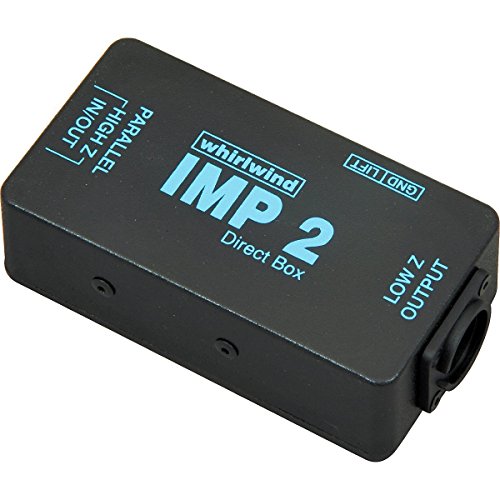
- Passive transformer-based operation
- Converts unbalanced to balanced mic level
- Compact stainless-steel construction
Best For: Budget-conscious setups needing basic one-channel DI conversion
Compact Acoustic Preamp and Boost
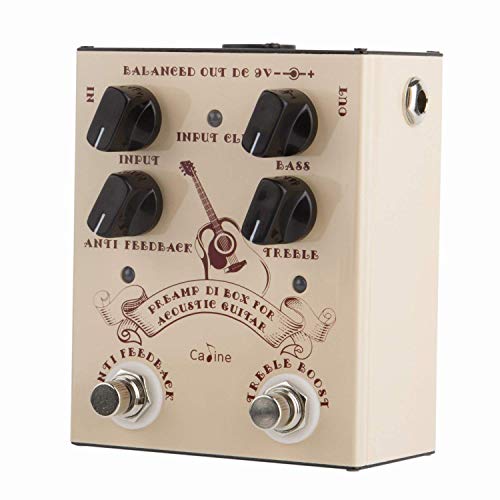
- Acoustic guitar preamp DI design
- True-bypass anti-feedback switch
- Compact pedal with higher boost
Best For: Players wanting a small powered acoustic DI pedal with boost
Reliable Stereo Isolation
Radial ProD2 Passive 2-Channel DI

- Two-channel passive stereo design
- Isolation transformer with lift switch
- 15dB pad and 1/4-inch/XLR connectivity
Best For: Stereo acoustic electric guitar setups needing passive isolation
Budget-Friendly Hum Control
Donner Special-I Passive DI Box

- Transformer isolation reduces ground-loop noise
- Ground lift and amp-thru routing
- Compact single-channel design
Best For: Affordable stage or studio guitar signal matching
Piezo Pickup Specialist
Radial StageBug SB-4 Active DI
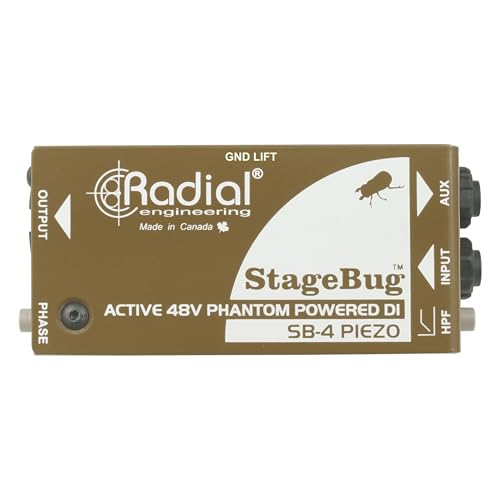
- Active DI designed for piezo pickups
- Additional 1/4-inch auxiliary output
- High-pass filter and polarity switch
Best For: Piezo-equipped acoustic electric guitars needing flexible routing
Feature-Rich Acoustic Control – L.R. Baggs Venue DI
The L.R. Baggs Venue DI is one of the more comprehensive DI boxes for acoustic electric guitars, combining pickup-friendly gain controls, detailed EQ, feedback management, tuning, and a footswitchable boost. It suits players who want hands-on control between the guitar and sound system.
Best For: Acoustic guitarists who need EQ, feedback control, tuning, and boost functions in one compact pedal.
Pros:
- Adjustable gain supports both passive and active pickups.
- Five-band EQ includes tunable low-mid and high-mid bands.
- Notch filter, chromatic tuner, mute, and volume boost add practical stage control.
Cons:
- Its feature set is more involved than a basic passive direct box.
- Battery-powered operation may require monitoring battery life.
Choose the Venue DI when you want a complete acoustic signal-shaping and performance-control station rather than a simple connection box.
Simple Passive Signal Conversion – Radial Pro DI Passive Direct Box
The Radial Pro DI is a straightforward passive option among DI boxes for acoustic electric guitars. Its mono design, custom transformer, stainless-steel enclosure, and XLR connectivity make it a practical choice for live or studio setups involving acoustic guitars and professional mixing systems.
Best For: Players and engineers who want a durable passive DI for acoustic guitar, bass, keyboards, or other instrument sources.
Pros:
- Passive mono design uses a custom transformer.
- Rugged stainless-steel enclosure is built for durable use.
- Works with live and studio acoustic guitar systems and professional snake or console setups.
Cons:
- It does not provide onboard EQ, tuning, or feedback-control functions.
- Passive operation may offer fewer adjustment options than an active DI or preamp.
The Pro DI is a sensible pick when reliability and simple signal routing matter more than onboard acoustic tone shaping.
Flexible Acoustic Preamp and DI – LR Baggs Para Acoustic D.I.
The LR Baggs Para Acoustic D.I. combines adjustable pickup gain, five-band EQ, feedback tools, and balanced or unbalanced outputs. For acoustic electric guitarists comparing DI boxes for acoustic electric guitars, its support for both a 9V battery and 48V phantom power adds useful setup flexibility.
Best For: Acoustic players who want detailed preamp control with both XLR and 1/4-inch output options.
Pros:
- Adjustable gain works with passive and active pickups.
- Five-band EQ includes tunable notch and midrange bands.
- Phase inversion and dual power options support feedback control and varied rigs.
Cons:
- It requires more setup than a basic passive DI.
- Its supplied notes do not indicate a built-in tuner or footswitchable boost.
The Para Acoustic D.I. is a strong middle ground for players who need acoustic tone shaping and feedback management without relying on a larger pedalboard system.
Compact Active Connectivity – Radial StageBug SB-1 Active DI
The Radial StageBug SB-1 is a compact active choice among DI boxes for acoustic electric guitars, using 48V phantom power and an 800k-ohm input impedance. Its polarity switch and 15dB pad provide useful signal-management options for guitar and keyboard connections.
Best For: Players who need a small phantom-powered active DI for guitar or keyboard.
Pros:
- 800k-ohm input impedance is specified for the instrument input.
- 48V phantom-powered operation avoids a separate battery requirement.
- Polarity switch and 15dB pad add practical signal flexibility.
Cons:
- It offers fewer acoustic-specific controls than the LR Baggs preamp/DI models.
- Its single-channel design provides no additional output channel.
The StageBug SB-1 is a focused solution for clean, compact signal conversion when you do not need onboard EQ, tuning, or dedicated feedback filtering.
Warmth and Feedback Control – Session DI
The L.R. Baggs Session DI is a feature-rich choice for players comparing DI boxes for acoustic electric guitars. It combines analog saturation, compression, EQ, notch filtering, and high-pass filtering to help shape an acoustic signal before sending it through the ¼-inch or XLR outputs.
Best For: Acoustic guitarists who want onboard tone shaping, compression, and feedback control in a metal DI/preamp pedal.
Pros:
- Analog saturation adds warmth and harmonic content.
- Compression and EQ help smooth common problem frequencies.
- Notch and variable high-pass filters address resonant feedback and low-frequency clutter.
- Mute footswitch works with the ¼-inch and XLR outputs.
Cons:
- More features than needed for players seeking a simple passive DI.
- Its listed output channel quantity is one.
With its combination of preamp-style processing and DI connectivity, the Session DI is suited to performers who want more control over an acoustic electric guitar signal than a basic transformer box provides.
Best for Everyday Use – IMP 2
The Whirlwind IMP 2 is a straightforward option among DI boxes for acoustic electric guitars. Its passive transformer converts an unbalanced line- or instrument-level signal into a low-impedance, balanced mic-level signal for a practical connection to a sound system or mixer.
Best For: Players and sound setups that need an economical, compact passive direct box with professional-oriented construction.
Pros:
- Passive design requires no listed power supply.
- Converts unbalanced instrument or line signals to balanced mic level.
- Compact footprint and light 8.8-ounce weight.
- TRHL transformer is riveted to the stainless-steel chassis.
Cons:
- Does not provide onboard EQ, compression, boost, or feedback filtering.
- Single-channel design offers one direct-box path.
The IMP 2 focuses on dependable signal conversion rather than tone shaping. It is a sensible fit when your acoustic guitar setup already has the controls you need and you primarily want balanced output.
Compact Acoustic Preamp and Boost – CP-40 Acoustic DI
The Caline CP-40 is a compact pedal-style option for shoppers comparing DI boxes for acoustic electric guitars. It combines an acoustic-guitar preamp DI function with a true-bypass anti-feedback footswitch and a higher-boost design in a small cream-colored enclosure.
Best For: Acoustic players who want an affordable compact pedal with boost and anti-feedback switching.
Pros:
- Designed specifically as an acoustic guitar preamp DI box.
- True-bypass anti-feedback footswitch.
- Higher boost supports level adjustment onstage.
- Compact 1.5-by-4.69-by-3.7-inch pedal format.
Cons:
- Uses a 9-volt, 50-milliamp power requirement.
- Listed audio output effect is volume, so extensive EQ controls are not specified.
- Uses a ¼-inch audio connection rather than a listed XLR connector.
The CP-40 emphasizes portability, boost, and anti-feedback operation. It is a practical choice for players who prefer a small pedal format and do not need the broader processing controls of a more elaborate acoustic preamp.
Reliable Stereo Isolation – Radial ProD2 Passive 2-Channel DI
The Radial ProD2 is a practical choice when you need passive DI boxes for acoustic electric guitars and want two channels in one unit. Its isolation transformer, ground-lift switch, and 15dB pad support flexible connections for stage or studio setups.
Best For: Players and engineers who need a two-channel passive DI with transformer isolation and attenuation.
Pros:
- Two-channel passive stereo design suits dual-channel instrument setups.
- Isolation transformer and lift switch help manage grounding issues.
- 15dB pad provides additional signal-level flexibility.
- Uses 1/4-inch and XLR connectors in a compact stainless-steel enclosure.
Cons:
- Its passive two-channel format may be more than needed for a single-output guitar.
- The supplied notes do not list an active buffer or piezo-specific auxiliary output.
The ProD2 stands out for buyers who value stereo capability and isolation in a straightforward passive DI. It is a solid fit when channel count and transformer-based signal management matter more than active-specific features.
Budget-Friendly Hum Control – Donner Special-I Passive DI Box
The Donner Special-I is one of the more accessible DI boxes for acoustic electric guitars when you need basic instrument-to-PA connectivity and hum reduction. It converts an unbalanced instrument or line signal to a balanced low-impedance microphone signal and includes a thru connection for an amplifier.
Best For: Stage and studio users seeking a compact passive DI with ground lift, transformer isolation, and amp-thru routing.
Pros:
- Ground-lift switch and transformer isolation help address ground-loop hum and buzz.
- Provides 1/4-inch input/thru connectivity alongside balanced and unbalanced XLR options.
- Designed for guitars, bass, and keyboards in stage or studio applications.
- Compact enclosure and one-year warranty support practical portable use.
Cons:
- Plastic body construction may be less reassuring than a metal enclosure for heavy touring.
- It is a single-channel passive unit rather than a stereo DI.
The Special-I focuses on the essentials: impedance and signal matching, balanced output, amp-thru routing, and noise control. It is a sensible option for straightforward acoustic electric guitar rigs where affordability and hum reduction are priorities.
Piezo Pickup Specialist – Radial StageBug SB-4 Active DI
The Radial StageBug SB-4 is a particularly targeted choice among DI boxes for acoustic electric guitars because it is an active direct box designed for piezo pickups. Its additional 1/4-inch auxiliary output, high-pass filter, and polarity switch add useful control for instrument-focused setups.
Best For: Acoustic electric guitar players using piezo pickups who want an active DI with an auxiliary output and basic filtering controls.
Pros:
- Active one-channel design is specifically noted for piezo pickups.
- Additional 1/4-inch auxiliary output supports expanded signal routing.
- High-pass filter and polarity switch provide useful setup controls.
- Offers 1/4-inch and XLR connectivity with a two-year warranty.
Cons:
- Single-channel design is not intended for stereo instrument output.
- The supplied notes do not specify a ground-lift switch or transformer isolation.
For an acoustic electric guitar with a piezo pickup, the SB-4’s active design and dedicated auxiliary output make it the most specialized option in this group. Its controls are useful when you need more than a basic instrument-to-PA conversion.
How We Picked the Best Di Boxes for Acoustic Electric Guitars
We focused on signal quality, compatibility with acoustic-electric pickups, stage reliability, useful controls, connection options, and overall value. The selection includes active and passive designs, dedicated acoustic preamps, single- and dual-channel units, and affordable choices for rehearsals or smaller performances.
Dedicated acoustic preamps were considered for their ability to shape pickup-heavy tones and provide feedback-management tools. Straightforward direct boxes were evaluated for clean signal conversion, rugged construction, noise performance, and ease of use.
Quick Comparison
| Type | Best For | Key Advantage |
|---|---|---|
| Acoustic preamp DI | Performers who need tone control | EQ, gain, and stage-focused features |
| Active DI | Passive or lower-output pickups | Added headroom and strong signal handling |
| Passive DI | Simple live and studio connections | Reliable, low-maintenance operation |
| Dual-channel DI | Stereo or two-source setups | Two independent inputs in one unit |
Key Buying Factors for Di Boxes for Acoustic Electric Guitars
Active or Passive Design
Active DI boxes typically need batteries or phantom power and can be helpful with passive piezo pickups or weaker instrument outputs. Passive models do not require power and are often preferred for hot active pickups, keyboards, or simple signal conversion.
Acoustic-Friendly Tone Controls
If your pickup sounds thin, harsh, or overly quacky through a PA, choose an acoustic preamp DI with EQ, notch filtering, phase control, or feedback reduction. Basic passive boxes are better when your guitar already sounds balanced and you only need a balanced XLR feed.
Inputs, Outputs, and Connectivity
Check for a 1/4-inch instrument input, balanced XLR output, and a thru output for an amplifier or personal monitor. A ground-lift switch can help reduce hum, while a dual-channel model is useful for guitars with separate pickup and microphone signals.
Headroom and Noise Performance
Look for enough headroom to handle strong strumming without clipping. Quiet operation matters on acoustic stages, where hiss, buzz, and grounding problems can be especially noticeable.
Portability and Durability
For frequent gigs, prioritize a sturdy enclosure, clearly marked controls, dependable switches, and a compact footprint. Battery access and phantom-power compatibility also affect convenience during setup.
Who Should Buy Which Di Boxes for Acoustic Electric Guitars?
Choose an acoustic preamp DI if you need EQ, feedback control, or more authority over your live tone. Choose an active DI for a passive pickup or when you need strong signal handling in a flexible compact format. Choose a passive DI for plug-and-play reliability, active electronics, or a clean connection to a mixer or interface. Choose a dual-channel unit when one guitar uses two pickup sources or when you want to route two instruments without carrying separate boxes.
Before buying, confirm your guitar’s pickup type, whether your mixer supplies phantom power, and whether you need an amplifier thru connection. Those details usually matter more than having the largest feature list.