Digital stage boxes simplify live audio by moving mic inputs and outputs closer to the stage while keeping your mix position clean and efficient.
Whether you need more channels for a band, a compact rack solution for install work, or a networked box that matches your console ecosystem, the right choice depends on connectivity, I/O count, and workflow.
Best 8 Digital Stage Boxes Picks for 2026
Best for Midas-Preamp Routing
Behringer SD16 16x8 AES50 Stage Box

- 16 remote-controllable MIDAS-designed mic preamps
- 8 balanced XLR outputs for stage routing
- AES50 plus ULTRANET for networking and monitoring
Best For: Bands and venues that need flexible networked stage I/O with personal monitoring support.
Best for AVB Stage Box Use
PreSonus StudioLive 24R Rack Mixer

- AVB stage box and monitor mixer in one
- Recallable XMAX preamps with full channel recall
- 16 FlexMixes plus USB and AVB recording
Best For: StudioLive Series III users who want a rack-mounted AVB stage box that can also act as a monitor mixer and recording interface.
Best for Large Channel Counts

- 32 Midas PRO mic preamps with phantom power
- 16 balanced outputs for flexible routing
- Dual AES50 plus ULTRANET for easy expansion
Best For: FOH and monitor engineers building larger live sound systems.
Best for Large I/O Counts
PreSonus NSB32.16 AVB Stage Box

- 32 remote-controllable XMAX preamps
- 16 locking XLR outputs
- 2-port AVB switch for daisy-chaining
Best For: Bands, venues, and installers who need a high-channel-count AVB stage box for StudioLive Series III systems.
Best for Midas Preamps

- 16 Midas PRO mic preamps with phantom power
- Dual AES50 ports for easy expansion
- ULTRANET and ADAT add flexible connectivity
Best For: Bands, churches, and venues needing a compact, expandable stage box with quality preamps.
Best for AVB Expansion
PreSonus NSB 16.8 16x8 Stage Box
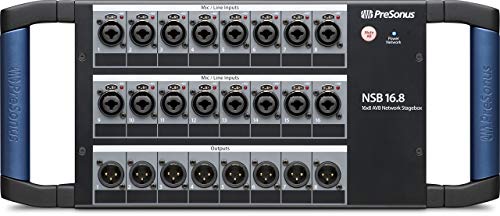
- 16 remote-controlled XMAX preamps
- 8 locking XLR outputs with AVB daisy-chaining
- Rugged steel chassis for live-stage use
Best For: StudioLive series III users expanding I/O with a rugged AVB stage box.
Best for Allen & Heath Qu/GLD Systems
Allen & Heath AB168 Remote Audio Rack
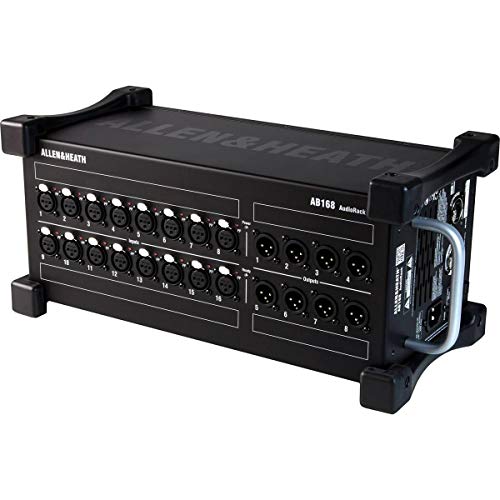
- 16 mic preamps and 8 XLR outputs
- Simple dSNAKE Cat5/EtherCon hookup
- Rugged, portable stage-ready design
Best For: Qu and GLD users who want a rugged remote stage box with straightforward Cat5-based setup.
Best for Simple Wired I/O
Pro Audio Recessed Floor Box with XLR

- 14-gauge steel build for installed durability
- Prewired 8 XLR connections for easier setup
- Adds 110V power and audio in one recessed box
Best For: Permanent stage installs that need tidy, built-in power and XLR access.
Best for Midas-Preamp Routing – Behringer SD16 16×8 AES50 Stage Box
If you want a compact, networked option among digital stage boxes, the Behringer SD16 gives you 16 remote-controllable Midas preamps, 8 balanced XLR outputs, and AES50 connectivity for clean multichannel runs back to your mixer.
Best For: Bands, churches, and live rigs that need flexible stage I/O with built-in personal monitoring support.
Pros:
- 16 MIDAS-designed, fully programmable mic preamps for detailed input control
- 8 servo-balanced XLR outputs for practical stage routing
- AES50 networking with low-jitter, low-latency SuperMAC performance
- ULTRANET hub supports up to 4 P16-M personal monitoring mixers
Cons:
- Best value is tied to Behringer/Midas ecosystem gear
- No built-in stage snake features beyond the core I/O and networking
- More advanced than simple analog stage boxes for first-time users
For buyers comparing digital stage boxes, the SD16 stands out for its mix of quality preamps, networked flexibility, and monitor-distribution features in a manageable rack-friendly format. It is a strong fit when you want dependable stage I/O without paying for extra complexity.
Best for AVB Stage Box Use – PreSonus StudioLive 24R Rack Mixer
PreSonus StudioLive Series III 24R Digital Rack Mixer with Studio One Pro Software
Check Price On AmazonIf you need one of the more flexible digital stage boxes for a StudioLive Series III rig, the PreSonus StudioLive 24R is built to handle both stage-box and monitor-mixer duties. It gives you recallable preamps, built-in AVB networking, and enough routing options to support live sound, rehearsals, and recording from one compact rack unit.
Best For: StudioLive Series III users who want a rack-mounted AVB stage box that can also act as a monitor mixer and recording interface.
Pros:
- Works as a simple stage box or a stage box plus monitor mixer
- Recallable XMAX preamps and fully recallable channel processing
- 16 FlexMixes, 4 subgroups, and strong AVB/USB recording options
Cons:
- Best suited to users already in the PreSonus StudioLive ecosystem
- More mixer than a basic stage box, so it may be overkill for simple setups
For buyers comparing digital stage boxes, the 24R stands out because it combines stage-box flexibility with serious mixing and recording features. It’s a smart choice if you want one rack unit to cover input expansion, monitor mixes, and multitrack workflow without adding more gear.
Best for Large Channel Counts – Midas DL32 32×16 Stage Box
The Midas DL32 is a strong fit for live rigs that need a lot of clean inputs in one rack unit. Among digital stage boxes, it stands out for its 32 Midas PRO mic preamps, 16 balanced outputs, and flexible ULTRANET and AES50 networking for larger systems.
Best For: FOH and monitor engineers who need high input count, quality preamps, and simple expansion on bigger digital consoles.
Pros:
- 32 Midas PRO microphone preamps with switchable 48V phantom power
- 16 electronically balanced low-impedance outputs for monitors or routing
- Dual AES50 ports make cascading additional stageboxes straightforward
- ULTRANET support adds easy personal monitoring integration
Cons:
- Overkill for small bands or simple club setups
- Requires compatible digital mixing hardware to get the most from it
If your priority is channel capacity and reliable expansion, the DL32 is one of the more capable digital stage boxes for demanding live sound workflows. It is especially appealing when you want premium preamps, clean networking, and room to grow.
Best for Large I/O Counts – PreSonus NSB32.16 AVB Stage Box
If you need one of the more capable digital stage boxes for a StudioLive Series III setup, the PreSonus NSB32.16 focuses on high channel count, remote control, and flexible rack mounting. It gives you 32 locking combo inputs, 16 XLR outputs, and AVB networking for clean stage-to-mixer routing.
Best For: Bands, venues, and installers who want a rack-mounted AVB stage box with lots of inputs and output routing flexibility.
Pros:
- 32 remote-controllable XMAX preamps with gain compensation support
- 16 locking XLR line outputs plus 2 AVB ports for daisy-chaining
- Rugged 3U rack chassis with multi-position ears for flexible install
Cons:
- Designed primarily for PreSonus StudioLive Series III workflows
- More stage box than small-setup users likely need
For users already invested in PreSonus, this is a practical high-capacity choice among digital stage boxes because it combines remote preamp control, AVB expansion, and a tough rack-friendly build in one unit.
Best for Midas Preamps – Midas DL16 16×8 Stage Box
The Midas DL16 is a practical choice for digital stage boxes when you want high-quality front-end capture and simple stage-to-console routing. It combines 16 Midas PRO mic preamps, 8 line outputs, and single-cable AES50 networking to keep live setups cleaner and faster.
Best For: Bands, churches, and live venues that need reliable stagebox I/O with strong preamp quality and easy expansion.
Pros:
- 16 Midas PRO microphone preamps with switchable +48 V phantom power
- Dual AES50 ports make it easy to cascade additional stage boxes
- ULTRANET and ADAT support add flexible monitoring and digital integration
- 8 balanced outputs help with monitor and return routing at the stage
Cons:
- Requires an AES50-compatible mixing ecosystem to get the most from it
- No onboard processing or local mixing controls
- Best suited to users who already understand digital routing
If your priority is clean cabling, dependable expansion, and respected mic preamps, the DL16 stands out among digital stage boxes. It’s especially appealing for users who need a compact stage rack that can grow with the rest of the system.
Best for AVB Expansion – PreSonus NSB 16.8 16×8 Stage Box
If you’re comparing digital stage boxes for a StudioLive series III rig, the PreSonus NSB 16.8 stands out for adding 16 remote-controlled mic/line inputs and 8 locked XLR outputs in a road-ready box. It’s built for clean AVB networking, simple expansion, and easy control from PreSonus hardware or UC Surface software.
Best For: StudioLive series III users who need a rugged AVB stage box with remote preamp control and straightforward setup.
Pros:
- 16 XMAX preamps with gain compensation for shared inputs
- 8 locking XLR outputs plus 2 AVB ports for daisy-chaining
- Rugged steel chassis with handles for live use
- Works with Series III mixers and UC Surface control
Cons:
- Best suited to the PreSonus ecosystem
- No built-in recording or processing features
- May be more box than needed for smaller setups
For users who already run PreSonus gear, this is one of the most practical digital stage boxes for expanding I/O without complicating the signal path. The NSB 16.8 focuses on reliable networking, flexible placement, and remote gain control rather than extra frills.
Best for Allen & Heath Qu/GLD Systems – Allen & Heath AB168 Remote Audio Rack
If you already run an Allen & Heath Qu or GLD console, the AB168 is a practical way to place I/O on stage without complicating the rig. It gives you 16 mic preamps, 8 XLR outputs, and a single-cat cable dSNAKE connection, which makes it a strong fit for digital stage boxes in live sound setups that need flexibility and quick deployment.
Best For: Qu and GLD owners who need a rugged, portable stage box with plenty of inputs and simple Cat5-based setup.
Pros:
- 16 mic preamps plus 8 XLR line outputs cover small to mid-size stage setups
- Single dSNAKE/EtherCon connection keeps setup clean and straightforward
- Rugged, road-ready design with carry handle for portable use
- Second EtherCon port supports daisy chaining or ME personal mixing
Cons:
- Works with Allen & Heath Qu/GLD systems, so it is not universal
- No built-in flexibility for users who need more than 16 onboard mic inputs
The AB168 is a focused solution rather than a general-purpose box, but that is exactly why it stands out. For Allen & Heath users comparing digital stage boxes, it offers reliable remote I/O, sensible portability, and an easy path to cleaner stage wiring.
Best for Simple Wired I/O – Pro Audio Recessed Floor Box with XLR
Pro Audio Stage Recessed Floor Box with 110v Electric and XLR Connections (8 XLR, Pre Wired)
Check Price On AmazonIf you need a rugged, built-in connection point for digital stage boxes or other pro audio setups, this recessed floor box offers a clean way to bring power and XLR lines to the stage. Its prewired layout makes installation more straightforward than a fully custom panel, while the steel housing is built for heavy use.
Best For: Installations that need a durable recessed floor box with both AC power and multiple prewired XLR connections for straightforward stage wiring.
Pros:
- 14-gauge steel construction for durable, installed-use reliability
- Prewired 8 female XLR connections simplify setup
- Hinged lid and cable access help keep the stage area tidy
- Includes both 110V electric and audio connections in one box
Cons:
- Requires a recessed installation, so it is not a portable option
- More suitable for wired infrastructure than flexible field setups
For venues, churches, and permanent installs, this is a practical utility choice rather than a flashy one. It fits the kind of infrastructure-minded workflow that supports digital stage boxes and keeps stage cabling organized at the source.
How We Picked These Digital Stage Boxes
We focused on practical stage-use factors: channel count, preamp quality, networking compatibility, output flexibility, and whether the unit fits touring, house-of-worship, rehearsal, or installed applications. We also favored models that match common digital ecosystems so setup is simpler and signal routing stays predictable.
Quick Comparison
The biggest differences among Digital Stage Boxes are format and system compatibility. Some are best as add-ons for specific mixer families, while others work as rack mixers or broader networked I/O solutions. High-channel-count options suit larger productions, while smaller 16×8 units are often the best balance for compact rigs. Floor boxes, by contrast, are better for fixed installations than for remote network audio.
Key Buying Factors for Digital Stage Boxes
I/O Count and Headroom
Choose enough inputs for your full microphone list plus a little expansion room. Outputs matter too, especially if you need monitor sends, in-ear systems, or additional speaker feeds.
Networking and Mixer Compatibility
Check whether the box uses AES50, AVB, or a console-specific protocol. Matching the stage box to your mixer is essential; the wrong network standard can make an otherwise strong unit unusable in your setup.
Preamp Quality and Remote Control
Remote-controlled preamps are a major advantage because they let you set gain from the mix position. In live environments, consistent gain structure is more important than flashy extras.
Physical Format and Deployment
Rackmount and portable stage boxes work well for live sound and fly dates. Recessed floor boxes make more sense for permanent installs where cable management and durability matter more than portability.
Who Should Buy Which Digital Stage Boxes?
If you run a medium to large live rig, look first at higher-channel Digital Stage Boxes with proven network compatibility. If you need a compact system for clubs, worship, or rehearsals, a 16-input model with solid outputs is often enough. If you are building a fixed venue or conference setup, consider an installed floor box for a cleaner, more permanent signal path. For owners tied to a specific ecosystem, the safest choice is the stage box made for that mixer family, even if another model offers more raw I/O on paper.