Choosing a network audio player with balanced outputs can make a real difference in system matching, noise control, and long-term flexibility. The best models combine modern streaming support with strong DAC performance and the connections serious listeners actually use.
Below, we focus on options that make sense for different budgets and setups, from compact streamers to all-in-one network players with CD, radio, and multi-room features.
Best 10 Network Audio Player with Balanced Outputs Picks for 2026
Flagship Hi-Res Streamer
Bluesound NODE ICON Wireless Music Player

- Dual-mono DAC design with ESS SABRE ES9039Q2M chips
- Balanced XLR outputs and high-end analog connections
- BluOS multi-room, HDMI eARC, AirPlay 2, and Bluetooth support
Best For: Premium home systems needing balanced outputs and versatile streaming
Balanced Output Streamer
Cambridge Audio EXN100 Network Audio Player

- Balanced XLR output for premium analog hookup
- ESS Sabre ES9028Q2M DAC for hi-quality conversion
- HDMI eARC plus Bluetooth 5 aptX HD support
Best For: Hi-fi users wanting XLR output and simple modern connectivity
Music Library Server

- Auto-organizes libraries with rich metadata
- Supports hi-res files up to 24-bit/192kHz
- Multi-zone playback with Tidal support
Best For: Collectors who need a library server for whole-home playback
Hi-Res Streamer Match
Arcam Radia ST5 Network Audio Player

- Hi-res playback up to 24-bit/192kHz with MQA and DSD128
- ESS ES9018K2M DAC with jitter control
- RCA analog plus coaxial and optical outputs
Best For: Arcam Radia amp owners wanting a matching network streamer
Classic Component Internet Radio
Ocean Digital WR-50 Hi-Fi Tuner

- 17-inch full-size component design
- Internet radio, podcasts, FM, and Bluetooth 5.0
- Optical, coaxial, and RCA outputs
Best For: Stereo stack users who want simple network radio playback
Reference DAC Streamer Decoder
Gustard X30 Balanced DAC Streamer

- Four ES9039SPRO chips in a balanced architecture
- Roon, AirPlay, UPnP, NAA, and Spotify support
- OCXO clocking with custom DSP filtering
Best For: Audiophile listeners building a balanced digital front end
Streaming Transport with Isolation
Eversolo T8 Isolated Music Transport

- Balanced AES/EBU XLR digital output
- Dual femtosecond clocks and electrical isolation
- Roon, TIDAL Connect, Qobuz Connect, and Spotify Connect Lossless
Best For: High-end setups that use an external DAC
High-Resolution Disc Hub
Marantz CD 50n Network Digital Player

- PCM 384 kHz/32 bit and DSD 128 support
- HEOS streaming plus voice control
- HDMI ARC and digital pre-amp volume control
Best For: Listeners who want a premium network player for CDs and streaming
All-in-One Home Stereo
Philips Wi-Fi CD Stereo System

- Wi-Fi, Bluetooth, CD, USB, Internet radio, and FM
- 100W output with tweeters and 5.25-inch woofers
- Color display and sound presets for easy use
Best For: Families or casual listeners who want one system for everything
Portable Balanced Player
SHANLING M1 Plus Hi-Fi Music Player
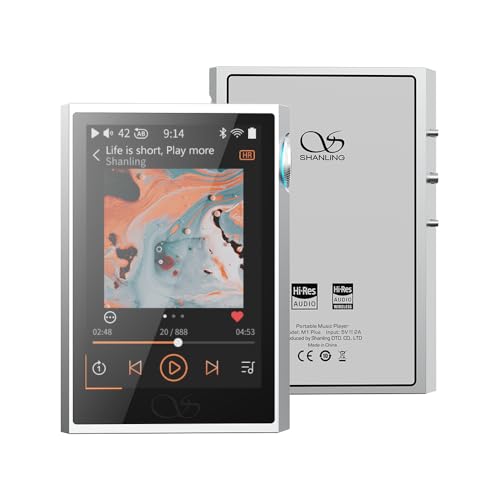
- 4.4mm balanced and 3.5mm headphone outputs
- Wi-Fi with DLNA and AirPlay streaming
- ESS ES9069Q DAC with portable battery life
Best For: Portable listeners who want balanced output and network streaming
Flagship Hi-Res Streamer – Bluesound NODE ICON Wireless Music Player
If you want a network audio player with balanced outputs that also doubles as a serious all-in-one streamer, the Bluesound NODE ICON is built for that role. Its dual-mono DAC design, balanced XLR connections, and hi-res playback focus make it a strong fit for systems where clean analog output matters.
Best For: Audiophiles who want a premium streamer with balanced XLR outputs, multi-room support, and TV integration.
Pros:
- Dual-mono DAC layout with two ESS SABRE ES9039Q2M DACs for high-resolution conversion.
- Balanced XLR outputs plus audiophile-grade connections for cleaner system integration.
- HDMI eARC, AirPlay 2, aptX Adaptive Bluetooth, and BluOS multi-room streaming support.
- THX AAA headphone amplifier and optional Dirac Live room correction add extra flexibility.
Cons:
- Dirac Live requires a separate upgrade and calibration kit purchase.
- Some of its strongest features are aimed at users with more advanced audio systems.
The NODE ICON is clearly positioned as a premium streamer first, with the hardware and outputs to match a high-end setup. If balanced XLR connectivity and broad streaming support are priorities, it brings a lot of capability into one component.
Balanced Output Streamer – Cambridge Audio EXN100 Network Audio Player
The Cambridge Audio EXN100 is a network audio player with balanced outputs aimed at listeners who want a straightforward upgrade path for a hi-fi system. With an ESS Sabre DAC, HDMI eARC, and premium XLR connectivity, it covers the core needs of a modern streamer without overcomplicating the setup.
Best For: Buyers who want balanced XLR output, hi-res streaming, and easy home-cinema integration.
Pros:
- Balanced XLR output for premium analog connectivity.
- ESS Sabre ES9028Q2M DAC for high-quality sound conversion.
- HDMI eARC, USB, Toslink, and SPDIF inputs for flexible system hookup.
- Bluetooth 5 with aptX HD adds convenient wireless playback.
Cons:
- Feature set is focused on core streaming and connectivity rather than extras.
- Only the supplied notes are available here, so advanced app or platform details are limited.
If you want a clean, practical streamer with balanced outputs, the EXN100 keeps the feature list centered on sound and connectivity. It looks especially appealing for users who want XLR output plus HDMI eARC in one box.
Music Library Server – ELAC Discovery Music Server
The ELAC Discovery Music Server is more of a library-focused network audio player than a simple streamer, but it can still fit into a system that values organized digital playback. It supports high-resolution formats, multi-zone use, and control from common devices, making it practical for a home music setup.
Best For: Music collectors who want a server to organize and stream a digital library across multiple rooms.
Pros:
- Automatically organizes your music collection with rich multi-level metadata.
- Supports hi-res formats including WAV, FLAC, ALAC, and AIFF up to 24-bit/192kHz.
- Multi-zone capable for different or shared music in multiple rooms.
- Tidal support and broad device control via iOS, Android, Windows, and Mac.
Cons:
- Does not list balanced analog outputs in the supplied notes.
- Tidal requires a separate subscription.
This is a strong option if your priority is managing a large music library rather than just streaming from services. It is less centered on audiophile output connections, but it brings useful server features for organized playback.
Hi-Res Streamer Match – Arcam Radia ST5 Network Audio Player
The Arcam Radia ST5 is a network audio player with balanced outputs only if you are pairing it into a system that uses external amplification on the analog side; in the supplied notes, it is specified with RCA analog output rather than XLR. Even so, it is a solid hi-res streaming transport for Arcam Radia owners who want clean playback and flexible digital/analog connections.
Best For: Arcam Radia A5+ and A15+ owners who want a matching streamer with hi-res playback and control integration.
Pros:
- Hi-res streaming up to 24-bit/192kHz with MQA and DSD128 support.
- ESS ES9018K2M DAC with jitter control for clean analog output.
- Includes RCA analog plus coaxial and optical digital outputs.
- Comms/control link integration works with compatible ARCAM Radia amps.
Cons:
- No balanced XLR output is listed in the supplied specifications.
- Best value is most obvious when used with compatible Arcam Radia amplifiers.
The ST5 is built for straightforward integration and high-resolution playback rather than feature overload. If you are already in the Arcam ecosystem, it offers a well-matched streaming upgrade with plenty of connectivity.
Classic Component Internet Radio – Ocean Digital WR-50 Hi-Fi Tuner
The Ocean Digital WR-50 is a practical pick for anyone wanting a network audio player with balanced outputs? not this one exactly, but it does cover the core job well as a full-size component tuner with internet radio, podcasts, FM, Ethernet, Wi-Fi, Bluetooth, and digital outputs. Its 17-inch-wide chassis is meant to sit naturally in a traditional hi-fi stack, and the included remote plus front display make it easy to use without relying on a phone.
Best For: Home stereo users who want a component-style internet radio and streamer with flexible digital connections.
Pros:
- Full-size 17-inch component design with aluminum front panel and metal housing
- Streams internet radio, podcasts, and FM via Wi-Fi or wired Ethernet
- Offers optical, coaxial, and RCA outputs for easy system integration
- Includes Bluetooth 5.0, USB playback, remote control, and web management
Cons:
- Does not list balanced XLR outputs
- Front display is 2.4 inches, so browsing is functional rather than luxurious
- Best suited to source and tuner duties, not a full all-in-one amplifier
If you want a straightforward network audio player for a home stereo rack, the WR-50 stands out for convenience and classic component styling. It is especially appealing when digital output flexibility and easy preset management matter more than advanced audiophile features.
Reference DAC Streamer Decoder – Gustard X30 Balanced DAC Streamer
The Gustard X30 is aimed at buyers who want a high-end network audio player with balanced outputs at the DAC level, using four ES9039SPRO chips in a fully balanced architecture. It also adds network streaming support for Roon, AirPlay, UPnP, NAA, and Spotify, plus a focus on clocking, filtering, and isolation for serious two-channel systems.
Best For: Audiophile systems that need a balanced DAC/streaming decoder with advanced clocking and digital processing.
Pros:
- Uses four ES9039SPRO chips in a fully balanced design
- Supports Roon, AirPlay, UPnP, NAA, and Spotify
- Includes OCXO clocking and a custom DSP digital filter program
- Built for high-precision digital handling with FPGA logic and independent power supplies
Cons:
- Connectivity details are more specialized than a simple plug-and-play streamer
- Large desktop component format may not suit compact setups
- Information provided emphasizes decoding and streaming, not user-friendly app simplicity
The X30 is best viewed as a serious digital front end for a hi-fi system rather than a casual streamer. If you want balanced architecture, advanced clocking, and broad streaming support in one component, it has a very focused feature set.
Streaming Transport with Isolation – Eversolo T8 Isolated Music Transport
The Eversolo T8 is a strong choice if you want a network audio player with balanced outputs in the form of a fully balanced AES/EBU XLR interface. It is built as a streaming transport, so it focuses on digital output quality, electrical isolation, dual femtosecond clocks, and broad service support for Tidal, Qobuz, Spotify Connect Lossless, Roon Ready, TIDAL Connect, and Qobuz Connect.
Best For: High-end systems that need a transport with isolated digital outputs and balanced AES/EBU connectivity.
Pros:
- Supports major streaming platforms including Roon Ready, TIDAL Connect, and Qobuz Connect
- Dual femtosecond clocks help reduce jitter at the source
- All audio outputs feature electrical isolation to reduce ground-loop noise
- Includes AES/EBU balanced XLR output plus IIS, coaxial, USB Audio, and optical
Cons:
- It is a transport, so it needs an external DAC for analog playback
- SFP modules are sold separately
- Some output formats require attention to compatibility and setup
For users building a careful digital chain, the T8 prioritizes clean signal delivery over built-in conversion. Its balanced AES/EBU output, isolation, and clocking features make it especially appealing in refined systems where source quality matters.
High-Resolution Disc Hub – Marantz CD 50n Network Digital Player
If you want a network audio player with balanced outputs feel in a more traditional two-channel package, the Marantz CD 50n is built for listeners who still care about CD playback, high-resolution streaming, and flexible system integration. It supports up to PCM 384 kHz/32 bit and DSD 128, includes HEOS network playback, and can even feed a power amplifier directly with its built-in digital pre-amp volume control.
Best For: Listeners who want a premium network player for CDs, streaming, and direct system control.
Pros:
- Supports high-resolution playback up to PCM 384 kHz/32 bit and DSD 128.
- Built-in HDMI ARC makes it easy to connect to a TV with one cable.
- Digital pre-amp function lets you control volume directly when driving a power amp.
- HEOS streaming and voice control add modern network convenience.
Cons:
- It is a 2-channel component rather than a full media system.
- The supplied notes do not list dedicated balanced analog outputs.
This is a strong fit if you want one component that bridges discs, streaming, and TV audio without giving up serious hi-fi credentials. It is especially appealing for systems built around a separate amplifier and careful source selection.
All-in-One Home Stereo – Philips Wi-Fi CD Stereo System
The Philips system is a practical pick if you want a network audio player with balanced outputs style of flexibility in a compact home setup, even though it focuses on convenience rather than audiophile hardware. It combines Wi-Fi streaming, Bluetooth, CD playback, USB playback, Internet radio, and FM radio in one AC-powered unit, so it can cover everyday listening without extra boxes.
Best For: Families or casual listeners who want an easy all-in-one stereo for streaming, radio, and CDs.
Pros:
- Wi-Fi, Bluetooth, USB, CD, Internet radio, and FM radio are all included.
- 100W output with dome tweeters and 5.25-inch woofers for a fuller room-filling sound.
- Color display shows source, station, album art, artist, and song info.
- Digital sound controls and presets make it easy to tailor playback.
Cons:
- It is a stereo system, not a dedicated network player component.
- The notes do not mention balanced analog outputs.
This model makes sense if you value simplicity and broad format support over a modular hi-fi stack. It is a good all-rounder for kitchens, living rooms, or shared spaces where one system needs to do almost everything.
Portable Balanced Player – SHANLING M1 Plus Hi-Fi Music Player
The SHANLING M1 Plus is the most direct match here if you are shopping for a network audio player with balanced outputs in a portable form. It adds Wi-Fi streaming through DLNA and AirPlay, Bluetooth 5.2 for wireless listening, and both 4.4mm balanced and 3.5mm single-ended headphone outputs for flexible headphone use.
Best For: Portable listeners who want balanced headphone output plus Wi-Fi streaming.
Pros:
- 4.4mm balanced output alongside standard 3.5mm headphone out.
- Built-in Wi-Fi supports DLNA and AirPlay network streaming.
- ESS ES9069Q DAC and dual SGM8262 amps are aimed at detailed playback.
- Compact body and long battery life make it travel-friendly.
Cons:
- Storage depends on microSD rather than a large built-in library.
- The 3.2-inch screen is small compared with larger desktop players.
For a portable hi-fi player, this is the clearest option in the group for balanced headphone use and network playback. It is a smart choice if you want serious audio features without giving up pocketable size and battery endurance.
How We Picked the Best Network Audio Player with Balanced Outputs
We focused on models that offer a practical mix of balanced connectivity, reliable streaming support, and overall value for home audio systems. Priority went to products with useful app control, broad service compatibility, strong digital-to-analog conversion, and enough output flexibility to fit integrated amps, powered speakers, or full separates.
Quick Comparison
The simplest way to narrow the list is by use case. If you want the most polished streamer-first experience, look at dedicated network players. If you need more than streaming, consider models that add CD playback, internet radio, or server-style storage. If you already own a DAC or want maximum signal control, a transport-oriented option may be the better fit.
Key Buying Factors for a Network Audio Player with Balanced Outputs
Balanced Output Type
Not all balanced outputs serve the same purpose. Look for true XLR balanced line outputs if you are connecting to a preamp, integrated amp, or active speakers with balanced inputs. These can help reduce noise over longer cable runs and integrate better in higher-end systems.
Streaming Platform Support
Check compatibility with the services you actually use, such as Tidal, Qobuz, Spotify Connect, internet radio, or UPnP/DLNA. A good network audio player should also offer stable app control and easy firmware updates.
DAC and Output Stage Quality
If you plan to use the player’s analog outputs, DAC quality matters as much as streaming features. A well-designed output stage can improve dynamics, separation, and tonal balance more than headline specs alone.
System Role
Some buyers need a true all-in-one component, while others want a streamer that feeds an external DAC or amplifier. Match the device to your system so you do not pay for features you will not use.
Who Should Buy Which Network Audio Player with Balanced Outputs?
Choose a full-featured Network Audio Player with Balanced Outputs if you want one component to handle streaming and analog output cleanly. Pick a transport if your system already has a favorite DAC. Choose a music server or hybrid player if you also want local library management, CD playback, or extra sources. For compact spaces or secondary systems, smaller streamers and portable hi-fi players can still deliver strong performance without the footprint of a full-size component.
In the end, the best choice depends on your inputs, your amplifier, and how much of your listening is local files versus streaming. Prioritize stable software, the right outputs, and the features you will use every day.