A passive preamplifier gives you volume control—and, on some models, source switching—without adding an amplifier stage. It can be a tidy way to connect a source to a power amp or to control powered speakers.
The right choice depends less on extra features than on your connections, cable lengths, and source output. These six options cover compact RCA controls, input switches, and a model with balanced connections.
Best 6 Passive Preamplifiers Picks for 2026
Simple Two-Source Control

- Two line-level inputs
- Passive volume control
- No power required
Best For: Switching between two RCA sources
More Inputs, Small Footprint
Bellari PP532 Passive Preamplifier
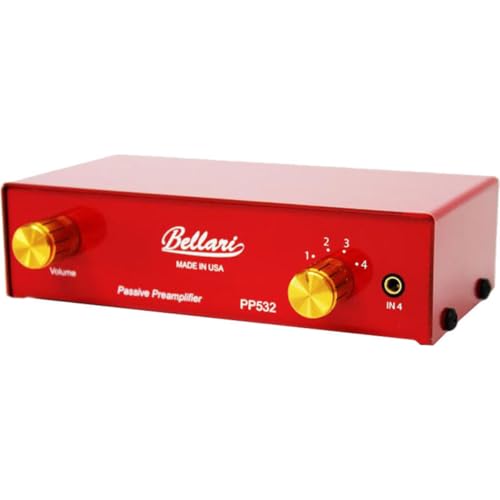
- Four stereo RCA input pairs
- 3.5mm option on input 4
- Compact steel chassis
Best For: Connecting multiple RCA sources and one 3.5mm source
XLR and RCA Monitor Control

- XLR and RCA connections
- Balanced or single-ended modes
- No amplifying circuit
Best For: Volume control for active monitors with XLR or RCA connections
Compact Source Switch

- Switches between two RCA sources
- A10K volume control
- No power supply or gain
Best For: Compact two-source RCA setups
Volume-Only Pick

- Single RCA input and output
- ALPS A50K volume potentiometer
- Aluminum-alloy chassis
Best For: Single-source RCA volume control
ALPS Switching Pick

- Two RCA inputs, one output
- ALPS RK27 A10K volume control
- No external power or gain
Best For: Two-source switching with ALPS volume control
Simple Two-Source Control – Schiit SYS Passive Preamp
The Schiit SYS is a straightforward pick among passive preamplifiers if you need to switch between two line-level sources and control volume without adding a powered component.
Best For: Listeners with two RCA sources who want one volume knob and a source switch.
Pros:
- Switches between two line-level inputs without swapping cables.
- Needs no power.
- Metal enclosure; designed and assembled in the USA.
Cons:
- Limited to two inputs.
- RCA connections only.
Choose SYS when simple source selection matters more than extra inputs or connection types.
For shoppers comparing passive preamplifiers by input options, the compact Bellari PP532 offers four stereo RCA input pairs, with a 3.5mm stereo connection available for input 4.
Best For: Listeners connecting several sources who also want a 3.5mm input option.
Pros:
- Four stereo RCA input pairs accommodate multiple sources.
- Input 4 also has a 3.5mm stereo connection.
- Compact steel chassis measures 5.5 by 3.1 by 1.6 inches.
Cons:
- Only one input has a 3.5mm connection.
- No XLR connections are listed.
The PP532 is worth a look when input flexibility is the priority, especially if one of your sources uses a 3.5mm plug.
The Nobsound Mini stands out among these passive preamplifiers for its XLR and RCA connections. It provides volume control for active monitor speakers without an amplifying circuit.
Best For: Active-monitor setups needing balanced XLR or single-ended RCA signal control.
Pros:
- Supports fully balanced and single-ended signal modes.
- Includes XLR and RCA connections with a mode-selection switch.
- Uses an ALPS 09 quadruple potentiometer and NEUTRIK XLR connectors.
Cons:
- Cannot amplify a signal.
- The listed corded-electric power specification makes power requirements worth confirming before purchase.
Pick this model when its XLR/RCA flexibility fits your monitor setup, and check the connection and power details against your equipment.
Compact Source Switch – HiFi FV2 RCA Passive Preamp
Among passive preamplifiers, the FV2 is a straightforward choice when you need to switch between two stereo RCA sources and adjust volume before an active speaker or power amplifier. Its passive design requires no power supply and adds no gain.
Best For: A compact, plug-and-play setup with two RCA sources feeding one output.
Pros:
- Two RCA inputs let you change sources without reconnecting cables.
- A10K potentiometer provides volume adjustment.
- Small 3.46 × 2.95 × 1.5-inch enclosure needs no power supply.
Cons:
- Cannot boost a weak source signal.
- Provides only one RCA output.
The FV2 makes sense if source switching matters as much as volume control; choose it for a system that already has adequate signal level and amplification.
If you want passive preamplifiers primarily for volume control, this Nobsound model keeps the signal path simple: one stereo RCA input, one output, and a knob. It is intended for higher-output sources such as DACs or CD players paired with active speakers or high-gain power amplifiers.
Best For: A single RCA source that needs smooth volume adjustment without source switching.
Pros:
- ALPS A50K dual potentiometer offers continuous volume adjustment.
- Gold-plated, oxygen-free-copper CMC-816U RCA connectors.
- Compact CNC-machined aluminum-alloy chassis.
Cons:
- One input means it cannot switch between sources.
- Passive operation provides no gain for low-output sources.
This is the more focused option when you already have a suitable source and amplifier and simply want an inline RCA volume controller.
The TENEALAY FV2PRO stands out among passive preamplifiers by combining two-input RCA source selection with an ALPS RK27 A10K volume potentiometer. It needs no power supply and is designed to feed active speakers, power amplifiers, or compatible monitor audio devices without adding gain.
Best For: Two RCA sources feeding one output when an ALPS volume control is a priority.
Pros:
- Switches between two RCA inputs without swapping cables.
- ALPS RK27 A10K potentiometer handles volume adjustment.
- Fully passive design requires no power supply.
Cons:
- Does not amplify or boost the source signal.
- Limited to one RCA output.
Choose the FV2PRO if you want source switching and the specified ALPS potentiometer in the same passive box; make sure the rest of your system supplies sufficient signal and amplification.
How We Picked These Passive Preamplifiers
We focused on practical differences visible across the six selected models: RCA versus XLR connections, input switching, volume-control layout, and suitability for a simple source-to-amplifier or powered-speaker setup. A passive unit does not boost the signal, so its fit with your existing equipment matters more than a long feature list. The products here offer different ways to manage level and connections; the best match is the one that solves your specific setup problem without adding unnecessary adapters or controls.
Quick Comparison: Which Layout Fits?
For two RCA sources and one output, start with a model that explicitly includes input switching, such as the Schiit SYS or the FV2-style A/B selector. If you need to choose between audio paths, check the product’s connection diagram rather than assuming every A/B switch has the same input and output arrangement. For a single-source system, a straightforward volume controller may be enough; the Bellari PP532 and Nobsound high-precision model are options to examine on that basis. The Nobsound mini balanced/single-ended model is the one to consider first if your system uses XLR as well as RCA. Verify the exact connector layout before ordering any unit.
Key Buying Factors for Passive Preamplifiers
Source Output and Amplifier Input
Because Passive Preamplifiers provide attenuation rather than gain, your source must supply enough level to drive your power amp or active speakers to the loudness you want. If your current system already struggles to get loud enough, a passive controller will not fix it. Check your source’s output and your amplifier’s input requirements if those specifications are available.
Connections, Cables, and Switching
Match RCA or XLR connectors to the equipment you own. An XLR socket alone does not establish how a device handles balanced signals, so confirm the manufacturer’s specifications if balanced operation is important to you. Keep cable runs reasonably short, particularly between the passive control and the amplifier or speakers: long cables or difficult input loads can make system matching less forgiving. Count your sources and outputs, then check whether the switch selects inputs, outputs, or both.
Volume-Control Feel
Think about where the box will sit and how often you will adjust it. A knob that is easy to reach and gives useful adjustment at your normal listening level matters more than its appearance. If channel balance at low volume is a priority, look for reliable measurements or owner feedback rather than judging by a component name alone.
Who Should Buy Which Passive Preamplifiers?
Choose a compact RCA switcher if you alternate between two sources; choose a simpler controller if you only need volume adjustment. Consider the XLR/RCA Nobsound model when your connections call for both connector types, subject to checking its signal-path specifications. If you need more gain, very long cable runs, remote control, or more inputs than these units provide, look at an active preamplifier instead. Before buying any of these Passive Preamplifiers, confirm the signal path, connector count, and return terms against your exact system.