The best samplers for recording can turn found sounds, drum hits, vocals, and instruments into complete musical ideas. The right model depends on whether you prioritize portability, detailed editing, live effects, sequencing, or hands-on performance.
We’ve selected 10 options across compact samplers, grooveboxes, sample pads, and portable production studios to help you find a practical fit for your workflow and budget.
Best 10 Samplers for Recording Picks for 2026
Best All-Around Portable Sampler

- Standalone sampling with battery power, speaker, and microphone
- 16 MPC pads plus chopping, timestretching, and resampling
- USB-C, MIDI, line I/O, effects, and microSD storage
Best For: Beginners, beatmakers, and DAWless creators
Best Touchscreen Sampling Studio

- Touchscreen workflow for recording, editing, and sequencing
- Creates songs without requiring a computer
- Compact design with USB and MIDI connectivity
Best For: Tabletop producers and hardware-focused setups
Best for Performance Beatmaking

- 17 velocity-sensitive RGB pads and OLED waveform display
- Fast editing, auto-chop, BPM detection, and resampling
- Extensive effects, 32-voice polyphony, and flexible power options
Best For: Live performers and hands-on beatmakers
Best Compact Sequencer Sampler
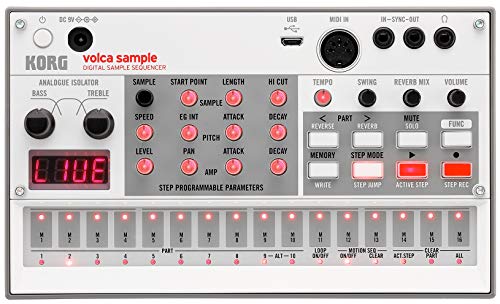
- 16-step sequencing with pattern chain and start delay
- Eight-voice polyphony, expanded memory, and onboard effects
- Integrated speaker, headphone output, and battery operation
Best For: Portable drum programming and electronic grooves
Deep Sound Design

- Four parallel stereo sampling tracks
- Granular, modulation, scenes, and macros
- Built for recording and live sound shaping
Best For: Detailed sound design and performance
Portable Beatmaking
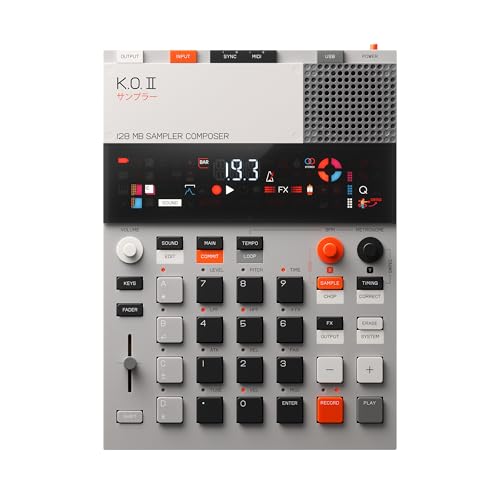
- Built-in microphone and line-in sampling
- Four groups with 99 patterns each
- Battery-powered with punch-in effects
Best For: Portable beats and quick musical sketches
Pocket Sampling

- Built-in microphone for quick captures
- Chop, step sampling, and resampling tools
- Granular, chromatic, and polyphonic playback
Best For: Mobile sampling and compact sound design
Most Expandable

- 1,000 sounds and 32GB internal storage
- Wireless Bluetooth sampling and onboard effects
- Expandable inputs for pads, cymbals, and pedals
Best For: Drummers needing a versatile studio and live-performance multipad
Most Portable

- Built-in microphone and 3.5mm line-in sampling
- Melodic mode, drum mode, sequencing, and 16 effects
- Battery-powered pocket-sized design
Best For: Portable beat making and quick sampled music sketches
Best for Complete Songs
Sonicware SmplTrek Portable Sampler

- One-touch sampling with slicing, time-stretching, and pitch control
- 16 scenes with sequencer and longer audio tracks
- Battery powered with USB, MIDI, SD card, and multiple audio inputs
Best For: Portable song production with vocals, instruments, and samples
Best All-Around Portable Sampler – MPC Sample
The Akai Professional MPC Sample is a strong choice for anyone comparing samplers for recording and wants a self-contained workflow. Its rechargeable battery, built-in microphone and speaker, microSD storage, sampling controls, and MPC pads support recording, chopping, sequencing, and playback without a computer.
Best For: Beginners, beatmakers, finger drummers, and DAWless creators who want portable MPC-style production.
Pros:
- Standalone, battery-powered design with built-in microphone and speaker
- 16 MPC pads, color display, sample chopping, timestretching, and resampling
- Four effects processors with 60 effect types and dedicated controls
- USB-C audio/MIDI, MIDI connectivity, line I/O, and microSD storage
Cons:
- MIDI DIN connection requires a separate 1/8-inch-to-DIN adapter
- Its compact controls and 2.4-inch display may feel limiting for more complex projects
MPC Sample offers one of the most approachable combinations of portability, sampling, sequencing, and effects in this group. It is especially practical when you want to record ideas away from a DAW and continue developing them in an MPC-based setup.
Best Touchscreen Sampling Studio – Blackbox
The 1010music Blackbox is a compact option for samplers for recording when you want a touchscreen-centered tabletop setup. It can record, edit, sequence, and arrange samples without a computer while also connecting to synths, drum machines, and other devices.
Best For: Producers building a compact tabletop studio with a fast touchscreen workflow.
Pros:
- Records, edits, and sequences through a familiar touchscreen interface
- Supports computer-free sample arranging and song creation
- Compact design fits easily into a tabletop setup
- USB connectivity can expand performance and control options
Cons:
- Touchscreen control may be less tactile than pad-based samplers
- The supplied notes do not specify built-in speakers or battery operation
Blackbox focuses on speed and simplicity rather than a large collection of physical controls. Choose it if touchscreen editing and integration with external hardware matter more to you than a traditional pad-based performance layout.
Best for Performance Beatmaking – SP-404MKII
The Roland SP-404MKII is built for hands-on samplers for recording workflows, especially performance-oriented beatmaking. It combines fast sample editing, expressive RGB pads, a waveform-capable OLED display, resampling, sequencing, and a broad effects suite in a portable unit.
Best For: Performers and beatmakers who want rapid sampling, finger control, live effects, and portable operation.
Pros:
- 17 velocity-sensitive RGB pads and a vivid OLED display support hands-on editing and performance
- Fast startup, loading, sample editing, auto-chop, BPM detection, and resampling
- 32-voice polyphony, 16 projects, and 160 samples per project
- USB-C, AA battery, mobile-battery, and AC power options
Cons:
- Its feature-rich workflow may take time to learn
- At 2.6 pounds, it is portable but not the lightest option listed
The SP-404MKII is the strongest fit here for quick, performance-based beat construction. Its pads, effects, storage, and flexible power options make it particularly useful for live sets and mobile production sessions.
Best Compact Sequencer Sampler – Volca Sample 2
Korg Volca Sample 2 Digital Sample Sequencer Drum Machine w/Pattern Chain Mode and 16-step Sequencer
Check Price On AmazonThe Korg Volca Sample 2 is a lightweight choice among samplers for recording, with a clear emphasis on pattern-based sequencing and sample-driven drums. Its 16-step sequencer, pattern chaining, expanded memory, integrated speaker, and battery operation make it easy to use away from a computer.
Best For: Producers making compact sample-based drum patterns, loops, and electronic grooves.
Pros:
- 16-step sequencer includes pattern chaining and start delay
- Eight-voice polyphony and increased memory over the previous model
- Built-in speaker, headphone output, and operation from six AA batteries
- Digital reverb, double filter, and dedicated Mac/PC Librarian software
Cons:
- Its sequencing-focused design is less suited to broad sample-editing workflows
- Micro USB provides computer connectivity, while the supplied notes do not list audio input
Volca Sample 2 is a practical pick when portability and pattern sequencing are the priority. It works especially well for quick drum programming and lo-fi or electronic ideas, though producers needing extensive recording and editing tools may prefer a larger sampler.
Deep Sound Design – S4 Sculpting Sampler
For recording and reshaping detailed textures, the S4 Sculpting Sampler combines four parallel stereo tracks with sampling, granular processing, modulation, scenes, macros, and a USB-C audio interface. Its extensive signal chains make it a strong option for hands-on sound design and live performance.
Best For: Musicians and sound designers who want deep sample manipulation, evolving textures, and performance-focused control.
Pros:
- Four parallel stereo tracks, each with Material, Granular, Filter, Color, and Space devices.
- Supports real-time recording, overdub, sound-on-sound loops, varispeed recording, and external audio processing.
- Includes four assignable modulators per track, scenes, global macros, and a four-channel master mixer.
- Granular processing provides control over grain size, pitch, movement, and up to 128 grains.
Cons:
- The broad processing feature set may take more time to learn than a simpler sampler.
- Its 850 g body is less pocket-friendly than the compact alternatives in this roundup.
The S4 is the most comprehensive choice here for layered recording and sculpted sound design. Choose it if modulation depth, parallel processing, and live control matter more than minimal size.
Portable Beatmaking – EP-133 K.O. II Sampler
The EP-133 K.O. II is a portable sampler, drum machine, and sequencer for recording ideas quickly. Its built-in microphone, line input, pattern-based workflow, punch-in effects, and battery power make it practical for sketching and performing beats away from a full studio.
Best For: Beatmakers who want quick sampling, portable sequencing, and live performance controls.
Pros:
- Records through the built-in microphone or line input and supports resampling and chopping.
- Four groups with 99 patterns each provide a flexible pattern-based workflow.
- Includes 6 master effects, 12 punch-in effects, a multifunctional fader, and song mode.
- Runs on four AAA batteries or USB-C and includes MIDI and sync input/output.
Cons:
- Its four-track sequencer is more focused on beatmaking than extensive multitrack recording.
- The built-in microphone and speaker are convenient, but external connections may be preferable for more controlled recording.
The K.O. II emphasizes speed and immediacy. It is a good fit for recording found sounds, building beat variations, and turning sketches into playable arrangements without carrying a larger setup.
Pocket Sampling – Roland AIRA Compact P-6
The Roland AIRA Compact P-6 is a pocket-size sampler for recording and manipulating sounds on the go. A built-in microphone handles quick captures, while chopping, step sampling, chromatic playback, resampling, and granular controls support both beat creation and sound design.
Best For: Mobile producers who want hands-on sampling, compact sequencing, and flexible sample playback.
Pros:
- Built-in microphone enables sample capture without external equipment.
- Chop and step sampling functions help turn recordings into playable segments and split samples.
- Supports chromatic, polyphonic playback, resampling, and custom loop creation.
- Offers dedicated filter and envelope controls plus granular parameters for deeper shaping.
Cons:
- Sample editing and import/export rely on the P-6 Sample Tool software for macOS and Windows.
- The compact format may offer less physical space for controls than larger samplers.
The P-6 balances portability with unusually broad sample-shaping tools. It makes sense for producers who want quick environmental recordings and granular experimentation in a small setup.
Most Expandable – PD708 Sampling Drum Pad
The PD708 is a strong choice among samplers for recording when you want a full-size pad with extensive storage, built-in sounds, and connections for studio or live use. Its wireless sampling feature can capture audio from a phone, tablet, or computer over Bluetooth.
Best For: Drummers and performers who need a versatile multipad for rehearsing, recording, and live shows.
Pros:
- Includes 1,000 built-in sounds, 30 kits, 32GB storage, and support for user samples.
- Offers wireless sampling, onboard effects, MIDI, USB, auxiliary, and stereo output connections.
- Can expand with additional pads, cymbals, and pedals.
- Customizable multicolor LEDs add visibility for dark venues.
Cons:
- At 7.19 pounds, it is less pocketable than compact samplers.
- Its many connections and expansion options may be more than casual users need.
Choose the PD708 if expandable triggering and live-ready connectivity matter as much as sampling. It is especially appealing for players who want one pad to cover practice, recording, and performance duties.
Most Portable – PO-33 K.O. Micro Sampler
The PO-33 K.O. is one of the most portable samplers for recording, fitting sampling, sequencing, and effects into a pocket-sized battery-powered device. It can capture sounds through its built-in microphone or 3.5mm line input, then turn them into melodic or drum parts.
Best For: Mobile beat makers and beginners who want an inexpensive, highly portable way to sketch sampled ideas.
Pros:
- Samples through a built-in microphone or 3.5mm line input.
- Provides melodic and drum modes with sequencing and 16 onboard effects.
- Includes 40 seconds of sample memory across melodic and drum slots.
- Runs on two AAA batteries and includes a built-in speaker and headphone support.
Cons:
- Its 40-second sample memory is limited compared with larger production samplers.
- The pocket-sized interface may feel restrictive for complex arrangements.
The PO-33 K.O. makes the most sense when portability and spontaneous idea capture are priorities. Its limited memory is a tradeoff for a compact device that can sample, sequence, and add effects almost anywhere.
Best for Complete Songs – Sonicware SmplTrek Portable Sampler
The SmplTrek is designed for samplers for recording that need to do more than trigger short sounds. It combines one-touch sampling, automatic slicing, time-stretching, pitch adjustment, sequencing, and dedicated audio tracks for longer recordings such as vocals or guitar.
Best For: Songwriters and producers who want a portable, battery-powered sampler for building structured arrangements.
Pros:
- Supports one-touch recording, auto-slicing, time-stretching, and pitch changes.
- Each song includes 16 scenes, 10 sequencer tracks, and three additional audio tracks.
- Includes over 1,000 samples, 30 DSP effects, and SD card import.
- Accepts microphones, instruments, line-level sources, and USB audio from computers or smartphones.
Cons:
- Its broader production feature set may have a steeper learning curve than a simple pocket sampler.
- It is larger and heavier than ultra-compact sampling devices.
The SmplTrek is the most production-focused option here for arranging complete ideas without a computer. Its multiple tracks, audio inputs, sample processing, and streaming support make it a flexible centerpiece for portable music creation.
How We Picked the Best Samplers for Recording
We compared these samplers by looking at the features that matter most when capturing and shaping audio: recording inputs, built-in microphones, sample memory, storage, editing tools, sequencing, effects, connectivity, portability, and live performance controls. We also considered how quickly each unit supports a real workflow, from recording a sound to arranging and performing with it.
The selection includes compact devices for sketching ideas, performance-focused samplers with effects, and more capable production tools for recording full arrangements. Because workflows vary, no single model is ideal for every musician.
Quick Comparison
| Best For | What to Prioritize |
|---|---|
| Portable beatmaking | Battery power, built-in microphone, speaker, and compact controls |
| Studio production | Flexible sampling, larger storage, sequencing, and reliable connectivity |
| Live performance | Responsive pads, pattern changes, effects, and fast sample triggering |
| Detailed sound design | Granular processing, modulation, slicing, and polyphonic playback |
| Drumming and sample triggering | Large pads, velocity sensitivity, sound libraries, and durable construction |
Key Buying Factors for Samplers for Recording
Sampling and Recording Inputs
Check how you can capture audio. A built-in microphone is convenient for field recordings and quick ideas, while line or instrument inputs are more useful for recording synthesizers, drum machines, guitars, and other studio gear. Also verify whether the device records in mono, stereo, or both.
Memory, Storage, and File Management
Sample memory determines how much audio you can keep available, while removable or internal storage affects how easily you can build a library. If you plan to record long phrases, vocals, or full loops, prioritize generous storage and straightforward file transfer.
Sequencing and Performance Controls
Look for the sequencing approach that matches your style. Step sequencers are excellent for precise patterns, while pad-based and clip-style workflows can feel more immediate during live performance. Pattern chaining, song modes, quantization, and probability tools can also make a major difference when building complete tracks.
Effects and Sound-Shaping Tools
Effects such as filters, delay, reverb, compression, and resampling help a sampler function as more than a playback device. Granular processing and modulation are particularly valuable for experimental sound design, but simpler controls may be preferable if speed and accessibility matter most.
Portability and Connectivity
Battery operation, size, and a built-in speaker make a sampler easier to use away from the studio. For a fixed setup, prioritize USB, MIDI, audio outputs, and synchronization options so the unit integrates cleanly with your computer and other hardware.
Who Should Buy Which Samplers for Recording?
Choose a compact sampler if you want to capture ideas, make beats while traveling, or add a small sketching tool to an existing setup. These models trade some depth for speed and portability.
Choose a performance sampler if you trigger samples live, reshape loops onstage, or rely on effects and tactile controls. Pad layout, pattern switching, and hands-on access should be more important than maximum storage.
Choose a production-focused sampler if you want one device to handle recording, sequencing, sound design, and arrangement. More capable units are better suited to longer sessions and complex projects, especially when connecting external instruments.
Choose a sample pad if your main goal is triggering sounds with drumstick- or finger-friendly pads. This is often the most natural option for drummers, live performers, and musicians who value physical playing over menu-based editing.