The best video switchers make it easier to combine multiple cameras, presentations, gameplay feeds, and audio sources into a polished live production. The right model depends on your inputs, output resolution, streaming workflow, and need for recording or audio control.
We’ve selected 10 video switchers spanning compact two-camera setups, HDMI production desks, podcast studios, and more advanced HDMI-and-SDI workflows. Use the guide below to narrow the options by features, connectivity, and production style.
Best 10 Video Switchers Picks for 2026
Best All-Around Pick

- Four HDMI inputs with built-in streaming and recording
- Multiview, transitions, keying, and audio mixing
- USB-C webcam output and external-drive recording
Best For: Multicamera streams, presentations, training, and esports
Best for Simple Two-Camera Streams

- Switches two HDMI cameras or devices
- Built-in 10-channel digital audio mixer
- USB-C streaming with app and footswitch control options
Best For: Teachers, gamers, worship, and beginner creators
Best for Larger HDMI Setups
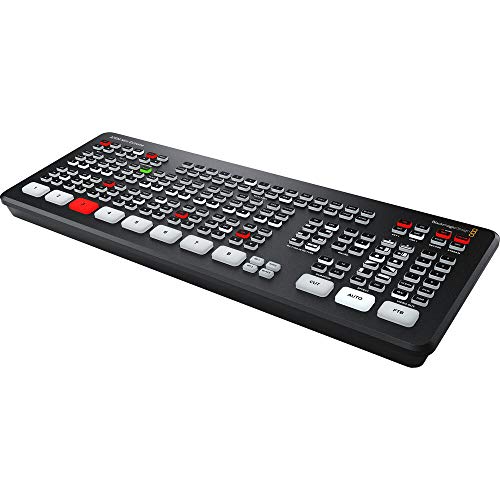
- Eight HDMI video inputs
- Resynchronization on all eight inputs
- Frame-rate and format conversion on every input
Best For: Multicamera productions with numerous HDMI sources
Best Integrated Video and Audio Hub

- Six inputs across HDMI and USB
- Custom scenes, overlays, transitions, and chroma keying
- XLR audio, direct streaming, and isolated recording
Best For: Professional creators needing integrated video and audio control
Compact HDMI Production Hub

- Eight HDMI inputs in a compact design
- Built-in multiview and AUX output
- 18-channel audio, keying, and automation
Best For: HDMI live events, presentations, and broadcasts
4K Streaming Control Center

- Four 4K60 HDMI inputs with loop-through
- PTZ control for up to four cameras
- UVC, IP streaming, and USB recording
Best For: Multi-camera streaming, churches, and studio productions
Podcast-Ready Video Studio

- Three HDMI plus one USB video input
- Scenes, overlays, chroma key, and media playback
- Integrated XLR audio and direct streaming
Best For: Podcasts, creator studios, and 1080p60 streaming
Hybrid Production Powerhouse

- Four HDMI and four SDI inputs
- Records eight ISO feeds plus program
- Built-in XLR audio and triple streaming
Best For: Professional hybrid HDMI/SDI productions
Simple Solo Streaming Pick

- Four HDMI inputs with 2K support
- USB 3.0 output works as a webcam
- Includes transitions and picture-in-picture layouts
Best For: Solo HDMI streaming setups
Compact 4K Touchscreen Switcher
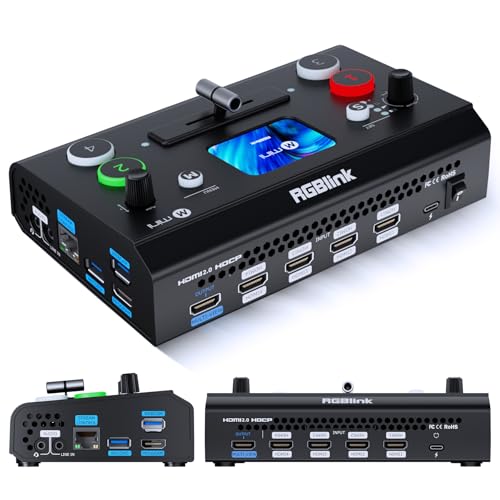
- Four HDMI inputs with touchscreen and T-bar
- Dual HDMI outputs plus UVC webcam mode
- Recording and advanced features may require licensing
Best For: Entry-level 4K HDMI multi-camera productions
Best All-Around Pick – ATEM Mini Pro
The Blackmagic Design ATEM Mini Pro is a versatile choice among video switchers for multicamera livestreaming, presentations, training, and esports. It combines four HDMI inputs with built-in streaming, recording, multiview, transitions, keying, and audio mixing.
Best For: Multicamera streaming, education, business presentations, and small broadcast setups.
Pros:
- Four HDMI camera inputs with 10-bit 4:2:2 YUV support
- Built-in streaming, recording, and multiview functions
- Includes multiple transitions, keying options, and a six-input audio mixer
- USB-C webcam output and external-drive recording support
Cons:
- Limited to four HDMI video inputs
- Does not list automatic chroma keying or scene automation
With a strong mix of production controls and connectivity, this ATEM model is a practical fit when you want more than basic camera switching without moving to a larger system.
Best for Simple Two-Camera Streams – V-02HD MK II
The Roland V-02HD MK II is one of the more approachable video switchers for creators who need a compact two-camera setup. It connects two HDMI sources, mixes audio through a 10-channel digital mixer, and sends video to streaming platforms over USB-C.
Best For: Online teachers, gamers, worship services, and creators seeking a plug-and-play two-camera workflow.
Pros:
- Simple setup for switching two HDMI cameras or devices
- Built-in 10-channel digital audio mixer
- Supports video effects and transitions
- Remote control options for iPad, macOS, and Windows
Cons:
- Only two video inputs
- USB-C streaming output may be less suitable for larger productions
This mixer prioritizes ease of use and a compact desktop design, making it a sensible starting point for two-camera livestreaming rather than a high-input production hub.
Best for Larger HDMI Setups – ATEM Mini Extreme
The Blackmagic Design ATEM Mini Extreme is designed for productions that outgrow four-input video switchers. It provides eight HDMI inputs, two outputs, input resynchronization, and frame-rate and format conversion on all eight inputs.
Best For: Multicamera productions using many HDMI cameras, computers, or other HDMI sources.
Pros:
- Eight HDMI video inputs for larger source counts
- Input resynchronization on all eight HDMI inputs
- Frame-rate and format converters on every input
- Two video outputs for expanded connectivity
Cons:
- More equipment than needed for a basic two-camera setup
- The supplied notes do not specify built-in audio or streaming features in detail
Its main advantage is input capacity and signal handling. Choose it when your workflow depends on connecting several HDMI sources and keeping them compatible during production.
Best Integrated Video and Audio Hub – RØDECaster Video
The RØDE RØDECaster Video brings video switching and audio production together in one system. Among video switchers, it stands out for six video inputs, customizable scenes, XLR microphone connectivity, overlays, automatic chroma keying, direct streaming, and recording features.
Best For: Professional creators and multicamera productions that need integrated video, audio, scenes, and streaming.
Pros:
- Supports up to six sources through four HDMI and two USB inputs
- Seven customizable multi-source scenes with transitions and overlays
- Two Neutrik combo inputs with Revolution Preamps
- Direct streaming, external USB recording, and isolated recording support
Cons:
- More features and controls than a simple switching workflow may require
- Requires corded power
- Its listed dimensions indicate a larger footprint than compact desktop switchers
This is a compelling option when audio quality and production integration matter as much as source switching. Its scene tools, automation, and recording options support more advanced live workflows.
Compact HDMI Production Hub – Roland V-8HD
The Roland V-8HD is one of the more capable video switchers for HDMI-based live events, presentations, and broadcasts. It combines eight HDMI inputs with built-in monitoring, flexible routing, visual effects, still graphics, and an 18-channel digital audio mixer in a compact 5.1-pound design.
Best For: Live producers who need eight HDMI sources, advanced compositing, and integrated audio control without a large rack-mounted setup.
Pros:
- Mixes up to eight HDMI sources in a lightweight, compact chassis.
- Includes a built-in multiview preview monitor plus external display support.
- Provides five-layer effects and keying, AUX output, still storage, and automated switching features.
- Offers an 18-channel digital audio mixer with effects and channel sync delay.
Cons:
- Its workflow is centered on HDMI sources rather than a broader mix of connection types.
- It does not list built-in streaming or recording features in the supplied specifications.
The V-8HD is a strong fit when source count, creative switching, and reliable monitoring matter more than integrated online distribution. Its version 3 updates add a chroma key engine, Graphics Presenter software, and VenuSet control support for more flexible productions.
4K Streaming Control Center – FoMaKo KC602 4K Video Mixer
The FoMaKo KC602 is a versatile choice among video switchers for multi-camera streaming and live production. It accepts four 4K60 HDMI inputs, provides 1080p60 output, supports PTZ control, and adds USB recording, UVC connectivity, IP streaming, and a 5.5-inch display for hands-on operation.
Best For: Churches, studios, and event teams that want 4K input handling, PTZ camera control, streaming, recording, and integrated audio in one console.
Pros:
- Supports four 4K60 HDMI inputs, 4K loop-through, and 1080p60 output.
- Controls up to four PTZ cameras and stores nine camera presets.
- Supports UVC, RTMP, and RTMPS streaming, including simultaneous streaming to up to three platforms.
- Combines USB recording with XLR/TRS audio, 48V phantom power, EQ, AUX mixing, and monitoring.
Cons:
- Its output is specified at 1080p60 even though the inputs and loop-through support 4K60.
- The feature-rich control panel may require time to learn for first-time operators.
The KC602 stands out for productions that need more than basic source switching. Its PTZ controls, streaming options, recording output, display, and professional audio facilities make it a broad all-in-one solution for live content workflows.
Podcast-Ready Video Studio – RØDE RØDECaster Video S
The RØDE RØDECaster Video S is a practical option among video switchers for podcasts and compact creator studios. It switches three HDMI sources and one USB source, while adding custom scenes, graphic overlays, chroma keying, media playback, streaming, recording, and built-in audio capture.
Best For: Podcasters and content creators who want video switching, studio-grade microphone inputs, scenes, and streaming in a single front-panel workflow.
Pros:
- Switches up to four video sources: three HDMI and one USB.
- Offers five customizable multi-source scenes with transitions, overlays, media playback, and chroma keying.
- Includes two Neutrik combo inputs with high-gain Revolution Preamps for XLR microphones and instruments.
- Streams over Wi-Fi or Ethernet, connects to streaming software by USB, and supports external USB recording with ISO capture.
Cons:
- It supports fewer video sources than the eight-input Roland and four-HDMI FoMaKo options.
- Its listed video workflow is oriented toward 1080p60 rather than 4K production.
The RØDECaster Video S is especially compelling when audio quality and creator-friendly operation are as important as switching. Inspect Mode and intelligent auto-switching can also help simplify hands-free podcast and streaming workflows.
Hybrid Production Powerhouse – Osee GoStream Duet 8 ISO
The Osee GoStream Duet 8 ISO is one of the most flexible video switchers for productions combining different camera types. With four HDMI 2.0 inputs, four 3G-SDI inputs, ISO recording, professional audio tools, and direct streaming, it is built for demanding multi-camera workflows.
Best For: Churches, event crews, podcasts, panels, and broadcast-style productions needing HDMI and SDI connectivity.
Pros:
- Combines four HDMI and four SDI inputs without requiring separate converters.
- Records eight individual ISO feeds plus the program output at up to 50Mbps per channel.
- Includes XLR and 3.5mm audio connections with phantom power and extensive processing.
- Supports NDI|HX, SRT, RTMP, UVC output, triple streaming, layers, keying, and browser-based graphics.
Cons:
- Its broad feature set may require more setup and learning than simpler video switchers.
- SDI inputs support up to 3G signals, while HDMI inputs handle up to 4K60.
Choose this model when production flexibility and recording security matter more than a minimal setup. It offers a strong all-in-one foundation for professional live switching, streaming, and post-production recovery.
Simple Solo Streaming Pick – RGBlink Mini Video Mixer
The RGBlink Mini is a compact HDMI video switcher for creators who want to manage up to four cameras or other HDMI sources. Its USB 3.0 output appears as a webcam to a computer, making it practical for streaming through OBS, vMix, and social platforms.
Best For: Solo streamers and small multi-camera setups using HDMI sources and computer-based streaming software.
Pros:
- Accepts four HDMI inputs with 2K input and output support.
- Offers 14 transition effects, nine picture-in-picture layouts, and six-picture preview or program views.
- USB 3.0 webcam output works with streaming software and social platforms.
- LAN control can be accessed from a phone or computer without additional software.
Cons:
- It does not include onboard recording; the notes direct buyers seeking that feature to Mini-Pro or higher models.
- Connectivity is limited to HDMI sources rather than mixed HDMI and SDI inputs.
This is a sensible entry point among video switchers when portability and straightforward computer streaming are the priorities. It keeps the workflow approachable while still providing useful transitions and picture-in-picture options.
Compact 4K Touchscreen Switcher – RGBlink Mini V3
The RGBlink Mini V3 is a compact 4K HDMI video switcher with a 2.1-inch touchscreen, professional T-bar, dual HDMI outputs, and UVC webcam mode. It suits creators building a multi-camera setup, though recording and selected advanced functions require optional TAO Cloud activation.
Best For: Entry-level creators and HDMI-based live productions wanting touchscreen control, dual outputs, and upgradeable features.
Pros:
- Provides four HDMI inputs, dual 1080p HDMI outputs, and a 2.1-inch touchscreen.
- Supports UVC webcam mode for streaming to platforms such as YouTube and Facebook.
- Offers PIP layouts, chroma key overlays, and 15 transition effects.
- Can record to USB drives up to 2TB and includes PTZ control among available premium features.
Cons:
- Recording and selected advanced functions require optional TAO Cloud licensing.
- Stable operation calls for a 35W or higher USB-C power adapter.
- It is designed for HDMI workflows and does not provide SDI inputs.
The Mini V3 is a capable choice among compact video switchers if you value hands-on control and room to add features later. Confirm licensing needs, camera compatibility, and power requirements before committing to the setup.
How We Picked These Video Switchers
We focused on practical features that affect real-world live production: input type and count, supported resolution and frame rates, preview and program monitoring, streaming connectivity, recording options, audio integration, portability, and ease of use. The lineup includes compact HDMI mixers for beginners, dedicated switchers for multicamera events, and integrated video-and-audio systems for podcasting and online content.
Because production needs vary, no single model is best for everyone. A simple two-camera teaching setup has very different requirements from a live event using SDI cameras, isolated recording, and multiple operators.
Quick Comparison
| Best For | Look For | Most Suitable Type |
|---|---|---|
| Teaching and basic streaming | Simple controls, HDMI inputs, direct streaming | Compact two- or four-input switcher |
| Gaming and creator setups | Low-latency HDMI handling, effects, reliable output | HDMI live production switcher |
| Video podcasts | Integrated audio mixing, camera control, recording | Video switcher with audio interface |
| Events and larger productions | More inputs, multiview, SDI, ISO recording | Professional HDMI/SDI switcher |
| Future-proofing | 4K support, scalable control, software updates | Advanced 4K or network-connected model |
Key Buying Factors for Video Switchers
Inputs, Outputs, and Compatibility
Check whether your cameras and computers use HDMI or SDI, then count the inputs you need today and the sources you may add later. Also verify output resolution, frame-rate compatibility, conversion support, and the connectors required for your displays, capture devices, or streaming computer.
Streaming, Recording, and Multiview
Direct streaming can simplify a portable setup, while HDMI or USB output gives you more flexibility with encoding software. If you need to edit content later, look for onboard recording or ISO recording. A multiview output is especially useful when monitoring several cameras, previewing transitions, and checking audio status.
Audio and Production Controls
Consider whether the switcher needs microphone inputs, balanced connections, audio mixing, synchronization, or embedded HDMI audio. Integrated audio features can reduce equipment and cabling, but dedicated audio hardware may offer more detailed control for complex productions. Look for the transitions, picture-in-picture layouts, keying, and macro controls you will actually use.
Resolution, Portability, and Workflow
Full HD remains practical for many livestreams and is often easier to manage. Choose 4K when your cameras, displays, recording workflow, or future plans justify the additional bandwidth and storage. For mobile work, prioritize compact dimensions, dependable controls, and simple power requirements over features that will remain unused.
Who Should Buy Which Video Switchers?
Choose a Compact HDMI Model If You Are Starting Out
Teachers, gamers, and solo creators should prioritize straightforward switching, a small footprint, and minimal setup. A two- or four-input HDMI unit is usually the easiest entry point.
Choose an Integrated Video-And-Audio System for Podcasts
Podcast producers and interview creators can benefit from a model that combines camera switching, audio mixing, monitoring, and recording. This reduces the need for separate hardware and keeps the workflow manageable for a small team.
Choose an Advanced Switcher for Events or Expansion
Frequent event producers and production teams should favor additional inputs, multiview, professional connections, recording flexibility, and room to grow. SDI support and ISO recording become increasingly valuable as the number of cameras and operators increases.
Before buying, map your complete signal chain—from cameras and microphones to displays, recording devices, and streaming platforms. The best choice is the one that supports that workflow reliably without making everyday production unnecessarily complicated.