Wireless video transmitters can simplify camera monitoring, livestreaming, and multi-display studio setups by sending a clean feed without long HDMI or SDI cable runs.
These 10 picks cover compact 1080p systems, 4K HDMI and SDI workflows, UVC-enabled streaming setups, and multi-receiver solutions. The right choice depends on your camera outputs, required range, latency tolerance, and whether you need professional monitoring features.
Best 10 Video Transmitters for Home Studios Picks for 2026
Long-Range 4K Pick

- 4K30 transmission with 60ms latency
- Up to 1,300ft range and four receivers
- HDMI loop-out and UVC streaming
Best For: 4K studio monitoring and collaborative live production
Simple Full HD Option

- 1080p60 video with 50ms latency
- 656ft open-space transmission range
- HDMI loop-out and dual power options
Best For: Full HD studio monitoring and portable camera setups
Quiet Low-Latency Choice

- Fanless 2W design for quiet operation
- 1080p60 transmission at 40ms latency
- Supports up to nine monitor endpoints
Best For: Noise-sensitive studios and responsive multi-view monitoring
Built-In Monitor System
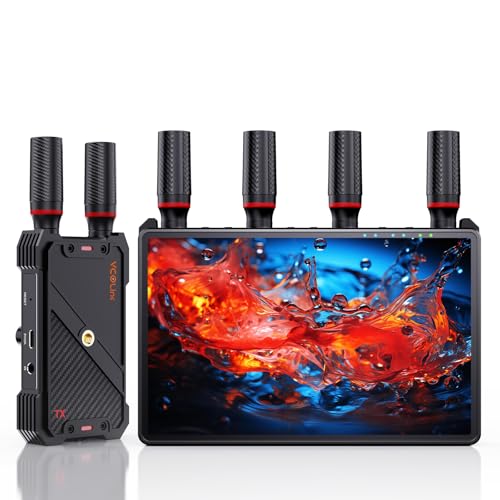
- Built-in 7-inch receiver monitor
- 1080p60 transmission under 0.05s latency
- Expandable to five receivers
Best For: Studios wanting integrated and shared monitoring
Premium Zero-Delay Pick
Teradek Ace 750 4K Wireless HDMI Kit

- 4Kp30 10-bit HDR over HDMI
- 750-foot range with under 0.01-second latency
- 6GHz transmission and app-based channel control
Best For: HDMI home studios needing premium 4K monitoring
Multi-Monitoring Choice
Hollyland Pyro S Wireless Video System

- 4K30 support with HDMI and SDI connectivity
- 1,300-foot range and listed 50ms latency
- Supports up to four receivers from one transmitter
Best For: Studios needing HDMI/SDI flexibility and multiple viewers
Budget Pocket 3 Pick
Vrriis 1080p Wireless Video Kit

- Designed for DJI Osmo Pocket 3 with Type-C connection
- 1080p60 UVC output for direct computer streaming
- 20 channels and support for up to five receivers
Best For: Portable Pocket 3 streaming and 1080p studio monitoring
Best Professional Hybrid Pick

- 4Kp30 transmission with HDMI and SDI
- 450-foot stated LOS range; 66 ms latency
- Supports up to four app monitoring devices
Best For: Home studios with SDI gear and multi-person monitoring needs
Best Long-Range Plug-and-Play Pick

- Pre-paired setup with no apps or drivers
- Supports 4K at 30 Hz and synchronized audio
- Up to four receivers; dual HDMI output on receiver
Best For: HDMI-based studios seeking simple, long-distance distribution
Best for Live Streaming
Vrriis WL087 UVC Wireless System
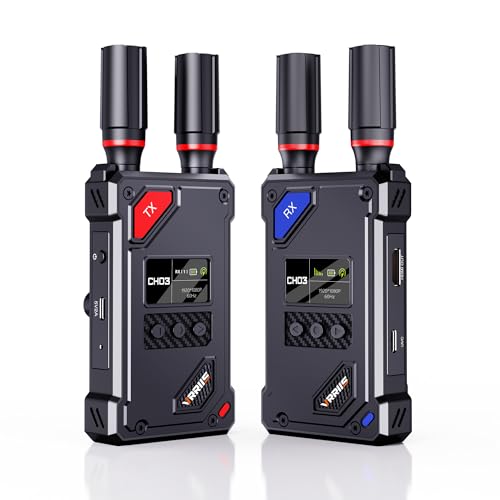
- UVC output supports OBS without a capture device
- 20 selectable channels with interference display
- 1080p60 transmission with HDMI loop-out
Best For: Home-studio creators streaming camera video to a computer
Long-Range 4K Pick – Hollyland Pyro H
For home studios that need 4K capability and multi-person monitoring, the Hollyland Pyro H is a versatile choice among video transmitters for home studios. It supports HDMI input, output, and loop-out connections, dual-band operation, UVC streaming, and transmission to as many as four receivers.
Best For: 4K studio monitoring, collaborative productions, and HDMI-based live streaming.
Pros:
- Transmits up to 4K30 video with 60ms latency.
- Offers up to 1,300 feet of transmission range in suitable conditions.
- Supports up to four receivers and the HollyView app for team monitoring.
- Includes HDMI loop-out and UVC support for computer streaming.
Cons:
- The 1TX+1RX kit does not include the additional receivers needed for multi-viewer setups.
- Its feature set may be more than a basic single-camera home studio requires.
The Pyro H stands out when resolution, range, and expandable monitoring matter. Smart channel scanning across 2.4GHz and 5GHz bands adds convenience, while the included accessories help get a compatible HDMI setup running quickly.
Simple Full HD Option – Lemorele R5000
The Lemorele R5000 is a practical entry point for video transmitters for home studios, combining 1080p60 transmission with HDMI loop-out and straightforward plug-and-play operation. Its USB-C power option suits fixed indoor setups, while NP-F battery support adds flexibility for mobile shoots.
Best For: Full HD camera monitoring, home streaming stations, and portable production setups.
Pros:
- Supports 1080p60 video with 50ms latency.
- Includes an HDMI loop-out port for simultaneous local monitoring.
- Offers up to 656 feet of range in open, unobstructed conditions.
- Supports USB-C or NP-F battery power and TUTUPlay app preview.
Cons:
- The listed range depends on open, unobstructed conditions.
- Batteries are not included.
- The phone app is for preview and cannot serve as the signal source.
Choose the R5000 if your studio workflow is centered on 1080p rather than 4K. It provides useful monitoring features without requiring complicated network settings, and its dual power design works for both desk-based and mobile use.
Quiet Low-Latency Choice – SYNCO XVision Wireless HD
Noise-sensitive home studios can benefit from the SYNCO XVision, a fanless wireless system designed for quiet operation. Among video transmitters for home studios, it is notable for 40ms latency, 1080p60 transmission, low power consumption, and support for monitoring at up to nine receiver endpoints.
Best For: Quiet recording spaces, live monitoring, and crews that need multiple viewing points.
Pros:
- Fanless 2W design helps avoid added operating noise.
- Provides 1080p60 transmission with 40ms latency.
- Claims up to 984 feet of transmission range with signal penetration.
- Supports up to nine monitor-only receiver endpoints and HDMI loop-out.
Cons:
- The system is limited to 1080p transmission.
- NP-F batteries are not included.
- Additional receiver endpoints are not included in this 1TX+1RX package.
The XVision is a strong fit when quiet operation and responsive monitoring are more important than 4K resolution. Its color display, automatic memory pairing, compact body, and USB-C power input also make it convenient for repeat studio sessions.
Built-In Monitor System – 7-Inch Wireless HDMI Kit
This wireless HDMI kit takes an all-in-one approach to video transmitters for home studios by building a 7-inch display into the receiver. It sends 1080p60 video over a stated 1,312-foot line-of-sight range, includes transmitter loop-out, and can expand from one transmitter to as many as five receivers.
Best For: Studios needing an integrated monitoring screen and expandable client or crew viewing.
Pros:
- Receiver includes a built-in 7-inch HD monitor.
- Supports 1080p60 transmission with less than 0.05-second latency.
- Allows one transmitter to send to up to five receivers.
- Offers HDMI loop-out, IR remote control, and multiple power options.
Cons:
- The stated 1,312-foot range is specified for line-of-sight use.
- Additional receivers and an external HDMI cable are not included.
- Smartphone or tablet use requires a Type-C-to-HDMI cable.
The built-in screen makes this kit especially convenient for a home studio that wants immediate camera feedback without adding a separate monitor. It is also a flexible option for shared viewing, though the included package remains a single-transmitter, single-receiver setup.
Premium Zero-Delay Pick – Teradek Ace 750 4K Wireless HDMI Kit
For home studios that need responsive monitoring, the Teradek Ace 750 is a premium choice among video transmitters for home studios. Its HDMI transmitter-and-receiver pair supports up to 4Kp30 10-bit HDR, while the claimed less-than-0.01-second latency helps keep camera action and monitoring closely synchronized.
Best For: Home studios using HDMI cameras that prioritize 4K image quality, very low latency, and long-range wireless monitoring.
Pros:
- Supports up to 4Kp30 10-bit HDR over HDMI.
- 750-foot range and claimed latency below 0.01 seconds.
- 6GHz transmission with 12 frequency options and automatic channel selection.
- Comes paired out of the box and includes AC and D-Tap power options.
Cons:
- Limited to HDMI-connected cameras and devices.
- A second AC adapter for studio setups is sold separately.
- Its premium feature set may be more than a basic home studio requires.
The Ace 750 stands out when reliable, near-zero-delay 4K monitoring matters more than minimizing cost. App control, included mounting accessories, and compatibility with Bolt 4K and Bolt 6 systems add flexibility for a growing studio.
Multi-Monitoring Choice – Hollyland Pyro S Wireless Video System
The Hollyland Pyro S is a versatile option for video transmitters for home studios, especially when several people need to monitor one camera feed. It combines HDMI and SDI connectivity with 4K30 support, automatic dual-band hopping, and the ability to connect one transmitter to up to four receivers.
Best For: Home studios, live-streaming spaces, and small production teams using HDMI or SDI equipment with multiple monitoring points.
Pros:
- Supports 4K30 video and both HDMI and SDI input/output.
- Transmits up to 1,300 feet with listed 50ms latency.
- One transmitter can connect to up to four receivers.
- Offers UVC computer connectivity and RTMP streaming capability.
Cons:
- Listed latency is higher than the Teradek Ace 750’s claimed figure.
- Its broader HDMI/SDI and streaming feature set may add complexity for simple setups.
- The supplied listing identifies the package as one transmitter and one receiver, so additional receivers may be needed for multi-viewing.
Choose the Pyro S when expansion and connection flexibility are central to your studio workflow. Its monitoring tools, including waveform, vectorscope, zebra, and aspect markers, are particularly useful for production and streaming work.
Budget Pocket 3 Pick – Vrriis 1080p Wireless Video Kit
For creators building a compact setup, this Vrriis kit is a practical entry among video transmitters for home studios. It is optimized for the DJI Osmo Pocket 3, sends up to 1080p at 60Hz, and adds UVC output so a receiver can connect directly to a computer for streaming through software such as OBS.
Best For: Pocket 3 users and small studios that want wireless 1080p monitoring or computer streaming without a separate capture device.
Pros:
- Built-in Type-C transmitter connection is designed for the Osmo Pocket 3.
- Receiver UVC output supports up to 1080p at 60Hz to a computer.
- Offers 20 adjustable channels and a status display with connection information.
- Supports one transmitter with up to five receivers and includes HDMI loop-out.
Cons:
- Supports 1080p rather than 4K transmission.
- Long-range performance is specified for open line-of-sight conditions; walls and metal obstacles can reduce coverage.
- NP-F batteries are not included.
This is a strong fit for a portable, budget-conscious studio centered on the Osmo Pocket 3. Its UVC workflow is the main advantage for live streaming, while the 20-channel selection and multi-receiver support add useful flexibility for monitoring.
Best Professional Hybrid Pick – Hollyland Mars 4K
For home studios that need a more production-ready option, the Hollyland Mars 4K combines wireless 4K transmission with both HDMI and SDI connectivity. It supports 4K video up to 30 fps, select professional decimal-point SDI frame rates, and app monitoring for flexible camera and monitor setups.
Best For: Home studios using cameras, switchers, SDI monitors, or multi-person monitoring workflows.
Pros:
- Supports up to 4Kp30 video transmission through HDMI.
- Provides both HDMI and 3G-SDI input/output options.
- Offers a stated 450-foot line-of-sight range and 66 ms latency in interference-free conditions.
- Supports monitoring on up to four app-connected devices in transmitter-only mode.
Cons:
- Its stated range depends on clear line-of-sight and interference-free conditions.
- It is more feature-rich than needed for a simple HDMI-only studio setup.
- USB-C QC/PD charging is not supported.
The Mars 4K is the strongest fit here when your home studio bridges consumer and professional video equipment. Its SDI support, 4K capability, display, and multiple monitoring options justify choosing it for more involved production setups.
Best Long-Range Plug-and-Play Pick – Vrriis WL095P 4K
The Vrriis WL095P is a straightforward choice among video transmitters for home studios when you want wireless HDMI between a camera, computer, projector, TV, or monitor. The pre-paired transmitter and receiver support up to 4K at 30 Hz and require no app or driver installation.
Best For: Home studios, presentation spaces, and entertainment setups that use HDMI devices and prioritize simple installation.
Pros:
- Pre-paired plug-and-play design requires no apps or drivers.
- Supports UHD 4K at 30 Hz with synchronized audio.
- Claims up to 1,150 feet of line-of-sight range in an open, interference-free field.
- Supports one transmitter with up to four receivers and includes dual HDMI outputs on the receiver.
Cons:
- Walls, metal, brick, and glass can substantially reduce coverage.
- The system is HDMI-only, without the SDI connectivity offered by the Hollyland option.
- Adding receivers can reduce the wireless transmission distance.
Choose the WL095P if convenience and HDMI compatibility matter more than advanced production connections. Its advertised range is impressive for open spaces, but typical home-studio layouts with walls may deliver less coverage.
Best for Live Streaming – Vrriis WL087 UVC Wireless System
The Vrriis WL087 stands out for home studios that stream through a computer. Its receiver provides UVC output for platforms such as OBS, while the transmitter adds HDMI loop-out for local monitoring. Manual selection across 20 channels can also help address interference.
Best For: Creators who need wireless camera video into a computer for live streaming at up to 1080p60.
Pros:
- UVC output can feed footage to OBS without a separate video capture device.
- HDMI loop-out supports a local monitor on the transmitter side.
- Offers 20 manually adjustable channels with an LCD showing signal and interference information.
- Supports up to 1080p at 60 Hz, multiple power options, and up to five receivers.
Cons:
- Resolution is limited to Full HD 1080p at 60 Hz rather than 4K.
- The stated 1,500-foot range applies to open, interference-free line-of-sight conditions.
- NP-F batteries are supported but not included.
The WL087 is the most purpose-built option in this group for wireless streaming workflows. Its UVC output simplifies the path to OBS, while channel selection and loop-out add useful control for a compact studio or live production desk.
How We Picked the Best Video Transmitters for Home Studios
We focused on the features that matter most in a home production environment: dependable wireless performance, practical transmission distance, supported resolutions and frame rates, connection options, latency, and setup simplicity. The selection includes both accessible HDMI systems and more advanced units with SDI, HDR, loop-through, multiple receivers, or UVC output.
Advertised range is measured under ideal conditions, so real-world performance can vary with walls, neighboring wireless networks, antenna placement, and the studio’s layout. We also considered whether each system fits a specific workflow rather than treating maximum range as the only priority.
Quick Comparison
| Best For | What to Prioritize |
|---|---|
| Basic camera-to-monitor setup | 1080p support, simple pairing, and low latency |
| 4K home production | 4K30 transmission, compatible HDMI standards, and stable bandwidth |
| Professional camera rigs | HDMI and SDI inputs, frame-rate support, and robust connectors |
| Livestreaming | UVC output, USB compatibility, and reliable channel selection |
| Multi-camera or multi-monitor work | Multiple receivers, loop out, or monitor integration |
Key Buying Factors for Video Transmitters for Home Studios
Resolution, Frame Rate, and Compatibility
Match the transmitter to the camera’s actual output. A system advertised as 4K may support only 4K at 30 frames per second, while 1080p modes may allow 60 fps. Check HDMI versus SDI requirements, supported frame rates, HDR compatibility, and whether the system handles your camera’s exact signal.
Latency and Reliability
Low latency is essential for talking-head recording, focus pulling, live directing, and interactive streaming. Look beyond the stated delay and consider signal stability, channel selection, antenna design, and whether the transmitter can maintain performance in a busy wireless environment.
Range, Receivers, and Studio Layout
Choose enough range for the room and leave headroom for walls or obstructions. A single receiver is adequate for one monitor, while multi-receiver support is useful for a director’s display, confidence monitor, and client viewing station. Loop-out can also keep a wired monitor connected at the source.
Power and Physical Setup
Check battery or DC power requirements, mounting options, connector placement, and operating time. Compact units suit small rigs, while larger professional transmitters may be preferable for permanent studio installations.
Who Should Buy Which Video Transmitters for Home Studios?
Choose a compact 1080p HDMI kit if you need affordable wireless monitoring for a mirrorless camera or webcam-style setup. Pick a 4K HDMI system when image detail matters for client previews or high-resolution recording workflows. Buyers using cinema cameras should favor a model with SDI support and broader frame-rate compatibility.
For livestreamers, prioritize UVC output and straightforward computer integration. If your studio feeds several screens, select a system with multiple receiver support, loop-out, or integrated monitors. Finally, choose the most robust professional option only when you genuinely need advanced signal support, HDR, SDI connectivity, or demanding low-latency monitoring; otherwise, a simpler transmitter can deliver better value and an easier setup.