A well-treated workstation makes it easier to hear vocals, instruments, and mix details accurately. The right acoustic panels can reduce early reflections and room echo without making a small room sound unnaturally dead.
This roundup compares 10 options across fiberglass, foam, and diffuser designs, with attention to coverage, thickness, installation, and the needs of home studios, podcast rooms, and editing desks.
Best 10 Acoustic Panels for Audio Workstations Picks for 2026
Best Overall

- NRC 1.0 absorption rating
- Durable solid wood internal frame
- Includes mounting hardware and template
Best For: Finished home studios and audio workstations needing strong absorption
Best Room Kit

- Four large panels for wider coverage
- NRC up to 0.91
- Recycled PET with rental-friendly installation
Best For: Project studios and rented spaces needing multi-panel coverage
Best Diffuser

- Scatters reflections and reduces harsh echo
- Tool-free modular installation
- Modern geometric design doubles as decor
Best For: Podcast, streaming, and home-office workstations needing diffusion
Best Foam Value

- Four 48-by-24-inch foam panels
- Wedge design helps reduce reflections
- Includes stickers and instructions
Best For: Budget-minded home studios needing large, easy-to-install foam panels
Best Fiberglass Pick

- 2-inch fiberglass panels
- Stated NRC of 0.95
- Installation accessories included
Best For: Recording rooms and studio spaces needing strong absorption
Best Budget Coverage

- 24 lightweight foam panels
- 2-inch pyramid profile
- Flame-retardant material
Best For: Home studios and podcast or gaming rooms
Best for Large Coverage
TroyStudio 52-Piece Groove Foam
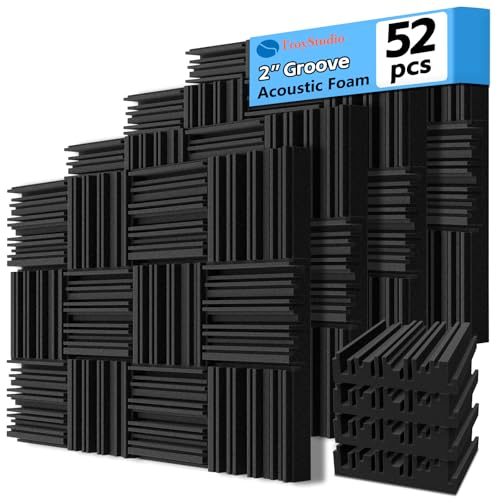
- 52 square feet of stated coverage
- 2-inch high-density foam
- Stated NRC of 0.8
Best For: Larger studios, streaming rooms, and workstation areas
Best Compact Treatment
Self-Adhesive Y-Lined Acoustic Panels

- Self-adhesive installation
- High-density polyester construction
- Approximately 7.5 sq. ft. of coverage
Best For: Small recording setups and targeted workstation treatment
Best Large-Panel Coverage

- Large 48 x 24-inch panels
- 2-inch thickness
- Cuttable and fire retardant
Best For: Broad studio-wall and workstation treatment
Best Easy-Setup Option
Egg Crate Acoustic Foam Panels

- Large 48 x 24-inch format
- Includes adhesive stickers
- High-density echo control
Best For: Quick studio and workstation installation
Best Overall – ATS Beveled Wool Panel
For audio workstations that need substantial broadband treatment, this 24-by-48-inch wool panel offers a polished alternative to basic foam. Its 2-inch thickness and stated NRC 1.0 rating are aimed at controlling unwanted reverb and echo, while the beveled, furniture-quality frame suits a visible studio setup.
Best For: Home studios, recording rooms, and audio workstations where strong absorption and finished presentation matter.
Pros:
- NRC 1.0 rating for strong sound absorption.
- Solid wood internal frame helps protect edges and corners.
- Textured wool fabric and beveled edge create a refined appearance.
- Mounting hardware and installation template are included.
Cons:
- Sold as a single panel, so treating a larger room may require several units.
- At 8.3 pounds, installation needs a secure mounting point.
This is a strong choice when you want acoustic performance without making the workstation look temporary or utilitarian. Its handcrafted-in-the-USA construction and one-year warranty add useful reassurance.
Best Room Kit – AudioSilk Large Panel Set
This four-panel ROOM KIT is a practical way to cover more wall area around acoustic panels for audio workstations. The recycled PET construction is designed to reduce flutter echo, reverb, and distortion, while the thin 0.4-inch profile and removable-installation options work well in project studios or rented spaces.
Best For: Project studios, rental rooms, and users who want a coordinated multi-panel treatment rather than a single absorber.
Pros:
- Four large panels provide broader wall coverage.
- High-density material has an NRC of up to 0.91.
- Made from post-consumer recycled PET without harsh chemical smell.
- Free acoustic treatment advice covers measurement and placement.
Cons:
- Removable sticky strips are sold separately.
- The 0.4-inch thickness may provide less physical absorption depth than thicker panels.
Choose this kit if coverage, clean styling, and flexible installation are more important than a deep, framed absorber. It is especially convenient for building a workstation treatment plan in a rented or changing space.
Best Diffuser – EchoGrid 3D Wall Panel
Unlike an absorber-focused treatment, this EchoGrid panel is designed to scatter reflections and reduce harsh echo while retaining a more natural room sound. For audio workstations, podcasts, or streaming setups, its 24-by-24-inch modular design adds a functional wall feature without requiring tools for installation.
Best For: Podcast studios, streaming desks, home offices, and workstations that need sound diffusion plus a modern decorative accent.
Pros:
- 3D cube pattern diffuses reflections to improve perceived clarity.
- Modular nine-piece design forms a 24-by-24-by-2-inch panel.
- Includes a 10-foot roll of double-sided mounting tape.
- Made in the USA and doubles as wall decor.
Cons:
- One panel covers less wall area than the four-panel room kit.
- It is a diffuser rather than a conventional broad absorption panel.
- The PLA enclosure is not waterproof.
This makes sense as a complement to absorbers or as a visual focal point near a workstation. Select it when you want to manage reflections while preserving some liveliness instead of deadening the room.
Best Foam Value – Art3d Wedge Foam Panels
These four large wedge-design foam panels offer a straightforward treatment option for acoustic panels for audio workstations. The high-density polyurethane construction and shaped surface are intended to reduce reflections and echo, while included double-sided stickers make setup quick.
Best For: Recording studios, home theaters, and budget-conscious workstation users who prefer lightweight foam panels with broad individual dimensions.
Pros:
- Four panels each measure 48 by 24 by 2 inches.
- Wedge profile extends the sound path to help reduce reflection and echo.
- High-density PU is designed for shape recovery and continued structural integrity.
- Includes double-sided stickers and installation instructions.
Cons:
- Foam construction has a less furniture-like appearance than framed fabric panels.
- The supplied notes do not specify an NRC rating.
- Double-sided installation may offer less flexibility for repositioning.
This set is a practical starting point when you want four large treatment surfaces and simple installation. Consider it for functional workstation acoustics where appearance and quantified absorption performance are secondary concerns.
Best Fiberglass Pick – Charcoal Grey 2-Inch Panels
For audio workstations where clear sound matters, these acoustic panels for audio workstations provide substantial absorption in a compact four-panel set. Their 2-inch fiberglass construction and stated NRC of 0.95 are designed to reduce reverberation, noise, and echoes.
Best For: Recording rooms, studio spaces, gaming rooms, and larger areas needing high sound absorption.
Pros:
- 2-inch thickness with a stated NRC of 0.95.
- High-density fiberglass core wrapped in 100% polyester fabric.
- Installation accessories are included.
- Charcoal grey finish suits professional or home studio setups.
Cons:
- The four-panel pack covers less area than the larger foam packs.
- At 14.77 pounds, the set is heavier than foam alternatives.
This is the strongest absorption-focused option in the group, especially for users who prefer fiberglass construction over lightweight foam. Plan your wall placement carefully, since the pack contains only four panels.
Best Budget Coverage – 24-Pack Pyramid Acoustic Foam
These acoustic panels for audio workstations use a pyramid-shaped polyurethane foam surface to absorb sound waves and reduce echo and reverberation. The lightweight 24-pack is suited to treating walls or ceilings in smaller recording and listening spaces.
Best For: Home studios, podcast rooms, gaming setups, vocal booths, and home theaters.
Pros:
- Two-inch foam panels use a pyramid design to increase surface area.
- Lightweight construction simplifies wall and ceiling installation.
- Flame-retardant foam is designed to meet industry-standard requirements.
- Can be installed with construction adhesive or nano double-sided tape.
Cons:
- Adhesive or mounting tape is not included.
- Designed for sound absorption, not full soundproofing or external noise isolation.
- The supplied dimensions list a 12-by-12-inch panel size, so broader coverage requires multiple panels.
This is a practical entry-level choice when you want a pyramid texture and flexible placement without the weight of fiberglass. Remember that acoustic treatment improves reflections inside the room but will not block outside noise.
Best for Large Coverage – TroyStudio 52-Piece Groove Foam
For audio workstations that need broad wall or ceiling treatment, this 52-piece TroyStudio set covers 52 square feet. The 2-inch high-density polyurethane foam uses a groove structure to help reduce reverb, echo, standing waves, and sound reflections.
Best For: Recording studios, streaming rooms, vocal booths, home theaters, and larger workstation areas.
Pros:
- 52 panels provide stated coverage of 52 square feet.
- Groove design combines acoustic treatment with a decorative 3D appearance.
- Stated NRC is 0.8, with an average absorption coefficient of 0.77.
- Soft panels can be cut and installed with external adhesive or small screws.
Cons:
- Double-sided tape and other mounting supplies are sold separately.
- Foam is flexible, so installation requires careful positioning for an even finish.
- Like the other foam option, it is intended to absorb reflections rather than fully soundproof a room.
This set stands out when coverage and placement flexibility matter more than a compact package. Its large quantity makes it easier to distribute treatment across an audio workstation, while the groove pattern adds visual texture.
Best Compact Treatment – Self-Adhesive Y-Lined Acoustic Panels
These compact panels are a practical option when you need acoustic panels for audio workstations but have limited wall space. Their self-adhesive backing simplifies installation, while the high-density polyester construction is designed to reduce echoes, reverb, and flutter echoes.
Best For: Small recording setups, home offices, music rooms, and targeted workstation treatment.
Pros:
- Self-adhesive backing avoids the need for tape or extra adhesive.
- High 9.4 lb/ft³ density helps absorb unwanted sound and reflections.
- Flame-retardant, odorless polyester construction can be cut for custom layouts.
- Y-lined, beveled design offers a more decorative appearance than plain foam.
Cons:
- Each panel is only 0.4 inches thick.
- The 12-pack covers approximately 7.5 square feet, so larger rooms may require multiple packs.
This pack suits creators who want quick, low-profile treatment around an audio workstation. Its limited coverage is worth considering before planning a full-room installation.
Best Large-Panel Coverage – 2-Inch Acoustic Foam Panels
For audio workstations that need broader wall coverage, these 2-inch acoustic panels provide a larger treatment format than small tiles. Their uniform-density foam is designed to reduce unwanted noise, reverb, flutter echoes, and reflections in selected areas.
Best For: Studio walls, offices, and workstation zones where larger panels are preferred.
Pros:
- Each panel measures 48 x 24 x 2 inches for substantial surface coverage.
- Uniform density and firmness support consistent sound absorption.
- Fire-retardant polyester material adds a safety-focused feature.
- Panels can be cut to size without affecting their acoustic performance.
Cons:
- Panels are vacuum-sealed and may require 24 to 48 hours to return to full size.
- The four-panel format may be less convenient for intricate decorative layouts.
This is a strong fit when coverage and 2-inch thickness matter more than small-panel flexibility. Allow recovery time after unpacking before installing or judging the final appearance.
Best Easy-Setup Option – Egg Crate Acoustic Foam Panels
These egg-crate panels are designed for straightforward installation around audio workstations, studios, and home theaters. The high-density foam helps control echoes and background noise, and included adhesive stickers support quick setup on suitable surfaces.
Best For: Users seeking large-format panels with included installation materials.
Pros:
- 48 x 24 x 2-inch panels provide broad wall coverage.
- High-density, uniform foam is designed for consistent sound absorption.
- Included adhesive stickers make installation quicker.
- Egg-crate shaping helps control reverberation and unwanted reflections.
Cons:
- The supplied notes do not specify total coverage for the four-pack.
- Adhesive installation depends on compatibility with the wall surface.
- The panels are 2 inches thick, which may project farther from the wall than low-profile treatments.
This option emphasizes convenient setup and broad-format treatment. It is particularly practical for users who want to address echoes around a workstation without sourcing adhesive separately.
How We Picked the Best Acoustic Panels for Audio Workstations
We focused on panels suited to nearfield listening areas, recording desks, podcast setups, and compact production rooms. Key considerations included absorber type, panel thickness, surface design, coverage, installation method, and whether a product is better for broadband treatment or targeted echo control.
We also separated sound absorption from soundproofing. These panels can improve room acoustics by reducing reflections and reverberation, but they generally will not stop bass, voices, or other noise from passing through walls.
Quick Comparison
- Fiberglass panels: Usually the strongest choice for broadband absorption and a balanced workstation sound, especially at 2 inches thick.
- Large foam panels: Offer substantial wall coverage at a relatively accessible price and can reduce mid- and high-frequency reflections.
- Small foam tiles: Useful for focused treatment, irregular layouts, and filling gaps around a desk or recording position.
- Diffuser panels: Scatter reflections rather than absorbing them, helping preserve liveliness when a room already has enough absorption.
- Self-adhesive panels: Convenient for temporary or low-effort installations, though the adhesive and thin profile may limit long-term flexibility.
Key Buying Factors for Acoustic Panels for Audio Workstations
Panel Thickness and Material
For general workstation treatment, 2-inch panels are a practical starting point. Fiberglass and other dense broadband absorbers typically handle a wider range of frequencies than thin decorative foam. Thicker panels or an air gap behind them can improve low-mid absorption.
Coverage and Placement
Prioritize the first-reflection points on the side walls, ceiling, and wall behind the monitors. A few large panels are often easier to position effectively than many tiny tiles. Add treatment behind the listening position if the room produces noticeable slap echo or flutter.
Absorption Versus Diffusion
Use absorbers to control reflections and diffusers to scatter them. A diffuser is most useful when placed where there is adequate distance for reflections to spread; it is not a replacement for absorption at a desk only a few feet from the wall.
Installation and Safety
Check mounting hardware, panel weight, wall compatibility, and whether the material has a documented fire rating. Avoid blocking vents, outlets, or equipment access, and follow the manufacturer’s mounting instructions.
Who Should Buy Which Acoustic Panels for Audio Workstations?
Choose fiberglass panels if mixing accuracy and broadband control are your priorities. They are especially suitable for producers, engineers, and vocal recording spaces that need controlled reflections without relying entirely on foam.
Choose large foam panels if you want broad wall coverage for a home studio, streaming room, or podcast setup on a tighter budget. They work best when combined with thoughtful placement rather than covering every wall indiscriminately.
Choose small tiles or self-adhesive panels for partial treatment, rental spaces, or compact areas where flexible placement matters most. Expect more limited low-frequency control from thinner products.
Choose a diffuser when the room sounds overly absorptive or needs more natural ambience after reflection control is already in place. For most untreated workstations, start with absorption before adding diffusion.