Upgrading to a NAS with two 2.5GbE ports can improve transfer speeds, support network redundancy or link aggregation, and give busy homes and small offices more flexibility than standard Gigabit models.
This roundup compares 10 NAS systems across two- to six-bay desktop designs and compact rackmount options, with attention to drive capacity, hardware, expansion, and practical workloads.
Best 10 Nas Enclosures with 2 5gbe Picks for 2026
Budget Pick

- Two-bay desktop design
- 2.5GbE networking
- 4GB DDR4 with NPU acceleration
Best For: Home storage and multimedia streaming
Small-Team Workhorse

- Four drive bays
- Dual 2.5GbE ports
- 8GB built-in memory
Best For: Shared storage for small teams
Creator-Friendly Upgrade

- 10GbE plus 2.5GbE ports
- 8GB DDR5 and 128GB SSD
- Docker, VMs, RAID, and 4K HDMI
Best For: Creators and small teams needing flexible high-speed storage
Rackmount Pick
QNAP TS-433eU 1U Short-Depth NAS

- Compact 1U rackmount form
- Dual 2.5GbE ports
- Short 11.51-inch chassis
Best For: Space-limited offices and edge storage
Creator Speed Pick
ASUSTOR Lockerstor 2 Gen2+ AS6702T v2
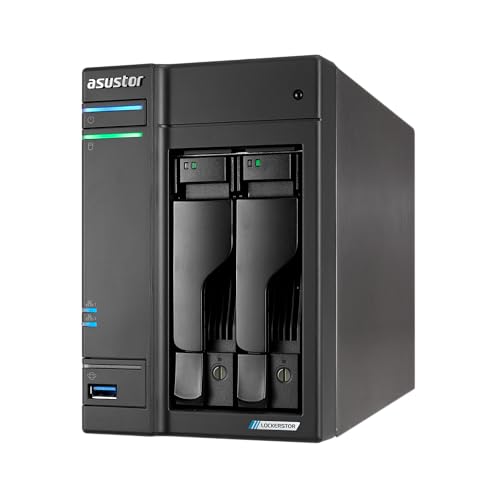
- Dual 5GbE networking for fast transfers
- Four M.2 NVMe slots for caching or storage
- Expandable DDR4 RAM and 4K media support
Best For: Creators and small businesses prioritizing dual 5GbE speed
Rackmount Team Storage

- Four-bay rackmount design for shared storage
- Dual 2.5GbE ports with backward compatibility
- 8GB RAM and PCIe expansion options
Best For: Office teams needing rack-mounted, expandable NAS storage
Smart Home Media Hub

- Two HDD bays and two M.2 NVMe slots
- Intel N100 with 8GB DDR5 memory
- Media, backup, Docker, and AI photo features
Best For: Advanced home users and creators managing media and backups
Best Value 2.5GbE NAS

- Four drive bays with 2.5GbE networking
- Dual M.2 slots and PCIe expansion
- 4GB RAM, expandable to 16GB
Best For: Home users and small teams seeking flexible storage and upgrade options
Best High-Speed Expansion NAS

- Two 2.5GbE and two 10GbE SFP+ ports
- Nine SATA drive bays in two sizes
- Backup, deduplication, and snapshot features
Best For: Businesses and power users with demanding transfer and backup needs
Best Premium 6-Bay NAS

- 10GbE and 2.5GbE ports for fast transfers
- Six SATA bays plus two M.2 NVMe slots
- Intel Core i3 processor with 8GB DDR5 RAM
Best For: Advanced users and small businesses building a high-capacity private storage system
Budget Pick – QNAP TS-216G 2-Bay 2.5GbE NAS
QNAP TS-216G-US 2-Bay 2.5GbE Desktop NAS | ARM Quad-Core CPU, Built-In NPU, 4GB RAM, Diskless
Check Price On AmazonThe QNAP TS-216G is a practical starting point among NAS enclosures with 2 5gbe, offering a compact two-bay design, 4GB of DDR4 memory, and a quad-core ARM processor. Its 2.5GbE connectivity is suited to faster file sharing and large transfers on a compatible network.
Best For: Families and home users who need centralized storage for photos, music, videos, and everyday files.
Pros:
- Two-bay desktop enclosure with a metal construction
- 2.5GbE port supports 2.5G, 1G, and 100M connections
- 4GB DDR4 RAM and built-in NPU for supported AI acceleration
- Designed for personal storage and multimedia streaming
Cons:
- Diskless, so storage drives must be purchased separately
- Two bays provide less expansion room than four-bay models
The TS-216G keeps the feature set focused and the setup footprint small. It is a sensible choice when you want faster-than-gigabit networking without moving to a larger NAS enclosure.
Small-Team Workhorse – QNAP TS-453E 4-Bay 2.5GbE NAS
The QNAP TS-453E-8G is a four-bay NAS enclosure with 2 5gbe connectivity, an Intel Celeron J6412 processor, and 8GB of built-in memory. With two 2.5GbE ports, it is positioned for larger storage pools and faster shared access than a basic two-bay unit.
Best For: Small teams and users who need four drive bays plus dual 2.5GbE networking.
Pros:
- Four-bay tower design offers more drive capacity options
- Dual 2.5GbE ports support 2.5G, 1G, and 100M networks
- Quad-core Intel Celeron processor reaches up to 2.6GHz
- Includes 8GB of built-in memory
Cons:
- Memory is built in and not expandable
- Diskless configuration requires separate hard drives
This model makes more sense than a compact two-bay NAS when capacity and multiple network connections matter. Its built-in memory is generous, but buyers should account for the lack of RAM expansion.
Creator-Friendly Upgrade – UGREEN DXP4800 Plus 4-Bay NAS
The UGREEN DXP4800 Plus combines four-bay storage with a 10GbE port and a 2.5GbE port, making it a flexible option among NAS enclosures with 2 5gbe. It also includes 8GB of DDR5 RAM, a 128GB SSD, 4K HDMI, and support for Docker and virtual machines.
Best For: Creators, families, and small teams that want high-speed networking, flexible applications, and private-cloud features.
Pros:
- Four-bay design supports up to 144TB with compatible drives
- Includes both 10GbE and 2.5GbE Ethernet ports
- 8GB DDR5 RAM, 128GB SSD, and 4K HDMI connectivity
- Supports RAID, Docker, virtual machines, backups, and AI-powered photo organization
Cons:
- Hard drives are not included
- Actual speeds depend on the network, drives, processor, and file sizes
- Wired Ethernet is required; Wi-Fi is not supported
The DXP4800 Plus is the most feature-rich option in this group. Its 10GbE connection provides room to grow, while the included 2.5GbE port keeps it compatible with faster home and small-office networks.
Rackmount Pick – QNAP TS-433eU 1U Short-Depth NAS
The QNAP TS-433eU-US is a compact 1U rackmount NAS for space-constrained installations. Its dual 2.5GbE ports place it firmly among NAS enclosures with 2 5gbe, while the short 11.51-inch chassis makes it easier to fit in shallow racks or edge-storage locations.
Best For: Small offices and edge deployments that need rackmount storage in a limited-depth environment.
Pros:
- Short-depth 1U rackmount chassis measures 11.51 inches deep
- Dual 2.5GbE ports support 2.5G, 1G, and 100M connections
- Quad-core Cortex-A55 processor and 4GB DDR4 onboard RAM
- Supports Google Workspace and Microsoft 365 backup through Boxafe
Cons:
- Diskless configuration requires separate drives
- Rackmount format is less suitable for typical desktop use
For buyers who need rack compatibility rather than a traditional tower, the TS-433eU-US is a focused solution. Its shallow chassis and dual 2.5GbE ports are particularly useful where cabinet depth and network throughput are both concerns.
Creator Speed Pick – ASUSTOR Lockerstor 2 Gen2+ AS6702T v2
For shoppers comparing NAS enclosures with 2 5GbE ports, the ASUSTOR Lockerstor 2 Gen2+ stands out with dual 5GbE connectivity in a compact two-bay design. Its Intel Celeron N5105 processor, four M.2 NVMe slots, expandable memory, and HDMI output make it a flexible choice for demanding file, media, and backup workflows.
Best For: Content creators and small businesses that need fast network transfers, NVMe acceleration, and 4K media support.
Pros:
- Dual 5GbE ports provide faster transfers than standard Gigabit networking.
- Four M.2 NVMe slots support caching or an all-flash storage pool.
- 4GB DDR4 memory can be expanded to 16GB for heavier multitasking.
- Hardware transcoding and HDMI output support 4K media workflows.
Cons:
- It has only two drive bays, limiting conventional HDD expansion.
- Storage drives are not identified as included in the supplied specifications.
The AS6702T v2 is the strongest fit here if dual 5GbE is the priority. Its NVMe flexibility and upgradeable RAM also give it room to support increasingly demanding creative and business applications.
Rackmount Team Storage – QNAP TS-464U-8G-US
The QNAP TS-464U-8G-US is a rackmount alternative for teams seeking high-speed network storage. While its two network ports are 2.5GbE rather than 5GbE, the four-bay layout, 8GB of RAM, PCIe expansion, and fast USB connectivity make it practical for shared files and large media transfers.
Best For: Offices and teams that need rack-mounted four-bay storage with dual 2.5GbE connectivity.
Pros:
- Four drive bays offer more conventional storage capacity than a two-bay enclosure.
- Dual 2.5GbE ports support 2.5G, 1G, and 100M connections.
- Intel quad-core processing and 8GB RAM suit team file-sharing workloads.
- PCIe Gen 3×2 slots allow expansion with compatible network or storage cards.
Cons:
- It does not meet a strict dual-5GbE requirement; networking is dual 2.5GbE.
- It is a rackmount model, which may be less suitable for a home-office setup.
- The supplied listing describes it as diskless.
This QNAP is best viewed as a capacity- and expandability-focused option rather than a true dual-5GbE enclosure. Its rackmount format and four bays make it more appropriate for organized office deployments.
Smart Home Media Hub – UGREEN NAS DXP2800
The UGREEN NAS DXP2800 is a two-bay home and creator NAS with 2.5GbE networking, two M.2 NVMe slots, and an Intel N100 processor. It is not a dual-5GbE enclosure, but it combines storage for up to 80TB with media-server, backup, Docker, surveillance, and AI photo features.
Best For: Advanced home users, remote workers, and creators managing photos, 4K media, backups, and multiple NAS applications.
Pros:
- Two HDD bays plus two M.2 NVMe slots support flexible storage configurations.
- 8GB DDR5 RAM and an Intel N100 processor support heavier home workloads.
- Supports Plex-compatible media applications, Docker, and virtual machines.
- AI photo organization and local surveillance features add useful home-management tools.
Cons:
- It has 2.5GbE networking, not dual 5GbE.
- HDDs and SSDs are sold separately because the unit is diskless.
- The two-bay design may limit future HDD expansion.
The DXP2800 is a versatile home-focused option for buyers who can accept 2.5GbE instead of dual 5GbE. Its NVMe slots, generous memory, and broad app support make it appealing for centralized personal data and media management.
Best Value 2.5GbE NAS – QNAP TS-462 4-Bay
The QNAP TS-462 is a practical choice for shoppers comparing NAS enclosures with 2 5gbe connectivity. Its 2.5GbE networking, four drive bays, M.2 NVMe slots, and PCIe expansion provide a flexible foundation for home media storage, backups, and faster file transfers.
Best For: Families, home offices, and small teams that need a versatile four-bay NAS with upgrade potential.
Pros:
- 2.5GbE connectivity supports faster transfers than standard gigabit Ethernet.
- Dual M.2 PCIe Gen3x1 slots can support cache acceleration or SSD storage pools.
- PCIe expansion enables additional network adapters or QM2 cards.
- Includes 4GB DDR4 RAM and supports expansion up to 16GB.
Cons:
- It has a dual-core, two-thread processor, so it is less suited to demanding multitasking.
- Drives are not included.
- Only one 2.5GbE connection is specified in the supplied details.
The TS-462 balances manageable size with useful expansion options. It is especially appealing if you want a four-bay enclosure today but may add SSD caching or faster networking later.
Best High-Speed Expansion NAS – QNAP TS-932PX 5+4 Bay
The QNAP TS-932PX is built for users who need more than basic network storage. Among NAS enclosures with 2 5gbe connectivity, it stands out with two 2.5GbE RJ45 ports plus two 10GbE SFP+ ports, while its five 3.5-inch and four 2.5-inch bays provide substantial drive flexibility.
Best For: Businesses and power users handling large file transfers, backups, and high-bandwidth storage workloads.
Pros:
- Combines two 10GbE SFP+ ports with two 2.5GbE RJ45 ports.
- Offers nine total bays: five 3.5-inch and four 2.5-inch SATA bays.
- HBS supports backup and recovery, while QuDedup helps reduce backup data and bandwidth use.
- Snapshots help protect files from accidental deletion and malware attacks.
Cons:
- It is diskless, so the total system cost rises after adding drives.
- SFP+ networking may require compatible equipment and cabling.
- Its high-speed hardware may be more than necessary for simple home storage.
With abundant bays and multiple high-speed interfaces, the TS-932PX is the most connectivity-focused option here. It makes the most sense when fast networking and storage expansion are priorities.
Best Premium 6-Bay NAS – UGREEN DXP6800 Plus 6-Bay
The UGREEN NAS DXP6800 Plus pairs a six-bay design with a 10GbE port and a 2.5GbE port, making it a strong candidate for buyers comparing NAS enclosures with 2 5gbe connectivity. Its Intel Core i3 processor, two M.2 NVMe slots, and support for up to 208TB create room for demanding storage setups.
Best For: Small businesses and advanced home users who want high capacity, fast networking, and support for RAID, containers, or virtual machines.
Pros:
- Includes one 10GbE port and one 2.5GbE port, with link aggregation support for the 10GbE ports as described.
- Six SATA bays and two M.2 NVMe bays support up to 208TB with compatible drives.
- 12th-generation six-core, eight-thread Intel Core i3 processor supports demanding workloads.
- Supports RAID 0, 1, 5, 6, and 10, plus Docker and virtual machines.
Cons:
- Drives are not included, and advertised capacity depends on the selected configuration.
- Actual speeds vary with the network, processor, drives, and file sizes.
- Wired Ethernet is required; Wi-Fi is not supported for this model.
The DXP6800 Plus is the most performance-oriented enclosure in this group. Its combination of processing power, capacity, and mixed-speed networking suits users planning a larger, more capable private storage system.
How We Picked the Best Nas Enclosures with 2 5gbe
We compared these NAS systems by looking at the features that matter after installation: the number of drive bays, dual-network connectivity, processor capability, memory, upgrade options, physical design, and likely workload. A two-bay model may suit backups and personal files, while four-, five-, or six-bay systems provide more room for RAID protection, larger media libraries, and shared team storage.
We also considered whether each enclosure is better suited to a desktop, home office, content-creation workstation, or rackmount environment. Because included memory, expansion support, and software features vary, verify the manufacturer’s current specifications before purchase.
Quick Comparison
| Best For | Recommended Type | Why It Stands Out |
|---|---|---|
| Basic home storage | Two-bay desktop NAS | Lower cost and simpler setup |
| Families and media libraries | Four-bay desktop NAS | More capacity and flexible RAID options |
| Creators and small teams | Four- to six-bay NAS | Higher performance and expansion headroom |
| Server racks | Short-depth rackmount NAS | Space-efficient centralized storage |
| Large growing archives | Five- or six-bay NAS | Greater drive capacity and resilience |
Key Buying Factors for NAS Enclosures with 2.5GbE
Drive Bays and RAID
Two bays are adequate for mirrored storage, but four or more bays make it easier to balance capacity, redundancy, and future expansion. RAID protects against some drive failures; it is not a substitute for a separate backup.
Dual 2.5GbE Connectivity
Two 2.5GbE ports can support link aggregation when your switch and network configuration allow it, or provide separate connections for different clients and services. They do not automatically double the speed of a single file transfer, and your router, switch, cabling, disks, and client devices must also support the desired throughput.
Processor, Memory, and Expansion
CPU and RAM affect file services, snapshots, applications, containers, indexing, and media tasks. Check whether memory is expandable and whether the enclosure includes M.2 slots or a PCIe slot for caching, networking, or other upgrades.
Noise, Size, and Power
Desktop units are usually easier to place in a home or office, while rackmount models suit structured server spaces. Fan noise, drive noise, power use, and depth are especially important when the NAS will operate continuously near people.
Who Should Buy Which Nas Enclosures with 2 5gbe?
Choose a two-bay enclosure if you want straightforward file storage, device backups, or a compact personal cloud. Move to a four-bay model if you need more usable capacity, improved RAID flexibility, or shared storage for a family or small business.
Creators and technically advanced users should prioritize faster processors, expandable memory, M.2 or PCIe support, and enough bays for project files and backups. Rackmount buyers should confirm rack depth, rail compatibility, cooling, and noise expectations before ordering. Finally, pair any of these Nas Enclosures with 2 5gbe with a compatible multi-gig switch and a tested backup plan to get reliable real-world value.