Adding an M.2 NVMe cache can make a network-attached storage system feel much more responsive during file transfers, backups, media management, and multi-user access. The right enclosure also needs suitable drive bays, networking, expansion options, and software for your workload.
We selected 10 NAS enclosures with M.2 cache ranging from compact two-bay systems to expandable six- and eight-bay platforms. Use the guide below to compare their strengths and choose the capacity, performance, and features that fit your setup.
Best 10 Nas Enclosures with M2 Cache Picks for 2026
Compact 2.5GbE Pick
- Four 2.5/3.5-inch HDD bays
- Dual M.2 NVMe cache slots
- 2.5GbE and USB-C connectivity
Best For: Compact home or desktop NAS setups
High-Speed Team Storage

- 10GbE and 2.5GbE networking
- Docker and virtual-machine support
- Up to 144TB advertised capacity
Best For: Creators, families, and small teams
Hybrid Expansion Choice

- Two SATA bays plus three M.2 slots
- Four selectable RAID modes
- USB 3.2 Gen 2 up to 10Gbps
Best For: Direct-attached hybrid storage
Expandable Multimedia NAS

- Dual M.2 PCIe cache slots
- 2.5GbE and PCIe expansion
- Four-bay diskless design
Best For: Home media, backups, and expandable storage
Best Hybrid DAS

- Four SATA bays plus four M.2 NVMe slots
- 10Gbps USB-C connectivity
- Eight independent drives with no built-in RAID
Best For: Mixed HDD/NVMe expansion and direct-attached storage
Best 4-Bay Creator NAS

- Four bays plus two M.2 SSD slots
- Dual 10GbE networking and expandable 64GB RAM
- Supports media, Docker, VMs, and surveillance
Best For: Creators and teams needing fast, expandable network storage
Best 8-Bay Business NAS

- Eight SATA bays for large storage pools
- M.2 NVMe SSD cache support
- Dual 10GbE plus dual 2.5GbE networking
Best For: Businesses and power users needing capacity and fast networking
Best Advanced Home NAS

- Two SATA bays plus two M.2 NVMe slots
- Intel N100, 8GB DDR5, and 2.5GbE
- Supports media, Docker, VMs, and backups
Best For: Advanced home users and creators
Best Expandable Hybrid NAS

- Six SATA bays and four M.2 NVMe slots
- Dual 2.5GbE and expandable 8GB RAM
- PCIe slot supports future 10GbE upgrades
Best For: Creators and small businesses planning to scale
Best Feature-Rich 2-Bay NAS

- Two HDD slots plus two M.2 NVMe slots
- Dual 2.5GbE, HDMI, USB-A, and USB-C
- Supports VMs, Docker, Plex, and AI albums
Best For: Home labs and 4K media libraries
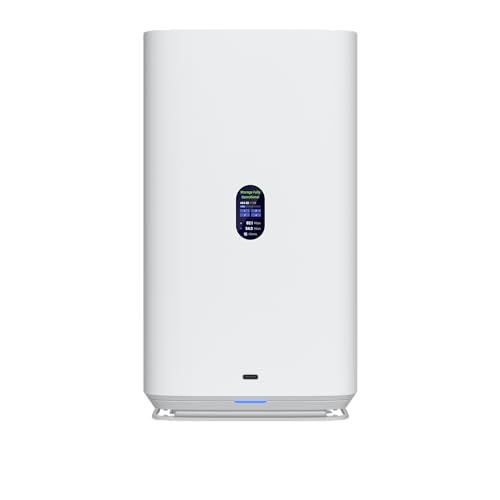
Compact 2.5GbE Pick – Ubiquiti UniFi NAS 4-Bay
Ubiquiti 4-Bay NAS with 2.5/3.5" HDD Slots & 2 M.2 NVMe SSD Cache Slots by Ubiquiti
Check Price On AmazonIf you want a straightforward NAS enclosure with M.2 cache support, the Ubiquiti UniFi NAS offers four 2.5/3.5-inch HDD bays plus dual M.2 NVMe SSD cache slots. Its 2.5GbE networking and USB-C connectivity make it a practical fit for desktop file storage and backups.
Best For: Users seeking a compact four-bay NAS with dual NVMe cache slots and 2.5GbE connectivity.
Pros:
- Four bays support 2.5- and 3.5-inch drives.
- Dual M.2 NVMe slots support SSD caching.
- Includes 2.5GbE networking and USB-C connectivity.
Cons:
- Storage drives are not specified as included in the supplied details.
- Provides less network bandwidth than the 10GbE-equipped options in this roundup.
The UniFi NAS is a focused option for buyers who prioritize a clean four-bay design and M.2 cache expansion without moving to a larger, more performance-oriented enclosure.
High-Speed Team Storage – UGREEN DXP4800 Plus 4-Bay NAS
The UGREEN DXP4800 Plus is a capable four-bay choice among NAS enclosures with M.2 cache support, aimed at families, creators, and small teams. It combines up to 144TB of advertised capacity with 10GbE, 2.5GbE, Docker, virtual-machine support, and a 128GB SSD listed in its specifications.
Best For: Small teams and creators needing fast networking, centralized storage, and advanced NAS applications.
Pros:
- Supports up to four 3.5-inch drives and up to 144TB capacity based on the supplied configuration note.
- Includes 10GbE, 2.5GbE, 10Gbps USB, and 4K HDMI connectivity.
- Supports Docker, virtual machines, RAID options, and private-cloud features.
- Includes AI-powered photo organization and broad device compatibility.
Cons:
- Hard drives are not included.
- Wired Ethernet is required; Wi-Fi is not supported according to the supplied note.
- Actual transfer speeds depend on the network, processor, drives, and file sizes.
With its high-speed ports and software-oriented feature set, the DXP4800 Plus is a strong fit when an M.2-equipped NAS needs to handle collaboration, backups, media, and containerized workloads.
Hybrid Expansion Choice – Cenmate 5-Drive M.2 Enclosure
Unlike a conventional network-attached system, this Cenmate unit is a USB 3.2 Gen 2 hybrid enclosure that combines two SATA HDD/SSD bays with three M.2 NVMe slots. It is a useful alternative for buyers comparing NAS enclosures with M.2 cache support who want direct-attached hybrid storage and selectable RAID modes.
Best For: Desktop users wanting combined SATA and M.2 storage in a single USB enclosure.
Pros:
- Holds two 2.5/3.5-inch SATA drives and three M.2 2230/2242/2260/2280/22110 NVMe SSDs.
- Supports RAID 0, RAID 1, JBOD, and Normal modes.
- USB 3.2 Gen 2 supports up to 10Gbps, with USB-A and USB-C cables supplied.
- Tool-free trays and built-in fans simplify installation and cooling.
Cons:
- It is a USB enclosure rather than a network NAS.
- The continuously running fans may be noticeable in quiet environments.
- Changing RAID configurations can result in data loss, and macOS does not support RAID software according to the supplied notes.
This is best viewed as a flexible local-storage enclosure, not a replacement for a networked NAS. Its five-drive hybrid layout is appealing when M.2 expansion and direct USB access matter more than remote sharing.
Expandable Multimedia NAS – QNAP TS-462 4-Bay NAS
The QNAP TS-462 is a four-bay diskless NAS for buyers who want M.2 cache support alongside upgrade potential. Its dual M.2 PCIe Gen3x1 slots can provide cache acceleration or SSD storage pools, while 2.5GbE, PCIe expansion, and fast USB ports support larger file transfers.
Best For: Home users and small offices building a multimedia NAS with cache acceleration and future expansion.
Pros:
- Dual M.2 PCIe Gen3x1 slots support cache or SSD storage pools.
- Four bays accept 2.5- and 3.5-inch drives.
- 2.5GbE networking and USB 3.2 Gen 2 ports support faster transfers.
- PCIe expansion enables additional network adapters or QM2 cards.
Cons:
- It is diskless, so storage drives must be purchased separately.
- The included Intel Celeron processor is dual-core.
- Memory is listed at 4GB DDR4, with expansion up to 16GB.
The TS-462 balances familiar four-bay NAS functionality with useful M.2 and PCIe expansion. It is a sensible choice for personal media, backups, and file sharing when a 10GbE connection is not essential.
Best Hybrid DAS – TerraMaster D8 Hybrid 2
The TerraMaster D8 Hybrid 2 is a flexible choice for shoppers comparing NAS enclosures with M2 cache, although it is a USB direct-attached storage enclosure rather than a complete network NAS. It combines four SATA bays with four M.2 2280 NVMe slots, letting you pair high-capacity hard drives with faster SSD storage.
Best For: Users who want eight independent drives, fast USB-C transfers, and mixed HDD/NVMe storage for computers or compatible NAS systems.
Pros:
- Supports four SATA HDDs or SSDs and four M.2 NVMe SSDs.
- USB 3.2 Gen 2 provides transfer speeds up to 10Gbps, with stated reads up to 1,020MB/s from one M.2 SSD.
- Works with Windows, macOS, Linux, and NAS operating systems without requiring drivers.
- Power Save and Active modes help balance efficiency and drive availability.
Cons:
- It has no built-in RAID; third-party RAID software is required if needed.
- It is diskless and connects through USB rather than functioning as a standalone network NAS.
The D8 Hybrid 2 stands out when capacity flexibility matters more than integrated NAS management. Its independent-drive design is straightforward, while the combination of SATA and NVMe slots suits backups, media workflows, and storage expansion.
Best 4-Bay Creator NAS – UGREEN DXP4800 GT
The UGREEN DXP4800 GT is a strong option for creators and small teams comparing NAS enclosures with M2 cache. It combines four SATA drive bays with two M.2 SSD slots, dual 10GbE networking, expandable memory, and software features for backups, media, containers, and surveillance.
Best For: Creators, office teams, and advanced home users who need fast network transfers, SSD expansion, media tools, and local security-camera storage.
Pros:
- AMD Ryzen Embedded R2514, 8GB DDR4 RAM, and memory expansion up to 64GB support multitasking.
- Two 10GbE ports can provide up to 20Gbps aggregate bandwidth with compatible link aggregation equipment.
- Two M.2 SSD slots complement four SATA bays, with stated total capacity up to 144TB.
- Includes SD-card backup, USB 10Gbps ports, HDMI 4K output, Docker, virtual-machine, and surveillance support.
Cons:
- Drives are not included, so the total setup cost depends on separately purchased storage.
- Maximum network and storage performance requires compatible drives and networking hardware.
With its combination of M.2 expansion, high-speed networking, and broad UGOS Pro features, the DXP4800 GT is more than a basic file server. It is a capable platform for demanding local workflows, provided your network and drives can take advantage of its performance.
Best 8-Bay Business NAS – Asustor Lockerstor 8 AS6508T
The Asustor Lockerstor 8 AS6508T is designed for buyers who need a larger NAS enclosure with M2 cache potential and strong wired networking. Its eight SATA bays, 8GB of DDR4 memory, dual 10GbE ports, and M.2 SSD cache support make it suited to centralized storage and multi-user access.
Best For: Businesses, offices, and advanced home users who need eight-drive capacity, SSD caching, and high-speed network connectivity.
Pros:
- Eight 3.5-inch SATA drive bays provide substantial expansion room.
- Supports M.2 NVMe SSD cache for accelerating frequently accessed data.
- Dual 10GbE interfaces support up to 20Gbps with link aggregation, alongside dual 2.5GbE ports.
- Includes 8GB DDR4 RAM, comprehensive backup features, cross-platform access, and Wake on LAN/WAN.
Cons:
- It is diskless, so drives and any cache SSDs must be purchased separately.
- The older Intel Atom C3538 platform runs at up to 2.1GHz and may be less suitable for especially demanding workloads.
- Only two USB ports are listed in the specifications.
The Lockerstor 8 prioritizes drive count and networking flexibility over compact size. It is a practical fit for users building a large shared storage pool with M.2 caching, though buyers should account for the cost of eight drives and verify that their network equipment supports the advertised link aggregation speeds.
Best Advanced Home NAS – UGREEN DXP2800 2-Bay
For shoppers comparing NAS enclosures with M.2 cache, the UGREEN DXP2800 combines two SATA drive bays with two M.2 NVMe slots in a compact, diskless system. Its Intel N100 processor, 8GB DDR5 RAM, and 2.5GbE networking make it a capable choice for centralized backups, media libraries, and demanding home applications.
Best For: Advanced home users, remote workers, and creators managing photos, 4K video, backups, and multiple NAS apps.
Pros:
- Two HDD bays and two M.2 NVMe slots support hybrid storage and up to 80TB of stated capacity.
- Intel N100, 8GB DDR5 RAM, and 2.5GbE are well suited to heavier file and media workloads.
- Supports Docker, virtual machines, compatible Plex applications, AI photo organization, and local surveillance features.
- Works across Windows, macOS, Android, iOS, web browsers, and compatible smart TVs.
Cons:
- Diskless design means HDDs and SSDs must be purchased separately.
- Its broad feature set may be more than casual users need.
The DXP2800 is a strong fit when you want M.2 expansion alongside conventional hard drives without moving to a larger multi-bay chassis. Consider it particularly if creator workflows, media serving, and device-wide backups are priorities.
Best Expandable Hybrid NAS – Asustor Lockerstor 6 Gen2
If you need NAS enclosures with M.2 cache and room to scale, the Asustor Lockerstor 6 Gen2 offers six SATA bays alongside four M.2 NVMe slots. Dual 2.5GbE, expandable memory, and a PCIe slot give this diskless tower a flexible foundation for storage, virtualization, and media workloads.
Best For: Content creators, small businesses, and advanced users who need substantial hybrid storage and future expansion.
Pros:
- Six SATA bays and four M.2 NVMe slots support caching or all-flash acceleration.
- Dual 2.5GbE ports provide faster networking than standard Gigabit connectivity.
- 8GB DDR4 RAM is expandable to 16GB for multitasking, Docker, and virtualization.
- PCIe expansion supports a potential 10GbE upgrade or additional SSD expansion.
Cons:
- Diskless configuration requires separate drive purchases.
- The six-bay chassis may be excessive for users with modest storage needs.
- Its Intel Celeron N5105 platform is less powerful than higher-end workstation-class NAS hardware.
The AS6706T stands out for capacity and upgrade flexibility rather than compactness. Its four M.2 slots and six drive bays make it a practical long-term platform for users who expect their storage, networking, or application requirements to grow.
Best Feature-Rich 2-Bay NAS – ORICO MetaBox HS200
The ORICO MetaBox HS200 is a versatile option among NAS enclosures with M.2 cache, pairing two HDD slots with two M.2 NVMe SSD slots. It also includes dual 2.5GbE, HDMI, USB connectivity, remote access, and preloaded options for virtual machines and Docker, making it geared toward hands-on home-lab and media use.
Best For: Home users who want private-cloud features, a 4K media library, remote sharing, and flexible operating-system experimentation.
Pros:
- Two HDD slots and two M.2 NVMe slots support up to 64TB of stated storage.
- Dual 2.5GbE, HDMI, USB-A, and USB-C provide versatile connectivity.
- Supports virtual-machine options including TrueNAS, Windows 11, Ubuntu 24, and Debian 12.
- Offers Docker deployment, Plex playback, AI album search, and remote multi-user access.
Cons:
- Diskless design requires separate HDDs and SSDs.
- The stated WAN transfer rate is 10MB/s, so remote performance depends heavily on the network connection.
- Its wide range of configurable features may require more setup than a basic backup NAS.
The HS200 is appealing if you want more than file storage from a two-bay enclosure. Its M.2 slots, HDMI output, virtual-machine support, and media organization tools make it a flexible platform for experimentation and entertainment.
How We Picked the Best Nas Enclosures with M2 Cache
We focused on storage enclosures that combine conventional SATA drive bays with one or more M.2 NVMe slots, allowing users to accelerate frequently accessed data or configure fast SSD storage where supported. The selection covers two-, four-, six-, and eight-bay designs, plus hybrid systems that accept both hard drives and NVMe SSDs.
We also considered processor performance, installed memory, network speed, RAID flexibility, expansion, media features, and the intended audience. Because M.2 support varies considerably, buyers should verify whether the slots support caching, storage pools, or both before purchasing.
Quick Comparison
- Two-bay options: The UGREEN DXP2800 and ORICO model suit home offices, remote workers, and smaller media libraries.
- Four-bay systems: Ubiquiti, UGREEN, QNAP, and hybrid TerraMaster models offer a useful balance of capacity, redundancy, and performance.
- High-capacity choices: The Asustor Lockerstor 6 Gen2 and Lockerstor 8 are better suited to larger libraries, teams, and expansion-focused users.
- Hybrid designs: TerraMaster and the dual-bay hybrid enclosure combine SATA storage with multiple NVMe drives for flexible layouts.
Key Buying Factors for NAS Enclosures with M.2 Cache
Drive Bays and Usable Capacity
Choose the bay count based on both current storage and future growth. More bays make RAID 5 or RAID 6 practical and let you replace smaller drives gradually. Two-bay systems are simpler, but RAID 1 cuts usable capacity roughly in half.
What the M.2 Slots Actually Support
Check the M.2 key type, supported sizes, PCIe generation, and whether NVMe drives can be used for read/write cache or as a separate storage tier. Cache SSDs do not replace a backup, and some systems require matched drives or specific software configurations.
Networking and Internal Performance
Gigabit Ethernet can limit large transfers, while 2.5GbE is a worthwhile step up for modern homes and small offices. Faster networking only helps when your switch, cabling, client devices, and storage drives can support it. CPU performance and RAM also affect containers, synchronization, indexing, and 4K media tasks.
RAID, Software, and Expansion
Look for the RAID levels you need, snapshot or backup support, user permissions, remote access, and a mature management interface. PCIe expansion, upgradeable memory, HDMI output, and additional networking can extend the useful life of a higher-end enclosure.
Who Should Buy Which Nas Enclosures with M2 Cache?
Home users and remote workers should start with a two-bay model if they mainly need private cloud storage, backups, and document access. Families and creators will usually benefit from a four-bay enclosure with 2.5GbE and NVMe support for shared photos, video, and project files.
Small teams and growing media libraries should consider six- or eight-bay Asustor systems, particularly when RAID flexibility, memory, and expansion matter. Storage enthusiasts who want separate fast and bulk tiers may prefer a hybrid enclosure, but should confirm operating-system compatibility, cooling, and drive-management limitations before buying.