Ribbon mics reward the right preamp with open highs, strong transient detail, and quiet performance. The wrong match can leave them sounding dull, noisy, or underpowered.
Below, we break down 10 of the best 500 series preamps for ribbon mics, focusing on clean gain, headroom, noise floor, and real-world versatility for tracking and mixing.
Best 10 500 Series Preamps for Ribbon Mics Picks for 2026
Best Clean-Then-Color Pick
Cranborne Camden 500 Mic Preamp

- Very clean gain suits ribbon microphones
- Mojo circuit adds Thump or Cream saturation
- Selectable impedance and HPF improve versatility
Best For: Engineers who want a transparent ribbon-friendly preamp with optional analog color.
Best for Built-In Compression
SSL SiX 500 Series Channel Strip
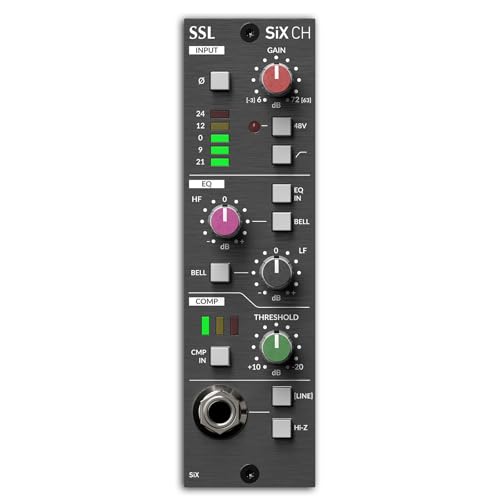
- All-in-one mic pre, EQ, HPF, and compressor
- Useful front-panel Hi-Z input and HPF
- Strong fit for fast tracking workflows
Best For: Engineers who want a versatile 500 series channel strip with easy onboard control.
Best Inline Gain Booster
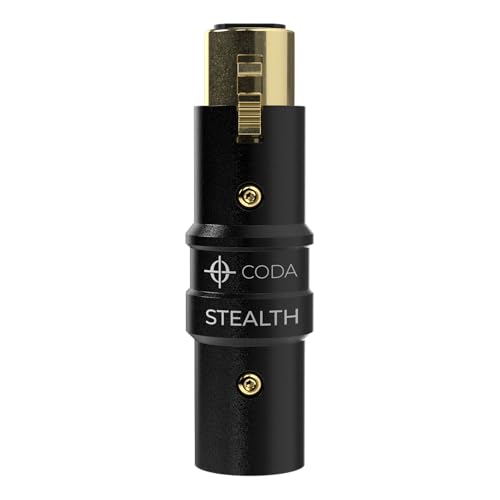
- 28 dB of ultra-clean gain from phantom power
- Low-noise inline design for ribbon and dynamic mics
- Compact, matte-black build for simple setups
Best For: Podcasters and streamers needing a clean, compact gain boost for ribbon or dynamic mics.
Best for Ribbon Mics
Midas 502 500 Series Microphone Preamplifier
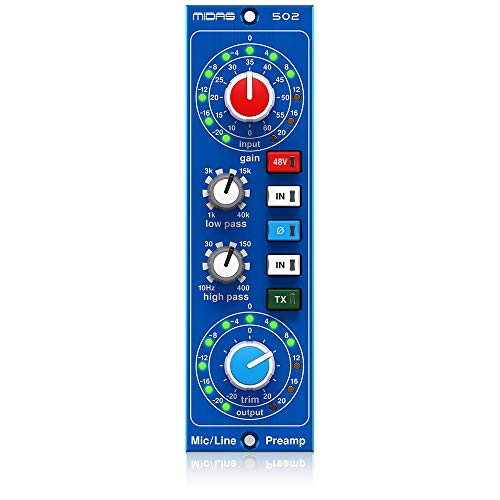
- Ultra-low-noise quad discrete input stage
- Classic XL4 high/low-pass filters
- Twin aux balanced output for splitter use
Best For: Engineers who want a ribbon-friendly 500-series preamp with practical filtering and routing.
Best Transformer Color

- Lundahl transformer-coupled mic path for smooth color
- Good match for ribbon mics when you want added warmth
- LED metering helps with quick gain staging
Best For: Engineers who want a colored 500-series preamp for ribbon mics and classic console tone.
Best for Gain-Hungry Ribbons

- 80dB gain for low-output ribbon mics
- Classic Marinair transformer coloration
- Gain trim and insert add workflow control
Best For: Engineers who want classic Neve tone and lots of clean gain for ribbon mics.
Best for Ribbon Gain
Heritage Audio Lang 312L 500 Series Preamp
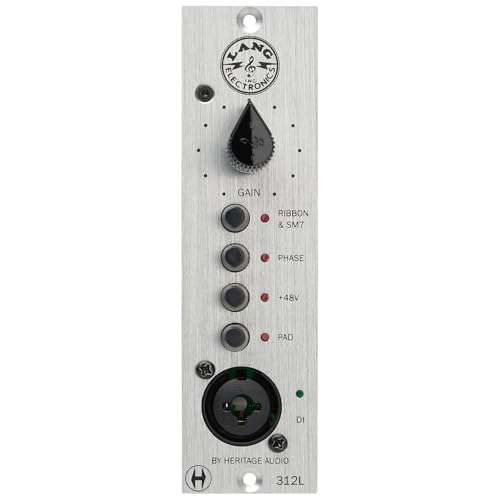
- Built-in +25dB lifter helps ribbon mics get enough level
- 90dB gain offers strong headroom for quiet sources
- Also works as a mic/DI preamp with pad, phase, and phantom power
Best For: Engineers who need extra gain for ribbon mics in a versatile 500 series module.
Best with Extra Features
PRE-573 MKIII 500 Series Preamp

- 80dB of mic gain for low-output ribbon mics
- Switchable impedance for flexible mic matching
- LED meter and DI add practical studio utility
Best For: Engineers who want a 500-series preamp with plenty of gain for passive ribbon mics and flexible input loading.
Best Heavy-Duty Pick
Burl B1 500 Series Mic Preamp / DI

- Transformer tone adds warmth and depth to ribbons.
- Class-A discrete design delivers punch and presence.
- Great for vocals, guitars, drums, and other color-forward sources.
Best For: Engineers who want a colored 500-series preamp for ribbon mics and other tone-friendly sources.
Best Simple Pick

- 20 to 70 dB of gain suits low-output ribbon mics
- Jensen transformer coupling adds musical character
- Front-panel I/O and filters speed up session work
Best For: Engineers who want a ribbon-friendly 500-series preamp with handy tone controls.
Best Clean-Then-Color Pick – Cranborne Camden 500 Mic Preamp
If you want one of the more flexible 500 series preamps for ribbon mics, the Cranborne Audio Camden 500 is worth a close look. It gives you a very clean, low-noise starting point for delicate ribbons, then lets you add Mojo saturation when you want thicker, more vintage-style character without giving up control.
Best For: Engineers who want a transparent 500-series preamp for ribbons, with optional analog color for vocals, guitars, and other tracked sources.
Pros:
- Clean, low-noise gain is ideal for sensitive ribbon microphones
- Selectable Mojo saturation adds Thump or Cream character when needed
- Selectable input impedance helps tailor the match to different mics and sources
- Mic, line, and instrument input support adds studio flexibility
Cons:
- Not the cheapest option if you only need a basic ribbon mic preamp
- Colorful modes are useful, but not as simple as a straight no-frills preamp
For buyers comparing 500 series preamps for ribbon mics, the Camden 500 stands out because it can stay extremely neutral at one moment and add tasteful harmonic weight the next. That makes it a strong choice if you want a single module that handles ribbons cleanly while still covering more character-based tracking jobs.
Best for Built-In Compression – SSL SiX 500 Series Channel Strip
If you want one compact front-end for tracking, the SSL SiX Channel Strip brings mic preamp, EQ, high-pass filtering, and a single-knob compressor into a 500 series slot. For players comparing 500 series preamps for ribbon mics, it offers the clean gain and onboard control that make it easier to shape a ribbon signal without piling on extra outboard gear.
Best For: Engineers and home-studio owners who want an all-in-one 500 series channel strip for tracking vocals, instruments, and dynamic microphones with simple, fast control.
Pros:
- Integrated mic preamp, EQ, HPF, and compressor in one module
- +48V phantom power and 1 MΩ Hi-Z front input add flexibility
- High-pass filter and switchable shelf/bell EQ help tame problem sources
- Single-knob compressor is quick to dial in during tracking
Cons:
- Not the simplest choice if you only need a plain transparent preamp
- Built-in compressor may be more than some ribbon-mic setups need
- Requires a 500 series rack, so it is not a standalone unit
As a channel-strip-style option, this SSL is a smart pick if you want flexible front-end shaping in a 500 series format. It is especially appealing for 500 series preamps for ribbon mics when you value quick control over a minimalist signal path.
Best Inline Gain Booster – Coda MB-Stealth Mic Preamp
If you need more clean level from a dynamic or ribbon mic without changing your interface, the Coda MB-Stealth is a simple solution worth considering. It works with 48V phantom power from your audio interface and adds 28 dB of gain, making it a practical alternative to more complex 500 series preamps for ribbon mics when you just want an easy, inline boost.
Best For: Podcasters, streamers, and home recordists using ribbon or dynamic mics who want extra clean gain from a compact inline preamp.
Pros:
- Adds 28 dB of clean gain using standard 48V phantom power
- Low-noise design helps reduce hiss while improving clarity
- Compact matte-black build is easy to place in any setup
- Works especially well with dynamic and ribbon microphones
Cons:
- Does not work with condenser microphones
- Not a replacement for a full-featured channel strip or desktop preamp
- Requires phantom power from an interface or mixer
For users comparing 500 series preamps for ribbon mics, this model stands out more as a no-fuss inline gain booster than a rack-format studio preamp. It’s a smart buy if your main goal is cleaner level, less noise, and easier gain staging from a ribbon or dynamic mic.
Best for Ribbon Mics – Midas 502 500 Series Microphone Preamplifier
If you want one of the more musical-feeling 500 series preamps for ribbon mics, the Midas 502 is built around the kind of clean gain and forgiving headroom that helps passive ribbons shine. Its quad discrete ultra-low-noise input stage, +24 dBu capability, and classic Midas soft-clipping behavior make it a practical choice when you need strong level without harsh edge.
Best For: Engineers and home-studio owners who want a compact, ribbon-friendly 500-series preamp with musical filtering and splitter flexibility.
Pros:
- Low-noise design with plenty of gain for passive ribbon and dynamic mics
- Classic XL4 swept high- and low-pass filters for quick tone shaping
- Soft-clipping character can smooth peaks without sounding brittle
- Twin aux balanced output adds useful splitter routing in supported racks
Cons:
- Filters and routing extras may be overkill if you only need a simple clean preamp
- Requires a compatible 500-series rack, so total cost is higher than a standalone preamp
For 500 series preamps for ribbon mics, the Midas 502 stands out as a versatile pick if you want clean gain, strong headroom, and useful onboard filtering in a compact module. It is especially appealing when you want a ribbon-ready preamp that can also handle line duties and flexible routing in a professional 500-series rig.
Best Transformer Color – 80B 500 Series Preamp
If you want a 500-series module with classic console-style character, the 80B 500 Series Preamp is a strong fit for 500 series preamps for ribbon mics. Its Lundahl transformer-coupled mic input and transformer output are aimed at adding depth and smoothness while still keeping the signal path studio-ready and flexible for line-level work.
Best For: Engineers and home-studio owners who want a colored 500-series preamp with transformer tone for ribbons, vocals, and other source material.
Pros:
- Lundahl transformer-coupled design adds musical warmth and weight
- Helpful choice when you want a preamp with extra body for ribbon mics
- Electronically balanced line input expands its usefulness beyond mics
- LED meter makes gain staging easier at a glance
Cons:
- Not the cleanest option if you want invisible, ultra-transparent gain
- Single-channel 500-series format may require multiple slots for stereo recording
- More about tone than lots of onboard features
For buyers comparing 500 series preamps for ribbon mics, this Trident-inspired design stands out when you want added transformer character rather than a starkly clinical sound. It makes the most sense in systems where a little color and density are part of the recording goal.
Best for Gain-Hungry Ribbons – Neve 1073LB 500 Series Preamp
If you want one of the more capable 500 series preamps for ribbon mics, the Neve 1073LB brings a huge 80dB gain range, transformer color, and a practical insert point for flexible tracking. It is a strong fit when you need quiet boost, musical saturation, and enough headroom to handle low-output ribbons without sounding thin.
Best For: Engineers and ribbon-mic users who want classic Neve character plus plenty of clean gain in a 500-series slot.
Pros:
- 80dB of gain helps low-output ribbon mics come alive
- Marinair transformers add the classic Neve tone many users want
- Gain trim and insert feature improve control and routing flexibility
- 500 Series format keeps the setup compact and modular
Cons:
- Not the most budget-friendly option
- Colorful sound may be less ideal if you want maximum transparency
- Requires a compatible 500-series rack
For players and engineers shopping for 500 series preamps for ribbon mics, the 1073LB stands out as a high-gain, character-rich choice that can add body without sacrificing control. It is especially appealing if you want a premium front end rather than a purely neutral preamp.
Best for Ribbon Gain – Heritage Audio Lang 312L 500 Series Preamp
If you’re shopping for 500 series preamps for ribbon mics, the Heritage Audio Lang 312L stands out for its built-in +25dB lifter and hefty 90dB of available gain. That makes it easy to bring low-output ribbons up to usable levels without immediately needing an external booster, while the transformer-based design keeps the sound punchy and focused.
Best For: Engineers who want a ribbon-friendly 500 series preamp with plenty of gain, a built-in lifter, and enough versatility for DI use too.
Pros:
- Built-in +25dB lifter is ideal for low-output ribbon microphones
- 90dB of gain gives plenty of headroom for quiet sources
- Combo XLR/TS input makes it useful for mics and DI signals
- Includes phantom power, pad, and phase switch for flexible sessions
Cons:
- More specialized than a simple clean gain stage
- Higher-end feature set may be overkill for basic recording setups
The 312L is a strong pick if you want one of the more ribbon-ready 500 series preamps for ribbon mics without sacrificing versatility. Its extra gain staging and transformer flavor make it practical for capture-heavy work, but it still covers everyday studio duties well.
Best with Extra Features – PRE-573 MKIII 500 Series Preamp
If you’re comparing 500 series preamps for ribbon mics, the PRE-573 MKIII is a strong fit thanks to its 80dB of mic gain, switchable impedance, and clean 1-channel 500-series format. Those features make it easy to get enough level from low-output ribbons while keeping your setup simple and rack-friendly.
Best For: Engineers who want a 500-series preamp with plenty of gain for passive ribbon mics and flexible input loading.
Pros:
- 80dB of mic gain helps bring low-output ribbon mics up to usable levels
- Switchable impedance can help tailor the response of different microphones
- LED output meter makes gain staging easier at a glance
- Includes phantom power and DI for broader studio use
Cons:
- Single-channel design may be limiting for stereo or multi-mic ribbon setups
- Impedance switching is useful, but not a substitute for a dedicated ribbon-specific color option
- Requires a 500-series chassis, so it’s not a standalone desktop preamp
For engineers building a modular rack, this is a practical choice when 500 series preamps for ribbon mics need high gain without adding unnecessary complexity. It focuses on the core requirements—level, loading, and metering—so it can slot into a working studio chain with minimal fuss.
Best Heavy-Duty Pick – Burl B1 500 Series Mic Preamp / DI
If you want 500 series preamps for ribbon mics that add thickness without sounding dull, the Burl B1 is a strong color option. Its transformer-based, class-A design is built to deliver warmth, depth, and a little extra attitude, making it a good fit when you want a ribbon to feel bigger and more finished in the mix.
Best For: Engineers and producers who want a vibey 500-series preamp for ribbons, vocals, guitars, and drums.
Pros:
- Transformer-driven tone adds warmth, body, and depth to ribbon mics.
- Class-A, discrete circuit path gives it punch and musical presence.
- Works well on sources that benefit from added size and character.
Cons:
- Not the cleanest choice if you want invisible gain.
- More of a tone box than a utility preamp.
For 500 series preamps for ribbon mics, the Burl B1 stands out when you want strong transformer color and a more finished, mix-ready sound. It is less about transparency and more about adding density, which is exactly why it can be a smart match for ribbons on sources that need extra presence.
Best Simple Pick – Harrison 32 Classic PrePlus
If you’re shopping for 500 series preamps for ribbon mics, the Harrison 32 Classic PrePlus is worth a close look thanks to its smooth 20 to 70 dB gain range and transformer-coupled design. It adds practical front-panel access, switchable pads, Hi-Z, phase, and filters, making it a flexible module for both tracking and quick session changes.
Best For: Engineers who want a ribbon-friendly 500-series preamp with plenty of clean gain and useful onboard tone shaping.
Pros:
- 20 to 70 dB of gain is well suited to low-output ribbon microphones.
- Jensen transformer coupling adds character without feeling overly aggressive.
- Front-panel combo XLR and 1/4" input make patching fast and convenient.
- HP/LP filters, pad, phase, and Hi-Z switches increase session flexibility.
Cons:
- Not the most minimalist option if you only want a bare-bones preamp.
- Its tonal character may be more colored than users seeking ultra-transparent gain prefer.
As a pick for 500 series preamps for ribbon mics, this Harrison module stands out for combining usable gain, transformer warmth, and practical controls in one rack-friendly package. It’s a strong fit when you want a preamp that can handle ribbons confidently while still offering enough shaping tools for real-world recording.
How We Picked These 500 Series Preamps for Ribbon Mics
We prioritized preamps that offer enough clean gain for low-output ribbons, stable phantom power handling where relevant, and a low-noise signal path. We also looked at tonal flexibility, build quality, and whether each unit is a strong fit for modern studio workflows.
Because ribbon microphones vary widely, the best choice is not always the most colored or the most transparent option. The right preamp should match your mic, source, and recording goals without forcing unnecessary noise or harshness.
Quick Comparison
For the cleanest, most neutral path, look toward transparent designs and gain boosters. For more character, transformer-based and classic-style preamps can add weight, density, and harmonic color. If you need maximum flexibility, channel-strip style options may be useful, but pure preamps often make more sense when ribbon mics are the priority.
Key Buying Factors for 500 Series Preamps for Ribbon Mics
Gain and Noise Performance
Many ribbon mics need a lot of gain. Aim for a preamp that can deliver sufficient boost without adding hiss or grain, especially if you record quiet sources like acoustic guitar, room mics, or spoken word.
Input Impedance and Tonal Match
Input impedance affects how a ribbon microphone interacts with the preamp. Higher or switchable impedance can preserve openness and detail, while lower settings may soften the top end or change the feel of the mic.
Phantom Power Safety
Passive ribbon mics generally do not need phantom power, but modern setups can involve inline boosters or active ribbons. Make sure the preamp and your workflow are compatible and that you understand safe connection practices.
Color Vs. Transparency
Some users want a clean, neutral preamp that simply amplifies the ribbon signal. Others prefer a transformer-rich or vintage-inspired sound that adds thickness and vibe. There is no single best option; it depends on the source and the mix.
System Fit
Since these units live in a 500 series rack, confirm chassis power availability, physical space, and whether you need one channel or multiple channels for stereo or ensemble work.
Who Should Buy Which 500 Series Preamps for Ribbon Mics?
If you want the safest all-around choice for 500 Series Preamps for Ribbon Mics, prioritize a clean, high-gain design with low noise and flexible impedance. If you track rock vocals, guitar amps, or drums and want more density, a character preamp may be the better fit. If your ribbon mics are consistently quiet and need help reaching line level, an inline gain booster can be the smartest upgrade. For engineers who want one slot to do more than preamp duty, a channel strip can add EQ or compression, but only if the added features will genuinely get used.
In short, match the preamp to the ribbon mic’s output level, the source you record most, and how much tonal shaping you want to commit to on the way in.