The right condenser microphone can capture an acoustic guitar’s picking detail, body resonance, and natural dynamics far more convincingly than many general-purpose recording options. The best choice depends on your room, interface, playing style, and whether you need one microphone for guitar or a more versatile studio tool.
We selected 10 options spanning pencil condensers, large-diaphragm studio microphones, instrument-focused designs, and budget-friendly models. Use the guide below to narrow the list by sound, placement flexibility, features, and value.
Best 10 Condenser Microphone for Acoustic Guitar Picks for 2026
Compact Studio Detail

- Small-diaphragm capsule for acoustic guitar and instruments
- Switchable pad handles up to 155 dB SPL
- Rugged all-metal construction
Best For: Detailed acoustic guitar and instrument recording
Quiet Vocal-Style Detail

- 4.5 dBA self-noise for quiet recording
- Cardioid pattern helps reject room sound
- Includes shock mount, pop filter, and XLR cable
Best For: Quiet home studios recording guitar and vocals
Instrument-Focused Value

- Small-diaphragm design for acoustic guitar and strings
- High-SPL handling up to 155 dB with attenuation pad
- Includes stand adapter
Best For: Close-miked acoustic guitar and instrument recording
Accessible Studio Starter
Mackie EM-91C Condenser Microphone

- Budget-friendly large-diaphragm condenser
- Cardioid pattern reduces ambient sound
- Includes shock mount and XLR cable
Best For: Affordable home-studio guitar and vocal recording
Best Focused Capture

- Wide frequency response for detailed string-instrument capture
- Cardioid pickup helps reject off-axis noise
- Includes clip, foam cover, bag, and user manual
Best For: Acoustic guitar and other string instruments in an XLR setup
Best Starter Bundle
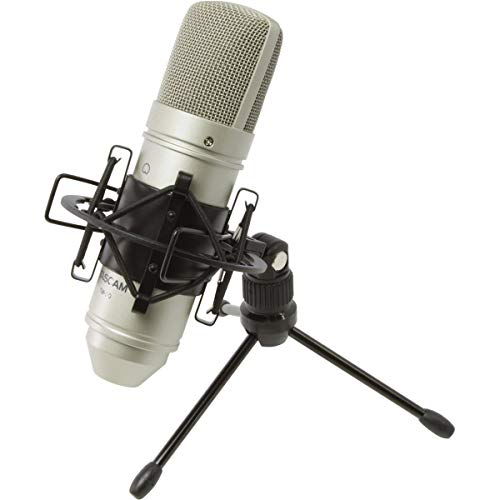
- 18mm aluminum diaphragm for acoustic instruments and vocals
- Cardioid pickup with noise- and distortion-conscious circuitry
- Includes stand, XLR cable, and elastic shockmount
Best For: Home recording with a convenient included accessory bundle
Best Studio All-Rounder

- Low-mass diaphragm supports detailed transient response
- Cardioid pattern improves source isolation
- High SPL handling suits varied recording applications
Best For: Project and home studios recording acoustic guitar and other sources
Best Mounted Pick
Behringer CB100 Guitar Gooseneck Mic

- Gooseneck design for acoustic guitar mounting
- Unidirectional condenser with XLR output
- Includes mounting kit, adapter, and case
Best For: Players wanting a lightweight mounted guitar microphone
Best Value Recording Kit
Blucoil Cardioid Studio XLR Mic

- 16mm diaphragm with 30Hz–18kHz response
- Cardioid pattern and 15dB self-noise
- Includes cable, shock mount, windscreen, and pouch
Best For: Home studios recording guitar, vocals, and podcasts
Best Large-Diaphragm Option

- 34mm gold-plated large-diaphragm capsule
- Cardioid pattern with 20Hz–20kHz response
- Includes pop filter, shock mount, and carry bag
Best For: Studio recording of acoustic guitar and vocals
Compact Studio Detail – AKG P170 Condenser Microphone
The AKG P170 is a small-diaphragm condenser microphone for acoustic guitar players who want clear detail and responsive transients. Its all-metal build and switchable attenuation pad make it a practical wired XLR option for home recording, rehearsal, or louder instrument sources.
Best For: Acoustic guitar recording, percussion, overheads, and other strings where clarity and transient response matter.
Pros:
- Small-diaphragm design suits acoustic guitars and other instruments.
- Switchable attenuation supports high-SPL applications up to 155 dB SPL.
- Heavy-duty, all-metal construction is built for regular use.
Cons:
- Requires a compatible XLR setup.
- Includes a stand adapter but not a listed shock mount or cable.
Choose the P170 if you prioritize focused instrument capture and durability over an included recording bundle. It is especially well matched to acoustic guitarists who already have an interface or mixer.
Quiet Vocal-Style Detail – RØDE NT1 Signature Series
The RØDE NT1 Signature Series is a large-diaphragm condenser microphone that can also serve as a polished condenser microphone for acoustic guitar. Its low 4.5 dBA self-noise, cardioid pattern, and included shock mount, pop filter, and XLR cable make it a convenient choice for a ready-to-record setup.
Best For: Players who want a quiet studio microphone for acoustic guitar, vocals, and general home recording.
Pros:
- Very low self-noise helps preserve subtle performances.
- Cardioid pattern focuses on the source and rejects room sound.
- Includes an SM6 shock mount with pop filter, six-meter XLR cable, and dust cover.
Cons:
- Requires an audio interface with XLR input.
- Large-diaphragm format may be less specialized for fast acoustic-guitar transients than a small-diaphragm design.
The NT1 Signature is a strong all-around pick when acoustic guitar is part of a broader recording setup. Its included accessories reduce the number of additional purchases needed to start recording.
Instrument-Focused Value – AKG Perception 170
The AKG Perception 170 is a practical condenser microphone for acoustic guitar, with a small-diaphragm capsule designed for clarity and transient response. Its unidirectional pattern, wired XLR connection, and high-SPL handling make it suited to close instrument recording.
Best For: Acoustic guitar, percussion, overheads, and other strings in a studio or project-recording setup.
Pros:
- Specifically designed for acoustic guitars and other instruments.
- Switchable attenuation pad supports sources up to 155 dB SPL.
- Lightweight metal body and included stand adapter simplify placement.
Cons:
- Requires an XLR cable and compatible preamp or interface.
- Does not list a shock mount or cable in the included contents.
The Perception 170 is a focused choice for guitarists who want an instrument-oriented microphone without unnecessary extras. Its pad provides useful headroom when recording louder sources or close placements.
Accessible Studio Starter – Mackie EM-91C Condenser Microphone
The Mackie EM-91C is an affordable large-diaphragm condenser microphone for acoustic guitar, vocals, and other studio instruments. Its cardioid pattern helps reduce ambient sound, while the included shock mount and XLR cable make it a convenient starting point for a home-based studio.
Best For: Budget-conscious musicians building a home studio for acoustic guitar, vocals, and general recording.
Pros:
- Affordable professional-quality condenser design.
- Cardioid pattern helps reduce room ambience.
- Includes a shock mount and XLR cable.
Cons:
- Large-diaphragm design is less specifically instrument-focused than the AKG P170.
- Requires a compatible XLR mixer or interface.
The EM-91C makes sense when value and included accessories are priorities. It offers a straightforward way to add condenser recording capability for acoustic guitar and vocals without assembling every accessory separately.
Best Focused Capture – Phenyx Pro PDM35
The Phenyx Pro PDM35 is a practical condenser microphone for acoustic guitar when you want a focused, detailed recording through an XLR setup. Its cardioid-style pickup and wide frequency response are suited to string instruments, while the included clip, foam cover, and bag make it ready for basic recording work.
Best For: Acoustic guitar, string instruments, percussion, and setups where off-axis noise rejection is useful.
Pros:
- Wide frequency response for crisp high-frequency detail and a balanced sound.
- Cardioid pickup helps minimize background and off-axis interference.
- Metal housing, standard XLR connection, and included accessories support reliable use.
Cons:
- Requires an XLR-compatible interface or mixer and suitable power setup.
- The pencil-style form factor may be less convenient for users wanting a large-diaphragm studio microphone.
Choose this model if focused capture and included essentials matter more than a full studio bundle. It is a versatile option for acoustic instruments, especially when you already have an XLR recording chain.
Best Starter Bundle – Tascam TM-80
The Tascam TM-80 is a sensible condenser microphone for acoustic guitar in a home-recording setup. Its 18mm aluminum diaphragm and cardioid pickup are designed for vocals and acoustic instruments, and the included tabletop stand, XLR cable, and shockmount reduce the need for separate accessories.
Best For: Home recording, acoustic guitar, vocals, and buyers who want a ready-to-use desktop package.
Pros:
- 18mm aluminum diaphragm and cardioid pattern suit acoustic instruments.
- Internal circuitry is designed to reduce noise and distortion.
- Includes a tabletop stand, six-foot XLR cable, and elastic shockmount.
Cons:
- Requires an audio interface or other compatible XLR recording equipment.
- A tabletop stand may be less flexible than a full-size boom stand for guitar positioning.
The TM-80 stands out for its practical accessory bundle and home-recording focus. It is a convenient choice when you want to start recording acoustic guitar without immediately purchasing a cable, stand, and shockmount separately.
Best Studio All-Rounder – Audio-Technica AT2020
The Audio-Technica AT2020 is a proven condenser microphone for acoustic guitar in project and home studios. Its low-mass diaphragm, cardioid pattern, high SPL handling, and wide dynamic range make it a flexible XLR microphone for capturing detailed acoustic performances.
Best For: Project studios, home recording, acoustic guitar, and users who need a versatile microphone for multiple sources.
Pros:
- Custom-engineered low-mass diaphragm supports extended frequency and transient response.
- Cardioid pattern improves isolation by reducing pickup from the sides and rear.
- High SPL handling and wide dynamic range provide broad recording versatility.
Cons:
- Requires phantom power from an audio interface or compatible XLR equipment.
- Sold as the microphone itself, with fewer included accessories than the Tascam bundle.
The AT2020 is a strong choice when you want one studio-oriented microphone that can handle acoustic guitar and other sources. Its isolation and dynamic-range features make it particularly suitable for a controlled home-recording environment.
Best Mounted Pick – Behringer CB100 Guitar Gooseneck Mic
If you want a purpose-built condenser microphone for acoustic guitar, the Behringer CB100 stands out for its gooseneck form factor and included mounting kit. Its unidirectional pickup, XLR connection, and phantom-power operation suit direct instrument recording and amplification setups.
Best For: Acoustic guitarists who want a lightweight, mountable microphone system with XLR connectivity.
Pros:
- Gooseneck design is intended for instrument applications and acoustic guitar mounting.
- Unidirectional condenser pickup focuses capture toward the instrument.
- Includes a mounting kit, phantom power adapter, and case.
Cons:
- Requires phantom power and an XLR-compatible setup.
- Its specialized mounting design is less versatile than a conventional studio microphone.
The CB100 is a practical choice when convenient guitar mounting matters more than broad studio versatility. Confirm that your interface, mixer, or amplifier setup provides the required phantom power and XLR connection.
Best Value Recording Kit – Blucoil Cardioid Studio XLR Mic
The Blucoil Studio XLR microphone is a flexible condenser microphone for acoustic guitar, vocals, woodwinds, streaming, and podcasting. Its 16mm diaphragm, cardioid pattern, 30Hz–18kHz response, and included accessories make it a practical starting package for a home recording setup.
Best For: Home-studio users who need one microphone for acoustic guitar, voice, and general content creation.
Pros:
- 16mm low-mass diaphragm is specified to capture detailed voice and guitar sound.
- Cardioid pickup rejects sound from the sides and rear, while 15dB self-noise supports cleaner recordings.
- Includes an XLR cable, shock mount, windscreen, and protective pouch.
- Handles up to 125dB SPL for louder instruments and guitar amplifiers.
Cons:
- Needs a +48V phantom-powered interface or mixer for XLR operation.
- Its frequency response ends at 18kHz rather than the wider 20kHz range listed by some studio microphones.
With its useful accessory bundle and multi-purpose design, the Blucoil is a sensible option for buyers building a basic recording chain. It is especially convenient if you plan to record both acoustic guitar and spoken content.
Best Large-Diaphragm Option – 512 Audio Skylight Studio Mic
The 512 Audio Skylight is a large-diaphragm condenser microphone for acoustic guitar and studio recording. Its 34mm gold-plated capsule, cardioid pattern, 20Hz–20kHz frequency range, and included shock mount and pop filter make it suited to controlled recording environments.
Best For: Studio users who want a full-size XLR condenser with a large capsule and polished accessory package.
Pros:
- 34mm gold-plated large-diaphragm capsule is designed for detailed, warm, modern sound.
- Cardioid pickup helps reduce ambient room sound from behind the microphone.
- Includes a metal mesh pop filter, low-profile shock mount, and carry bag.
- 144dB maximum SPL provides substantial headroom for louder sources.
Cons:
- At 2.2 pounds, it is considerably heavier than the Behringer CB100.
- Its large-diaphragm studio form factor is less convenient for direct guitar mounting.
- Requires an XLR recording setup and appropriate powered interface or mixer.
The Skylight is the strongest fit here for a conventional studio workflow, particularly when you want acoustic guitar recording alongside vocals. Choose it when capsule size, included isolation accessories, and broad frequency coverage matter more than portability.
How We Picked the Best Condenser Microphone for Acoustic Guitar
We focused on microphones that use an XLR connection and are suitable for recording acoustic guitar in a home studio, project studio, rehearsal space, or professional room. The selection includes both small-diaphragm condensers, which are often valued for transient detail and focused articulation, and large-diaphragm models that can provide a fuller, more rounded presentation.
We also considered polar pattern, attenuation features, frequency-response versatility, included accessories, construction, brand reputation, and overall usefulness beyond guitar. Because room acoustics and microphone placement strongly affect results, no single model is ideal for every player or recording environment.
Quick Comparison
- For detailed picking and fingerstyle: Consider a small-diaphragm pencil condenser with a cardioid pattern.
- For guitar plus vocals: A large-diaphragm studio condenser is usually the more flexible choice.
- For loud strumming or close placement: Look for high SPL handling or a switchable pad.
- For a basic home studio: Prioritize an included shock mount, reliable XLR connectivity, and compatibility with 48V phantom power.
- For tight budgets: An entry-level cardioid condenser can deliver strong results when placement and room treatment are handled carefully.
Key Buying Factors for a Condenser Microphone for Acoustic Guitar
Small Vs. Large Diaphragm
Small-diaphragm microphones commonly deliver a precise, fast response that can reveal pick attack, string separation, and high-frequency detail. Large-diaphragm microphones often sound more substantial and may be preferable when you want body, warmth, or a microphone that also works well for vocals and other instruments.
Polar Pattern and Placement
Cardioid microphones reject much of the sound behind them, making them practical for untreated rooms. Start by aiming near the 12th fret rather than directly at the sound hole; moving toward the bridge generally adds body, while moving toward the neck emphasizes articulation. Test several distances before using equalization.
Room, Gain, and Phantom Power
Condenser microphones typically require 48V phantom power from an audio interface, mixer, or preamp. They also hear more of the room than many dynamic microphones, so a reflective space can matter as much as the microphone itself. Check your interface’s clean gain and use a stable stand, shock mount, and pop or wind protection when needed.
Useful Extras
A pad can help with loud sources and close placement, while a low-cut filter can reduce rumble and excess low-end buildup. A shock mount, case, and quality cable add practical value, but they should not outweigh a microphone’s sound and compatibility with your setup.
Who Should Buy Which Condenser Microphone for Acoustic Guitar?
Choose a small-diaphragm model if your priority is crisp fingerstyle, articulate strumming, or stereo acoustic-guitar recording. Choose a large-diaphragm model if you want one condenser for guitar, vocals, voiceovers, and general studio work. Choose an instrument-focused or gooseneck design when flexible positioning, compact placement, or live and rehearsal use matters most. Choose a budget cardioid condenser if you are building your first XLR setup and can spend time improving placement and room control.