When it comes to achieving the best sound quality in 2025, choosing the right headphone distribution amplifier is essential. With so many options available, you might find it overwhelming to select one that fits your needs. From compact models like the Mackie HM-4 to more versatile options like the 8-channel mixing amplifiers, there’s a perfect match for every audiophile. Let’s explore these top contenders and see which one stands out for your listening experience.
Mackie HM-4 Headphone Amplifier Mixer Accessory

If you’re a music producer or audiophile seeking a reliable solution for simultaneous listening, the Mackie HM-4 Headphone Amplifier Mixer is a standout choice. This ultra-compact device features a 1/4” stereo input and four 1/4” headphone outputs, each with individual level controls, making it perfect for studio or home use. Weighing just 8 ounces, it’s built like a tank but maintains a sleek design. You’ll enjoy crystal-clear audio with minimal noise, ensuring high-quality sound for collaborative projects. With a solid 4.6-star rating from nearly 2,000 users, the HM-4 proves to be a dependable companion for any audio endeavor.
Best For: Music producers, artists, and audiophiles seeking a reliable and high-quality headphone amplification solution for collaborative listening.
Pros:
- Crystal clear audio amplification with minimal noise and high-quality output.
- Ultra-compact and durable design, making it easy to transport and set up.
- Individual volume controls for each headphone output, allowing personalized listening experiences.
Cons:
- Some users report static or cross-talk noise when multiple outputs are in use.
- Minor design layout issues with the placement of jacks and dials.
- Occasional defects, such as units not powering up, have been noted.
8-Channel Headphone Mixing Distribution Amplifier

The 8-Channel Headphone Mixing Distribution Amplifier is ideal for sound engineers and musicians who demand versatility and high-quality audio monitoring. With 16 headphone outputs and support for both mono and stereo modes, you can monitor eight discrete mixes simultaneously. Its high-power amplifiers feature independent channel control, guaranteeing superior sound tailored to your needs. The premium JRC operational amplifier chips deliver low distortion and a high signal-to-noise ratio. Plus, the rack-mount design fits seamlessly into your studio or mobile setup. With features like independent volume control and built-in overload protection, this amplifier guarantees safe and precise sound management.
Best For: Sound engineers and musicians seeking a versatile and high-quality audio monitoring solution with multiple headphone outputs.
Pros:
- High-power amplifiers with independent channel control for tailored sound.
- Supports both mono and stereo modes, allowing for flexible monitoring options.
- Rack-mount design for easy integration into existing studio or mobile setups.
Cons:
- Weighs 6.93 pounds, which may be cumbersome for portable use.
- Limited to wired connectivity, potentially restricting placement options.
- Higher price point may not be suitable for casual users or beginners.
LZSIG 4 Channel Headphone Amplifier
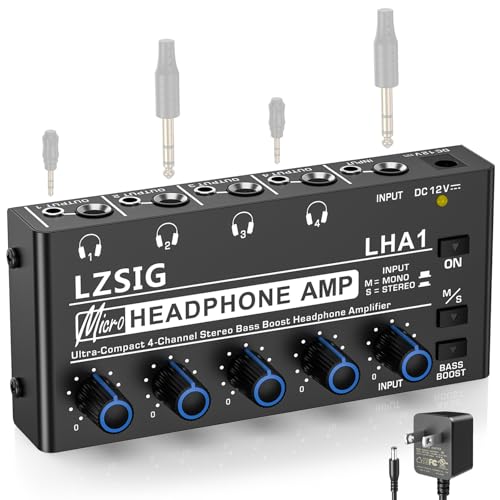
For musicians and audio professionals searching for a reliable solution to manage multiple headphone outputs without sacrificing sound quality, the LZSIG 4 Channel Headphone Amplifier stands out. This compact, metal stereo audio amplifier is designed for both 1/8 inch and 1/4 inch headphones, making it versatile for various setups. With independent volume controls for each of its four channels, you’ll enjoy high-power audio with minimal distortion. It features low-noise operational amplifiers to guarantee clarity and a stereo/mono switch for flexibility. Overall, it’s an ideal choice for studio and stage applications, earning high ratings from satisfied users.
Best For: Musicians and audio professionals who need a reliable and high-quality headphone amplifier for multiple outputs.
Pros:
- High-quality audio performance with low noise and distortion due to advanced operational amplifiers.
- Independent volume controls for each channel allow for personalized listening experiences.
- Compact design makes it easy to integrate into various setups, maintaining a tidy appearance.
Cons:
- Some users report audio hum issues related to cable routing.
- A few customers experienced sound quality inconsistencies under certain conditions.
- The power supply may require careful handling to ensure optimal performance.
PreSonus HP4 4-Channel Compact Headphone Amplifier

Musicians and audio engineers seeking a reliable solution for headphone monitoring will find the PreSonus HP4 4-Channel Compact Headphone Amplifier an excellent choice. Its compact 1/3U rack-mount chassis makes it easy to fit into any setup. With four stereo headphone amps delivering 130 mW per channel, you’ll enjoy a wide dynamic range for clear sound. The HP4 features two balanced ¼” line inputs and monitor outputs for daisy-chaining additional units. Plus, the control room monitor control and monitor mute button enhance your workflow. Designed for versatility, it’s perfect for studio environments and various monitoring applications.
Best For: Musicians and audio engineers looking for a compact and versatile headphone monitoring solution.
Pros:
- Compact design allows for easy integration into various setups.
- Powerful headphone amps deliver 130 mW per channel for enhanced sound clarity.
- Versatile connectivity with balanced line inputs and monitor outputs for daisy-chaining.
Cons:
- Limited channels with only four headphone outputs, which may not suffice for larger groups.
- Rack-mountable design may require additional equipment for those without a rack setup.
- No built-in effects or EQ controls, which might limit customization for some users.
Fosi Audio PH05 5-Channel Headphone Splitter Amplifier

Whether you’re a podcaster needing to monitor audio with multiple guests or a music enthusiast wanting to share your listening experience, the Fosi Audio PH05 5-Channel Headphone Splitter Amplifier is an excellent choice. This powerful device supports up to five headphones simultaneously, with independent volume controls for tailored listening. It delivers impressive sound quality, boasting a signal-to-noise ratio of 105dB and low distortion levels. The all-aluminum build guarantees durability, while its compact size makes it easily portable. With a master volume control and one-touch mute, managing audio is straightforward, making it perfect for both professional and casual use.
Best For: Podcasters, music enthusiasts, and seniors who want to share audio experiences with multiple headphones simultaneously.
Pros:
- Excellent sound quality with a high signal-to-noise ratio and low distortion.
- Independent volume controls for each channel, allowing for personalized listening experiences.
- Durable all-aluminum construction and compact design make it portable and stable.
Cons:
- Limited amplification for low-impedance headphones may not satisfy all users.
- Requires manual power-on, which may be inconvenient for some.
- Some users may find the initial setup and connections a bit complex.
Bolanle PH800 8-Channel Headphone Amplifier

The Bolanle PH800 8-Channel Headphone Amplifier stands out as a top choice for those seeking versatile audio solutions, thanks to its ability to support both 3.5mm and 6.35mm headphone connections. With 16 output ports, you can connect multiple headphones without worrying about interference. Its Mono/Stereo switch allows you to tailor your audio experience to your needs. Powered by a reliable DC 12V 2A supply, it drives high-impedance headphones up to 600 ohms effortlessly. Plus, the 7-color breathing light button enhances your listening environment, making it perfect for performances or personal use. Enjoy high-quality audio anywhere!
Best For: Musicians, audio engineers, and anyone needing a reliable headphone amplifier for live performances or studio settings.
Pros:
- Versatile Connectivity: Supports both 3.5mm and 6.35mm headphone jacks with 16 output ports, accommodating multiple users.
- High-Impedance Support: Effectively drives high-impedance headphones up to 600 ohms, ensuring quality sound for demanding headphones.
- Enhanced User Experience: Features a 7-color breathing light button that adds a dynamic element to the listening environment.
Cons:
- Limited Power Supply: Requires a DC 12V 2A power supply, which may limit mobility compared to battery-operated options.
- Size Consideration: While compact, it may still be cumbersome for those seeking ultra-portable audio solutions.
- Mono/Stereo Switch Dependence: Users must actively switch between modes, which could be inconvenient for those who prefer seamless audio transitions.
Fifine Headphone Amplifier (N6)
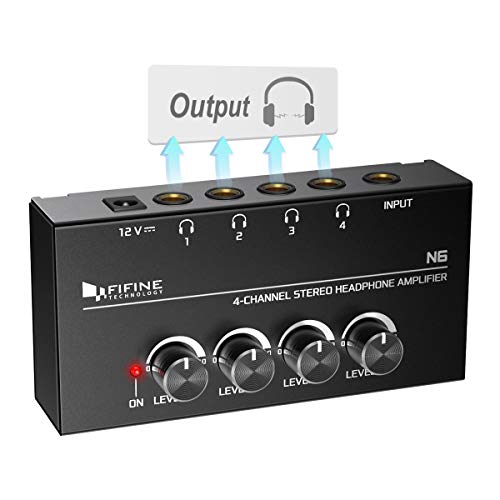
For those needing to connect multiple headphones to a single audio source, the Fifine Headphone Amplifier (N6) stands out with its ability to accommodate up to four headphones simultaneously. This compact, metal stereo amplifier features separate volume knobs for each output, ensuring you won’t experience audio crackle or distortion, even at higher volumes. With four 1/4″ TRS output jacks, it’s perfect for studio sessions or on-stage performances. Durable and built to last, it includes a 12V DC power adapter. Just remember, you’ll need to provide your own TRS or TS cables for connections. Enjoy seamless sound quality!
Best For: Those who need to connect multiple headphones to a single audio source for studio sessions, performances, or collaborative listening experiences.
Pros:
- Separate volume controls for each output allow for customized listening levels.
- Durable metal construction ensures longevity and reliability in various environments.
- Compact design makes it suitable for both studio and stage use without taking up much space.
Cons:
- TRS/TS cables not included, requiring additional purchases for setup.
- Limited to headphone outputs only, meaning it cannot function as a mixer.
- Requires external power via a 12V DC adapter, limiting portability without a power source.
ART HeadAMP4 Eight Output Stereo Headphone Amplifier

With its eight outputs, the ART HeadAMP4 Eight Output Stereo Headphone Amplifier stands out as an excellent choice for musicians and audio engineers who need to provide multiple headphone feeds without sacrificing sound quality. This 4-channel stereo headphone amp features both 1/8-inch and 1/4-inch inputs and outputs, making it versatile for any setup. You’ll appreciate the lower noise and distortion, paired with increased output that guarantees crystal-clear audio. Its custom extruded stackable metal case adds durability and a sleek look, making it ideal for home or project studio applications. This amp is a must-have for serious audio work.
Best For: Musicians and audio engineers who need multiple headphone feeds without compromising sound quality.
Pros:
- Lower noise and distortion for a cleaner audio experience.
- Versatile connectivity with both 1/8-inch and 1/4-inch inputs and outputs.
- Durable and stackable design that fits well in home or project studio setups.
Cons:
- May be overkill for casual listeners needing only one or two headphone outputs.
- Limited to stereo output, which may not suit all audio applications.
- The custom metal case may add extra weight compared to plastic alternatives.
Samson QH4 4-Channel Headphone Amplifier (Restock)

Ideal for musicians, podcasters, and home entertainment enthusiasts, the Samson QH4 4-Channel Headphone Amplifier delivers exceptional sound quality through its four independent channels. Weighing just 1.5 pounds, its compact design makes it perfect for studios, desktops, and even smartphones. You’ll appreciate the individual volume controls for each channel, ensuring everyone hears the mix they want. With a frequency range of 17Hz–47kHz, it provides transparent audio with minimal signal degradation. Users rave about its solid construction and ease of use, making it a great value compared to cheaper alternatives. Overall, it’s an excellent choice for both professional and personal use.
Best For: Musicians, podcasters, and home entertainment enthusiasts looking for a reliable and high-quality headphone amplifier.
Pros:
- Compact and lightweight design suitable for various setups including studios, desktops, and smartphones.
- Individual volume controls for each channel allow for personalized listening experiences.
- Transparent sound quality with minimal signal degradation, making it ideal for multiple headphone types.
Cons:
- May not provide the richest sound quality for amplifying musical instruments.
- Occasional clicks or static during power-up reported by some users.
- Some users might find it less effective for specific high-impedance headphones.
Fosi Audio PH04 4 Channel Headphone Amplifier

The Fosi Audio PH04 4 Channel Headphone Amplifier stands out as an excellent choice for musicians and audio professionals who need to manage multiple headphone outputs efficiently. It powers up to four pairs of headphones simultaneously, allowing each user to control their volume independently—a perfect setup for group sessions. With its ultra-low-noise operational amplifiers, the PH04 delivers outstanding sound quality, even at maximum volume. Its ultra-compact and lightweight design guarantees portability, making it easy to transport for studio or stage use. The package includes everything you need for immediate setup, including a 12V DC power adapter and a user manual.
Best For: Musicians and audio professionals who require a reliable and efficient solution for managing multiple headphone outputs during collaborative sessions.
Pros:
- Simultaneous Use: Powers up to four pairs of headphones at once, making it ideal for group playback or tracking multiple musicians.
- Independent Volume Control: Each user can adjust their own volume, enhancing the listening experience for everyone involved.
- High Sound Quality: Utilizes ultra-low-noise operational amplifiers, ensuring exceptional audio performance even at maximum volume levels.
Cons:
- Limited to Four Headphones: Only supports four pairs of headphones at a time, which may not be sufficient for larger groups.
- Adapter Required for 6.35MM Headphones: Users need an adapter to use 6.35MM headphones, which may not be included in all setups.
- Compact Design May Limit Connectivity Options: The ultra-compact design might restrict accessibility to ports for additional devices or connections.
Factors to Consider When Choosing Headphone Distribution Amplifiers
When you’re choosing a headphone distribution amplifier, there are several key factors to keep in mind. You’ll want to contemplate the number of channels, audio quality performance, and connectivity options available. Additionally, independent volume control and build quality can greatly impact your overall experience.
Number of Channels
Choosing the right number of channels in a headphone distribution amplifier is essential for guaranteeing everyone can enjoy a tailored listening experience. Typically, you’ll find options ranging from 4 to 8 channels. If you’re working in a small studio or need a personal setup, a 4-channel amplifier lets up to four users listen simultaneously. However, for larger groups or complex sessions, an 8-channel model is ideal, as it supports multiple discrete mixes, perfect for band rehearsals or collaborative projects. Each channel usually features independent volume control, allowing users to adjust levels according to their preferences. When selecting an amplifier, think about your specific audio needs to guarantee the number of channels matches your users and intended application.
Audio Quality Performance
Selecting the right number of channels is just the start; audio quality performance plays a significant role in your headphone distribution amplifier’s effectiveness. Look for a high signal-to-noise ratio (SNR)—values up to 105dB promise clearer sound reproduction. Pay attention to distortion levels too; aim for total harmonic distortion (THD) as low as 0.001% for an accurate audio signal without unwanted artifacts. If you plan to drive multiple headphones, make sure the amplifier maintains clarity at high volumes, often achieved with low-noise operational amplifiers. Features like independent volume controls can help manage audio output and reduce crosstalk. Finally, consider compatibility with various headphone impedances, typically ranging from 8Ω to 600Ω, to guarantee the best sound quality across different headphone types.
Connectivity Options Available
Understanding the connectivity options available is essential for maximizing the effectiveness of your headphone distribution amplifier. First, assess the input connections like balanced 1/4″ or unbalanced 1/8″ jacks to guarantee compatibility with your audio sources. Many amplifiers come with multiple output options, accommodating both 3.5mm and 6.35mm headphones, which is great for versatility. Look for models with front and rear output jacks to enhance accessibility and organization during studio sessions or live events. It’s also beneficial to choose amplifiers that support Mono/Stereo modes, catering to your listening preferences. Finally, consider the ability to connect multiple headphones simultaneously through dedicated output channels, which is essential for collaboration, allowing each user to monitor their mix independently.
Independent Volume Control
When you’re working with a headphone distribution amplifier, independent volume control can greatly enhance your audio experience. This feature allows each user to adjust their headphone levels according to personal preferences, which is especially important in collaborative settings like recording studios. You’ll find many amplifiers equipped with separate volume knobs for each output channel, giving you flexibility to cater to varying hearing sensitivities among users. With independent volume control, you can also minimize audio interference and crosstalk, ensuring clear and isolated sound for everyone, even with multiple headphones connected. Overall, amplifiers that offer this feature boost usability and comfort, making them ideal for both casual listening and serious audio applications.
Build Quality and Durability
Build quality and durability are essential factors in choosing a headphone distribution amplifier that can handle the rigors of professional use. You’ll want a robust, built-like-a-tank construction to withstand frequent handling. Look for a metal chassis; it offers superior durability compared to plastic and guarantees longevity. Quality components, including premium operational amplifiers, not only enhance audio performance but also contribute to the overall durability of the amplifier. A compact design can also be beneficial, making it easier to integrate into studio consoles or mobile racks without sacrificing sturdiness. Plus, user-friendly features like smooth volume knobs and a well-organized layout can greatly improve your experience while maintaining a solid build. Prioritize these aspects for a reliable choice.
Size and Portability
Choosing the right headphone distribution amplifier involves more than just build quality; size and portability play a significant role, especially for professionals on the go. Compact models, like the Mackie HM-4, measure just 4.3 x 2.3 x 2 inches and weigh only 8 ounces, making them perfect for mobile setups. If you need something rack-mountable, consider options like the 8-Channel Headphone Mixing Distribution Amplifier, designed to fit standard studio racks. Lightweight amplifiers, such as the Fosi Audio PH04 at 1.1 pounds, are also great for frequent movers. Don’t forget about design layout; a compact design with back panel connections can minimize cable clutter, making transport easier. Smaller amplifiers, like the LZSIG 4 Channel, are ideal for tight spaces too.
Compatibility With Headphones
Guaranteeing compatibility with your headphones is essential for getting the best performance from a headphone distribution amplifier. First, check the impedance range; some amplifiers are optimized for low impedance (16-80Ω), while others can handle higher loads (up to 600Ω). Next, look at the headphone jacks available; having both 1/8 inch (3.5mm) and 1/4 inch (6.35mm) connectors increases your options. Independent volume control for each output channel is also important, as it accommodates different headphone sensitivities. If you plan to share the amplifier, verify it can handle multiple headphone types simultaneously. Finally, verify the output power specifications (in mW) to make sure it can drive your headphones effectively without distortion, especially at higher volumes.
Power Supply Requirements
When selecting a headphone distribution amplifier, power supply requirements play a significant role in ensuring reliable performance. Most amplifiers operate on a DC power supply, typically ranging from 12V to 15V, which is essential for peak functionality. Pay attention to the wattage rating, as it determines how many headphones can be driven simultaneously without distortion. Check if the amplifier includes a power adapter or requires a separate purchase, impacting both setup convenience and overall cost. Some models offer built-in overload protection to safeguard against power surges, extending the lifespan of your equipment. Finally, consider the efficiency of the power supply; higher efficiency means less heat generation and lower energy consumption, enhancing your overall experience.