When you’re looking to share audio seamlessly, the right headphone distribution system can make all the difference. Whether you’re in a studio setting or enjoying music at home, choosing from the best options available can enhance your experience. From high-performance amplifiers to compact splitters, there’s a variety to take into account. But what specific features should you prioritize to guarantee you pick the perfect system for your needs? Let’s explore the top contenders.
8-Channel Headphone Mixing Distribution Amplifier

If you’re a music producer or sound engineer looking for a reliable solution for headphone monitoring, the 8-Channel Headphone Mixing Distribution Amplifier is your go-to choice. This high-power amplifier supports both mono and stereo modes, providing 16 headphone outputs for versatile monitoring. You can easily manage up to eight discrete mixes simultaneously, thanks to independent volume controls and dual input options. Its standard 1U rack-mount design guarantees seamless integration into your studio setup. With premium components delivering low distortion and high signal-to-noise ratios, you’ll enjoy crisp sound quality every time. Choose this amplifier for durable and flexible audio sharing.
Best For: Music producers, sound engineers, and audio professionals seeking a reliable and high-quality headphone monitoring solution.
Pros:
- High-Power Output: Supports up to 16 headphone outputs with independent volume control for each channel.
- Versatile Connectivity: Dual input modes (Mono/Stereo) allow for flexible monitoring options.
- Durable Build: Standard 1U rack-mount design and robust structure ensure long-lasting performance.
Cons:
- Weight: At 6.93 pounds, it may be heavier than some portable options.
- Limited to Wired Connectivity: No wireless options available for headphone connections.
- Higher Price Point: Professional-grade features may come at a more premium price compared to basic models.
Fosi Audio PH05 5-Channel Headphone Splitter Amplifier

The Fosi Audio PH05 5-Channel Headphone Splitter Amplifier is perfect for anyone needing to share audio among multiple listeners, whether in a music studio, during a podcast session, or while watching TV with family. With its one-in-five-out design, you can connect up to five headphones simultaneously. Each channel delivers impressive sound with up to 310mW@32Ω, and independent volume controls let you customize the experience. Its robust all-aluminum build guarantees durability, while an SNR of 105dB assures crystal-clear audio. Users rave about its sound fidelity and ease of use, making it a top choice for both casual and professional audio sharing.
Best For: Anyone looking to share audio among multiple listeners, such as in music studios, podcast sessions, or family TV viewing.
Pros:
- Excellent sound fidelity with an SNR of 105dB and minimal distortion.
- Independent volume controls for each channel allow for personalized listening experiences.
- Durable all-aluminum construction ensures long-lasting use.
Cons:
- Limited amplification performance for low-impedance headphones.
- Requires manual power-on, which may be inconvenient for some users.
- Some users may find the power adapter necessary for operation a drawback.
Fosi Audio PH04 4 Channel Headphone Amplifier

Fosi Audio PH04 is perfect for audio engineers and musicians who need a reliable solution for group playback or tracking sessions. This 4-channel headphone amplifier lets you power up to four pairs of headphones at once, making it great for collaborative work. Each channel features independent volume control, so everyone can find their sweet spot. You’ll appreciate the high sonic quality, even at max volume, thanks to its ultra-low-noise operational amplifiers. Plus, its compact and lightweight design makes it easy to transport. The included 12V DC power adapter guarantees you’re ready to go right out of the box.
Best For: Audio engineers and musicians seeking a dependable solution for group playback or tracking sessions.
Pros:
- Each channel offers independent volume control for customized listening experiences.
- Maintains high sonic quality even at maximum volume with ultra-low-noise operational amplifiers.
- Compact and lightweight design allows for easy transport and setup in various environments.
Cons:
- Requires an adapter for 6.35MM headphones, which may not be included in all setups.
- Limited to powering only four pairs of headphones simultaneously, which may not suffice for larger groups.
- May not have advanced features found in more expensive headphone amplifiers, limiting its versatility.
Behringer DS2800 Professional 2-Input 8-Output Distribution Splitter

For those in need of a reliable audio distribution solution, the Behringer DS2800 Professional 2-Input 8-Output Distribution Splitter stands out with its dual mode and independent level controls. Weighing just 3.5 pounds and measuring 20.75 x 9.88 x 4.13 inches, it’s perfect for mobile gigs and stage setups. With eight channels, gold-plated XLR connectors, and ultra-low noise performance, you’ll enjoy clean sound without daisy chaining issues. Users appreciate its flexibility and ease of setup. Just keep in mind some might find the level knobs tricky for achieving unity gain, but overall, it’s a solid choice for audio sharing.
Best For: Audio professionals and musicians seeking a reliable and flexible audio distribution solution for live performances and studio setups.
Pros:
- Ultra-low noise performance ensures clean sound quality without interference.
- Independent level controls allow for precise volume adjustments on each channel.
- Lightweight and compact design makes it ideal for mobile gigs and easy to transport.
Cons:
- Some users may find the level knobs difficult to set accurately for unity gain, potentially complicating monitoring setups.
- Requires 48V power for optimal functionality, which may necessitate additional equipment.
- Limited to indoor usage, which may restrict its versatility in certain environments.
Bolanle PH800 8-Channel Headphone Amplifier

Offering versatility and high-quality sound, the Bolanle PH800 8-Channel Headphone Amplifier is perfect for musicians and audio professionals who need reliable audio sharing in a compact form. With 16 output ports, you can connect up to 16 headphones using 3.5mm and 6.35mm jacks without worrying about interference. It supports high impedance headphones up to 600 ohms, ensuring excellent performance. The Mono/Stereo switch lets you tailor audio to your needs, while the 7-color breathing light enhances the atmosphere during live sessions. Whether you’re recording, composing, or performing, the PH800 delivers an exceptional audio experience.
Best For: Musicians and audio professionals seeking a reliable and versatile headphone amplifier for sharing high-quality audio in both personal and professional settings.
Pros:
- Versatile Connectivity: Features 16 output ports (8 x 3.5mm and 8 x 6.35mm) for connecting various headphone types without interference.
- High Impedance Support: Capable of driving high impedance headphones up to 600 ohms, ensuring excellent sound quality.
- Enhanced User Experience: Includes a Mono/Stereo switch and a 7-color breathing light for an engaging live atmosphere.
Cons:
- Limited to 8-Channel Output: May not suffice for larger groups needing more than 16 headphone connections simultaneously.
- Requires External Power Supply: Dependent on a DC 12V 2A power supply, which may limit portability.
- Compact Design: While space-saving, it may feel cramped for users with larger connectors or cables.
4 in 1 Out AUX 3.5mm Stereo Audio Switch Selector Splitter Box

If you’re looking to simplify your audio setup without compromising quality, the TENEALAY 4 in 1 Out AUX 3.5mm Stereo Audio Switch Selector Splitter Box is perfect for you. This compact device lets you connect up to four audio sources and switch seamlessly between them. Its sturdy aluminum chassis guarantees durability, while the plug-and-play design eliminates the need for a power supply. Users appreciate the clear, full bass and minimal audio quality loss. Although some notice a slight popping sound when switching inputs, most find it incredibly convenient for managing multiple devices without hassle.
Best For: Those seeking an efficient and compact solution for managing multiple audio devices without sacrificing sound quality.
Pros:
- Durable construction: Solid aluminum CNC chassis ensures longevity and robustness.
- Easy to use: Plug-and-play design allows for simple setup and hassle-free switching between devices.
- High audio quality: Users report clear sound with minimal quality loss, making it ideal for audiophiles.
Cons:
- Slight popping sound: Some users experience a minor popping noise when switching inputs.
- No amplification: The passive volume control may not suffice for users needing significant volume adjustments.
- Requires additional cables: Compatibility with devices may necessitate extra cables or adapters, potentially complicating setups.
Fifine 4 Channels Headphone Amplifier (N6)
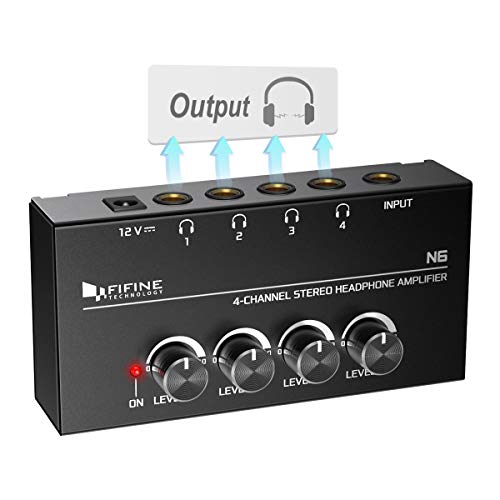
The Fifine 4 Channels Headphone Amplifier (N6) is perfect for musicians and audio professionals who need to share a single stereo source among multiple users. This compact, metal amplifier features four 1/4″ TRS headphone outputs, each with individual volume controls, ensuring clear audio without crackle or distortion. It’s built tough for studio or stage use, promoting durability and longevity. Whether you’re connecting to computers or stereo amplifiers, the N6 makes sharing easy. Just remember, you’ll need to acquire TRS or TS cables separately. With the included 12V DC power adapter, you’re all set for seamless audio experiences.
Best For: Musicians and audio professionals looking for a reliable way to share a single stereo source among multiple headphones.
Pros:
- Durable metal construction ensures longevity and reliability for both studio and stage use.
- Individual volume controls for each output allow for personalized listening levels without audio distortion.
- Compact design makes it easy to transport and set up in various audio environments.
Cons:
- TRS or TS cables are not included, requiring an additional purchase for full functionality.
- Limited to four headphone outputs, which may not be sufficient for larger groups.
- Not a mixer, so it cannot control or combine multiple audio sources.
ART HeadAMP4 Eight Output Stereo Headphone Amplifier

For those seeking a reliable solution to share audio among multiple listeners, the ART HeadAMP4 Eight Output Stereo Headphone Amplifier stands out with its eight output channels. This 4-channel stereo headphone amp features both 1/8-inch and 1/4-inch inputs and outputs, making it versatile for various setups. You’ll appreciate its lower noise and distortion levels, ensuring a clean listening experience. The amplifier’s increased output delivers powerful sound to each headphone. Plus, its custom extruded stackable metal case not only looks great but also enhances durability. It’s an ideal choice for your home or project studio applications.
Best For: Audio professionals and enthusiasts looking for a reliable headphone amplifier to accommodate multiple listeners in home or project studio settings.
Pros:
- Lower noise and distortion levels for a cleaner audio experience.
- Versatile input/output options with both 1/8-inch and 1/4-inch connections.
- Durable and stylish design with a custom extruded stackable metal case.
Cons:
- Limited to 4-channel stereo output, which may not suffice for larger setups.
- No built-in EQ or sound shaping features, which could limit customization.
- Price may be higher than simpler headphone amplifiers on the market.
Mackie HM-4 Headphone Amplifier Mixer Accessory

Designed with collaboration in mind, the Mackie HM-4 Headphone Amplifier Mixer is perfect for studios and home setups where multiple users need to listen simultaneously. This ultra-compact unit features a 1/4” stereo input and four 1/4” headphone outputs, each with individual level controls. Weighing only 8 ounces, it’s built-like-a-tank, ensuring durability and a sleek, professional look. You’ll enjoy crystal-clear audio amplification, preserving sound quality while supporting various headphone impedances. With an impressive 4.6-star rating from nearly 1,900 users, it’s a trusted choice for both casual listeners and professional audiophiles alike—ideal for tracking, playback, and collaborative projects.
Best For: The Mackie HM-4 Headphone Amplifier Mixer is best for music producers, artists, and audiophiles who require a reliable solution for collaborative listening in studios or home setups.
Pros:
- Ultra-compact design makes it easy to integrate into any workspace.
- Individual level controls for each output allow for customized listening experiences.
- High-quality audio output with minimal noise ensures an enjoyable listening experience.
Cons:
- Some users report static or cross-talk noise when using multiple outputs.
- Minor design layout issues with jacks and dials can affect usability.
- Occasional defects, such as units not powering up, have been noted.
Xvive PX Portable 3-Channel Personal Mixer and Headphone Amplifier System

Musicians seeking a personalized in-ear monitoring experience will find the Xvive PX Portable 3-Channel Personal Mixer and Headphone Amplifier System an ideal choice. This system lets you mix up to three audio sources with dedicated volume controls, ensuring you get the sound just right. You can enhance your stereo image using flexible channel panning through internal DIP switches. Plus, it’s expandable, allowing you to daisy-chain multiple units for customized mixes. Powered by Power over Ethernet or 2 AAA batteries, it’s convenient for both stage and studio. The included components make setup quick and hassle-free.
Best For: Musicians who require customizable in-ear monitoring and wish to mix multiple audio sources seamlessly.
Pros:
- Flexible audio control with dedicated volume controls and channel panning for a tailored listening experience.
- Expandable system allows for daisy-chaining multiple units, providing personalized mixes for each band member.
- Versatile power options including Power over Ethernet and battery operation for convenience in various setups.
Cons:
- Requires additional batteries for operation if not using Power over Ethernet, which may not always be readily available.
- Limited to three audio sources, which may not meet the needs of larger setups or more complex monitoring requirements.
- Weight may be a factor for some users, as it weighs 2.53 pounds, potentially affecting portability.
Factors to Consider When Choosing Headphone Distribution Systems
When choosing a headphone distribution system, you need to take into account several key factors. The number of outputs, channel control options, and impedance compatibility can greatly impact your setup. Additionally, think about power supply requirements and the build quality to guarantee durability and performance.
Number of Outputs
Choosing the right number of outputs in a headphone distribution system is essential for guaranteeing everyone can participate comfortably in group monitoring situations, like recording sessions or live performances. You’ll find systems that support anywhere from 4 to 16 headphone outputs, so think about your specific needs. More outputs usually mean you’ll need a more powerful amplifier to avoid distortion, so verify it can handle the load. Additionally, look for systems that offer independent volume controls for each output; this allows users to tailor their listening experience. Also, consider headphone impedance—choose a system that accommodates a wider range to support different headphone types among users. This flexibility guarantees everyone stays engaged and satisfied with the audio quality.
Channel Control Options
With multiple headphone outputs set up, you’ll want to contemplate the channel control options that can enhance your audio sharing experience. Look for systems with independent channel controls, allowing you to adjust the volume for each headphone separately—perfect for collaborative environments. Dual input modes, like Mono and Stereo, add versatility in audio routing and mixing. High-power amplifiers with independent control can handle headphone loads as low as 8Ω, ensuring compatibility with various headphone types. Additionally, dedicated master input volume controls let you manage overall output while keeping individual settings intact. Systems with LED meters offer real-time signal level monitoring for each channel, providing better control during audio sessions. Prioritize these features for seamless audio experiences!
Impedance Compatibility
Understanding impedance compatibility is vital for achieving the best audio experience with headphone distribution systems. Impedance measures the resistance headphones offer to electrical signals, and matching it to your headphone amplifier is essential. Most amplifiers support a range of impedance values—some can drive loads as low as 8Ω, while others handle high-impedance headphones up to 600Ω. If you use headphones with an impedance too high for the amplifier, you risk low volume levels. Conversely, pairing low-impedance headphones with a high-powered amplifier can cause distortion or even damage. Many professional audio amplifiers feature independent volume controls for each channel, helping you manage different impedance headphones effectively within your setup for ideal sound quality.
Power Supply Requirements
When selecting a headphone distribution system, it’s vital to evaluate the power supply requirements, as they can greatly impact performance. Different models have varying needs; some might require specific voltage levels like 12V AC adapters for peak operation. Verify your power supply can deliver enough wattage for the number of channels you’re using—multiple outputs may demand more power to maintain audio quality. While some systems offer battery options for portability, others depend on stable AC power. Additionally, consider models with built-in power protection features to guard against voltage fluctuations. Understanding these requirements will help you avoid problems like insufficient amplification, which can lead to sound degradation or distortion when using several headphones at once.
Build Quality and Design
Choosing a headphone distribution system means paying close attention to build quality and design, as these factors directly affect durability and usability. Look for systems made from durable materials like all-aluminum alloy or custom extruded metal cases; they resist wear and tear. Consider the size and weight—compact, lightweight designs make portability easier and fit well in studio setups or live sound environments. Rack-mountable options are a plus, as standard 1U designs maximize space efficiency. User-friendly features, like smooth volume knobs and clear labeling, enhance your experience. Finally, assess stability; units with anti-slip foot pads or robust construction minimize movement, ensuring consistent performance during operation. Prioritize these elements for the best audio-sharing experience.