If you’re on the lookout for a MIDI keyboard that meets your musical needs, you’re in the right place. M-Audio offers a diverse lineup that caters to various preferences, whether you need portability or a full piano feel. Each model has unique features designed to enhance your creativity and workflow. Let’s explore our top picks for 2025 and find the perfect match for your setup.
M-AUDIO, 49-Key Midi Controller, (Keystation MK3)

The M-Audio Keystation MK3 is an excellent choice for musicians who crave a natural playing experience, thanks to its 49 full-size velocity-sensitive keys that capture every nuance of your performance. You’ll appreciate the volume fader and transport buttons, making software control seamless. The ergonomic pitch and modulation wheels, along with octave buttons and sustain pedal input, add expressiveness to your playing. Plus, the plug-and-play connectivity simplifies setup on both Mac and PC, while iOS compatibility offers added versatility. With a compact design and customizable controls, it’s perfect for any desk, studio, or stage. Enjoy the included premium software suite for enhanced creativity!
Best For: Musicians and producers seeking a versatile, user-friendly MIDI controller that offers a natural playing experience.
Pros:
- Full-size velocity-sensitive keys provide an authentic feel for expressive performances.
- Plug-and-play connectivity allows for easy setup on both Mac and PC without the need for additional drivers.
- Compact design makes it ideal for use in various settings, from home studios to live performances.
Cons:
- Limited control options compared to more advanced MIDI controllers with additional knobs and pads.
- Requires an adapter for compatibility with iOS devices, which is sold separately.
- No built-in display for easier navigation of settings and parameters.
M-AUDIO, 32-Key Midi Controller, (KEYSTATION MINI MK3)

If you’re a musician on the go, the M-AUDIO 32-Key Midi Controller (Keystation Mini MK3) is an excellent choice thanks to its portable design and lightweight build. Weighing just 1 pound, it features 32 velocity-sensitive keys that respond to your touch. With pitch bend buttons, octave controls, and a volume knob, you can easily express your creativity. Plus, it’s compatible with both Mac and PC, requiring no extra drivers. The included MPC Beats software and lessons from Melodics make it user-friendly. Just keep in mind that Windows users might encounter some setup challenges. Overall, it’s a fantastic tool for electronic music production.
Best For: Musicians seeking a portable MIDI controller for music production, particularly those using Mac systems.
Pros:
- Compact size makes it easy to transport and use anywhere.
- Seamless compatibility with Mac systems, allowing for immediate use.
- Comes with useful software and lessons that enhance the learning experience.
Cons:
- Keys may feel fragile, impacting durability during transport.
- Windows users may experience setup challenges and inconsistent performance.
- Some users report issues with USB compatibility that could hinder functionality.
M-AUDIO Oxygen Pro Mini 32-Key USB MIDI Keyboard Controller

Ideal for musicians on the go, the M-AUDIO Oxygen Pro Mini 32-Key USB MIDI Keyboard Controller packs powerful features into a compact design. With 32 velocity-sensitive semi-weighted mini keys, it’s perfect for music production, livestreaming, and performances. This USB-powered controller auto-maps to popular DAWs like Ableton Live and Logic, making it easy to integrate into your setup. The OLED screen simplifies DAW map selection, while the 8 RGB backlit drum pads enhance your beat-making experience. Enjoy added control with assignable knobs and buttons, plus features like Smart Chord and an Arpeggiator to elevate your music creation process.
Best For: Musicians and producers looking for a portable MIDI keyboard controller that integrates seamlessly with popular DAWs for music production and performances.
Pros:
- Compact design makes it easy to transport and use in various settings.
- Auto-mapping feature simplifies setup with major DAWs and plugins.
- Versatile production features, including RGB backlit drum pads and Smart Chord functionality.
Cons:
- Mini keys may not be suitable for users who prefer full-sized keys for playing.
- Limited number of keys may be restrictive for complex compositions.
- Some users may find the OLED screen small for detailed navigation.
M-AUDIO Oxygen MKV 49 Key USB MIDI Keyboard Controller

For musicians looking to enhance their creativity without overwhelming complexity, the M-AUDIO Oxygen MKV 49 Key USB MIDI Keyboard Controller stands out with its 49 velocity-sensitive keys and smart features. You’ll appreciate its 8 backlit drum pads, arpeggiator, and assignable knobs and faders, which give you hands-on control over your music. The included software, like MPC Beats and Ableton Live Lite, guarantees smooth integration with your DAW. With a solid build and easy setup, this controller is perfect for beginners. Just be mindful of its size and occasional velocity response issues. Overall, it’s an excellent choice for your musical journey.
Best For: Beginners and casual musicians looking for a user-friendly MIDI keyboard controller with essential features for music production.
Pros:
- Solid build quality that enhances durability and longevity.
- Easy setup and plug-and-play functionality for a hassle-free experience.
- Includes useful software and virtual instruments for enhanced creativity.
Cons:
- Inconsistent velocity response on keys may affect performance.
- Size may not fit all studio setups comfortably.
- Some advanced users might find it lacking in features compared to higher-end models.
M-AUDIO Oxygen Pro 61 Key USB MIDI Keyboard Controller
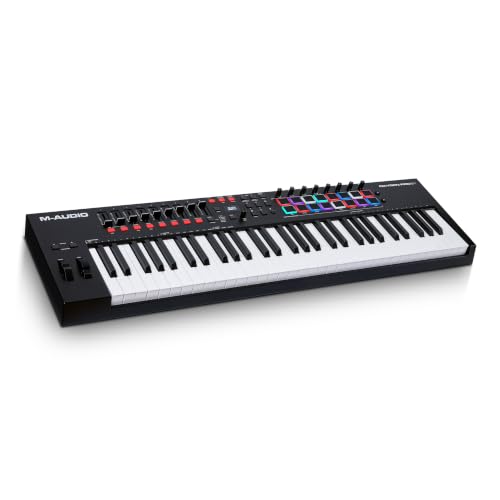
The M-AUDIO Oxygen Pro 61 Key USB MIDI Keyboard Controller stands out with its 61 velocity-sensitive, semi-weighted keys, making it perfect for musicians who crave expressive playability. You’ll love the 16 RGB backlit drum pads for beat production and clip launching, along with 8 assignable knobs and 9 faders for total control. Its Native Kontrol Standard integration simplifies working with Native Instruments, while smart features like Auto-mapping and built-in arpeggiator enhance your creativity. With powerful software included, it’s an excellent choice for both beginners and pros, providing exceptional value for your music production needs.
Best For: The M-AUDIO Oxygen Pro 61 Key USB MIDI Keyboard Controller is best for both beginners and experienced musicians looking for a versatile and expressive MIDI controller for live performance and studio work.
Pros:
- Superior build quality and responsive keys enhance playability.
- Versatile control options with 16 drum pads, 8 knobs, and 9 faders.
- Includes powerful software, making it great value for music production.
Cons:
- Some users experience difficulty syncing tempo with Logic.
- Drum pad programming can be cumbersome in Logic.
- Basic pitch and modulation wheels may not meet all users’ expectations.
M-Audio Hammer 88 USB MIDI Keyboard Controller

If you’re a pianist looking for an authentic playing experience, the M-Audio Hammer 88 USB MIDI Keyboard Controller stands out with its 88 fully-weighted, hammer-action keys that closely mimic the feel of an acoustic piano. Weighing 38.5 pounds, it’s sturdy yet portable. The controller features pitch bend, modulation, and octave controls, along with fully assignable MIDI buttons for seamless integration with your favorite software. Plus, it includes a free 3-month subscription to Skoove for interactive lessons. While some users note a learning curve, the realistic feel and solid build make it a top choice for serious musicians.
Best For: Serious musicians and pianists seeking an authentic piano playing experience with a MIDI controller.
Pros:
- Realistic Feel: 88 fully-weighted, hammer-action keys replicate the touch of an acoustic piano.
- Versatile Controls: Includes pitch bend, modulation, and fully assignable MIDI buttons for seamless integration with music software.
- Learning Support: Comes with a free 3-month subscription to Skoove for interactive piano lessons.
Cons:
- Weight: At 38.5 pounds, it may be heavy for some users to transport.
- USB Connection Issues: Some users report looseness in the USB jack, which can be mitigated by using a different cable.
- Learning Curve: Initial software setup may present challenges for some users.
Akai Professional MPK Mini MK3 USB MIDI Keyboard Controller

Compact and lightweight, the Akai Professional MPK Mini MK3 is perfect for musicians who need a portable MIDI keyboard without sacrificing functionality. With 25 velocity-sensitive mini keys and 8 backlit drum pads, you can easily program beats and control virtual instruments. The 8 assignable knobs enhance mixing and plugin control, while the built-in arpeggiator adds creative flair. Plus, its USB compatibility guarantees seamless integration with any DAW on Windows or Mac. Weighing just 2 pounds, it’s ideal for traveling musicians. Enjoy the included MPC Beats software and explore your creativity with additional sound packs from Akai’s store.
Best For: The Akai Professional MPK Mini MK3 is best for beginners and young musicians looking for a portable and affordable MIDI keyboard to explore music production.
Pros:
- Compact and lightweight design makes it easy to transport for on-the-go music creation.
- Versatile features including 25 velocity-sensitive mini keys, 8 backlit drum pads, and 8 assignable knobs for enhanced control.
- Comes bundled with MPC Beats software and virtual instruments, providing an excellent starting point for music production.
Cons:
- Some users experience a slight delay with certain programs, which may affect performance.
- Initial setup and customization may have a learning curve for new users.
- Additional sound packs may require further investment for expanded creative options.
M-Audio SP-2 Universal Sustain Pedal for MIDI Keyboards and Digital Pianos

For musicians seeking a reliable and versatile sustain pedal, the M-Audio SP-2 Universal Sustain Pedal stands out as an essential companion for MIDI keyboards and digital pianos. Its classic design features a chrome foot pedal that offers natural, realistic action. You’ll appreciate the conveniently located polarity switch, ensuring compatibility with all electronic keyboards. Built to last, its robust, heavy-duty mechanism guarantees reliability, while the lightweight, ultra-compact design makes it easy to transport. Plus, specially designed rubber pads on the underside keep it stable during play. With a 6-foot cable and a 1-year warranty, it’s a solid investment for any musician.
Best For: Musicians looking for a reliable and versatile sustain pedal compatible with various MIDI keyboards and digital pianos.
Pros:
- Classic design with a chrome foot pedal for realistic pedal action.
- Convenient polarity switch for compatibility with all electronic keyboards.
- Lightweight and ultra-compact design, making it easy to transport.
Cons:
- May not be as durable as higher-end models for heavy use.
- Limited features compared to some advanced sustain pedals.
- The 6-foot cable length may be short for certain setups.
Arturia KeyLab Essential mk3 — 61 Key USB MIDI Keyboard Controller

The Arturia KeyLab Essential mk3 stands out as an exceptional choice for musicians seeking a versatile 61-key MIDI keyboard controller that seamlessly integrates with major DAWs like Ableton Live and Logic Pro X. Weighing just 6.78 pounds, its sleek design enhances portability. With creative features like Scale Mode and an Arpeggiator, you can easily explore new sounds. The included Analog Lab V software offers 2000 presets, while RGB-backlit pads and assignable faders guarantee an intuitive experience. Users rave about its solid build quality and responsive keys, making it a fantastic option for both beginners and pros alike.
Best For: Musicians and producers looking for a lightweight, versatile MIDI keyboard controller with deep software integration and creative features.
Pros:
- Intuitive controls with RGB-backlit pads and assignable faders enhance workflow.
- Solid build quality and responsive keys make it suitable for both beginners and professionals.
- Comprehensive software package includes 2000 presets and compatibility with major DAWs.
Cons:
- Some users may find the included USB-C power cord requires additional adapters.
- Product dimensions may be inaccurately listed, leading to potential purchase confusion.
- A few users have reported minor frustrations with software integration setup.
Akai Professional MPK Mini Plus USB MIDI Keyboard Controller

If you’re a musician looking for a portable yet powerful MIDI keyboard, the Akai Professional MPK Mini Plus is designed to meet your needs. With 37 responsive mini keys and 8 MPC pads, it offers dynamic control for your music. Its lightweight, compact design makes it easy to transport, while advanced connectivity options like MIDI/CV/Gate I/O let you integrate with modular gear. You’ll also appreciate the bundled MPC Beats software, packed with sounds and plugins. Despite a steep learning curve and smaller key size, this keyboard delivers exceptional performance and versatility, making it a top choice for creatives on the go.
Best For: Musicians and producers seeking a compact and versatile MIDI keyboard for on-the-go music creation and performance.
Pros:
- Lightweight and portable design, making it easy to transport for live performances or studio sessions.
- Advanced connectivity options, including MIDI/CV/Gate I/O, allowing integration with various gear and instruments.
- Bundled MPC Beats software provides a wealth of sounds and plugins, enhancing creative possibilities.
Cons:
- Smaller mini keys may be limiting for users accustomed to full-sized keyboards, affecting extensive performances.
- Requires a computer connection for MIDI I/O functionality, limiting standalone use.
- Some users report a steep learning curve with the bundled software, which can be intimidating for beginners.
Factors to Consider When Choosing M Audio Midi Keyboards
When you’re choosing an M-Audio MIDI keyboard, several factors can make all the difference. Consider the key count and size that best fits your playing style, along with the portability and weight for your setup. Don’t forget to check software compatibility, control features, and key sensitivity type to guarantee it meets your needs.
Key Count and Size
Choosing the right key count and size for your M-Audio MIDI keyboard is essential for your musical experience. MIDI keyboards usually range from 25 to 88 keys, with common sizes like 32, 49, and 61. If you’re a traditional piano player, full-size keys offer a familiar feel, while mini keys are perfect for portability. Keep in mind that velocity-sensitive keys enhance expressiveness, allowing for dynamic play across genres. Fewer keys might limit your ability to perform complex pieces without octave shifting, so consider your playing style. Ultimately, the key size and sensitivity can greatly impact your playability, so choose what feels best for your needs, whether that’s the tactile feedback of full-sized keys or the convenience of mini keys.
Portability and Weight
Portability and weight are essential factors for musicians who need to transport their M-Audio MIDI keyboards frequently. Look for portable models that weigh less than 6.72 pounds, making them easy to carry during gigs or rehearsals. Compact designs, as thin as 0.72 inches, allow for convenient storage in tight spaces, like small studios or crowded stages. Many MIDI controllers utilize lightweight materials, balancing portability with functionality. If you’re traveling or performing quickly, consider smaller key counts, such as 32 or 37 keys, which often lead to lighter keyboards. Finally, check the dimensions to verify your chosen keyboard slides effortlessly into your backpack or gig bag, making your setup process smoother and more efficient.
Software Compatibility
As you explore M-Audio MIDI keyboards, understanding software compatibility is crucial for your music production workflow. Most M-Audio keyboards offer seamless plug-and-play functionality with both Mac and Windows, meaning you won’t need extra drivers. Many models come bundled with popular software like MPC Beats and Ableton Live Lite, which enhances your production capabilities right out of the box. Their performance features, including assignable knobs and pads, auto-map to mainstream DAWs, simplifying your setup. Additionally, with the right adapters, you can connect these keyboards to iOS devices, making mobile music production easy. However, keep in mind that Windows users may occasionally need to tweak settings for peak performance. Choose wisely to guarantee a smooth experience!
Control Features Available
After getting a handle on software compatibility, it’s time to contemplate the control features available on M-Audio MIDI keyboards. Many of these keyboards come with velocity-sensitive keys, capturing the nuances of your playing dynamics. You’ll find pitch bend and modulation wheels, along with octave up/down buttons, enhancing your expressive capabilities. Some models offer assignable knobs, faders, and buttons, allowing you to customize control over virtual instruments and DAWs. Integrated transport and directional buttons make accessing essential software functions a breeze. If you’re into beat production, certain MIDI controllers even have backlit drum pads and note repeat functionality, perfect for triggering samples and creating rhythms. These features can greatly enhance your music production experience.
Key Sensitivity Type
When choosing an M-Audio MIDI keyboard, key sensitivity type plays an essential role in your playing experience. You’ll find options like velocity-sensitive keys that respond to how hard you play, making them perfect for expressive performances. If you’re shifting from an acoustic piano, consider semi-weighted keys, which balance responsiveness and a natural feel. They give you a bit of resistance without being too heavy. On the other hand, fully-weighted keys mimic the authentic action of an acoustic piano, providing the most resistance and enhancing your overall experience. Understanding these key sensitivity types can greatly impact your playing technique and satisfaction with the instrument, so choose wisely based on your personal style and needs.
Connectivity Options
Choosing the right M-Audio MIDI keyboard goes beyond just key sensitivity; connectivity options are equally important for optimizing your music production setup. Look for keyboards with plug-and-play connectivity to simplify your setup process with Mac or PC systems. USB connectivity is a must, as it’s the standard for most computers and integrates easily with Digital Audio Workstations (DAWs).
If you plan to produce music on the go, check for compatibility with iOS devices through adapters. Consider models that offer MIDI outputs or CV/Gate connections to connect with external hardware synthesizers and modular setups. Guarantee the keyboard’s connectivity options align with your existing equipment and workflow, especially if you want advanced features like auto-mapping to popular DAWs for seamless operation.
Build Quality and Design
While you might focus on features like key sensitivity and connectivity, build quality and design are just as essential when selecting an M-Audio MIDI keyboard. A sturdy construction guarantees your keyboard can endure frequent use in both studio and live settings, so look for robust materials. If you’re often on the move, consider compact and lightweight models, some weighing around 1 pound. Key action varies too; you can choose from velocity-sensitive mini keys to fully-weighted hammer-action keys, catering to different playing styles. Ergonomic features, like well-placed knobs and faders, enhance usability, promoting efficient workflow during long sessions. Finally, don’t overlook aesthetics—sleek designs with customizable RGB lighting can make your setup visually appealing.
Price and Value
Finding the right M-Audio MIDI keyboard involves balancing price and value to guarantee you get the most for your investment. Prices range from budget-friendly models like the Keystation Mini MK3 at around $119 to premium options like the Hammer 88, costing about $499. Assess value by looking at included software bundles; many keyboards come with MPC Beats and virtual instruments, enhancing their appeal. Customer ratings also matter—keyboards like the Oxygen MKV boast an impressive 4.6 out of 5 stars. Consider the keyboard’s size and features too; compact models offer portability at lower prices, while larger ones provide versatility. Finally, check warranty and customer support options, as a longer warranty can justify a higher initial cost.