A good studio desk should do more than hold your gear. For music producers, it should keep cables under control, support the right ergonomics, and make room for monitors, controllers, and outboard equipment.
These 10 picks focus on music production desks with cable management so you can build a cleaner, more efficient workspace without sacrificing stability or storage.
Best 10 Music Production Desks with Cable Management Picks for 2026
Compact Rack-Ready Layout
Headliner Sunset Production Desk

- 8U rack space for studio hardware
- Rear cable routing and floor path
- Tray fits full-size 61-note controllers
Best For: Home studios needing rack storage and tidy cable routing
Built-In Power Convenience
Armocity Studio Desk with Outlets

- 3 USB ports and 2 built-in outlets
- Velcro tape helps organize wires
- 47-inch shelf fits two monitors
Best For: Small studios that want built-in charging and simple cable control
Large Multi-Storage Station
Bowery Hill Contemporary Music Desk

- 6 open compartments plus hutch shelf
- Cord management system included
- Wheels for easier repositioning
Best For: Larger setups that need storage and mobility
Adjustable-Height Studio Pick
Music Studio Desk Piano Desk with Keyboard Tray

- 4-level adjustable keyboard tray
- 59-inch desktop for studio gear
- Under-desk cable management
Best For: Keyboard players and home producers needing a roomy desk with cable routing
Compact Rolling Setup
Acme Suitor Music Recording Desk

- Keyboard tray and shelf storage
- Caster wheels for easy repositioning
- Includes headset hook and cup holder
Best For: Smaller studios that need a movable desk with basic organization
Organization-Focused Creator Desk
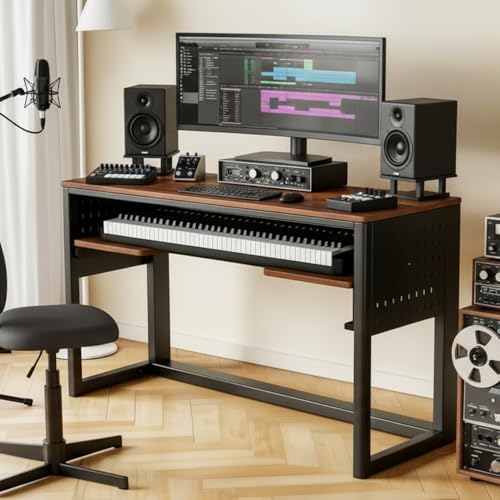
- Sliding tray for 61-key MIDI keyboards
- Pegboard side panel and headphone hook
- Cable management included
Best For: Creators who want a tidy workstation for recording, mixing, and streaming
Winged Studio Desk Pick
72" Gaming Desk with Keyboard Tray

- Two cable grommets and power socket holders
- Wing-shaped 72-inch desktop with monitor shelves
- Pull-out keyboard tray and accessory hooks
Best For: Producers and streamers who need a large, organized desk
Storage-Heavy Studio Desk
72" Music Desk with Cord Management

- Cord management with six open storage compartments
- Pull-out keyboard tray and long upper shelf
- Includes wheels for easier repositioning
Best For: Studio users who want built-in storage and cord control
White-Black Studio Organizer

- Multiple pass-through cable holes
- Hutch storage plus mounting rack space
- Pull-out keyboard tray and headset hook
Best For: Home studios needing cable routing and extra storage
Compact Rack-Ready Layout – Headliner Sunset Production Desk
If you want music production desks with cable management that still feel compact, this Headliner workstation is built to keep a small studio organized. The integrated rack bays, slide-out keyboard tray, and upper monitor shelf give you a clean, efficient layout for recording and mixing without wasting space.
Best For: Home studios and project rooms that need rack storage, a keyboard tray, and tidy cable routing in one desk.
Pros:
- 8U integrated rack space for preamps, compressors, interfaces, and other rack gear
- Rear cable routing and an open cable path to the floor help keep wiring neat
- Slide-out keyboard tray fits full-size 61-note MIDI controllers with three height positions
- Rotating speaker platforms and a raised shelf support a more flexible monitor setup
Cons:
- Compact footprint may feel tight for larger multi-device setups
- Designed around a 61-note controller, so 88-key boards are not the ideal fit
This is a smart pick if you need a production desk that balances storage, ergonomics, and cable cleanup in a smaller studio footprint. It focuses on the essentials without adding extra bulk.
Built-In Power Convenience – Armocity Studio Desk with Outlets
For music production desks with cable management, this Armocity workstation stands out because it adds built-in power right into the desk. The three USB ports, two outlet plugs, and included Velcro tape make it easier to keep chargers and wires under control while still leaving a generous workspace for recording and editing.
Best For: Small home studios that want integrated charging, a monitor riser, and a straightforward cable-tidying setup.
Pros:
- Built-in power station with 3 USB ports and 2 outlet plugs
- Included Velcro tape helps organize cords and reduce clutter
- 47-inch shelf can hold two monitors at eye level
- Pull-out keyboard tray adds extra surface flexibility
Cons:
- Best suited to smaller studio setups rather than sprawling rigs
- Only one open shelf is listed, so storage is more limited than larger desks
This desk is a practical choice if you want a tidy, all-in-one workstation without adding extra power strips and charging docks. It keeps the setup simple while covering the basics well.
Large Multi-Storage Station – Bowery Hill Contemporary Music Desk
If you need music production desks with cable management and plenty of storage, this Bowery Hill desk leans into size and organization. Its open compartments, pull-out keyboard tray, hutch shelf, and cord management system make it easier to separate gear, route cables, and keep a larger studio layout under control.
Best For: Larger studio or office-style setups that benefit from open storage, a hutch, and rolling mobility.
Pros:
- 6 open storage compartments and a hutch shelf help organize gear
- Cord management system supports a cleaner workspace
- Pull-out keyboard tray adds a dedicated performance surface
- Wheels make it easier to reposition the desk when needed
Cons:
- At 141 pounds, it is much heavier than many compact desks
- Large 72-inch footprint may be too big for smaller rooms
This is a strong fit for users who want more storage and a more furniture-like workstation layout. The tradeoff is size, but the added organization can be worth it for a dedicated studio space.
Ergonomic Dual-Shelf Design – 88-Key Studio Production Desk
Among music production desks with cable management, this workstation is aimed at players who need a larger instrument tray and a tiered layout. The open-back design helps keep cables organized, while the dual monitor shelves and sliding keyboard tray create a practical setup for recording, mixing, and other desk-based work.
Best For: Producers who use an 88-key controller and want a roomy, ergonomic workstation with a cleaner back area.
Pros:
- Sliding tray is sized for full 88-key digital pianos and synthesizers
- Dual elevated monitor shelves support a more structured monitor and speaker layout
- Reinforced steel frame is built for heavier studio equipment
- Open-back design supports straightforward cable management and airflow
Cons:
- More desktop-oriented than rack-oriented, so it lacks dedicated rack bays
- Best for larger instruments, which may be unnecessary for smaller controllers
This desk makes sense if your main priority is an 88-key workflow and a clean, tiered workstation. It focuses on ergonomic positioning and cable access rather than extra storage add-ons.
Adjustable-Height Studio Pick – Music Studio Desk Piano Desk with Keyboard Tray
If you want music production desks with cable management that also double as a keyboard station, this 59-inch workstation is built for a practical home setup. The adjustable pull-out tray, roomy desktop, and under-desk cable routing make it easier to keep monitors, interfaces, and cords organized while still leaving space for recording and editing.
Best For: Keyboard players and home producers who want a wider desk with adjustable tray height and built-in cable routing.
Pros:
- 4-level adjustable keyboard tray helps you set a more comfortable playing position.
- 59-inch desktop gives room for monitors, speakers, audio interfaces, and accessories.
- Under-desk cable management helps route power, USB, audio, and monitor cables.
- Pegboard-style side panels can hold compatible hooks for cables or headphones.
Cons:
- Hooks for the pegboard-style panels are not included.
- Assembly is required.
This is a solid option if your priority is a larger studio desk that keeps a keyboard within reach while helping tame cable clutter. The footrest bar and adjustable tray add comfort, but the footprint is better suited to users who have room for a wider setup.
Compact Rolling Setup – Acme Suitor Music Recording Desk
Among music production desks with cable management, this 47-inch model keeps things straightforward with a keyboard tray, shelf storage, and built-in accessories for a smaller studio footprint. The included caster wheels add mobility, making it a practical fit when you need to reposition your recording space or roll it out of the way.
Best For: Smaller home studios that need a compact desk with basic storage and easy movement.
Pros:
- Keyboard tray is included for MIDI or digital piano use.
- Built-in shelf, cup holder, and headset hook add everyday convenience.
- Caster wheels make it easier to move the desk around a room.
- Compact 47-inch width suits tighter studio spaces.
Cons:
- No explicit cable management feature is listed in the supplied details.
- Assembly requires two people according to the notes.
This desk makes sense if you value mobility and basic studio organization more than a fully featured cable-hiding design. It covers the essentials well, but buyers focused on dedicated cable management may want a model with clearer routing features.
Organization-Focused Creator Desk – 61 Key Music Studio Desk
If you’re comparing music production desks with cable management for a clean home studio, this 47.2-inch workstation is built around organization. It combines a sliding keyboard tray, pegboard side panel, headphone hook, and cable management to support recording, mixing, streaming, and general content creation without clutter.
Best For: Music creators who want a tidy, purpose-built workstation for MIDI keyboards and studio gear.
Pros:
- Sliding tray keeps a 61-key MIDI keyboard accessible without eating desktop space.
- Built-in pegboard side panel and headphone hook help organize accessories.
- Cable management is included for a cleaner studio layout.
- Wide desktop fits monitors, audio interfaces, mixers, microphones, and laptops.
Cons:
- The notes do not list exact dimensions beyond the 47.2-inch width.
- Assembly is required.
This is the most clearly organization-driven option in the group, especially if you want a workstation that keeps cables and small gear easier to manage. Its main appeal is the blend of keyboard access, storage aids, and a larger work surface for a serious home studio.
Winged Studio Desk Pick – 72" Gaming Desk with Keyboard Tray
If you want music production desks with cable management that also double as a roomy workstation, this 72-inch Eureka Ergonomic desk is built for busy setups. The wing-shaped surface, two cable grommets, and dual power socket holders help keep studio gear organized, while the pull-out keyboard tray and monitor shelves add flexibility for mixing, streaming, or everyday computer work.
Best For: Producers, streamers, and gamers who want a large desk with organized wiring and extra accessory storage.
Pros:
- Two cable management grommets plus dual power socket holders help reduce desktop clutter.
- Wide 72-inch wing-shaped surface provides ample room for monitors and studio gear.
- Pull-out keyboard tray adds comfort for long sessions.
- Built-in headphone hooks, cup holder, and monitor shelves add convenience.
Cons:
- More gaming-oriented styling may not suit a minimal studio aesthetic.
- Large footprint requires plenty of floor space.
- Assembly and setup can be more involved than a basic desk.
This is a strong option if you need an all-in-one desk that helps manage cables while supporting multiple devices and accessories. The feature set is broad, but the real appeal is the practical layout for active production or streaming work.
Storage-Heavy Studio Desk – 72" Music Desk with Cord Management
This Bowery Hill model is a practical choice among music production desks with cable management if you want lots of storage built into the workstation. It combines cord management with open compartments, a pull-out keyboard tray, and a long top shelf, giving you space to sort interfaces, accessories, and paperwork without letting cords sprawl across the surface.
Best For: Home studio users who prioritize storage compartments and a built-in keyboard tray.
Pros:
- Cord management helps keep studio wiring more organized.
- Six open storage compartments provide plenty of room for gear and accessories.
- Pull-out keyboard tray adds ergonomic typing or controller placement.
- Included wheels make repositioning easier in flexible spaces.
Cons:
- At 141 pounds, it is a very heavy desk.
- Maximum weight recommendation is listed at 44 pounds.
- The large 72 x 30 x 40-inch size needs a dedicated room.
If storage matters as much as cable control, this desk offers a lot of utility in one footprint. It looks best as a fixed studio anchor rather than a lightweight, minimal workstation.
White-Black Studio Organizer – 72" Music Desk with Hutch
For buyers comparing music production desks with cable management, this Bowery Hill desk stands out for its pass-through cable holes and added hutch storage. The 72-inch workspace gives you room for monitors and instruments, while the pull-out keyboard tray, mounting rack space, and headset hook help keep the studio layout efficient and tidy.
Best For: Home studios that need cable routing, storage, and a clean two-tone look.
Pros:
- Multiple pass-through cable holes support easier cord organization.
- Hutch storage and mounting rack space add useful storage options.
- Pull-out keyboard tray improves comfort and workflow.
- Headset hook keeps audio gear within easy reach.
Cons:
- At 141 pounds, this is not a light desk.
- Assembly is required.
- The white-and-black finish may not match every studio setup.
This desk is a good fit if you want a cleaner cable layout plus extra vertical storage above the main work surface. The design is practical and studio-friendly without giving up desk width.
How We Picked These Music Production Desks with Cable Management
We looked for desks that balance cable routing, usable surface area, gear storage, and real-world studio ergonomics. Priority went to models with features such as rear cable pass-throughs, integrated cord channels, rack space, monitor shelves, keyboard trays, and layouts that reduce clutter around audio interfaces and power strips.
We also considered build materials, weight support, footprint, and how well each desk fits common production setups like a laptop-and-controller rig, a dual-monitor workstation, or a full home studio with rack gear.
Quick Comparison: What Matters Most
If you want the simplest setup, choose a desk with built-in cable management and a pull-out keyboard tray. If you run multiple screens or rack-mounted gear, look for more vertical storage and a wider top surface. Compact producers may prefer a smaller footprint with a few smart cable-routing features over a larger desk with extra shelving.
Best for Small Studios
Choose a compact desk that still leaves room behind the frame for power and signal cables.
Best for Larger Control Rooms
Choose a wider desk with monitor stands, open compartments, and clear access to the back panel for cable organization.
Key Buying Factors for Music Production Desks with Cable Management
Cable routing: Look for grommets, rear cutouts, channels, or open-back designs that let you separate power, audio, and USB cables.
Work surface layout: Make sure the top is deep enough for monitors at a proper viewing distance and leaves space for a keyboard, MIDI controller, or pad controller.
Keyboard tray and monitor height: A tray can improve posture, while raised monitor shelves help keep screens at eye level. Check that both features suit your chair height and playing style.
Storage and access: Shelves, rack bays, and compartments help keep interfaces, preamps, and accessories close by without crowding the main workspace.
Build quality: Steel frames, solid hardware, and sturdy panels matter if you use heavy monitors or rack gear. Stability is especially important for typing, mixing, and live recording sessions.
Who Should Buy Which Music Production Desks with Cable Management?
Bedroom producers: Pick a compact desk with basic cable management, a tray, and enough space for one screen and a controller.
Hybrid creators: Choose a wider workstation with dual-monitor support and better storage for both music and everyday computer work.
Serious home studios: Look for Music Production Desks with Cable Management, rack space, and dedicated monitor positioning so the setup can grow with your gear.
Budget-focused buyers: Prioritize a stable frame and practical routing features first; extra shelving is secondary if it compromises desk depth or layout.
In the end, the best desk is the one that matches your workflow, keeps cabling out of the way, and gives every piece of gear a clear place to live.