Listening to records through headphones should feel intimate and detailed—not require a complicated stack of separate components. A phono preamp with headphone output combines the essential RIAA signal conversion with convenient personal listening in a compact format.
We compared 10 options across MM and MC compatibility, output connections, controls, power requirements, noise performance, and everyday usability to help you find the right fit for your turntable and headphones.
Best 10 Phono Preamp with Headphone Output Picks for 2026
Best Plug-and-Play Pick

- MM phono input with RIAA-compliant response
- RCA and 3.5mm outputs can be used simultaneously
- Grounding post and included 12V adapter
Best For: Simple vinyl setups with both speakers and headphones
Best for Easy Volume Control

- Front power switch and volume knob
- RCA and 3.5mm outputs for speakers or headphones
- Grounding rod, metal case, and 12V adapter
Best For: Convenient everyday vinyl listening
Best Compact Multi-Input Option
Mini Stereo Phono and Headphone Amp

- RCA and 3.5mm inputs
- RCA, 3.5mm, and dedicated headphone outputs
- Supports headphones up to 16 ohms
Best For: Compact systems using multiple analog sources
Compact MM Choice
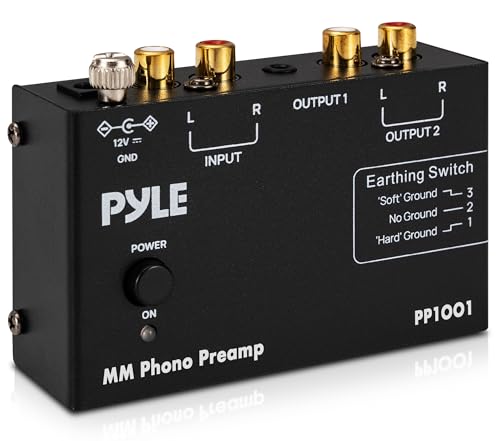
- MM input with RIAA equalization
- RCA and 3.5mm outputs
- Selectable grounding controls
Best For: Simple vinyl setups needing both speaker and headphone connections
Tube-Sound Upgrade
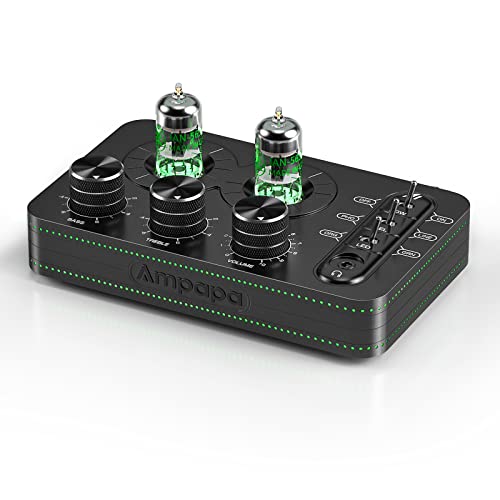
- JAN 5654 vacuum tube design
- Bass and treble tone controls
- RCA and 3.5mm connections
Best For: MM vinyl listeners wanting warm tube character and headphone amplification
Basic Line-Level Adapter
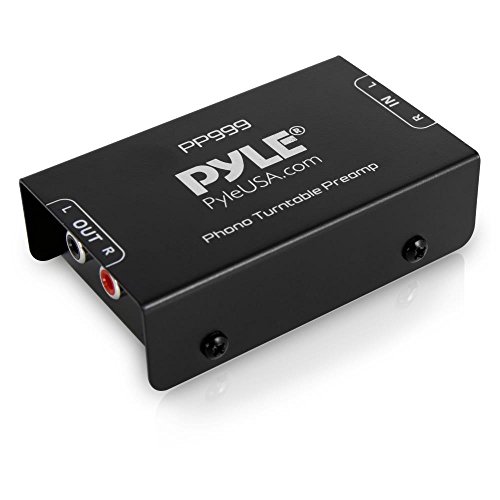
- Converts magnetic phono to line level
- Stereo RCA input and output
- Low-noise operation with 12V power
Best For: Simple RCA connections to receivers, speakers, computers, or laptops
Best Compact MM/MC Pick

- MM and MC cartridge support
- 16–200Ω headphone output
- USB-powered metal mini design
Best For: Compact vinyl systems with flexible cartridge and headphone support
Best Budget Signal Booster
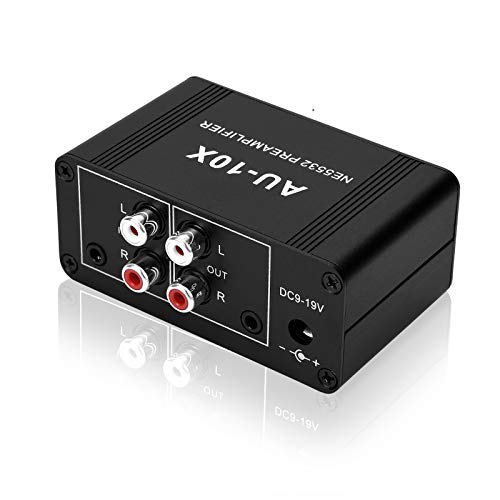
- 20dB signal gain
- RCA and 3.5mm connectivity
- Direct output for headphones up to 16Ω
Best For: Simple, low-cost setups needing basic gain and headphone output
Best Simple Pick
Douk Audio T9 Tube Phono Preamp

- MM/MC phono and RCA inputs
- 16–300Ω headphone amplifier
- Replaceable tube sockets and tone controls
Best For: Hi-Fi systems seeking tube features and versatile headphone listening
Best Plug-and-Play Pick – Fosi Audio Box X1
If you want a straightforward phono preamp with headphone output, the Fosi Audio Box X1 combines MM turntable compatibility, RCA line output, and a 3.5mm headphone jack in a compact metal enclosure. Its RIAA-compliant circuitry and included 12V power adapter make it a practical choice for a simple vinyl listening setup.
Best For: Vinyl listeners who need simultaneous RCA and headphone connectivity.
Pros:
- Supports MM turntable input with RIAA-standard frequency response.
- Offers RCA output and 3.5mm headphone output for flexible connections.
- Includes a grounding post, 12V power supply, and durable aluminum case.
Cons:
- Designed for MM cartridges rather than other cartridge types.
- Has one channel listed in the product details.
The Box X1 is a sensible all-around option when you want low-noise phono signal conversion and easy headphone listening without a larger component.
Best Tube-Sound Option – Douk Audio T4 PRO
The Douk Audio T4 PRO stands out among phono preamp with headphone output options by pairing an MM phono stage with JAN5654 tubes and a dedicated headphone amplifier. It also accepts a 3.5mm AUX source, making it useful for listeners who want a compact, flexible desktop unit with adjustable tube character.
Best For: Listeners seeking warm tube sound and headphone support in a small system.
Pros:
- Includes JAN5654 tubes and supports tube rolling for sound shaping.
- Dedicated 3.5mm headphone output is rated for 32–300 ohm headphones.
- Adds a 3.5mm AUX input for phones, tablets, PCs, and MP3 players.
Cons:
- Its tube-based design may be less suitable for listeners wanting a strictly neutral presentation.
- The phono input is intended for MM turntables.
With its tube stage, gain adjustment, and 150mW headphone output at 32 ohms, the T4 PRO offers more sound-shaping flexibility than a basic phono converter.
Best for Easy Volume Control – Mini Stereo Phono Preamp
This compact phono preamp with headphone output adds useful everyday controls, including a front-mounted power switch and volume knob. It supports RCA connections plus a 3.5mm headphone output, while its grounding post and low-noise circuit are designed for clean, convenient turntable listening.
Best For: Daily vinyl listening where front-panel control and flexible outputs matter.
Pros:
- Includes a front power switch and adjustable volume control.
- Provides gold-plated RCA input/output and a 3.5mm headphone jack.
- Features a grounding rod, metal casing, anti-slip pads, and 12V adapter.
Cons:
- The product details do not specify cartridge support beyond the listed phono-preamp application.
- Its compact design offers fewer stated features than the tube-equipped alternative.
This model is particularly practical for users who want a simple, stable unit that can feed speakers or headphones while keeping power and listening level adjustments close at hand.
Best Compact Multi-Input Option – Mini Stereo Phono and Headphone Amp
If you need more than a basic turntable connection, this compact phono preamp with headphone output provides RCA and 3.5mm inputs alongside RCA, 3.5mm, and dedicated headphone outputs. Its dual NE5532 circuit is designed to reduce background noise, and the volume control allows direct adjustment for headphone listening.
Best For: Users building a compact setup around multiple analog and 3.5mm sources.
Pros:
- Offers RCA and 3.5mm inputs for several source devices.
- Provides separate RCA, 3.5mm, and headphone outputs.
- Uses dual NE5532 circuitry and includes adjustable volume control.
Cons:
- Headphone output supports headphones up to 16 ohms.
- It cannot power passive speakers because it is not a power amplifier.
- Power requirements are listed broadly as DC 9–19V, so an appropriate supply is important.
This is the most connection-focused choice in the group, but its low headphone-impedance limit makes it better suited to compatible headphones and compact source switching than demanding headphone systems.
Compact MM Choice – Pyle PP1001 Phono Preamp
If you need a phono preamp with headphone output for a straightforward vinyl setup, the Pyle PP1001 combines MM cartridge support, RIAA equalization, and both RCA and 3.5mm outputs in a compact metal housing. Its grounding controls are useful for managing hum when connecting a turntable to a stereo system or headphones.
Best For: Vinyl listeners seeking a simple MM turntable preamp with flexible RCA and headphone connections.
Pros:
- Supports MM magnetic cartridges with RIAA-standard playback.
- Provides RCA line output and a 3.5mm headphone port.
- Includes a grounding post and selectable hard, soft, or no-earthing settings.
- Compact metal housing is suited to home audio or studio use.
Cons:
- Designed for MM cartridges rather than other cartridge types.
- The supplied notes do not specify headphone output power or volume controls.
The PP1001 is a practical pick when connection flexibility matters more than advanced features. It is especially suitable for listeners who want direct headphone access alongside an RCA connection to speakers or a receiver.
Tube-Sound Upgrade – Ampapa A1 Tube Phono Preamp
The Ampapa A1 is a phono preamp with headphone output for listeners who want a warmer, more adjustable presentation. It combines an MM phono stage and headphone amplifier with JAN 5654 vacuum tubes, bass and treble controls, and RCA and 3.5mm connections.
Best For: MM turntable owners who prefer tube styling, warm sound, and tone adjustment for headphone or stereo listening.
Pros:
- Combines phono preamp, audio preamp, and headphone amplifier functions.
- Uses JAN 5654 tubes and offers bass and treble controls.
- Supports MM turntables plus several additional line-level sources.
- Includes RCA and 3.5mm connectivity in a metal enclosure.
Cons:
- Only MM turntables are specified as compatible.
- Tube operation may be less suitable for shoppers seeking a strictly solid-state design.
- The supplied notes do not provide detailed headphone impedance or power specifications.
Choose the A1 if you want more than basic signal conversion. Its tone controls and tube-based design make it the most feature-focused option here, while the dedicated headphone function suits desktop or private listening.
Basic Line-Level Adapter – Pyle PP999 Phono Preamp
The Pyle PP999 is a compact phono preamp for converting a turntable’s magnetic-cartridge signal to line level. It uses stereo RCA input and output, low-noise operational amplifiers, and a 12-volt DC adapter, making it useful for connecting older turntables to receivers, speakers, computers, or laptops.
Best For: Buyers who need an uncomplicated RCA phono-to-line converter for equipment without a dedicated phono input.
Pros:
- Converts magnetic phono signals to line-level output.
- Offers stereo RCA input and stereo RCA output for simple connections.
- Designed for low-noise operation and placement near the source.
- Works with receivers, speakers, computers, and laptops.
Cons:
- It does not list a headphone output, so it is not a direct match for headphone-focused setups.
- Connectivity is limited to RCA input and output.
- Requires the supplied 12-volt DC power arrangement.
The PP999 is best viewed as a basic signal-conversion solution rather than a headphone amplifier. If your priority is connecting a turntable to RCA-equipped audio gear, its simple layout and low-noise design keep setup uncomplicated.
Best Compact MM/MC Pick – Douk Audio T14-EQ
If you want a phono preamp with headphone output that works with both MM and MC cartridges, the Douk Audio T14-EQ offers a compact, flexible setup. It adds RCA outputs, tone controls, and a 3.5mm headphone jack while running from a convenient USB 5V source.
Best For: Vinyl listeners who need MM/MC support, private headphone listening, and adjustable bass and treble in a small desktop-friendly unit.
Pros:
- Supports both MM and MC cartridges with built-in RIAA equalization.
- 3.5mm headphone output supports headphones rated from 16–200Ω.
- Independent bass and treble controls provide ±5dB adjustment.
- Compact metal enclosure and USB-C 5V power suit flexible installations.
Cons:
- Its 0.25-watt output is intended for preamp and headphone use rather than powering passive speakers.
- USB power may require a separate compatible wall charger or other USB source.
The T14-EQ is a practical choice when cartridge compatibility and compact headphone listening matter most. Its tone controls and dual outputs make it adaptable for both a desktop vinyl setup and a small stereo system.
Best Budget Signal Booster – ATNEDCVH PA001
The ATNEDCVH PA001 is a straightforward phono preamp with headphone output for boosting weak audio signals to line level. Its 20dB gain, volume knob, and RCA and 3.5mm connections make it a versatile option for basic turntable and source-device setups.
Best For: Budget-minded users who need simple signal gain and direct headphone operation for compatible low-impedance headphones.
Pros:
- Provides 20dB, or 10-times, signal amplification.
- Includes RCA and 3.5mm inputs and outputs for broad source compatibility.
- Dedicated headphone output can drive headphones up to 16Ω.
- Small enclosure and volume control support easy desktop use.
Cons:
- The headphone output cannot be used simultaneously with the other output ports.
- Its stated headphone support is limited to headphones up to 16Ω.
- It is a preamp, not a power amplifier for passive speakers.
The PA001 fits users who want an inexpensive, compact gain stage rather than a feature-rich phono component. Check your headphone impedance and system connections carefully before choosing it.
Best Simple Pick – Douk Audio T9 Tube Phono Preamp
For listeners seeking a phono preamp with headphone output and a more distinctive presentation, the Douk Audio T9 combines MM/MC phono support with vacuum tubes, tone controls, and a dedicated headphone amplifier. It also accepts RCA line-level sources for added flexibility.
Best For: Home Hi-Fi listeners who want tube-based styling, adjustable tone, and headphone support for a wider range of impedances.
Pros:
- Supports both MM and MC turntable cartridges.
- Dedicated 3.5mm headphone amplifier supports 16–300Ω headphones.
- Includes adjustable treble and bass controls.
- Tube sockets are designed for replacement with several compatible tube types.
Cons:
- Its tube-based design is larger and more involved than a simple mini preamp.
- It requires the included DC12V power supply rather than USB power.
- Tube operation may appeal less to listeners seeking a purely solid-state design.
The T9 is the most characterful option here, pairing flexible phono connectivity with tube hardware and a higher stated headphone-impedance range. It is a strong fit for a dedicated listening setup where presentation and adjustability are priorities.
How We Picked the Best Phono Preamp with Headphone Output
We focused on practical features that affect setup, sound, and long-term usefulness. The products in this roundup were assessed for phono-cartridge compatibility, RIAA equalization, headphone connectivity, output flexibility, controls, compactness, and value. We also considered whether each model is best suited to basic MM turntables, more flexible MM/MC systems, or listeners who want tone adjustment and a more distinctive tube-based presentation.
Because product specifications and included accessories can vary, check the manufacturer’s current listing for exact input sensitivity, gain, power supply details, and headphone impedance support before buying.
Quick Comparison
| Best For | Look For | Typical Feature Set |
|---|---|---|
| Simple headphone listening | MM support and 3.5mm output | Compact size, volume control, RCA output |
| Flexible turntable systems | MM/MC compatibility | RIAA EQ, selectable input support, headphone output |
| Vinyl enthusiasts | Tone or gain controls | Treble/bass adjustment, larger control layout |
| Tube-style setups | Vacuum-tube circuitry | Tube buffer or amplification, distinctive styling |
Key Buying Factors for a Phono Preamp with Headphone Output
Cartridge Compatibility
First, confirm whether your turntable uses a moving-magnet (MM) or moving-coil (MC) cartridge. Many affordable units support MM only, while MM/MC models offer greater upgrade flexibility. Using an incompatible input can result in very low volume or poor balance.
Connections and Listening Controls
A 3.5mm headphone jack is convenient for common headphones, while RCA outputs let you connect powered speakers, an amplifier, or another audio system. A front-panel volume control is especially useful because many phono outputs do not provide a convenient way to adjust headphone level.
Noise, Gain, and Sound Adjustment
Phono signals are quiet and require substantial amplification, so low-noise design and proper grounding matter. Tone controls can help tailor older records or headphones, but purists may prefer a simpler signal path. Tube models may appeal to listeners who enjoy their appearance and presentation, though tubes also add maintenance considerations.
Power and Placement
Check whether the unit uses USB, an included adapter, or another power source. Compact models fit easily beside a turntable, but keep power cables and unnecessary signal sources away from the phono leads to reduce hum.
Who Should Buy Which Phono Preamp with Headphone Output?
Choose a basic MM model if you want an affordable, straightforward way to connect a turntable and headphones. Pick an MM/MC preamp if you expect to upgrade cartridges or want broader system compatibility. Models with tone controls suit listeners who want easy adjustment, while tube-based units are a better match for buyers who value tube styling and a more distinctive listening experience. If you also use powered speakers or a stereo receiver, prioritize a unit with both headphone and RCA outputs.