The right recorder depends on what you need to capture: a quick interview, lavalier audio for video, multiple microphones on location, or a full-band demo. TASCAM’s lineup covers all of these, but the models differ substantially in inputs, recording workflow, and size.
This roundup brings together 10 options, from pocketable field recorders to tabletop Portastudios. Use the guide below to narrow your choice by source count, recording format, and how you plan to work.
Best 10 Tascam Digital Recorders Picks for 2026
Best for Flexible Field Recording
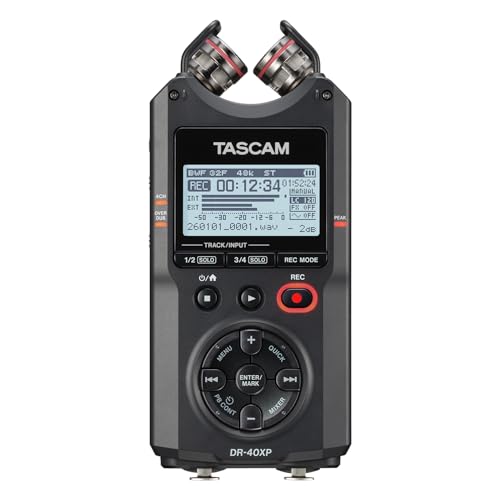
- Four-channel, 32-bit float recording
- Adjustable stereo mics and two XLR/TRS inputs
- 2-in/2-out USB-C interface
Best For: Musicians and video creators capturing multiple sources on location
Best for Home Multitracking

- Eight tracks with two simultaneous inputs
- Built-in stereo microphones
- Onboard editing and mastering effects
Best For: Musicians building layered demos on a standalone recorder
Best for Touchscreen Workflow

- 2.4-inch touchscreen with task presets
- Four tracks plus stereo mix simultaneously
- Two XLR inputs and switchable A-B/true X-Y mics
Best For: Creators switching between interviews, podcasts, music, and field audio
Best for Simple Stereo Capture
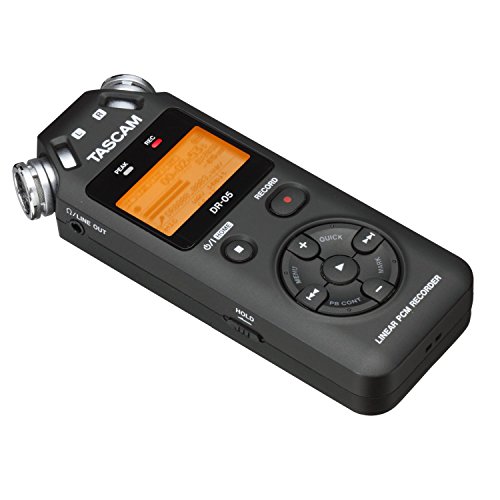
- Built-in omnidirectional stereo mics
- External stereo mic/line input
- Variable-speed playback and included 4 GB microSD
Best For: Portable stereo recording with playback and practice tools
Best for Video Production

- 32-bit float recording with dual ADCs
- Two XLR/TRS inputs plus 3.5 mm input
- Built-in timecode generation and sync
Best For: Videographers using external microphones and timecode
Best for Four-Track Recording

- Portable four-track recorder
- Built-in stereo microphones
- USB 2.0 and 3.5 mm headphone jack
Best For: Portable four-track recording with built-in microphones
Best for Wearable Dialogue

- Includes TM-10L clip-on lavalier
- 32-bit float mono WAV recording
- LTC jam sync with firmware V2.0
Best For: Personal dialogue recording for video and events
Best for Camera Crews
TASCAM DR-70D 4-Channel Recorder
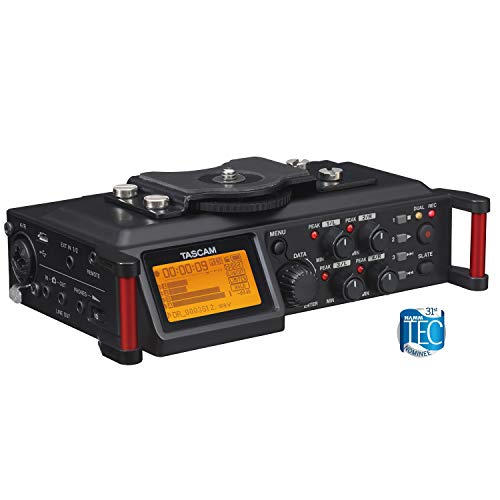
- Four phantom-powered XLR inputs
- Mounts above or below a camera
- Lower-level safety recording
Best For: Multi-source audio on video shoots
Best for Handheld Interviews

- Attaches to a handheld XLR mic
- Records WAV or MP3
- Lower-level safety recording
Best For: Compact interview and news-gathering setups
Best for Multitrack Projects
TASCAM DP-24SD 24-Track Portastudio

- 24-track recording format
- Eight XLR inputs
- Effects, mastering, and color screen
Best For: Home or project-studio multitracking
Best for Flexible Field Recording – TASCAM DR-40XP
Among TASCAM digital recorders, the DR-40XP suits creators who want built-in stereo mics and external inputs in one portable unit. Its four-channel recording lets you capture both sources at once, while 32-bit float recording offers more flexibility when levels change unexpectedly.
Best For: Musicians and video creators recording multiple sources on location.
Pros:
- Adjustable A-B or X-Y mics accommodate different stereo setups.
- Two XLR/TRS inputs support four-channel recording alongside the built-in mics.
- Works as a 2-in/2-out USB-C audio interface.
Cons:
- microSD card and batteries are not included.
- Only two external XLR/TRS inputs are provided.
Choose the DR-40XP when simultaneous onboard and external recording matters more than a self-contained kit; budget for storage media and batteries before your first session.
Best for Home Multitracking – TASCAM DP-03SD Portastudio
For buyers comparing TASCAM digital recorders for songwriting at home, the DP-03SD takes a Portastudio approach: record up to eight tracks, with two inputs available simultaneously. Built-in stereo mics, editing, and mastering effects keep the workflow centered on the recorder.
Best For: Musicians building layered demos without relying on a computer for recording and mastering.
Pros:
- Eight-track recording supports overdub-based projects.
- XLR connections accommodate condenser mics; TRS connections handle guitars and keyboards.
- Onboard editing, mastering effects, tuner, and metronome support a self-contained workflow.
Cons:
- Records only two inputs simultaneously, despite having eight tracks.
- At 5.3 pounds, it is less suited to handheld field recording.
The DP-03SD makes the most sense when you prefer recording parts in layers and finishing them on one device rather than capturing a full group at once.
Best for Touchscreen Workflow – TASCAM Portacapture X6
The Portacapture X6 stands out among TASCAM digital recorders for its 2.4-inch touchscreen and recording presets for music, podcasts, interviews, and field work. It captures up to four tracks plus a stereo mix simultaneously at up to 96 kHz, 32-bit float.
Best For: Creators who want guided setup for interviews, podcasts, music, and location audio.
Pros:
- Touchscreen presets simplify switching between common recording tasks.
- Records four tracks plus a two-track mix simultaneously.
- Two XLR inputs pair with built-in mics that switch between A-B and true X-Y patterns.
Cons:
- Only two XLR inputs are available for external microphones.
- The AK-BT2 adapter is not compatible; the notes specify using only the AK-BT1.
Pick the X6 if quick, task-based setup is a priority. Its track layout is useful for mixed sources, but check the XLR input count against your microphone plans.
Best for Simple Stereo Capture – TASCAM DR-05 Version 2
If you are shopping TASCAM digital recorders for straightforward stereo capture, the DR-05 Version 2 keeps the essentials close at hand. Built-in omnidirectional mics handle direct recording, while a stereo mic/line input with plug-in power gives you an external-source option.
Best For: Buyers who want a portable stereo recorder with useful playback and practice tools.
Pros:
- Built-in stereo mics and an external stereo mic/line input provide two ways to record.
- Variable-speed playback preserves pitch and pairs with loop and repeat functions.
- A 4 GB microSD card is included.
Cons:
- Built-in mics are omnidirectional, with no adjustable pickup pattern specified.
- No XLR inputs are listed.
The DR-05 Version 2 is a practical choice when easy stereo recording and review matter most; look elsewhere in the lineup if XLR connections are essential.
Best for Video Production – TASCAM FR-AV2 Field Recorder
Among tascam digital recorders, the FR-AV2 is a practical choice for videographers who need two external microphone inputs and timecode in a compact unit. Its 32-bit float recording with dual ADCs helps capture audio when levels change unexpectedly.
Best For: Videographers recording through XLR or TRS microphones who want built-in timecode generation and synchronization.
Pros:
- Two XLR/TRS combo inputs with Ultra HDDA preamps, plus a 3.5 mm input.
- Built-in timecode input/output and generation reduce the need for an external timecode device.
- Supports 48, 96, and 192 kHz recording.
Cons:
- Wireless monitoring requires the separately available AK-BT2 adapter; other adapters are not compatible.
- Requires three AA batteries.
Choose the FR-AV2 when timecode and flexible wired inputs matter more than having a microphone included in the package.
Best for Four-Track Recording – Tascam DR-40 Silver
The silver DR-40 is a four-track portable option among tascam digital recorders. Its built-in stereo microphones make it worth considering when you want to record without starting with a separate microphone.
Best For: Buyers seeking a portable four-track recorder with built-in stereo microphones.
Pros:
- Four-track portable recorder with built-in stereo microphones.
- USB 2.0 interface and 3.5 mm headphone jack.
- Listed recording times are up to 16 hours in WAV or 240 hours in MP3.
Cons:
- At a listed 1.2 pounds, it is heavier than the other two recorders in this roundup.
- The supplied specifications do not establish 32-bit float recording or timecode support.
The DR-40 fits a straightforward four-track use case; check the recording features you need before choosing it for a video workflow.
Best for Wearable Dialogue – TASCAM DR-10L Pro
For dialogue recorded on a person, the DR-10L Pro offers a different approach to tascam digital recorders: it comes with a clip-on TM-10L lavalier microphone. Its 32-bit float recording is useful when a speaker’s volume shifts during a take.
Best For: Filmmakers and event recordists who need a compact personal recorder with an included lavalier microphone.
Pros:
- Included TM-10L lavalier provides a ready-to-use personal audio setup.
- 32-bit float WAV recording helps handle wide changes in speaking volume.
- Supports microSDXC cards up to 512 GB and LTC jam sync with firmware V2.0.
Cons:
- Records in mono, so it is not a built-in stereo recording option.
- Wireless timecode features require the separately sold AK-BT1 adapter; the AK-BT2 is incompatible.
Pick the DR-10L Pro for discreet, individually recorded dialogue, especially if you can use its lavalier-and-timecode workflow.
Best for Camera Crews – TASCAM DR-70D 4-Channel Recorder
Among tascam digital recorders, the DR-70D is the camera-oriented choice for capturing separate audio tracks on a shoot. Its compact body mounts above or below a camera, while four balanced XLR inputs and built-in microphones offer ways to capture sound on set.
Best For: Videographers and documentary crews recording multiple audio sources alongside a camera.
Pros:
- Four XLR inputs support phantom power and have individual gain controls.
- Dual Recording can save a lower-level safety copy.
- Built-in microphones, a limiter, and a high-pass filter add on-set flexibility.
Cons:
- At 1.2 pounds, it is less pocketable than a microphone-mounted recorder.
- Its camera-mounting design may be more than a simple interview setup needs.
Choose the DR-70D when separate inputs and level control matter more than the smallest possible recorder. It records tracks to SD, SDHC, or SDXC cards, with support for cards up to 128GB.
Best for Handheld Interviews – TASCAM DR-10X XLR Recorder
For interviewers comparing tascam digital recorders, the DR-10X offers a compact way to record from a handheld XLR microphone. Its captive connector attaches directly to the mic, keeping the recording setup small for news gathering.
Best For: Reporters and interviewers who want a recorder attached to a handheld XLR microphone.
Pros:
- Manual and automatic gain settings, a low-cut filter, and a limiter provide level-control options.
- Dual Recording captures a lower-level safety copy.
- Records WAV or MP3 to microSD and offers headphone monitoring.
Cons:
- Mono operation is not suited to recording a stereo scene.
- A handheld microphone is needed to make use of its direct-attach design.
The DR-10X makes the most sense when portability and a direct microphone connection outweigh the need for multiple inputs. Its sliding recording switch also helps prevent accidental operation.
Best for Multitrack Projects – TASCAM DP-24SD 24-Track Portastudio
The DP-24SD fills a different role from portable tascam digital recorders: it is a 24-track Portastudio for projects that need a larger recording workspace. The supplied product title lists eight XLR inputs, effects, mastering, and a color screen.
Best For: Musicians building multitrack recordings in a home or project-studio setting.
Pros:
- 24-track format suits layered recording projects.
- Eight XLR inputs provide connection options for multiple sources.
- Includes effects, mastering, and a 3.5-inch color screen.
Cons:
- Its 20.2-inch width and 13.7-pound weight make it less convenient to carry than a small field recorder.
- It is a larger setup than a single-microphone interview requires.
Choose the DP-24SD when track count and onboard project controls are the priority. If you need a recorder to mount on a camera or microphone, the other formats in this roundup are more purpose-built for that use.
How We Picked the Best Tascam Digital Recorders
We selected these 10 Tascam Digital Recorders to cover distinct recording jobs rather than rank similar-looking devices by specifications alone. The lineup includes handheld recorders, camera-oriented field units, a bodypack lavalier recorder, an XLR-mounted recorder, and two multitrack Portastudios. We prioritized meaningful differences in input options, portability, and workflow. This is a feature-based comparison, not a claim that every model was hands-on tested.
Quick Comparison
For portable recording with built-in microphones, start with the DR-05 Version 2, DR-40, DR-40XP, or Portacapture X6. The DR-40XP adds 32-bit float recording and XLR/TRS inputs; the X6 is another 32-bit float option for mixed voice, music, and field work. For video, compare the compact FR-AV2, the four-input DR-70D, and the lavalier-focused DR-10L Pro. The DR-10X is a specialized choice for recording directly from a compatible XLR microphone. For music production without a computer, compare the eight-track DP-03SD with the larger 24-track DP-24SD.
Key Buying Factors for Tascam Digital Recorders
Inputs and Source Count
Count the microphones or instruments you must capture at the same time, not just the tracks you might want later. Built-in mics are convenient for ambience and simple interviews; XLR/TRS inputs give you more flexibility with external microphones and line-level gear. If you need several isolated sources for a video shoot or music session, confirm the recorder’s simultaneous input capacity before buying.
Recording Format and Level Control
32-bit float can provide more flexibility when correcting unexpectedly loud or quiet recordings in post-production, but it cannot fix poor mic placement, wind noise, or a distorted signal earlier in the chain. A conventional recorder can still be a good fit when levels are predictable and you can monitor them. Check the recording format supported by the specific model rather than assuming every unit offers the same options.
Workflow and Connections
For video, consider how you will sync sound with footage; timecode features matter more on some shoots than others. For interviews, a small recorder and straightforward file transfer may be more useful. If you intend to use a recorder with a computer, verify its USB audio-interface capabilities. Also check media compatibility, power options, mounting needs, and headphone monitoring for your setup.
Who Should Buy Which Tascam Digital Recorders?
Choose a compact handheld model for travel notes, ambience, or uncomplicated interviews. Look at the DR-40XP or Portacapture X6 if you want portable 32-bit float recording with more connection flexibility. Video crews should match the FR-AV2 or DR-70D to their input and sync needs, while solo creators recording one speaker should consider the DR-10L Pro. The DR-10X makes sense when an XLR microphone is central to your mobile setup. Pick the DP-03SD for a smaller standalone music workflow, or the DP-24SD when you need substantially more tracks and inputs.