Kaqiluo closed cell foam is a straightforward Kaqiluo High Density Self-Adhesive Sound Insulation Acoustic Closed Cell Foam review for buyers who want a dense, easy-to-install treatment rather than decorative studio foam.
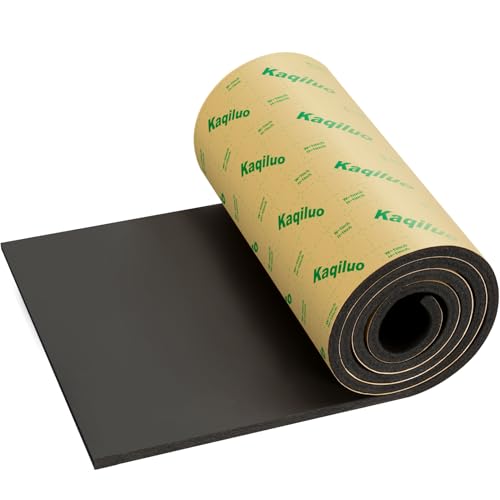
Kaqiluo Closed Cell Foam Review Summary
This product makes sense if you need a thick, self-adhesive noise-control layer for a room, vehicle, or workspace and you care more about practical installation than boutique acoustics.
The listing emphasizes density, closed-cell construction, fire and water resistance, and a cut-to-fit sheet format, so the appeal is clear: it is a utilitarian damping and insulation material for people solving a real sound or finish problem.
It is not the product I would choose if I wanted a classic wedge-style studio look or a treatment whose main job is to shape a listening room’s reflections with finesse.
But if your priority is coverage, convenience, and resilient material behavior, Kaqiluo’s foam has a believable use case.
Review Scorecard
| Category | Score | Rationale |
|---|---|---|
| Noise-control utility | 8/10 | Dense closed-cell foam is positioned for insulation and reflection reduction, not just decoration. |
| Installation ease | 9/10 | The full-back self-adhesive design should simplify placement on suitable surfaces. |
| Durability | 8/10 | Fire-resistant and waterproof claims point to a tougher, more practical material profile. |
| Coverage value | 7/10 | The 5.8 sq ft sheet is useful for targeted jobs, but not for large-area coverage. |
| Versatility | 8/10 | The listing calls out cars, apartments, studios, classrooms, and factory use. |
| Precision fit | 8/10 | The 0.4-inch sheet can be cut into shapes, which helps with awkward panels and corners. |
| Buyer confidence | 7/10 | The spec sheet is specific on size and material behavior, though it is still a listing-driven product. |
Key Features and Specifications of Kaqiluo Closed Cell Foam
Kaqiluo describes this as a high-density self-adhesive acoustic closed-cell foam.
The important details are the ones that affect use: it is built as a 0.4-inch thick sheet, measures 12 x 71 inches, and covers about 5.8 square feet.
That size tells you this is better for spot treatment, patches, or small-area lining than for blanketing an entire wall.
The listing also emphasizes a density of 50+ kg/m³ and a closed-cell construction.
For buyers, that combination usually signals a firmer, more resilient foam than soft wedge-style panels.
The material is presented as sound insulating rather than purely absorptive, and the copy specifically says it can reduce flutter echoes, reverberation, and reflections.
Here are the most useful facts from the record:
| Spec | Detail |
|---|---|
| Brand | Kaqiluo |
| Product type | Self-adhesive acoustic closed-cell foam |
| Thickness | 0.4 in / 10 mm |
| Sheet size | 12 x 71 in |
| Coverage | 5.8 sq ft |
| Density | 50+ kg/m³ |
| Resistance claims | Fire resistant, water proof |
| Installation | Full-back self-adhesive layer |
| Suggested uses | Automobiles, condos, apartments, studios, classrooms, factories |
The installation story matters.
Because the adhesive covers the whole back, the product is meant to stick without extra glue or a long expansion period.
That makes it more convenient than compressed foams that need time to recover shape.
It also means buyers should think carefully about placement before pressing it down, since repositioning an adhesive-backed sheet is usually harder than installing loose panels.
The waterproof claim is also notable.
In practice, this points toward a foam that is more tolerant of moisture exposure than open-cell absorptive products.
That does not make it a replacement for proper waterproofing, but it does make the material easier to imagine in automotive or utility settings where spills or condensation are possible.
Pros and Cons of Kaqiluo Closed Cell Foam
Pros
- Dense, closed-cell construction suggests a more serious insulation-oriented material than decorative foam.
- Full-back adhesive should make installation fast on clean surfaces.
- 0.4-inch thickness is manageable for tight spaces and trim-sensitive areas.
- The sheet can be cut to fit irregular sections.
- Fire-resistant and waterproof claims broaden the practical use cases.
- The listing supports a wide range of environments, from apartments to classrooms and vehicles.
Cons
- One 5.8 sq ft sheet is limited coverage for bigger projects.
- The product is more utilitarian than visually polished.
- Buyers focused on classic studio absorption may want a different foam profile.
- Adhesive-backed products can be unforgiving if you misalign the sheet.
- The listing is strong on claims, but the real-world effect depends heavily on surface prep and application quality.
Overall, the biggest strength is that the product knows what it is.
It is not pretending to be a luxury acoustic solution.
It is a dense, self-adhesive foam for people who want practical coverage and simple installation.
Who Should Buy Kaqiluo Closed Cell Foam?
This is a good fit for DIY buyers, renters, vehicle owners, and maintenance-minded users who need a small-to-moderate area treated with a material that is easy to cut and stick.
It also makes sense for utility spaces where the user values moisture resistance and a firmer foam profile more than a decorative finish.
It is especially reasonable if you need to line a panel, patch a noisy section, or add a layer in a constrained area where thicker or loose-fitting products would be awkward.
The 0.4-inch profile and adhesive backing support that kind of work.
You should probably skip it if you are trying to treat a large room on a single purchase, because the coverage is modest.
It is also not the best first choice if you want a traditional studio aesthetic or you are optimizing specifically for broad acoustic absorption rather than denser sound insulation behavior.
Sound Treatment Use Cases for Kaqiluo Closed Cell Foam
Small-area panel lining
The most believable use is targeted lining on doors, panels, cabinets, or similar surfaces.
The 10 mm thickness is thin enough to fit in narrow spaces, while the dense material profile makes it more plausible as a damping layer than a soft decorative panel.
Vehicle and condo applications
The listing explicitly mentions automobiles and condos.
That matters because these settings often demand a foam that is compact, easy to cut, and less sensitive to incidental moisture.
In those contexts, the full-back adhesive is a real convenience advantage.
Studio and classroom support
For studios and classrooms, the product reads as a supplemental treatment rather than a complete acoustic cure.
It may help with reflections and flutter echo on selected surfaces, but buyers should treat it as one piece of a larger setup, not a universal fix.
Cutting and fit
The sheet format is one of the most practical parts of the offer.
Being able to cut the foam into custom shapes makes it easier to work around corners, trim pieces, and nonstandard dimensions.
That flexibility increases its usefulness even though the coverage area itself is limited.
Alternatives to Kaqiluo Closed Cell Foam
If you want a more conventional acoustic foam option, look at Auralex Acoustics on Amazon.
Auralex is a familiar brand for buyers who want purpose-built room treatment rather than a general-purpose closed-cell sheet.
If you want broader access to budget acoustic panels, Foamily on Amazon is another common search target.
It is a better comparison point for buyers looking at basic panel coverage and layout flexibility.
If your priority is heavy-duty adhesive-backed material for vehicles or utility use, Noico sound deadening products on Amazon are worth checking.
That lane is closer to insulation and damping than to decorative acoustic panels.
If you want a familiar brand with a wide foam lineup, Room/Studio foam from Amazon Basics search results can also be a practical comparison.
The main reason to compare is simple availability and the ability to size a project around a known brand family.
Is Kaqiluo Closed Cell Foam Worth It?
Yes, if you want a dense, adhesive-backed, cut-to-fit foam for targeted sound insulation work. The listing supports a clear buyer profile: someone who values simple installation, firmer material behavior, moisture resistance, and compact coverage more than ornamental studio styling.
No, if you need large-scale room treatment or you are chasing a classic absorptive studio solution. In that case, a different product line is likely a better match.
For the right project, Kaqiluo closed cell foam looks like a sensible buy because it is specific, practical, and easy to deploy.
For the wrong project, it will probably feel too small and too utilitarian.
If your job is localized noise control, it is worth considering.