Distributing one 4K source to multiple displays can be straightforward—if the amplifier matches your resolution, refresh-rate, HDR, HDCP, and cable-length requirements. The wrong model may cause blank screens, handshake errors, or inconsistent audio and video.
We selected 10 options ranging from compact 1×2 splitters to larger HDMI distribution systems and long-distance extenders. Use the buying guide below to narrow your choices by display count, signal format, installation distance, and budget.
Best 10 4K Video Distribution Amplifiers Picks for 2026
Best for Stable 4K Workflows

- 18Gbps 4K signal distribution
- Downscaler and audio extraction on output 2
- 10-year warranty and cascade support
Best For: Stable professional setups with legacy-device integration
Best for Long-Distance Multi-Display Runs

- Distributes one source to eight displays
- 4K at 30Hz up to 165 feet
- Loop-out, IR pass-back, and power over LAN
Best For: Large rooms and commercial displays using CAT cable
Best for HDMI 2.1 Installations

- 48Gbps bandwidth and FRL 6 support
- Custom and four-block EDID handling
- Extracted 7.1 digital or 2-channel analog audio
Best For: Advanced gaming and NextGen multi-display systems
Best Budget Mirror Splitter

- One HDMI source to four mirrored displays
- Supports 4K at 30Hz and 1080p at 60Hz
- Powered metal enclosure with cascade support
Best For: Simple home, classroom, retail, and conference-room mirroring
Best Commercial-Residential Pick
Atlona Rondo 442 1x2 HDMI Distribution Amplifier

- Distributes one HDMI source to two displays
- Manages EDID communications
- Suitable for commercial or residential deployment
Best For: Two-display HDMI installations
Best Flexible Switching Option
Monoprice Blackbird 4K 2x4 HDMI Splitter and Switch

- Switches between two HDMI sources
- Distributes a signal to four displays
- Built-in adjusting amplifier supports longer input cables
Best For: Two-source, four-display setups
Best for Eight Displays
KanexPro 4K UHD 1x8 HDMI Distribution Amplifier

- Feeds one source to up to eight displays
- Supports 4K UHD and 1080p at 60Hz
- HDCP 2.2 compliant with surround-audio support
Best For: Large one-source, multi-display installations
Best Compact Splitter
Monoprice Blackbird 4K 1x2 HDMI Splitter

- One HDMI input feeds two displays
- Supports 4K@30Hz and 3D video
- Includes 48-bit Deep Color and HD audio support
Best For: Two-display home theater and presentation setups
Best Professional-Style Option
Kramer VM-2H2 HDMI Distribution Amplifier

- Dedicated HDMI audio/video distribution component
- Compact 7.38-inch-wide design
- Lightweight 14.1-ounce chassis
Best For: Installation buyers verifying system specifications
Best for Long HDMI Runs
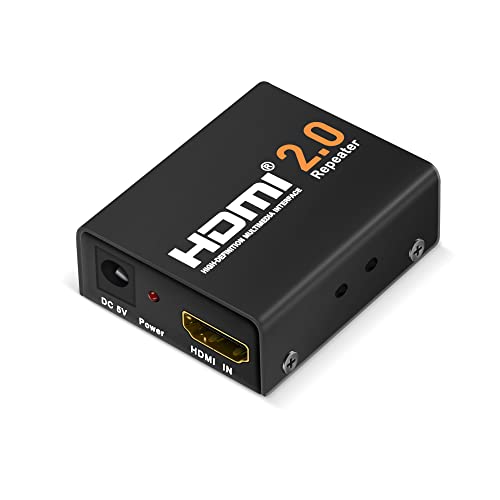
- Supports 4K at 60Hz and 18Gbps bandwidth
- Extends transmission up to 60m/200ft
- Compact metal housing with backup power cord
Best For: Long-run conference room and classroom HDMI connections
Best for Stable 4K Workflows – AVPro Edge 1×2 18Gbps DA
For dependable 4k video distribution amplifiers in professional installations, the AVPro Edge AC-DA12-AUHD-GEN2 combines 18Gbps signal handling with two HDMI outputs. Its downscaler and audio extraction on output 2 can help integrate legacy displays and audio equipment into a modern 4K system.
Best For: Installations that need stable 4K distribution, legacy-device compatibility, and the option to cascade for more outputs.
Pros:
- 18Gbps distribution for 4K workflows.
- Downscaler on HDMI output 2 supports legacy 4K-incompatible products.
- Audio extraction and cascade capability add installation flexibility.
- Includes a 10-year warranty.
Cons:
- Provides two channels, so larger systems may require cascading or additional hardware.
- Supplied notes do not specify the exact downscaled output resolution.
This is a strong choice when reliability and mixed-generation equipment support matter more than having many outputs in a single chassis.
Best for Long-Distance Multi-Display Runs – OREI 1×8 CAT Extender
Among 4k video distribution amplifiers, this OREI system stands out for sending one HDMI source to eight remote displays over CAT6, CAT6a, or CAT7 cable. It also includes a loop-out for a local display, IR pass-back, and power over LAN for the receivers.
Best For: Meeting rooms, exhibitions, bars, and other installations that need eight distributed displays over network cable.
Pros:
- Includes one transmitter and eight receivers.
- Supports 4K at 30Hz up to 165 feet and 1080p at 60Hz up to 230 feet.
- Provides a local HDMI loop-out and IR remote pass-back.
- Plug-and-play setup with no software installation required.
Cons:
- 4K operation is limited to 30Hz.
- Requires CAT cabling and receiver placement for each remote display.
- Includes a one-year manufacturer warranty.
Choose this model when display count and cable distance are priorities, particularly for commercial layouts where conventional short HDMI connections are impractical.
Best for HDMI 2.1 Installations – AVPro Edge 1×4 48Gbps DA
For newer 4k video distribution amplifiers, the AVPro Edge AC-DA14-AUHD-GEN2 offers 48Gbps bandwidth and HDMI 2.1b-focused features across four outputs. Custom EDID blending, four-block EDID support, and extracted audio make it suited to demanding display and audio configurations.
Best For: Gaming-oriented HDMI 2.1 systems and advanced installations using multiple NextGen displays.
Pros:
- 48Gbps bandwidth with Fixed Rate Link 6 support.
- Custom EDID blending can combine EDIDs from different devices.
- Supports extended four-block EDID for demanding displays.
- Extracts up to 7.1 digital or 2-channel analog audio.
Cons:
- Advanced features may be unnecessary for basic 4K distribution.
- Supplied notes do not specify maximum resolution or refresh-rate combinations.
This is the most technically ambitious option in the group for systems built around high-bandwidth HDMI 2.1 sources, modern displays, and detailed EDID management.
Best Budget Mirror Splitter – MT-ViKI 1×4 4K HDMI Splitter
This powered MT-ViKI splitter is a straightforward option among 4k video distribution amplifiers, sending one HDMI source to four identical displays. Its metal housing, included AC adapter, and signal-boosting design suit home theaters, conference rooms, schools, and retail displays.
Best For: Simple mirror-mode distribution to four TVs or monitors at up to 4K resolution at 30Hz.
Pros:
- Splits one HDMI input across four outputs simultaneously.
- Supports 4K at 30Hz, 1080p at 60Hz, 3D, and HDCP 1.4.
- Powered operation helps reduce flickering and signal drops.
- Metal case provides heat dissipation and EMI protection.
Cons:
- Supports mirrored content only, not extended desktop mode.
- Limited to 4K at 30Hz.
- Does not include switching, remote control, or built-in speakers.
Its simple design makes sense when every screen should show the same source and you want a compact, powered splitter rather than a configurable matrix or extender system.
Best Commercial-Residential Pick – Atlona Rondo 442 1×2 HDMI Distribution Amplifier
The Atlona Rondo 442 is a straightforward choice for 4k video distribution amplifiers when you need to send one HDMI source to two displays. It is designed for commercial and residential installations and manages EDID communications to help provide the intended audio formats and video resolutions.
Best For: Installations distributing one HDMI source to two displays.
Pros:
- Supports HDMI signal distribution for compatible displays and source devices.
- Manages EDID communications for coordinated audio and video settings.
- Designed for easy deployment in commercial and residential applications.
Cons:
- Limited to one input and two outputs.
- Does not provide the multi-source switching or eight-display capacity of larger models.
The Rondo 442 fits buyers who want a focused, easy-to-deploy distribution amplifier rather than a high-output matrix or splitter. Its EDID management is useful when consistent system compatibility matters.
Best Flexible Switching Option – Monoprice Blackbird 4K 2×4 HDMI Splitter and Switch
The Monoprice Blackbird combines source switching and distribution, making it a versatile option among 4k video distribution amplifiers. It accepts two HDMI inputs and can send the selected signal simultaneously to four displays, while its built-in automatically adjusting amplifier supports longer-than-normal HDMI input cables.
Best For: Users switching between two HDMI sources while feeding up to four displays.
Pros:
- Offers two HDMI inputs and four HDMI outputs.
- Includes a built-in automatically adjusting amplifier for longer input cables.
- Supports 4K video and high-definition audio formats including Dolby TrueHD and DTS-HD Master Audio.
Cons:
- Its listed support specifies video resolutions up to 4K at 30Hz.
- Supplied notes list no warranty.
This Blackbird model is a practical fit for home or small AV setups that need both switching and four-display distribution. Choose it when input flexibility and supported surround-sound formats are more important than higher output counts.
Best for Eight Displays – KanexPro 4K UHD 1×8 HDMI Distribution Amplifier
The KanexPro HDSP184K is built for larger display deployments, distributing one 4K HDMI video and audio signal to as many as eight displays. As a 4k video distribution amplifier, it also supports 1080p at 60Hz, HDCP 2.2, and several high-definition audio formats.
Best For: Larger installations that need one HDMI source shared across up to eight televisions or displays.
Pros:
- Distributes one HDMI source to up to eight displays.
- Supports 4K UHD and Full HD 1080p at 60Hz.
- Supports Dolby Digital, DTS-HD, and Dolby TrueHD audio.
Cons:
- Provides one input, so it is not designed for switching among multiple sources.
- Its larger eight-output capacity may be unnecessary for small setups.
The HDSP184K is the strongest match here for one-to-many distribution. Its eight outputs and HDCP 2.2 compliance make it suitable when a single source must serve a sizable group of compatible displays.
Best Compact Splitter – Monoprice Blackbird 4K 1×2 HDMI Splitter
Monoprice Blackbird 4K 1x2 HDMI Amplifier Splitter - 48-bit Deep Color, 3D Video Support, Black
Check Price On AmazonFor straightforward 4k video distribution amplifiers setups, the Monoprice Blackbird sends one HDMI source to two displays. It supports 4K at 30Hz, 3D video, 48-bit Deep Color, and a broad selection of digital audio formats.
Best For: Home theater or presentation systems that need one HDMI source distributed to two displays.
Pros:
- Splits one HDMI input to two HDMI sink devices.
- Supports 4K@30Hz, 1080p@120Hz, and multiple 3D formats.
- Handles 48-bit Deep Color and formats including DTS-HD, Dolby TrueHD, and 7.1-channel LPCM.
Cons:
- HDCP support is limited to version 1.4.
- Does not list 4K at 60Hz support.
This is a focused two-output splitter rather than a long-distance repeater, making it a practical choice when your source and displays need simple HDMI distribution.
Best Professional-Style Option – Kramer VM-2H2 HDMI Distribution Amplifier
The Kramer VM-2H2 is an HDMI distribution amplifier for systems that need a dedicated audio or video distribution component. The supplied information identifies it as a compact Kramer model, though it does not specify supported resolutions, HDCP version, or output count.
Best For: Buyers considering a compact Kramer distribution component for an audio/video installation where detailed format requirements are confirmed separately.
Pros:
- Designed as an HDMI distribution amplifier.
- Compact listed dimensions of 7.38 x 4.53 x 1 inches.
- Lightweight at 14.1 ounces.
Cons:
- The supplied notes do not state 4K, 3D, bandwidth, or HDCP capabilities.
- The supplied notes do not specify the number of HDMI outputs.
The VM-2H2 may suit installation-oriented buyers who already know their signal requirements, but verify resolution, compatibility, and port specifications before choosing it for a 4K distribution system.
Best for Long HDMI Runs – Flashmen HDMI 2.0 4K Repeater
For 4k video distribution amplifiers installations where cable distance is the concern, the Flashmen HDMI Booster 2.0 repeats and strengthens an HDMI signal between two devices. It supports 18Gbps bandwidth, 4K at 60Hz, HDCP 2.2, and transmission distances up to 60m/200ft.
Best For: Conference rooms, classrooms, offices, showrooms, and other setups requiring longer HDMI transmission between a source and display.
Pros:
- Supports 4K/2K at 60Hz, 18Gbps bandwidth, and HDCP 2.2.
- Designed for transmission distances up to 60m/200ft.
- Compact metal housing, plug-and-play operation, and HDMI-powered use.
- Includes a backup power cord for high-power devices.
Cons:
- It is a repeater for extending one HDMI connection, not a multi-output splitter.
- High-power devices may require the included backup power cord.
This model is the strongest fit when maintaining a 4K signal over a longer HDMI run matters more than distributing one source to multiple displays.
How We Picked the Best 4K Video Distribution Amplifiers
We focused on the specifications that most affect real-world multi-display performance: input and output count, HDMI bandwidth, supported 4K refresh rates, HDR and HDCP compatibility, audio support, EDID management, signal regeneration, and installation flexibility. We also included both straightforward HDMI splitters and models designed for longer cable runs or more demanding commercial AV systems.
Because “4K” does not describe one uniform signal, buyers should confirm whether a unit supports 4K at 30Hz or 60Hz, 4:4:4 color, HDR formats, Dolby Vision, and the source devices being connected. A lower-cost splitter may be suitable for basic televisions, while a professional distribution amplifier may offer more dependable handshaking and system control.
Quick Comparison
| Best For | Look For | Typical Configuration |
|---|---|---|
| Small home theater | 4K60, HDCP 2.2, HDR | 1×2 or 1×4 HDMI |
| Several room displays | More outputs and reliable EDID | 1×4 or 1×8 HDMI |
| Long cable runs | HDMI extension over Cat cable or signal regeneration | Splitter with extender or repeater |
| Commercial AV | Robust construction, stable switching, and installation support | Professional distribution amplifier |
Key Buying Factors for 4K Video Distribution Amplifiers
Output Count and Expansion
Choose a unit with enough outputs for every current display, then leave room for expansion if the system may grow. A 1×2 model is compact and affordable; 1×4 and 1×8 designs are better for conference rooms, signage, classrooms, and whole-home distribution.
Resolution, Refresh Rate, and Bandwidth
Check the exact signal you need rather than relying on a 4K label. Gaming and smooth 4K playback generally call for 4K at 60Hz and higher-bandwidth HDMI support. Basic streaming or presentation systems may work with 4K at 30Hz. Verify color depth, chroma format, and 3D requirements when relevant.
HDR, HDCP, and Audio Compatibility
HDR support is important for compatible TVs and projectors, while HDCP support helps protected content pass correctly. If you use Dolby Vision, Dolby Atmos, Dolby TrueHD, or other advanced formats, confirm that the amplifier passes both the required video and audio signals.
EDID and Cable Distance
EDID management can prevent compatibility problems when connected displays have different capabilities. For runs beyond standard HDMI distances, consider a model with signal boosting, HDMI regeneration, or extension over Cat6/Cat7 cable. Use quality cables and observe the manufacturer’s distance limits.
Who Should Buy Which 4K Video Distribution Amplifiers?
Choose a compact 1×2 amplifier for a television-and-projector setup or another simple two-display installation. A 1×4 model is a practical middle ground for homes, meeting rooms, and small signage systems. Select a 1×8 unit when one source must feed many screens, but pay close attention to EDID behavior and power requirements.
For long-distance installations, prioritize an extender or repeater that specifies both the supported resolution and maximum cable length. Professional users should favor sturdier hardware with predictable HDCP handling, broad format support, and installation-friendly controls. Before ordering, map every source, display, cable run, and audio requirement so the selected amplifier supports the weakest component in the chain.