The best audio interface with onboard DSP can improve more than sound quality. It can also provide low-latency monitoring, microphone processing, loopback, and flexible routing without relying entirely on computer software.
We compare 10 models for streamers, podcasters, musicians, and home studios, covering compact USB interfaces, live-streaming mixers, and more capable multi-input systems.
Best 10 Audio Interface with Onboard Dsp Picks for 2026
Streamer’s Choice

- 80dB gain for XLR microphones
- Onboard voice effects and Wave FX
- Touch controls with LED feedback
Best For: Streamers and voice-focused creators
Studio Expansion Pick

- 18 inputs and 22 outputs
- Six DSP monitor mix buses
- Reverb, EQ, and dynamics onboard
Best For: Multi-source recording and monitoring
Compact Streaming Mixer

- Three-channel mixer and USB interface
- DSP, loopback, and mute button
- AG Controller for Windows, Mac, and iOS
Best For: Compact live-streaming setups
Dual-PC Creator Pick

- DSP mic chain with EQ and compression
- Up to eight channels over dual USB
- Designed for streaming, gaming, and podcasts
Best For: Multi-computer creator workflows
Best Streaming Mixer

- 3-channel USB mixer with onboard DSP
- Loopback and mute controls for streaming
- Includes Cubase AI and WaveLab Cast
Best For: Solo streamers, podcasters, and content creators
Best Multi-Input Mixer

- Six channels with four XLR inputs
- 16 DSP effects and three-band EQ
- Bluetooth, USB playback, and phantom power
Best For: Karaoke, small live performances, and multi-source mixing
Best Premium DSP Pick
Zenith 2 USB-C Audio Interface

- Onboard vocal and guitar DSP effects
- Two independent headphone mixes
- 75 dB preamp gain with 123 dB conversion
Best For: Advanced streaming, podcasting, and guitar setups
Best All-Around Studio Option

- DSP monitoring with reverb and amp effects
- Two combo inputs plus MIDI I/O
- Rugged full-metal housing
Best For: Compact home studios and two-channel recording
Best for Mobile Creators
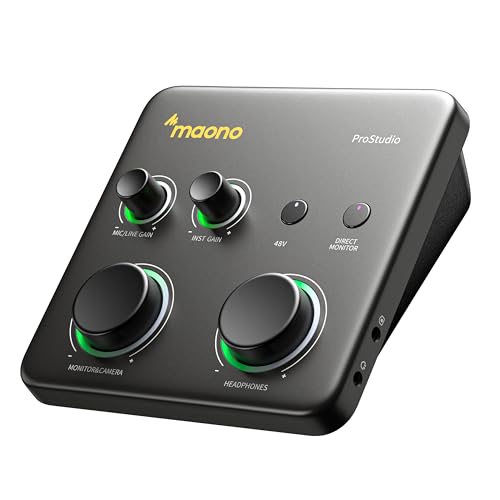
- Connects computer and phone or iPad together
- 70 dB gain with 24-bit/192 kHz recording
- Loopback, routing, and Auto-Gain for streaming
Best For: Mobile recording, podcasting, and solo streaming
Streamer’s Choice – Wave XLR MK.2
The Elgato Wave XLR MK.2 is a focused audio interface with onboard DSP for creators using one XLR microphone. Its 80dB of gain, touch controls, low-latency monitoring, and Wave Link integration make it practical for streaming and voice-focused setups.
Best For: Streamers and creators who want simple microphone control with integrated voice processing.
Pros:
- 80dB gain supports a wide range of XLR microphones.
- Built-in voice enhancer, compressor, EQ, and Wave FX processing.
- Touch mute, LED feedback, and ultra-low-latency monitoring.
- Wave Link provides routing, effects, and monitoring control.
Cons:
- Two-channel design is less suited to larger recording setups.
- Wave Link requires Windows 11 or Apple Silicon Mac systems.
This is a strong fit when streaming workflow and hands-on control matter more than extensive input and output expansion.
Studio Expansion Pick – UltraLite-mk5
MOTU UltraLite-mk5 18x22 USB Audio Interface 3 for Mac, Windows and iOS with mixing and effects
Check Price On AmazonThe MOTU UltraLite-mk5 is an audio interface with onboard DSP aimed at recording, monitoring, and routing many sources. With 18 inputs, 22 outputs, six mix buses, and onboard reverb, EQ, and dynamics, it is built for more complex studio or live-monitoring needs.
Best For: Musicians and producers who need flexible I/O, multiple monitor mixes, and detailed routing.
Pros:
- Extensive analog, digital, and optical connectivity.
- DSP-driven mixing supports a separate mix for each output pair.
- Onboard reverb, parametric EQ, and dynamics processing.
- OLED metering and CueMix 5 control provide monitoring flexibility.
Cons:
- More involved than necessary for a basic one-microphone setup.
- Its larger feature set and 2.9-pound weight may reduce portability.
The UltraLite-mk5 is the most capable choice here for users who expect their interface to manage multiple sources and monitor mixes.
Compact Streaming Mixer – AG03MK2
The Yamaha AG03MK2 combines a compact mixer layout with an audio interface with onboard DSP for live streaming. Its loopback function, mute button, and AG Controller software make it especially convenient for managing a small streaming or voice setup.
Best For: Streamers who want a small mixer-style interface with loopback and software-controlled DSP.
Pros:
- Compact three-channel design for space-conscious setups.
- Onboard DSP, loopback, and dedicated mute button support streaming.
- AG Controller works on Windows, Mac, and iOS.
- Includes Cubase AI and WaveLab Cast software.
Cons:
- Three channels provide less expansion than larger interfaces.
- The compact format is geared more toward streaming than broad studio routing.
Choose the AG03MK2 when straightforward live-streaming control and a small footprint are more important than extensive I/O.
Dual-PC Creator Pick – BEACN Studio
The BEACN Studio is an audio interface with onboard DSP designed for streaming, gaming, and podcasting. Its mic processing chain includes EQ, compression, gate, noise suppression, and low-frequency enhancement, while dual USB connectivity supports multi-device workflows.
Best For: Creators managing microphone processing and audio across two computers, consoles, or phones.
Pros:
- DSP chain includes EQ, compression, expander/gate, and noise suppression.
- Dual USB technology sends up to eight channels of digital audio.
- BEACN App manages routing and audio sources.
- BEACN Link supports remote app assignments between PCs.
Cons:
- Its feature set is more specialized than needed for simple recording.
- The dual-PC workflow depends on the BEACN software ecosystem.
The BEACN Studio stands out for creators who need detailed voice processing and flexible audio movement between multiple connected systems.
Best Streaming Mixer – Yamaha AG03MK2
The Yamaha AG03MK2 is a compact audio interface with onboard DSP designed for solo livestreaming, podcasting, and simple recording setups. Its three-channel mixer combines USB connectivity, loopback, a mute button, and controllable DSP effects in a small corded unit.
Best For: Solo streamers, podcasters, and creators who want hands-on mixing with loopback and onboard effects.
Pros:
- Includes onboard DSP effects, loopback, and a dedicated mute button.
- AG Controller supports detailed control from Windows, Mac, and iOS devices.
- Includes Cubase AI and WaveLab Cast software.
Cons:
- Three channels may be limiting for larger multi-person or band setups.
- It requires corded power rather than operating as a bus-powered portable interface.
Choose the AG03MK2 when streaming-focused controls matter more than a large input count. The loopback function and included software make it a practical all-in-one option for content creation.
Best Portable XLR Interface – Shure MVX2U Gen 2
The Shure MVX2U Gen 2 is a one-channel audio interface with onboard DSP that converts an XLR microphone to USB-C. It adds automatic gain control, noise reduction, and pop protection while supporting desktop, tablet, and smartphone workflows.
Best For: Podcasters, streamers, and mobile creators using one XLR microphone.
Pros:
- Onboard processing includes Auto Level Mode, a real-time denoiser, and Digital Popper Stopper.
- Provides up to 60 dB of clean gain and 48V phantom power.
- Works with Windows, macOS, iOS, and Android through compatible MOTIV apps.
Cons:
- Its single channel is intended for one XLR microphone at a time.
- No specific DAW software or versions are included in the supplied details.
The MVX2U Gen 2 is a focused choice for improving a single-microphone setup. Its portable USB-C design and zero-latency DSP processing are particularly useful when consistent vocal levels and straightforward setup are priorities.
Best Multi-Input Mixer – 6-Channel DSP Audio Mixer
This six-channel mixer combines USB audio connectivity with onboard DSP effects, Bluetooth playback, and multiple XLR and 1/4-inch inputs. It is a traditional analog-style console suited to karaoke, live performance, streaming, and basic recording where hands-on channel controls are useful.
Best For: Karaoke setups, small live performances, and users mixing several microphones or instruments.
Pros:
- Six channels include four XLR inputs plus 1/4-inch connections for instruments and other sources.
- Four XLR channels support switchable 48V phantom power.
- Includes 16 DSP effects, three-band EQ, Bluetooth, USB playback, and USB recording connectivity.
Cons:
- At 2.3 kg, it is less portable than compact interface-only designs.
- The listed manufacturer warranty is 90 days from purchase.
- The supplied notes identify it as a traditional analog product, so operation is more hands-on.
This mixer makes sense when channel count and built-in entertainment features are more important than a minimal desktop footprint. Its multiple inputs, phantom power, Bluetooth, and DSP effects give small performance and karaoke systems considerable flexibility.
Best Premium DSP Pick – Zenith 2 USB-C Audio Interface
If you want an audio interface with onboard DSP for polished vocals, guitar tones, and live content, the Antelope Audio Zenith 2 offers unusually broad processing. Its onboard effects let you record and monitor with low latency without relying as heavily on your computer’s CPU.
Best For: Streamers, podcasters, guitarists, and creators who want advanced DSP, flexible monitoring, and a portable USB-C setup.
Pros:
- Onboard DSP supports real-time vocal processing, guitar amp and cab simulations, and other effects.
- Two independent headphone mixes are useful for interviews, collaboration, and recording.
- Class-compliant USB-C operation works with PC, Mac, iOS, and Android devices.
- Two preamps provide up to 75 dB of gain and support demanding microphones such as the Shure SM7B.
Cons:
- Its extensive effects and Studio Wizard controls may be more than a basic user needs.
- The included software ecosystem and optional control panel can add setup complexity.
The Zenith 2 is the most feature-rich choice here for creators who want onboard processing rather than a straightforward input box. It is especially compelling when zero-latency monitoring, vocal shaping, and guitar effects are central to your workflow.
Best All-Around Studio Option – Yamaha URX22C USB-C Interface
The Yamaha URX22C is a practical audio interface with onboard DSP for musicians who want latency-free monitoring and familiar studio effects. Its two combo inputs, MIDI connectivity, and rugged metal housing make it a versatile fit for a compact recording setup.
Best For: Home-studio musicians and creators who need two inputs, MIDI, DSP monitoring, and cross-platform compatibility.
Pros:
- DSP-powered monitoring includes REV-X reverb, Channel Strip, and Guitar Amp Classics.
- Two Class-A D-PRE combo inputs include phantom power, with one Hi-Z input for guitar or bass.
- Supports 32-bit/192 kHz audio and includes MIDI input and output.
- Full-metal construction is designed for durability.
Cons:
- With two input and two output channels, it is aimed at smaller recording setups.
- The DSP feature set is focused on monitoring effects rather than the broader processing found on higher-end interfaces.
The URX22C strikes a sensible balance between studio essentials and onboard processing. Choose it if you want Yamaha preamps, MIDI, and latency-free effects in a compact two-channel interface without needing a larger input count.
Best for Mobile Creators – MAONO P1 USB Audio Interface
The MAONO P1 is a creator-focused audio interface with software-based routing and effects support for streaming, podcasting, and mobile recording. Its dual USB design lets you connect a computer and phone or iPad simultaneously, while up to 70 dB of gain supports many dynamic microphones.
Best For: Mobile streamers, podcasters, and solo creators who need flexible device connections, loopback, and simple audio routing.
Pros:
- Dual USB ports support simultaneous computer and phone or iPad connections.
- Up to 70 dB of gain is suitable for gain-hungry dynamic microphones.
- Software routing, loopback, VST support, and real-time noise reduction simplify content workflows.
- Auto-Gain, independent mute controls, and direct monitoring are useful for streaming.
Cons:
- It records at 24-bit/192 kHz rather than the higher 32-bit format offered by the Yamaha.
- Its processing and routing depend more on the supplied software than dedicated onboard DSP.
The P1 is a strong practical pick when connectivity and creator-friendly controls matter more than a large studio feature set. It is particularly well suited to mobile workflows, live streaming, and setups that combine microphones, instruments, and desktop audio.
How We Picked the Best Audio Interface with Onboard Dsp
We selected interfaces that combine audio conversion with onboard processing, monitoring, mixing, or routing features. The lineup includes compact single-microphone options, streaming-focused mixers, portable interfaces, and higher-channel-count studio units. We considered input and output flexibility, connection options, DSP effects, software support, ease of use, compatibility, and likely workflow rather than focusing on specifications alone.
Because onboard DSP implementations differ, we also looked at whether processing is useful during monitoring, recording, streaming, or live production. Some units emphasize vocal effects and loopback, while others provide broader console-style mixing and studio routing.
Quick Comparison
- For simple streaming: Look for an easy USB interface with a dedicated microphone chain, physical controls, and reliable headphone monitoring.
- For podcasting and dual-computer setups: Prioritize loopback, independent mixes, multiple USB connections, and flexible routing.
- For music production: Focus on preamp quality, converter performance, MIDI, instrument inputs, monitor outputs, and channel expansion.
- For live mixing: A compact mixer-style interface may be more convenient than a traditional recording interface.
Key Buying Factors for an Audio Interface with Onboard Dsp
Inputs, Outputs, and Connectivity
Count the microphones, instruments, headphones, monitors, and other sources you need to connect at once. Two combo inputs suit many solo creators, while multi-channel models are better for bands, interviews, and external hardware. USB-C is convenient, but confirm whether the interface works with your computer, tablet, or phone and whether the required cables are included.
DSP Effects and Monitoring
Check which effects are processed onboard and whether they can be recorded, monitored only, or routed independently. Compression, equalization, reverb, noise reduction, and amp modeling can reduce computer load and help you hear a polished signal while streaming. Also verify whether DSP settings require proprietary software or remain available without it.
Loopback and Routing
Loopback is especially valuable for streaming, tutorials, and podcasting because it can combine microphone audio with computer playback. Look for separate stream and monitor mixes if you need independent control of what guests hear versus what your audience receives.
Gain, Latency, and Compatibility
High-gain microphones may need more preamp headroom, while guitars and other instruments benefit from a suitable high-impedance input. Low-latency monitoring matters for live performance and conversation. Review operating-system support, driver requirements, mobile compatibility, and software-bundle limitations before buying.
Who Should Buy Which Audio Interface with Onboard Dsp?
Streamers and solo creators should favor straightforward controls, dependable loopback, and a useful vocal processing chain. Podcasters may prefer multiple headphone outputs, independent mixes, and dual-system routing. Musicians and home-studio users should prioritize clean preamps, instrument connectivity, MIDI or expansion, and enough outputs for monitors and headphones. Small live setups can benefit from a mixer-style interface with onboard reverb and physical channel controls. Choose the model that matches your current connections and workflow, not simply the one with the highest channel count or sample-rate figure.