The best desktop power amplifiers make it easy to build a capable stereo system without sacrificing valuable space. Compact Class D designs now offer useful power, Bluetooth connectivity, subwoofer support, and convenient desktop-friendly controls.
Our selection covers simple budget amplifiers, high-output stereo models, balanced designs, and 2.1-channel options. Use the guide below to match amplifier power, inputs, speaker compatibility, and features to your listening setup.
Best 10 Desktop Power Amplifiers Picks for 2026
Best All-Around Desktop Amp

- Up to 300W per channel
- Bass and treble controls
- RCA input for flexible setups
Best For: Compact stereo systems and passive bookshelf speakers
Best Upgrade-Friendly Amp

- 300W per channel potential
- Volume-controlled 3.5mm pre-out
- Replaceable NE5532 op-amp
Best For: Expandable desktop hi-fi systems
Best 2.1 Desktop Amp

- 165W x2 plus 350W sub output
- Adjustable subwoofer crossover
- Bluetooth 5.0 connectivity
Best For: Desktop 2.1 systems and bass-heavy listening
Best Balanced Hi-Fi Amp

- Balanced TRS and RCA inputs
- 140W x2 at 4 ohms
- Ultra-low stated distortion
Best For: Hi-fi and studio desktop systems
High-Output Wireless Pick
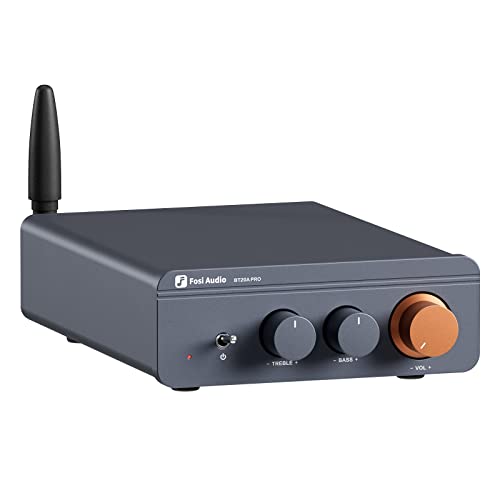
- 300W x2 TPA3255 output
- Bluetooth 5.0 with pairing memory
- Replaceable op-amps and tone controls
Best For: Powerful wireless stereo setups with passive speakers
Audiophile-Oriented Power Pick

- Up to 300W x2 with 48V supply
- Designed for 2–8 ohm speakers
- Cooling-focused chassis and swappable op-amps
Best For: High-output desktop and bookshelf-speaker systems
Best Compact Bluetooth Pick

- Bluetooth 5.0 and AUX input
- 50W x 2 for passive speakers
- Compact design with tone controls
Best For: Small desktop and home audio setups
Best Expandable Power Option

- Stereo or mono operation
- Up to 235W maximum output
- Balanced input and op-amp rolling
Best For: Powerful, scalable desktop and home audio systems
Best Simple Value Amplifier

- Two-channel Class D design
- Up to 50W per channel
- Compact aluminum chassis
Best For: Basic, efficient passive-speaker systems
Best All-Around Desktop Amp – Fosi Audio TB10D
The Fosi Audio TB10D is a practical choice for desktop power amplifiers when you want strong stereo output in a compact enclosure. Its TPA3255-based design delivers up to 300 watts per channel, while RCA input, passive speaker output, and front bass and treble controls keep setup and adjustment straightforward.
Best For: Driving 2–8-ohm passive bookshelf speakers, bass shakers, or a compact home audio system.
Pros:
- Up to 300 watts per channel from the TPA3255 amplifier chip.
- Simple RCA connectivity and passive speaker outputs.
- Adjustable bass and treble controls with built-in protection circuits.
- Compact 2.4-pound design that works with computers, TVs, phones, and other sources.
Cons:
- No Bluetooth or Wi-Fi connectivity is listed.
- Designed for passive speakers rather than powered speakers.
Choose the TB10D if you want high output, basic analog connectivity, and hands-on tone control without a full-size receiver. It is especially appealing for desktop, game-room, and small home-theater systems.
Best Upgrade-Friendly Amp – AIYIMA A07 Premium
The AIYIMA A07 Premium is one of the more flexible desktop power amplifiers for listeners who want a compact Class D stereo setup with expansion options. It uses a TPA3255 chip, includes a volume-controlled 3.5 mm pre-out, and supports replaceable NE5532 op-amps for future experimentation.
Best For: Hi-fi desktop systems using passive speakers, powered subwoofers, or other active audio equipment.
Pros:
- Up to 300 watts per channel with a compatible power supply.
- 3.5 mm pre-out can feed active speakers, a subwoofer amplifier, or another power amp.
- Swappable NE5532 op-amps provide an upgrade path for enthusiasts.
- Full-metal housing, enhanced cooling, and included 32V/5A adapter.
Cons:
- Maximum output requires upgrading the included power supply.
- It does not support Wi-Fi.
- Setup requires choosing an appropriate compatible DC power supply.
The A07 Premium makes sense when straightforward stereo amplification is not enough and you want a pre-out or replaceable op-amp design. Its compact chassis also fits neatly into a desktop hi-fi system.
Best 2.1 Desktop Amp – Fosi Audio BT30D Pro
The Fosi Audio BT30D Pro is a strong pick among desktop power amplifiers when your system needs both stereo speakers and a passive subwoofer. Its 2.1-channel layout provides two passive speaker outputs plus a dedicated subwoofer output, with separate controls for subwoofer volume and crossover frequency.
Best For: Desktop gaming, movies, music, and outdoor listening with passive speakers and a passive subwoofer.
Pros:
- 2.1-channel output rated up to 165 watts x2 plus 350 watts for the subwoofer.
- Dedicated subwoofer volume and 0–300 Hz frequency controls.
- Bluetooth 5.0 supports wireless playback up to 15 meters.
- Solid all-metal body with a compact 1.5-pound design.
Cons:
- Its subwoofer-focused design is more specialized than a basic stereo amp.
- Bluetooth range and performance can vary with the listening environment.
Pick the BT30D Pro if adding controlled low-end matters as much as powering the main speakers. It combines wired 2.1 output with Bluetooth convenience in a small enclosure suited to desktop and outdoor setups.
Best Balanced Hi-Fi Amp – TOPPING Mini300
The TOPPING Mini300 is a compact choice for desktop power amplifiers where balanced connections, low distortion, and system integration take priority. Its fully balanced Class D design supports TRS and RCA inputs, delivers up to 140 watts per channel at 4 ohms, and uses an aluminum chassis with cooling vents.
Best For: Hi-fi desktop listening, studio monitoring, and systems built around balanced DACs, preamps, or audio interfaces.
Pros:
- Fully balanced architecture with TRS and RCA input compatibility.
- Up to 140 watts x2 at 4 ohms and very low stated distortion at 8 ohms.
- 124 dB SNR/DNR supports a detailed, quiet signal path.
- TRIG control enables synchronized power with connected equipment.
Cons:
- Its 1-year warranty is shorter than some competing models listed here.
- It requires a separate source or preamp; no wireless input is listed.
- Balanced connectivity may be unnecessary for a basic desktop setup.
The Mini300 is the most specification-focused option in this group. It is best suited to listeners who already use balanced audio equipment and want a clean, compact amplifier with automatic power synchronization.
High-Output Wireless Pick – BT20A Pro
The Fosi Audio BT20A Pro is a strong choice for shoppers comparing desktop power amplifiers with wireless connectivity and substantial output. Its TPA3255 Class D design delivers up to 300 watts per channel, while Bluetooth 5.0 and adjustable bass and treble controls add everyday flexibility.
Best For: Desktop, home, or outdoor stereo setups using passive speakers and Bluetooth sources.
Pros:
- Up to 300W x2 output for driving compatible passive speakers.
- Bluetooth 5.0 includes memory for easier pairing.
- Replaceable NE5532 op-amps support sound customization.
- Low stated distortion and an SNR of at least 108dB.
Cons:
- It requires passive speakers and an external power adapter.
- The compact amplifier has no stated built-in media playback beyond Bluetooth connectivity.
The BT20A Pro stands out when power, wireless convenience, and upgradeable op-amps matter more than a larger traditional receiver layout. Bass and treble controls also make it easy to adjust the presentation for different speakers or rooms.
Compact Connectivity Pick – Nobsound Mini Bluetooth Amp
The Nobsound Mini is a practical option among desktop power amplifiers for small spaces, offering a compact aluminum design with AUX, USB, and Bluetooth 5.0 inputs. Its updated configuration provides 50 watts per channel and includes the cables and power supply needed for a straightforward setup.
Best For: Desktop or office systems that need multiple input options in a small enclosure.
Pros:
- Compact 2.76 x 3.07 x 1.5-inch form factor.
- Supports AUX, USB, and Bluetooth 5.0 sources.
- Rated output of 50W x2, or 100 watts total.
- Includes a 19V power supply, AUX, USB, and RCA cables.
Cons:
- Its output is lower than the higher-powered amplifiers in this roundup.
- The supplied specifications identify it as a two-channel amplifier for compatible passive-speaker setups.
This Nobsound model prioritizes convenience and footprint over maximum power. USB input is especially useful for computer audio, while Bluetooth and analog inputs make it adaptable to other desktop sources.
Audiophile-Oriented Power Pick – Fosi Audio V3
The Fosi Audio V3 is designed for buyers seeking high-output desktop power amplifiers with a minimalist footprint and component-focused construction. Its TPA3255 Class D platform can deliver up to 300 watts per channel, and the included 48V power supply supports setups using 2–8 ohm passive speakers.
Best For: Desktop, bookshelf, tower-speaker, and compact home-theater systems where power and upgradeability are priorities.
Pros:
- Up to 300W x2 output for compatible 2–8 ohm speakers.
- Uses premium listed capacitors and Sumida inductors.
- Top-and-bottom vents plus a whole-body heatsink aid cooling.
- Volume-controlled pre-out adds connection flexibility.
Cons:
- It is a power amplifier for passive speakers rather than a complete source component.
- Op-amp rolling requires separately sourced compatible replacements.
The V3 is the most component-focused choice here, pairing high stated output with cooling provisions, a volume-controlled pre-out, and replaceable op-amps. It is a good fit for listeners who want to build around the amplifier rather than use an all-in-one receiver.
Best Compact Bluetooth Pick – BT10A Mini Stereo Amplifier
For shoppers comparing desktop power amplifiers, the Fosi Audio BT10A is a compact two-channel option designed for passive bookshelf or desktop speakers. Its Bluetooth 5.0 and 3.5mm AUX inputs make it practical for streaming from phones, computers, and other compatible devices, while bass and treble controls allow basic sound adjustment.
Best For: Small home or desktop setups that need wireless streaming and straightforward speaker amplification.
Pros:
- Bluetooth 5.0 supports wireless streaming from compatible devices.
- Two-channel output is rated at 50W x 2 and works with most bookshelf or desktop speakers.
- Includes short-circuit, thermal, overvoltage, undervoltage, and DC protection.
- Compact aluminum design includes bass and treble controls.
Cons:
- Bluetooth range is specified at up to 50 feet, so placement and surroundings may affect connectivity.
- Its compact feature set is aimed at simple systems rather than advanced component installations.
The BT10A is a practical choice when desk space, wireless convenience, and easy setup matter more than extensive connections or system expansion.
Best Expandable Power Option – ZA3 Balanced Stereo Amplifier
Among desktop power amplifiers, the Fosi Audio ZA3 stands out for its higher output and flexible configuration. It can operate in stereo mode at up to 180W or mono mode at up to 235W, and its balanced input, 12V trigger, and subwoofer support make it suitable for more advanced passive-speaker systems.
Best For: Listeners building a more powerful desktop, bookshelf, home theater, or scalable stereo system.
Pros:
- Switches between stereo and mono operation for different system needs.
- Offers up to 180W in stereo mode and up to 235W in mono mode.
- Balanced XLR/1/4-inch TRS input helps reduce interference and noise.
- Includes a 12V trigger, subwoofer output, improved cooling, and swappable op-amps.
Cons:
- Its advanced features may be unnecessary for a basic desktop speaker setup.
- Mono operation and op-amp rolling require additional system planning or compatible components.
The ZA3 is the strongest fit here for buyers who want desktop amplification with substantial output and room to customize or expand their system over time.
Best Simple Value Amplifier – V1.0G Class D Stereo Amp
The Fosi Audio V1.0G is a straightforward choice for shoppers seeking desktop power amplifiers without extra connectivity features. This two-channel Class D amplifier uses the TPA3116D2 chip, delivers up to 50W per channel according to the supplied specifications, and includes a power adapter and AC cord for a simple home speaker setup.
Best For: Users who want an efficient, compact amplifier for basic passive home speakers.
Pros:
- Two-channel Class D design supports up to 50W per channel.
- TPA3116D2 technology is designed for efficient operation and low power loss.
- Solid aluminum chassis and built-in speaker protection circuit.
- Compact 5 x 3 x 1-inch form factor suits space-limited setups.
Cons:
- Unlike the BT10A, the supplied notes do not list Bluetooth or other wireless connectivity.
- It offers fewer system-integration features than the ZA3.
The V1.0G keeps the focus on efficient two-channel amplification, making it a sensible option for a clean, compact setup where basic operation is the priority.
How We Picked the Best Desktop Power Amplifiers
We selected these Desktop Power Amplifiers based on their stated output, amplifier topology, connectivity, channel configuration, controls, and intended use. The lineup includes compact models for bookshelf speakers, higher-powered TPA3255-based amplifiers, Bluetooth receivers, balanced designs, and dedicated 2.1-channel units with subwoofer output.
Because amplifier power claims can depend on impedance, distortion limits, power supplies, and listening conditions, treat wattage as a comparison point rather than a guarantee of real-world volume. System matching matters just as much as the headline specification.
Quick Comparison
- Best for basic stereo: Choose a simple two-channel amplifier with RCA or AUX input and straightforward speaker connections.
- Best for wireless listening: Bluetooth-equipped models simplify phone, tablet, and computer playback.
- Best for higher output: TPA3255-based amplifiers generally offer more headroom for demanding passive speakers.
- Best for a subwoofer system: A 2.1-channel amplifier or a model with a dedicated subwoofer output provides easier bass integration.
- Best for refined source equipment: A balanced amplifier can help reduce noise when paired with compatible balanced sources.
Key Buying Factors for Desktop Power Amplifiers
Power and Speaker Matching
Check both the amplifier’s rated impedance and your speakers’ nominal impedance. More power can provide useful headroom, but an amplifier should remain stable with the speakers you plan to use. Small bookshelf speakers may not need a high-output model, while inefficient speakers or larger rooms benefit from additional reserve.
Inputs and Wireless Features
Bluetooth is convenient for casual streaming, but wired RCA, AUX, USB, or balanced inputs may be preferable for permanent sources. Confirm the input types on your source devices before buying. Bluetooth version alone does not determine overall sound quality; codec support and source quality also matter.
Channel Layout and Bass Control
Two-channel amplifiers suit conventional stereo speakers. A 2.1-channel design is more appropriate when you want independent subwoofer amplification and easier bass adjustment. If an amplifier has tone controls, a pre-out, or a subwoofer output, check whether those connections work in the configuration you intend to build.
Power Supply, Cooling, and Controls
Some compact amplifiers require a separate power supply or perform differently depending on the included adapter. Review what is included and allow adequate ventilation around the chassis. Front-panel controls are useful on a desktop, while remote control support may matter for a living-room installation.
Who Should Buy Which Desktop Power Amplifiers?
Choose a basic 50-watt-per-channel model for a small desk, efficient bookshelf speakers, and straightforward wired or Bluetooth playback. Choose a higher-powered TPA3255 amplifier if you want more headroom, louder listening, or flexibility with less-efficient speakers.
Choose a 2.1-channel amplifier for a compact speaker-and-subwoofer system. Choose a balanced model when your source includes balanced outputs and minimizing connection noise is important. For a simple computer, turntable preamp, or streaming setup, prioritize the right inputs and speaker compatibility over the largest wattage number.