The right power amplifier can turn a capable speaker system into a cleaner, louder, and more reliable setup. Whether you are building a portable PA, upgrading a DJ rack, or powering home speakers, matching output and connectivity matters more than headline wattage alone.
These 10 power amplifiers cover professional rack units, compact stereo designs, bridgeable models, and home-audio options. Use the guide below to narrow your choices by system size, speaker impedance, installation style, and budget.
Best 10 Power Amplifiers Picks for 2026
High-Output Pick

- Up to 2,000W per channel at 2 ohms
- 4,000W bridge mode output
- Limiters and LED performance monitoring
Best For: Demanding live sound and high-output passive speaker systems
Portable Class D Choice

- 1,400W RMS at 4 ohms
- Stereo, parallel, and bridge modes
- LCD monitoring and selectable crossover
Best For: Mobile DJs and flexible rack-based sound systems
Compact Stereo Option

- 750-watt two-channel amplifier
- ATR technology for responsive output
- 18.7-pound item weight
Best For: Moderate-power stereo systems and smaller installations
Feature-Rich Connectivity Pick

- 2,000W bridgeable output
- Bluetooth and USB-A MP3 playback
- TRS, XLR, SpeakON, and binding-post connections
Best For: Rack systems needing convenient wireless and wired connectivity
High-Power Rack Workhorse

- Up to 2 x 1,000W into 2 ohms
- Bridged 2,000W output at 4 ohms
- XLR/TRS inputs and speaker-ready outputs
Best For: Demanding PA systems and rack installations
Flexible DJ and PA Power
Rockville RPA12 2-Channel Amplifier

- 1,400W RMS and 5,000W peak rating
- Stereo, parallel, and bridged modes
- Built-in crossover and limiter
Best For: DJ rigs, clubs, concerts, and events
Compact Balanced Home Amp
Fosi Audio ZA3 Mini Stereo Amplifier

- Up to 180W stereo or 235W mono
- Balanced XLR/TRS input and 12V trigger
- Compact chassis with 48V power supply
Best For: Desktop audio, home theater, and passive speakers
Quiet Reference Power

- 2 x 400 watts into 4 ohms
- 800 watts in bridged mono operation
- Convection-cooled for quiet operation
Best For: Studios, post-production, live sound, and HiFi systems
Tour-Ready DJ Power
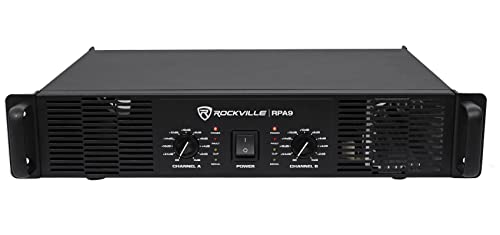
- 3000 watts peak and 800 watts RMS
- XLR, 1/4-inch, and RCA inputs
- Stereo, bridged, and 2U rackmount operation
Best For: DJs, mobile entertainers, and live venues
Proven Stage Simplicity

- 300 watts per channel at 4 ohms
- 600-watt bridged 8-ohm operation
- Forced-air cooling and flexible I/O
Best For: DJ, PA, and stage systems
High-Output Pick – Behringer EUROPOWER EP4000
The Behringer EUROPOWER EP4000 is a powerful choice among power amplifiers for demanding stereo or bridged setups. It provides substantial output at 2 and 4 ohms, with ATR technology, switchable limiters, and front-panel monitoring controls.
Best For: High-output passive speaker systems, live sound, and installations needing stereo or bridged operation.
Pros:
- Delivers up to 2,000 watts per channel at 2 ohms or 4,000 watts in bridge mode.
- ATR technology is designed for punch and clarity.
- Switchable limiters help provide overload protection.
- Detented gain controls and power, signal, and clip LEDs support precise monitoring.
Cons:
- At 38.4 pounds, it is relatively heavy for a rack amplifier.
- Its 100-volt power specification may require checking system compatibility.
The EP4000 prioritizes substantial output and monitoring features over portability. It is a practical fit when your system can accommodate its larger, heavier chassis.
Portable Class D Choice – Rockville D12
The Rockville D12 is a lightweight two-channel option among power amplifiers, combining rack mounting with stereo, parallel, and bridge modes. Its LCD monitoring, selectable crossover, and quiet cooling fans make it adaptable for DJ, live-event, and home audio systems.
Best For: DJs, mobile sound setups, and users who want flexible speaker or subwoofer configuration in a lightweight rack chassis.
Pros:
- Provides 1,400 watts RMS at 4 ohms and 700 watts RMS at 8 ohms.
- Supports stereo, parallel, and bridged operation.
- LCD monitoring shows channel volume in dB and operating temperature.
- Switchable 80Hz and 160Hz crossover settings support subwoofer or full-range use.
Cons:
- The listed 5,000-watt peak rating is higher than its 1,400-watt RMS rating, so power claims should be compared carefully.
- Its 1.5U chassis may not match every rack layout.
With a 9.7-pound Class D design and useful routing controls, the D12 is especially appealing when portability and configuration flexibility matter.
Compact Stereo Option – Behringer KM750
The Behringer KM750 is a straightforward two-channel choice among power amplifiers, offering 750 watts of output and ATR technology in a comparatively manageable chassis. Its tabletop mounting option can suit users who need stereo amplification without the EP4000’s higher output.
Best For: Stereo systems and smaller installations that need a 750-watt, two-channel amplifier.
Pros:
- Two-channel design provides stereo amplification.
- 750-watt output suits systems that do not require extreme power.
- ATR technology is intended to support responsive performance.
- At 18.7 pounds, it is lighter than the EP4000.
Cons:
- It offers less output than the other higher-powered options in this roundup.
- The supplied notes do not specify operating modes, impedance ratings, or protection features.
The KM750 is best viewed as a simpler stereo amplifier for moderate power requirements. Confirm speaker matching and installation details before purchasing.
Feature-Rich Connectivity Pick – Pyle PTA1000BT
The Pyle PTA1000BT adds Bluetooth and USB-A MP3 playback to a bridgeable two-channel design, making it a versatile option among power amplifiers. It also includes TRS and XLR inputs, SpeakON outputs, LED level indicators, and built-in cooling fans.
Best For: Users who want rack-mounted amplification with wireless streaming and multiple input and output options.
Pros:
- Offers up to 2,000 watts in bridged mode or 1,000 watts per channel in stereo.
- Bluetooth and USB-A MP3 playback add convenient source options.
- TRS, XLR, SpeakON, and binding-post connections support varied setups.
- Cooling fans and front-panel signal, clip, protect, and level indicators aid operation.
Cons:
- The supplied voltage details list 220 volts and a 120-volt minimum, so electrical compatibility should be verified.
- At 6.94 kg, it is less lightweight than the Rockville D12.
- Wireless and USB features may be unnecessary for systems using dedicated source equipment.
The PTA1000BT stands out when convenience features are as important as amplification. Its broad connectivity makes it flexible, but check voltage requirements and speaker impedance before installation.
High-Power Rack Workhorse – Behringer EUROPOWER EP2000
The Behringer EUROPOWER EP2000 is one of the more substantial power amplifiers for demanding PA setups, offering flexible output across stereo and bridged configurations. Its monitoring LEDs, broad input compatibility, and selectable low-frequency filters make it practical for installations and live sound systems.
Best For: PA users who need high output, flexible speaker wiring, and straightforward front-panel monitoring.
Pros:
- Delivers up to 2 x 1,000 watts into 2 ohms and 2,000 watts in bridged mode.
- Accepts both XLR and 1/4-inch TRS input connections.
- Includes signal, power, and clip LEDs plus selectable 30 Hz or 50 Hz filters.
Cons:
- At 34.6 pounds, it is relatively heavy for a rack-mounted amplifier.
- Its 19-inch rack-style dimensions may be excessive for compact home setups.
The EP2000 prioritizes substantial power and broad system compatibility over portability. It is a sensible choice when you need a traditional rack amplifier with clear performance monitoring and multiple speaker-connection options.
Flexible DJ and PA Power – Rockville RPA12 2-Channel Amplifier
The Rockville RPA12 is a two-channel option among power amplifiers for concerts, clubs, and event systems. It combines high rated output with stereo, parallel, and bridged modes, while its built-in crossover and limiter help adapt the amplifier to PA speakers or subwoofers.
Best For: DJs, venues, and live-event setups that need bridgeable output and built-in speaker-management features.
Pros:
- Rated at 1,400 watts RMS with a 5,000-watt peak specification.
- Supports stereo, parallel, and bridged operating modes.
- Includes a limiter, selectable 80 Hz or 160 Hz crossover, cooling fans, and a steel chassis.
Cons:
- The 2U rack-mount design requires dedicated equipment space.
- Its 26-pound weight may be less convenient for highly portable rigs.
- Its feature set may be more than necessary for simple home audio systems.
With flexible routing and integrated crossover controls, the RPA12 is built for practical event audio rather than minimalist listening spaces. Its bridgeable design is especially useful when a system needs additional configuration flexibility.
Compact Balanced Home Amp – Fosi Audio ZA3 Mini Stereo Amplifier
The Fosi Audio ZA3 is a compact choice among power amplifiers for desktop audio, home theater, and passive speakers. Its stereo and mono modes, balanced combo input, 12V trigger, and included 48V power supply provide useful flexibility without the footprint of a full-size rack unit.
Best For: Home listeners who want a small amplifier for bookshelf, tower, floorstanding, or subwoofer-based systems.
Pros:
- Produces up to 180 watts in stereo mode or 235 watts in mono mode.
- Supports XLR and 1/4-inch TRS balanced connections plus a 12V trigger input.
- Compact 6.1-by-7.24-by-2-inch chassis includes upgraded ventilation and swappable op-amps.
Cons:
- Its maximum output is lower than the large PA amplifiers in this roundup.
- The op-amp rolling feature may be unnecessary for users seeking a plug-and-play setup.
- It is intended for passive-speaker systems rather than professional rack deployment.
The ZA3 stands out for combining a small footprint with useful system-building options. Choose it when balanced connectivity, mono expansion, and desktop or home-audio integration matter more than very high venue-scale output.
Quiet Reference Power – Behringer A800
The Behringer A800 is a practical choice among power amplifiers for recording studios, post-production, live sound, and HiFi systems. Its two-channel design, flexible bridged operation, and convection cooling suit setups where stable, quiet performance matters.
Best For: Studios, post-production rooms, live sound systems, and HiFi applications using passive speakers.
Pros:
- Delivers 2 x 400 watts into 4 ohms or 800 watts in bridged mono operation.
- Convection cooling supports noise-free operation without fan noise.
- Ultra-low impedance design can drive a wide range of passive speakers.
- Level meters and clip indicators make performance monitoring straightforward.
Cons:
- The supplied notes do not specify a broad range of input or output connections.
- Its 800-watt bridged rating may be more capacity than smaller systems require.
The A800 stands out when quiet operation and flexible power delivery are priorities. Check your speaker impedance and system requirements before choosing between stereo and bridged use.
Tour-Ready DJ Power – Rockville RPA9
The Rockville RPA9 is a versatile pick among power amplifiers for DJs, live events, and professional audio racks. It combines 800 watts RMS output with multiple input and output formats, bridged or stereo modes, and cooling designed for extended use.
Best For: DJs, mobile entertainers, large venues, and rack-mounted live sound systems.
Pros:
- Provides 3000 watts peak and 800 watts RMS output.
- Accepts XLR, 1/4-inch, and RCA inputs for flexible system integration.
- Offers speakON and banana outputs, plus stereo and bridged modes.
- Dual fans and a heat sink help manage heat during long sessions.
Cons:
- Fan-based cooling may be less suitable where the quietest operation is required.
- The 2U rackmount format requires compatible rack space.
Choose the RPA9 when connectivity and high output are more important than a compact installation. Its front-panel controls and LED indicators also make it practical for live operation.
Proven Stage Simplicity – Crown XLi800
Crown XLi800 Two-channel, 600-Watt Bridged 8Ω Power Amplifier. Professional DJ, PA, Stage Amp. Black
Check Price On AmazonThe Crown XLi800 offers a straightforward two-channel option among power amplifiers for DJs, PA systems, and stage setups. It supplies 300 watts per channel at 4 ohms, supports bridged operation up to 600 watts, and includes forced-air cooling with flexible I/O.
Best For: DJs, PA systems, and stage users who need a conventional two-channel amplifier with bridged capability.
Pros:
- Delivers 300 watts continuously per channel at 4 ohms.
- Can provide up to 600 watts in bridged operation at 8 ohms.
- Forced-air cooling supports operation during demanding sessions.
- Selectable input voltage adds installation flexibility.
Cons:
- Its 600-watt maximum output is lower than the other listed amplifiers.
- Forced-air cooling may produce more audible system noise than convection cooling.
- The stated warranty applies to purchases from authorized U.S. Crown sellers.
The XLi800 is a sensible fit for conventional PA and stage rigs that value familiar operation and flexible I/O. Confirm speaker impedance and authorized-seller warranty coverage before buying.
How We Picked These Power Amplifiers
We selected models across several common use cases: mobile DJs, small venues, rehearsal spaces, installed PA systems, desktop listening, and home theater. The lineup includes stereo and bridgeable designs, compact Class D amplifiers, conventional rack-mount units, and options with balanced inputs or consumer-friendly connections.
Our comparison focuses on practical ownership factors: published output, impedance support, input and output connections, cooling, rack compatibility, portability, and the type of speakers each amplifier can realistically serve. Because manufacturers may state power under different testing conditions, treat wattage as a starting point and verify the specifications for your speakers before buying.
Quick Comparison
- Large PA systems and demanding live use: Consider the Behringer EUROPOWER EP4000 or EP2000 when substantial headroom and rack installation are priorities.
- Mobile DJ and budget rack setups: Rockville’s D12, RPA12, and RPA9 models offer practical two-channel layouts for different system sizes.
- Compact or home listening: The Fosi Audio ZA3 and Behringer A800 suit smaller, cleaner installations where size and sound quality matter.
- Flexible general-purpose use: The Behringer KM750, Pyle amplifier, and Crown XLi800 cover everyday stereo PA and entertainment applications, subject to their published limits.
Key Buying Factors for Power Amplifiers
Output Power and Speaker Impedance
Match amplifier output to the speaker’s continuous and peak ratings, not just the maximum number printed on the box. Check whether specifications are listed at 8, 4, or 2 ohms, and confirm that the amplifier supports your speakers’ impedance. Bridging channels can increase output, but it also changes the minimum safe load and may remove ordinary stereo operation.
Connections and System Compatibility
Balanced XLR or TRS inputs are valuable for long cable runs because they help reject hum and interference. Speakon outputs are common in PA systems, while binding posts and quarter-inch outputs may suit other installations. Bluetooth, USB, or MP3 inputs can be convenient, but they should not replace the connection types your mixer, interface, or speakers require.
Cooling, Noise, and Installation
Rack amplifiers typically use active fans and need unobstructed airflow. Check rack depth, ventilation clearance, fan noise, and weight before installing one in a small room or portable case. Compact Class D designs are often easier to carry and may run cooler, while larger conventional units can be better suited to sustained professional workloads.
Protection and Controls
Look for safeguards such as thermal, overload, short-circuit, and clip protection. Front-panel gain controls, signal indicators, and limiter behavior also affect setup and troubleshooting. A reliable amplifier should provide enough headroom without forcing you to run it continuously at the edge of clipping.
Who Should Buy Which Power Amplifiers?
Choose a high-output Behringer EUROPOWER model for larger PA systems, live events, or installations that need substantial reserve power. Choose a Rockville or Pyle rack amplifier for budget-conscious DJ rigs and general-purpose entertainment systems, after confirming the stated ratings and connector requirements.
Choose the Fosi Audio ZA3 for a compact desktop, bookshelf, or home-theater system where a small footprint and flexible home-audio configuration matter. Choose the Behringer A800 when a quieter reference-style home or studio installation is more important than maximum PA output. Choose the Crown XLi800 when you prefer a recognizable professional audio platform for moderate two-channel applications.