Choosing among power amplifiers with XLR inputs starts with matching the amplifier to your speakers, source equipment, and intended listening environment. Balanced XLR connectivity can help reduce noise over longer cable runs, making it useful for home audio, DJ rigs, rehearsal spaces, and small PA systems.
This roundup includes compact mono amplifiers, stereo home-audio models, and rack-mount professional units. Compare power ratings carefully, since output can vary by impedance, channel count, and bridged operation.
Best 10 Power Amplifiers with Xlr Inputs Picks for 2026
Best Overall

- 350W per channel at 4 ohms
- Balanced XLR, TRS, and RCA inputs
- DSP protection and crossover controls
Best For: Professional two-channel systems and live audio
Best Feature-Packed Value

- Up to 2,000W in bridged mode
- XLR, TRS, Bluetooth, and USB inputs
- Speakon and binding-post outputs
Best For: DJs and flexible event sound systems
Best Compact Monoblock

- 240W at 4 ohms from a compact chassis
- Balanced XLR/TRS and RCA inputs
- PFFB Class D design with low listed THD
Best For: Modular HiFi and home theater systems
Best for DJs and Live Events
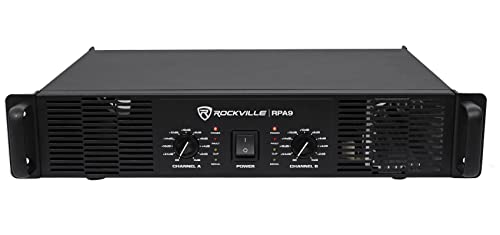
- 800W RMS and 3,000W peak output
- XLR, 1/4-inch, and RCA inputs
- Stereo/bridged modes with built-in crossover
Best For: DJ rigs, touring setups, and live events
Best Balanced Hi-Fi Power

- 250W per channel into 4 ohms
- XLR, RCA, and XLR-mono inputs
- Expandable mono-bridge operation
Best For: Home hi-fi systems using balanced sources
Best High-Power PA Value
MUSYSIC SYS-4500 Professional Amplifier

- 4500W stated peak power
- Stereo XLR and 1/4-inch inputs
- Rack-mount two-channel design
Best For: DJ, live-performance, and passive-speaker systems
Best Rack-Mount Flexibility
Rockville D12 Class D Amplifier

- 1400W RMS at 4 ohms
- Stereo, parallel, and bridged modes
- LCD, crossover, and XLR inputs
Best For: Flexible DJ and PA speaker configurations
Reliable Stage Power
Crown XLi800 Two-Channel Amplifier

- 300W per channel at 4Ω
- 600W bridged maximum output
- Forced-air cooling with flexible I/O
Best For: DJs, small PA systems, and straightforward stage amplification
High-Output Venue Power
Rockville RPA16 Professional Amplifier

- Up to 3000W RMS bridged at 8Ω
- Combo XLR/1/4-inch inputs and Speakon outputs
- Crossover, limiter, LCD, and bridge modes
Best For: Large venues, touring systems, and subwoofer applications
Lightweight DSP Control
Crown XLS1502 Class D Amplifier
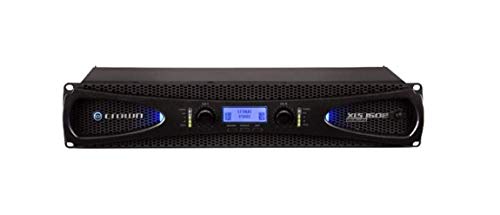
- 525W per channel at 4Ω
- XLR, 1/4-inch TRS, and RCA inputs
- DSP filters, PeakX limiters, and crossover
Best For: Mobile DJs and PA systems needing lightweight DSP-equipped amplification
Best Overall – Crown XLS1002
For buyers seeking power amplifiers with xlr inputs, the Crown XLS1002 is a lightweight two-channel option with balanced XLR connectivity, useful DSP features, and flexible output modes. It delivers 350 watts per channel at 4 ohms while weighing less than 11 pounds.
Best For: Professional audio setups, live events, and studios needing efficient two-channel amplification with built-in protection and crossover controls.
Pros:
- Provides 350 watts per channel at 4 ohms, with up to 1,100 watts bridged at 4 ohms.
- Includes two balanced XLR inputs plus TRS and RCA connectivity.
- DSP features include Peakx Limiters, PureBand crossover controls, and selectable input sensitivity.
- Class D DriveCore design weighs 8.6 pounds and includes sleep mode for energy savings.
Cons:
- Its official warranty applies to purchases from authorized Crown North American dealers within the United States.
- The amplifier is designed for rack mounting and professional system integration rather than simple desktop use.
The XLS1002 stands out for combining useful signal processing, broad input compatibility, and strong power-to-weight performance. It is a practical choice when reliability and setup flexibility matter more than extra consumer features.
Best Feature-Packed Value – Pyle PTA1000BT
The Pyle PTA1000BT is a versatile choice among power amplifiers with xlr inputs, adding Bluetooth, USB playback, bridge mode, and multiple speaker connections to a rack-mountable two-channel design. It is rated at 1,000 watts per channel in stereo or 2,000 watts in bridged mode.
Best For: DJs, event setups, and users who want pro-style inputs and outputs alongside convenient wireless and USB playback.
Pros:
- Offers two XLR and two 1/4-inch TRS inputs, plus Speakon and binding-post outputs.
- Supports stereo and bridged operation for 4- to 8-ohm speaker systems.
- Built-in Bluetooth and USB-A MP3 playback provide flexible source options.
- Front-panel LCD and LED indicators make levels, signal, clipping, and protection easy to monitor.
Cons:
- The listed 2,000-watt figure is maximum or bridged output, not continuous per-channel stereo power.
- At 6.94 kg, it is less portable than lightweight Class D alternatives.
With its broad connectivity and front-panel controls, the PTA1000BT is aimed at convenience as much as amplification. It makes sense for systems where wireless playback and flexible routing are as important as rack compatibility.
Best Compact Monoblock – Fosi Audio V3 Mono
The Fosi Audio V3 Mono is a compact single-channel option for buyers comparing power amplifiers with xlr inputs for home audio. With balanced XLR/TRS and RCA inputs, a 48V/5A power supply, and up to 240 watts at 4 ohms, it can be used alone or expanded into a multichannel system.
Best For: HiFi home audio, AV receiver upgrades, and modular speaker systems where a small monoblock amplifier is preferred.
Pros:
- Delivers up to 240 watts at 4 ohms from a compact 750-gram chassis.
- Supports balanced XLR/TRS and single-ended RCA inputs with gain selection.
- Uses PFFB technology and a TPA3255 Class D design, with listed THD as low as 0.006%.
- Includes auto power or signal sensing and replaceable DIP8-compatible op-amps.
Cons:
- It is a single-channel amplifier, so stereo or multichannel systems require additional units.
- Its 48V power supply requirement may complicate replacement or system matching.
The V3 Mono is best viewed as a flexible building block rather than a conventional stereo power amp. Its small footprint and balanced inputs make it especially appealing for discreet home installations and expandable systems.
Best for DJs and Live Events – Rockville RPA9
The Rockville RPA9 is a rugged two-channel rack amplifier for shoppers seeking power amplifiers with xlr inputs for DJ rigs and live sound. It combines XLR, 1/4-inch, and RCA inputs with Speakon and banana outputs, plus stereo and bridged modes.
Best For: DJs, mobile entertainers, and live-event systems that need rack mounting, high peak output, and multiple connection options.
Pros:
- Rated at 800 watts RMS and 3,000 watts peak for demanding sound applications.
- Provides XLR, 1/4-inch, and RCA inputs for compatibility with varied source equipment.
- Includes Speakon and banana outputs, stereo/bridged modes, and a built-in crossover.
- Dual fans and a heatsink design support extended operation, while front LEDs aid monitoring.
Cons:
- The supplied notes do not specify per-channel output by impedance.
- Its 2U rackmount format is less suited to compact home listening setups.
The RPA9 focuses on practical live-sound features: sturdy construction, flexible connections, cooling, and straightforward front-panel monitoring. It is a sensible fit for users who need a conventional rack amplifier for events rather than a small home-audio component.
Best Balanced Hi-Fi Power – SMSL PA400 GaN Amplifier
The SMSL PA400 is a strong choice among power amplifiers with XLR inputs for desktop or home hi-fi systems. Its balanced XLR input, RCA connectivity, and Class D GaN design provide flexible setup options, while stereo output reaches 250 watts per channel into 4 ohms.
Best For: Home listeners who want a compact, high-power stereo amplifier with balanced connectivity.
Pros:
- Balanced XLR, RCA, and XLR-mono input options.
- Delivers 250 watts per channel into 4 ohms in stereo mode.
- Can reach 500 watts into 4 ohms in mono mode with a second unit.
- CNC-machined aluminum chassis provides rigidity and heat dissipation.
Cons:
- Mono operation requires two PA400 amplifiers.
- Its one-year warranty is relatively limited.
The PA400 stands out for listeners prioritizing balanced signal connections and clean, transparent home-audio performance. Its mono-bridge option also leaves room to expand for more demanding speakers.
Best High-Power PA Value – MUSYSIC SYS-4500 Professional Amplifier
The MUSYSIC SYS-4500 is a rack-mount two-channel option for shoppers comparing power amplifiers with XLR inputs for DJ rigs, live performance, or passive-speaker systems. It offers 4500 watts of peak power, a 10Hz–50kHz frequency response, and multiple connection configurations.
Best For: DJs, musicians, and users needing a high-output two-channel amplifier for passive speakers or PA systems.
Pros:
- 4500 watts of stated peak power for demanding PA applications.
- Includes stereo XLR and 1/4-inch inputs.
- 0.77V input sensitivity helps amplify weaker source signals.
- Rack-mount aluminum chassis is suited to installed or mobile systems.
Cons:
- The supplied notes specify peak power but do not provide detailed continuous output ratings.
- At 18 pounds and 19 inches wide, it is less suited to compact desktop setups.
With its rack-ready format and professional input options, the SYS-4500 is oriented toward larger audio systems rather than casual listening. Verify speaker power requirements and available rack space before buying.
Best Rack-Mount Flexibility – Rockville D12 Class D Amplifier
The Rockville D12 combines XLR and 1/4-inch inputs with practical controls, making it a versatile pick among power amplifiers with XLR inputs. Its two-channel Class D design supports stereo, parallel, and bridged operation, while the built-in crossover and LCD monitoring help with system setup.
Best For: DJs and mobile or installed PA users who need flexible speaker modes, crossover control, and rack mounting.
Pros:
- Provides 1400 watts RMS at 4 ohms and 700 watts RMS at 8 ohms.
- Supports stereo, parallel, and bridged operating modes.
- Switchable bypass, 80Hz, and 160Hz crossover settings.
- LCD monitoring shows channel volume and operating temperature.
Cons:
- The 1.5U rack chassis may not suit non-rack home setups.
- Its 100-volt listed voltage specification should be checked against the intended installation.
The D12 is particularly appealing when you need more than basic amplification. Its crossover, limiter, monitoring display, and multiple output modes make it easier to adapt to passive speakers, subwoofers, and mixed systems.
Reliable Stage Power – Crown XLi800 Two-Channel Amplifier
Crown XLi800 Two-channel, 600-Watt Bridged 8Ω Power Amplifier. Professional DJ, PA, Stage Amp. Black
Check Price On AmazonThe Crown XLi800 is a straightforward choice among power amplifiers with XLR inputs for DJs, PA systems, and small stage setups. Its two-channel design delivers 300 watts per channel at 4 ohms, with a bridged maximum output of 600 watts and forced-air cooling for sustained operation.
Best For: DJs, small PA systems, and users seeking a dependable two-channel rack-style amplifier.
Pros:
- 300 watts per channel at 4 ohms.
- Two-channel operation with 600-watt bridged capability.
- Forced-air cooling and flexible I/O.
- Selectable input voltage supports varied setups.
Cons:
- At 25.1 pounds, it is considerably heavier than compact Class D alternatives.
- The supplied notes do not specify built-in DSP or crossover features.
The XLi800 focuses on essential amplification rather than extensive signal processing. Choose it when reliable two-channel output and straightforward operation matter more than advanced DSP controls or a lightweight chassis.
High-Output Venue Power – Rockville RPA16 Professional Amplifier
The Rockville RPA16 is a high-output option for buyers comparing power amplifiers with XLR inputs for large venues, DJ events, and sound reinforcement. It combines combo XLR/1/4-inch inputs with bridge mode, substantial RMS output, crossover settings, protection features, and a rack-mount steel chassis.
Best For: Large venues, touring systems, subwoofer applications, and users who need flexible routing and high power.
Pros:
- Up to 2 x 1500W RMS at 4 ohms or 3000W RMS bridged at 8 ohms.
- Combo XLR/1/4-inch inputs, Speakon outputs, and XLR line outputs.
- Selectable stereo, parallel, and bridged operating modes.
- Built-in crossover, limiter protection, LCD monitoring, and cooling fans.
Cons:
- Its 40.8-pound weight makes installation and transport less convenient.
- The 2U rack-mount chassis may be more amplifier than smaller systems require.
- Warranty coverage is listed as one year.
The RPA16 is built around power and system flexibility. Its bridge mode and crossover make it especially useful for demanding low-frequency setups, while the display and protection features help with monitoring during events.
Lightweight DSP Control – Crown XLS1502 Class D Amplifier
The Crown XLS1502 is a lightweight, versatile pick among power amplifiers with XLR inputs. Its Class D DriveCore design weighs 8.6 pounds while providing 525 watts per channel at 4 ohms, plus DSP features such as band-pass filters, PeakX limiters, and the PureBand crossover system.
Best For: Mobile DJs, rack-mounted PA systems, and users who want strong output with DSP control and low weight.
Pros:
- 525 watts per channel at 4 ohms and 1550 watts bridged at 4 ohms.
- Balanced XLR, 1/4-inch TRS, and RCA inputs accommodate varied sources.
- Integrated DSP includes band-pass filters, PeakX limiters, and PureBand crossover.
- Lightweight 8.6-pound Class D design with forced-air cooling.
Cons:
- The supplied output specifications do not list Speakon or banana outputs.
- Its advanced menu and DSP controls may be unnecessary for simple setups.
The XLS1502 is a strong fit when portability and processing flexibility are priorities. Selectable input sensitivity, sleep mode, and menu lock add practical control for professional installations and mobile performance rigs.
How We Picked These Power Amplifiers with Xlr Inputs
We selected models across several common use cases, including home theater, desktop hi-fi, DJ setups, live sound, and installed audio. Our comparison emphasizes XLR input availability, channel configuration, published power ratings, connectivity, amplifier class, installation format, and practical control features such as DSP, limiters, bridge mode, and protection circuitry.
Because manufacturers do not always report wattage under identical conditions, treat power figures as a starting point rather than a direct ranking. Speaker impedance, distortion limits, cooling, and whether the rating is per channel or bridged all affect real-world performance.
Quick Comparison
Compact models such as the Fosi Audio V3 Mono and SMSL PA400 suit desktop or home-audio systems where size and low noise matter. Crown’s XLS series adds DSP-oriented features and efficient Class D operation for flexible stereo setups. Rack-mount options from Pyle, Rockville, and MUSYSIC are better suited to DJ racks, PA systems, and applications requiring conventional professional connections. The Crown XLi800 focuses on straightforward two-channel amplification, including bridged operation for compatible setups.
Key Buying Factors for Power Amplifiers with Xlr Inputs
Power and Speaker Impedance
Check the amplifier’s output at your speakers’ nominal impedance, commonly 4 or 8 ohms. Avoid choosing based only on a headline peak or bridged figure. The amplifier should provide enough clean headroom for your speakers without operating continuously at its limit.
Input and Output Compatibility
Confirm whether the XLR connection is balanced input, XLR pass-through, or an XLR mono input option. Also check for RCA, TRS, Speakon, binding-post, or other outputs required by your system. Adapters can work, but a native connection is usually simpler and more reliable.
Channels, Bridge Mode, and DSP
A two-channel amplifier is useful for stereo speakers or separate speaker zones. Bridge mode can increase output for a single compatible load, but it changes impedance requirements and eliminates normal stereo operation. DSP, band-pass filters, limiters, and protection controls are valuable for PA and speaker-management applications.
Size, Cooling, and Noise
Rack-mount amplifiers are practical for mobile and installed systems, while compact units fit desktops and living rooms. Review ventilation requirements and fan behavior, especially if the amplifier will be near listeners or used in a quiet room.
Who Should Buy Which Power Amplifiers with Xlr Inputs?
Choose a compact mono or desktop model for a small home-audio system, powered by a compatible preamp or AVR. Pick a Crown XLS model if you want efficient stereo amplification with useful DSP and protection features. A Crown XLi800 is a straightforward choice for users who prefer a conventional professional power amplifier.
For DJs, rehearsal spaces, and small PA systems, a rack-mount Pyle, Rockville, or MUSYSIC amplifier may offer the connection layout and output capacity you need. Before buying, verify speaker impedance, continuous power requirements, rack depth, ventilation, and the exact XLR signal path so the amplifier fits your complete system rather than just your target wattage.