The right keyboard stand can make a major difference onstage, where stability, setup speed, portability, and usable playing height all matter. This roundup compares 10 stands for digital pianos, MIDI controllers, synthesizers, and stage keyboards.
From compact folding X stands to heavy-duty Z frames and two-tier designs, these options cover rehearsals, touring, church services, studio work, and live performance setups.
Best 10 Keyboard Stands for Stage Use Picks for 2026
Heavy-Duty Z-Style Pick

- 250-pound load capacity
- Seated or standing height range
- Straps, feet, and headphone hook included
Best For: Heavy keyboards and stability-focused stage setups
Classic Portable Pick
On-Stage Double-X Keyboard Stand

- Supports keyboards up to 120 pounds
- Quick pull-knob adjustment
- Folds flat for transport
Best For: Portable gig setups with traditional X-style support
Rolling Heavy-Duty Pick
Z-Style Keyboard Stand with Wheels

- 250-pound load capacity
- Integrated wheels for repositioning
- Adjustable for seated or standing play
Best For: Heavy keyboards that need easier movement on stage
Fast-Setup Budget Pick
RockJam Xfinity Double-X Stand
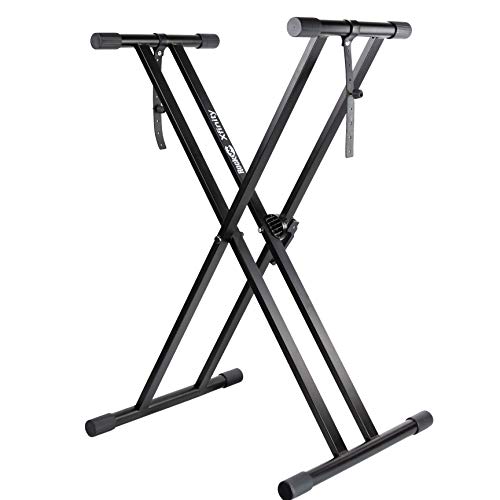
- Arrives pre-assembled
- Height adjusts from about 4 to 38 inches
- Safety lock and straps included
Best For: Beginners and lighter keyboards needing simple setup
Best for Multi-Keyboard Rigs
On-Stage KSA8500 Deluxe Keyboard Tier

- Supports up to three keyboards
- Adjustable height, depth, and tilt
- Fits compatible X-style stands
Best For: Compact stacked or staggered keyboard setups
Best Complete Performance Bundle
Tipatyard Double-X Stand and Bench Set

- Includes an adjustable bench
- Seven stand height settings
- Folds flat with locking straps
Best For: Portable 54- to 61-key performance setups
Best Simple Folding Stand
Stage Rocker Single-X Keyboard Stand
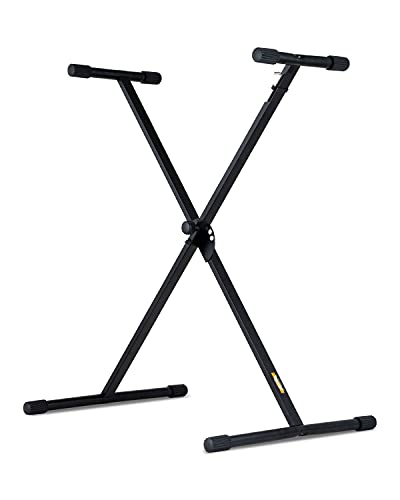
- Adjustable width and height
- Folds for travel and storage
- Bolted single-X frame with cushion feet
Best For: Portable single-keyboard stage setups
Heavy-Duty Z-Stand
Adjustable Keyboard Stage Stand

- Supports up to 250 pounds
- Height and width adjustable
- Protective buckles, straps, and pads
Best For: Performers needing a strong, adaptable single-keyboard stand
Double-Keyboard Rig
OnStage Folding-Z Stand with Second Tier

- Accommodates two keyboards
- 400-pound main-tier capacity
- Tool-free disassembly for transport
Best For: Players building a stable two-keyboard stage setup
Portable Z-Frame
Pyle Folding Adjustable Keyboard Stand

- Lightweight 4.4-kilogram build
- Foam-padded arms protect the keyboard
- Folds compactly for travel and storage
Best For: Traveling players and lighter single-keyboard setups
Heavy-Duty Z-Style Pick – Adjustable Keyboard Stand
For keyboard stands for stage use, this reinforced Z-style model offers substantial support, flexible positioning, and quick setup. Its adjustable height and width accommodate 54- to 88-key keyboards and allow seated or standing play.
Best For: Players who want a sturdy, adjustable stand for stage, studio, home, or travel use.
Pros:
- Supports up to 250 pounds and is designed to be less prone to tipping than common X-style stands.
- Height adjusts from 22.5 to 33.5 inches, while width adjusts from 22.5 to 33.5 inches.
- Includes anchoring straps, anti-skid feet, a headphone hook, and quick pack-flat transport.
Cons:
- The Z-style frame is heavier than the listed X-style alternatives at about 7 kg.
- It has one support level rather than a multi-tier configuration.
With its high load capacity and stability-focused design, this is a strong choice for performers carrying heavier keyboards or additional gear.
Classic Portable Pick – On-Stage Double-X Keyboard Stand
Among keyboard stands for stage use, the On-Stage KS7191 emphasizes straightforward adjustment, dependable support, and easy transport. Its double-X frame folds flat and supports keyboards weighing up to 120 pounds.
Best For: Gigging keyboardists who need a compact, uncomplicated stand with a traditional double-X design.
Pros:
- Square tubing provides stable support for keyboards up to 120 pounds.
- Pull-knob adjustment makes height and width changes quick and simple.
- Nonslip feet and adjustable arm sleeves help keep the instrument positioned during performance.
- Folds flat for load-in, teardown, storage, and transportation.
Cons:
- Its 120-pound capacity is lower than the 250-pound Z-style options listed here.
- The X-style frame may provide less inherent stability than a Z-style design.
This stand is a practical stage workhorse for musicians who value familiar controls, folding portability, and a professional black finish.
Rolling Heavy-Duty Pick – Z-Style Keyboard Stand with Wheels
For keyboard stands for stage use where repositioning matters, this rolling Z-style stand combines a 250-pound load rating with adjustable height and width. Its wheels can help move a keyboard during setup, while anchoring straps and anti-skid feet add security during playing.
Best For: Performers and production setups that need heavy-duty support with easier onstage or studio movement.
Pros:
- Supports up to 250 pounds and fits 54- to 88-key electric pianos.
- Adjusts for seated or standing play, with height from 22.5 to 33.5 inches.
- Built-in wheels support rolling transport and repositioning.
- Includes anchoring straps, adjustable feet, anti-skid foam pads, and a headphone hook.
Cons:
- At about 7.31 kg, it is the heaviest listed option.
- Its rolling hardware and Z-style construction may be bulkier than a basic folding X stand.
This model is a compelling choice when a heavy keyboard needs both a stable platform and more convenient movement between positions.
Fast-Setup Budget Pick – RockJam Xfinity Double-X Stand
For keyboard stands for stage use that prioritize quick setup, the RockJam Xfinity arrives pre-assembled: unfold it, select the height, and lock it in place. Its reinforced double-X steel frame is intended for full-size digital pianos and adjusts from about 4 to 38 inches.
Best For: Beginners, lessons, and performers who want a simple stand that transitions from seated-child height to standing-adult height.
Pros:
- Pre-assembled design avoids screws and complicated setup.
- Wide height range suits seated kids through standing adults.
- Safety lock, securing straps, and nonslip rubber caps help support the keyboard.
- Heavy-duty steel construction works for home, lessons, studio, and stage use.
Cons:
- Its listed 45-pound capacity is considerably lower than the other stands in this roundup.
- It offers no stated wheels or additional accessories such as a headphone hook.
- The warranty is 12 months, shorter than the three-year warranties listed for the other models.
The Xfinity is a convenient entry-level option for lighter keyboards and users who want minimal assembly, but heavier instruments require careful attention to its lower load rating.
Best for Multi-Keyboard Rigs – On-Stage KSA8500 Deluxe Keyboard Tier
For performers comparing keyboard stands for stage use, the On-Stage KSA8500 is a tiered add-on for building a compact multi-keyboard setup. It fits compatible X-style stands and supports up to three keyboards, with adjustable arms for positioning each instrument.
Best For: Musicians stacking or staggering multiple keyboards in a compact stage setup.
Pros:
- Supports up to three keyboards with three levels.
- Arms adjust in height, depth, and tilt.
- Fits 1-inch or 30 mm tubing on X-style stands.
- Supports up to 66 pounds.
Cons:
- Designed as a tier accessory rather than a complete standalone stand.
- Compatibility is limited to suitable X-style stand tubing.
- Its 15.3-pound weight may add to transport demands.
The KSA8500 is a practical choice when stage space is limited and several keyboards need dedicated positions. Confirm your existing stand’s tubing size and total instrument load before setup.
Best Complete Performance Bundle – Tipatyard Double-X Stand and Bench Set
This Tipatyard set combines a folding double-X keyboard stand with an adjustable bench, making it a convenient option among keyboard stands for stage use. Its steel construction, locking straps, and multiple height settings support portable performance setups for compatible 54- to 61-key instruments.
Best For: Players who want one portable package for keyboard support and seating at performances, rehearsals, or studio sessions.
Pros:
- Includes both a keyboard stand and PU leather bench.
- Stand offers seven height settings; bench offers four.
- Double-X construction, non-slip caps, and locking straps add stability.
- Folds flat for transport and storage.
Cons:
- Specified fit is limited to 54- to 61-key electric pianos.
- Requires assembly before use.
- Its bundled design may be more than needed if you already have a bench.
Choose this set if portability and an included seat matter as much as keyboard support. The locking straps and adjustable design are useful for stage work, while the stated key-range fit should be checked before purchase.
Best Simple Folding Stand – Stage Rocker Single-X Keyboard Stand
The Stage Rocker Single-X is a straightforward folding option for shoppers seeking keyboard stands for stage use without extra tiers or accessories. Its width and height adjust independently, and the stand folds for transport, storage, classroom use, home studios, or live performance.
Best For: Players who need a portable single-keyboard stand with adjustable sitting and standing positions.
Pros:
- Adjusts from 13.3 to 31.9 inches wide and 24.6 to 38.2 inches high.
- Single-X frame uses bolted construction for stability.
- Folds into a slim profile for travel and storage.
- Includes cushion feet and keyboard rests.
Cons:
- Single-level design does not support stacked keyboards.
- Assembly is required.
- Its stated support depth is 19.3 inches, so instrument dimensions should be checked.
This stand keeps the setup simple while providing useful width and height adjustment. It is a sensible fit for performers who prioritize portability and a basic single-keyboard platform over tiered expansion.
Heavy-Duty Z-Stand – Adjustable Keyboard Stage Stand
For keyboard stands for stage use, this adjustable Z-style model emphasizes capacity, stability, and quick setup. It supports up to 250 pounds, fits 54-, 61-, and 88-key keyboards, and folds flat for transport.
Best For: Performers and studios needing a strong, adjustable stand with protective features and accessory hooks.
Pros:
- Heavy-duty 1.5mm metal construction supports up to 250 pounds.
- Adjustable height from 22 to 37 inches and width from 24 to 33.8 inches.
- Z-bracket design, keyboard buckles, mounting straps, and non-slip pads improve stability and protection.
- Sets up and breaks down in under a minute, with headphone hooks for organization.
Cons:
- Single-level design does not provide a second keyboard tier.
- At 10.3 pounds, it may be heavier than basic portable stands.
This is a versatile choice when stage reliability and high load capacity matter more than the lightest possible carry weight. Its wide adjustment range also makes it suitable for different keyboards and playing positions.
Double-Keyboard Rig – OnStage Folding-Z Stand with Second Tier
Among keyboard stands for stage use, the OnStage KS7365EJ stands out for handling two keyboards in one footprint. Its main tier supports up to 400 pounds, while the adjustable second tier supports 60 pounds.
Best For: Keyboardists who need a two-tier performance setup for digital pianos, synthesizers, or organs.
Pros:
- Holds two keyboards without requiring two separate stands.
- Main stand supports up to 400 pounds; second tier supports up to 60 pounds.
- Main height adjusts from 23.5 to 36.5 inches, and the second tier angle adjusts for comfort.
- Disassembles quickly without tools for storage and transport.
Cons:
- At 29.5 pounds, it is substantially heavier than single-tier alternatives.
- The second tier has a lower 60-pound capacity than the main stand.
This is the most performance-oriented option in the group for a compact two-keyboard rig. Choose it when capacity and a second tier are priorities, and the additional carrying weight is acceptable.
Portable Z-Frame – Pyle Folding Adjustable Keyboard Stand
For keyboard stands for stage use on a tighter travel budget, this Pyle folding Z-frame offers adjustable height and width with foam-padded arms. It fits 54- to 88-key electric pianos and folds into a compact form for storage or transport.
Best For: Beginners, traveling musicians, classrooms, and home studios needing a lightweight single-tier stand.
Pros:
- Lightweight 4.4-kilogram design folds for travel and storage.
- Foam-padded arms help prevent slippage and surface scratches.
- Sliding adjustment provides flexible positioning between 20 and 34 inches.
- Stability lock mechanism supports secure keyboard placement.
Cons:
- 85-pound load capacity is lower than the other stands listed here.
- Single-tier design does not accommodate a second keyboard.
This stand makes sense when portability and straightforward adjustment are more important than maximum load capacity. Its padded arms and folding Z design provide useful stage and travel conveniences for lighter keyboard setups.
How We Picked These Keyboard Stands for Stage Use
We focused on the practical requirements of live performance: dependable support, adjustable height and width, transport-friendly folding or assembly, and compatibility with common 54- to 88-key instruments. We also considered frame style, weight capacity, locking hardware, padding, available tiers, wheels, and whether a stand is better suited to a single keyboard or a more complex rig.
Because stage setups vary, no single design is ideal for everyone. A lightweight X stand may be preferable for quick gigs, while a Z-style frame or reinforced folding stand can provide a more substantial platform for heavier digital pianos. Tiered models were included for players who need multiple keyboards, modules, or controllers within reach.
Quick Comparison
| Stand type | Best for | Main advantage | Potential trade-off |
|---|---|---|---|
| Single-X | Portable gigging | Fast folding and easy transport | Less room for accessories or a second keyboard |
| Double-X | General stage use | Broad balance of stability and portability | May have fewer ergonomic adjustment options |
| Z-style | Digital pianos and heavier setups | Solid footprint and useful legroom | Usually bulkier than X-style designs |
| Tiered | Multi-keyboard rigs | Adds a second playing level | More setup complexity and stage space |
| Wheeled | Frequent repositioning | Easier movement between locations | Locking wheels and floor conditions matter |
Key Buying Factors for Keyboard Stands for Stage Use
Stability and Weight Capacity
Check the manufacturer’s stated capacity against the actual weight of your keyboard, stand-mounted accessories, and any downward playing force. Wide feet, reinforced joints, locking mechanisms, and non-slip padding are especially valuable for energetic performances. A stand rated for a high load is not automatically stable if it is set too narrow or too high.
Height, Width, and Playing Ergonomics
Choose a stand that lets you position the keys comfortably while seated or standing. Width adjustment should accommodate your keyboard without leaving excessive overhang. For two-tier stands, confirm that the upper level can be angled and positioned without blocking controls or forcing an awkward reach.
Portability and Setup
Folding X stands typically win for public transit and quick load-ins. Z-style stands can offer better support but may take more room in a vehicle. Look for tool-free adjustments, secure locking pins or straps, manageable weight, and a folded profile that fits your case or storage area.
Stage Features and Compatibility
Foam-padded arms help protect the instrument, while locking straps can reduce movement during performance. Wheels are useful when moving a fully assembled setup, but they should lock securely. Measure your keyboard and check clearance for pedals, cables, sustain bars, and any second-tier equipment before buying.
Who Should Buy Which Keyboard Stands for Stage Use?
Choose a Single-X Stand If You Travel Light
Single-X models are a practical choice for musicians who need the smallest, fastest setup for a single keyboard. They suit rehearsals, lessons, smaller venues, and players who prioritize portability over maximum rigidity.
Choose a Double-X or Z-Style Stand for a Stable Main Keyboard
Double-X stands are versatile all-purpose options. A Z-style stand is often the better match for a heavier 88-key digital piano, seated playing, or a setup where legroom and a broader base are important.
Choose a Tiered Stand for Multiple Keyboards
Players using a piano plus synthesizer, MIDI controller, organ module, or other compact instrument should consider a second tier. Confirm the total load, available adjustment range, and whether the added height works with your preferred posture.
Choose a Wheeled or Bench-Equipped Option for Convenience
Wheels can simplify room changes and stage positioning when they include reliable locks. A bundled bench may be worthwhile for fixed or semi-permanent setups, but traveling musicians should compare the package’s total weight and packed size before choosing convenience over portability.