Choosing the right MIDI controller can make composing, beat-making, and recording faster, cleaner, and more creative. The best options balance key feel, portability, controls, and software workflow.
In this roundup, we focus on practical MIDI keyboards for production, covering compact travel-friendly models and more capable controllers for fuller studio setups.
Best 10 Midi Keyboards for Production Picks for 2026
Compact Beat-Making Starter

- 25 velocity-sensitive mini keys
- 8 MPC-style pads and 8 knobs
- Built-in arpeggiator and thumbstick control
Best For: Beat makers and portable home studios
Hands-On Workflow Controller

- 25 slim velocity-sensitive keys
- 8 RGB pads, 8 encoders, 4 faders
- Mini display and browsing knob
Best For: DAW users who want tactile control and bundled software
Wireless Mobile Production Pick
DaierTek 25-Key Bluetooth MIDI Controller

- Bluetooth and USB connectivity
- Built-in battery for about 16 hours
- 8 pads, 8 encoders, and touch strips
Best For: Mobile producers who want wireless MIDI and broad device support
Expanded Studio Control Choice

- 37 keys for more melodic range
- CV/Gate and MIDI I/O for hardware
- 64-step sequencer and transport controls
Best For: Producers who use DAWs plus external synths or modular gear
Studio Workflow Pick
49-Key MIDI Keyboard Controller with DAW Integration
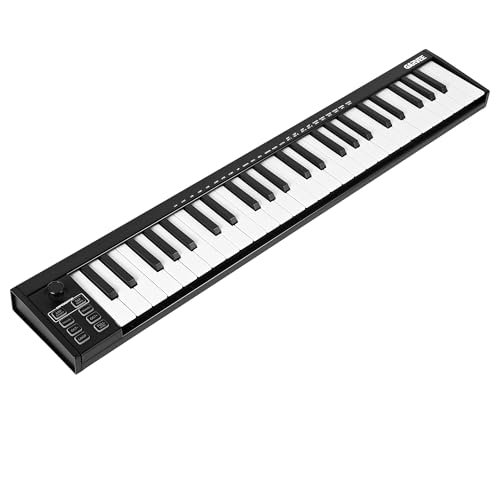
- 49 standard keys for broader playing range
- 8 pads plus ARP and transpose for beat-making
- OLED display and DAW controls streamline workflow
Best For: producers who want a larger keyboard with integrated DAW control
Portable Learning Pick
M-AUDIO Keystation Mini 32 MK3 USB MIDI Controller

- 32 compact velocity-sensitive mini keys
- Plug-and-play USB with no external power needed
- Includes MPC Beats and Melodics lessons
Best For: laptop users, beginners, and mobile producers
Wireless Beat-Making Pick
M-VAVE 25 Key Bluetooth MIDI Controller

- Bluetooth plus USB for wireless or wired sessions
- 8 RGB pads and 8 knobs for beat control
- Built-in battery rated for about 16 hours
Best For: mobile beat makers who want wireless control and pads
Compact Mini Keys for Quick Ideas
Akai LPK25 25-Key USB MIDI Keyboard Controller

- 25 velocity-sensitive mini keys
- Built-in arpeggiator and clock
- 8 programmable preset slots
Best For: Portable songwriting, melody sketching, and simple studio control
Standalone Sound and Pad Control
Akai MPK Mini Play MK3 25-Key USB MIDI Keyboard Controller

- Over 100 internal sounds for standalone use
- 8 velocity-sensitive MPC pads
- OLED display plus 4 encoder knobs
Best For: Mobile beat making and songwriting with built-in sounds
Modern USB-C Production Controller
Akai MPK Mini IV 25-Key USB-C MIDI Keyboard Controller

- USB-C connectivity with plug-and-play setup
- 8 RGB MPC pads and 8 assignable knobs
- Color screen plus chord and scale tools
Best For: Compact studio control, beat making, and mobile production
Compact Beat-Making Starter – Akai MPK Mini MK3
If you want midi keyboards for production that stay compact without giving up hands-on control, the Akai MPK Mini MK3 is an easy place to start. It combines 25 velocity-sensitive mini keys with 8 MPC-style pads, 8 knobs, an arpeggiator, and pitch/mod control, so you can sketch beats, play melodies, and tweak instruments from one small controller.
Best For: Beat makers and home producers who want a portable all-in-one MIDI controller for drums, synths, and DAW control.
Pros:
- 25 velocity-sensitive mini keys keep the footprint small and portable.
- 8 backlit MPC-style pads work well for drum programming and sample triggering.
- 8 assignable knobs give you quick control over plugins and synth parameters.
- Built-in arpeggiator and thumbstick pitch/mod control add useful performance tools.
Cons:
- Mini keys may feel cramped for players used to larger keybeds.
- Limited to 25 keys, so full two-handed parts will require octave shifting.
- Best suited to compact production setups rather than piano-style playing.
The MPK Mini MK3 is a strong fit if you want a lightweight controller that focuses on beat making and fast sketching. Its bundled software and sound content add value, while the pad-and-knob layout keeps everyday production tasks close at hand.
Hands-On Workflow Controller – Arturia MiniLab 3
For midi keyboards for production that aim to speed up workflow, the Arturia MiniLab 3 focuses on hands-on control more than just basic note entry. It gives you 25 slim velocity-sensitive keys, 8 RGB pads, 8 rotary encoders, 4 faders, a mini display, and a clickable browsing knob, making it easy to shape sounds and manage tracks without reaching for the mouse as often.
Best For: Producers who want a compact controller with pads, faders, encoders, and software included for a more tactile workflow.
Pros:
- 25 slim keys keep it compact while still offering velocity sensitivity.
- 8 RGB pads and 8 rotary encoders support beat programming and parameter control.
- 4 faders add useful mixing and track-level control.
- Includes a software suite, plus built-in arpeggiator and browse controls.
Cons:
- Still a 25-key controller, so extended keyboard parts may feel limited.
- Designed around a compact layout, not a full-size performance keybed.
- Some users may prefer more dedicated drum pad surface area.
The MiniLab 3 stands out if you want a compact production controller that feels organized and efficient. Its mix of pads, faders, encoders, and display makes it especially appealing for DAW-heavy workflows and sound browsing.
Wireless Mobile Production Pick – DaierTek 25-Key Bluetooth MIDI Controller
If you need midi keyboards for production that can move beyond the studio desk, the DaierTek 25-key controller brings Bluetooth and USB connectivity together. It pairs 25 velocity-sensitive keys with 8 RGB backlit pads, 8 assignable encoders, a mini display, and touch strips for pitch and modulation, while the built-in battery adds roughly 16 hours of cordless use.
Best For: Mobile producers and multi-device users who want Bluetooth MIDI, battery power, and a full set of compact controls.
Pros:
- Bluetooth plus USB connectivity makes it flexible for different setups.
- Built-in 2,000 mAh battery supports about 16 hours of operation.
- 8 RGB pads, 8 encoders, and touch strips offer broad control in a compact size.
- Compatible with Windows, Mac OS, Android, and iOS when used with supported MIDI software.
Cons:
- Bluetooth use can require extra setup, including a driver on Windows.
- It does not produce sound on its own and must be used with DAW or music apps.
- Wireless performance depends on app and device compatibility.
The DaierTek controller is a practical choice when portability matters as much as control. Its wireless design, battery life, and cross-platform support make it especially useful for quick composing sessions and on-the-go production.
Expanded Studio Control Choice – Akai MPK Mini Plus 37-Key
For midi keyboards for production that need more range and deeper hardware integration, the Akai MPK Mini Plus steps up with a 37-key layout. In addition to 8 RGB MPC pads and 8 assignable knobs, it adds CV/Gate and MIDI I/O, a transport section, and a built-in 64-step sequencer, giving you more ways to control both software and external gear.
Best For: Producers who want a compact but more capable controller for DAW work, sequencing, and external hardware.
Pros:
- 37 keys provide more range than typical 25-key compact controllers.
- CV/Gate and MIDI I/O support integration with modular gear and sound modules.
- Built-in 64-step sequencer lets you compose without a computer.
- 8 RGB pads, 8 knobs, and transport controls support flexible studio use.
Cons:
- Larger than ultra-compact 25-key models, so it takes up more desk space.
- More advanced connectivity may be more than casual beginners need.
- Still a compact controller, not a full-size keyboard for pianistic playing.
The MPK Mini Plus is the most studio-expansive option here, especially if you want to work across a DAW and external hardware. The extra keys and sequencer make it a strong fit for more layered production workflows.
Studio Workflow Pick – 49-Key MIDI Keyboard Controller with DAW Integration
If you want midi keyboards for production with more room to play and a cleaner workflow, this 49-key controller is built around hands-on control. The standard keybed, 8 drum pads, ARP, transpose tools, OLED display, and DAW transport controls make it a practical fit for beat-making, sketching ideas, and managing sessions without reaching for the mouse as often.
Best For: Producers who want a full 49-key layout with DAW control and pad-based beat workflow.
Pros:
- 49 standard keys offer more range for melodies, chords, and practice.
- 8 touch-responsive drum pads support beat making and live performance.
- DAW integration adds transport, track selection, and workflow control.
- OLED display and sustain pedal port improve day-to-day studio use.
Cons:
- Not as compact as 25-key or mini controllers for tight desks or travel.
- iOS use requires an adapter, which is not included.
This is the most traditional all-around option in the group if you want a controller that feels closer to a real keyboard while still giving you production-focused features. It suits home studios and stage setups where flexibility matters more than ultra-portability.
Portable Learning Pick – M-AUDIO Keystation Mini 32 MK3 USB MIDI Controller
For midi keyboards for production on the move, this compact 32-key controller keeps the setup simple and lightweight. It focuses on velocity-sensitive mini keys, octave controls, pitch bend and modulation buttons, plus plug-and-play USB operation, so you can start programming parts or laying down ideas quickly on a laptop.
Best For: Laptop producers, beginners, and anyone who wants a simple portable controller with bundled software.
Pros:
- Very compact 32-key design is easy to carry and fits small workspaces.
- Velocity-sensitive mini keys with selectable response curves add playability.
- Plug-and-play USB connection needs no external power supply.
- Includes MPC Beats software and Melodics lessons for getting started.
Cons:
- Mini keys may feel limiting for players who prefer full-size keys.
- No drum pads or extensive hardware controls for more advanced hands-on production.
This model keeps the focus on portability and immediate use rather than performance extras. It makes sense if your priority is writing and recording from a laptop with minimal gear and a low-friction setup.
Wireless Beat-Making Pick – M-VAVE 25 Key Bluetooth MIDI Controller
If you want midi keyboards for production that stay easy to move between rooms, this 25-key controller adds wireless Bluetooth plus USB connectivity. It combines velocity-sensitive keys, 8 RGB pads, 8 assignable knobs, touch strips, and smart chord/sound features, giving beat makers a compact tool for sketches, synth control, and mobile sessions.
Best For: Beat makers and mobile producers who want wireless control, pads, and a compact footprint.
Pros:
- Bluetooth and USB connectivity support flexible wireless or wired use.
- Built-in 2,000 mAh battery is rated for about 16 hours of use.
- 8 RGB backlit pads and 8 assignable knobs expand hands-on control.
- Works with Windows, Mac, Android, iOS, and major DAWs listed in the notes.
Cons:
- 25 keys provide a limited range for full two-handed playing.
- Compact mini layout may not suit players who prefer larger keybeds.
This is the most mobile-friendly option here, especially if you value wireless convenience and built-in battery power. It is strongest as a beat-making and sketching controller rather than a full-size performance keyboard.
Compact Mini Keys for Quick Ideas – Akai LPK25 25-Key USB MIDI Keyboard Controller
If you want a simple entry point into midi keyboards for production, the Akai LPK25 keeps the focus on playing and sketching ideas fast. Its 25 velocity-sensitive mini keys, octave controls, and built-in arpeggiator make it a practical fit for songwriting, composing, beat-making, and remix work without adding much clutter to your desk.
Best For: Producers who want a compact, plug-and-play controller for basic songwriting, melodies, and portable studio setups.
Pros:
- 25 responsive mini keys with velocity sensitivity for expressive playing
- Octave up/down buttons and a sustain button expand the playable range
- Built-in arpeggiator and clock add creative control for software instruments and USB gear
- Eight programmable preset slots help you recall DAW and instrument mappings quickly
Cons:
- No pads, knobs, or display for deeper hands-on control
- Mini key format may feel limiting for players who want a larger keyboard
- Best suited to lightweight control rather than a full production workstation
Overall, the LPK25 is a lean controller that prioritizes speed and portability over extra features. For producers who mainly need a small keyboard to write parts and trigger software instruments, it covers the essentials well.
Standalone Sound and Pad Control – Akai MPK Mini Play MK3 25-Key USB MIDI Keyboard Controller
Among midi keyboards for production, the MPK Mini Play MK3 stands out if you want a controller that can also make sound on its own. It combines 25 dynamic mini keys, eight velocity-sensitive MPC pads, an OLED display, four knobs, and more than 100 internal drum and instrument sounds, so you can sketch ideas even when you are away from your DAW.
Best For: Beat makers and songwriters who want portable MIDI control plus built-in sounds for on-the-go creation.
Pros:
- Standalone operation with over 100 internal drum and instrument sounds
- Eight velocity-sensitive backlit MPC pads for finger drumming and triggering parts
- OLED display, four encoder knobs, arpeggiator, and note repeat support hands-on workflow
- USB MIDI plus battery power option adds flexibility for mobile setups
Cons:
- Batteries are not included for standalone use
- Mini keybed may be too small for players who prefer full-size keys
- Feature set is broad, but the onboard sounds are not a substitute for a full production rig
The MPK Mini Play MK3 is a strong pick if you value portability and immediate sound generation. It gives you enough pads, knobs, and onboard voices to capture ideas quickly before moving them into your DAW.
Modern USB-C Production Controller – Akai MPK Mini IV 25-Key USB-C MIDI Keyboard Controller
The MPK Mini IV is aimed squarely at modern midi keyboards for production, especially if you want a compact controller with deeper hands-on editing. It pairs 25 velocity-sensitive mini keys with eight assignable knobs, RGB MPC pads, a full-color screen, and chord, scale, and arpeggiator tools, making it easy to move from sketching to arranging without constant mouse work.
Best For: Producers and creators who want a compact controller with strong DAW integration and performance features.
Pros:
- 25 velocity-sensitive mini keys plus 10-octave up/down range for broader note access
- Eight RGB MPC pads and eight assignable 360-degree knobs support beat programming and control
- Full-color screen and push/turn encoder reduce reliance on the computer
- Chord, scale, arpeggiator, pattern, freeze, and mutate functions support fast idea generation
Cons:
- Mini keys may not suit players who want a larger, more piano-like feel
- Advanced feature set may be more than casual users need
- Designed around compactness, so it is not a substitute for a larger studio keyboard
For producers who want a modern compact controller with real workflow depth, the MPK Mini IV covers a lot of ground. Its combination of pads, knobs, screen feedback, and DAW mapping makes it a versatile centerpiece for small studios and travel rigs.
How We Picked These Midi Keyboards for Production
We prioritized controllers that are useful in real-world production workflows: responsive keys, dependable DAW compatibility, useful hands-on controls, and strong value for the price. Portability mattered, but so did features that speed up writing and programming, such as pads, knobs, transport controls, and display feedback.
Quick Comparison
Smaller 25-key and 32-key models are best for mobile beatmaking, sketching ideas, and tight desk spaces. Larger 37-key and 49-key options are better if you want two-handed playing, more comfortable chord work, or less octave shifting while composing. If you mainly trigger drums and enter notes, compact controllers are usually enough. If you play melodies and harmony often, a larger board can feel much less limiting.
Key Buying Factors for Midi Keyboards for Production
Key Count and Playing Style
Choose key count based on how you work. Producers who mainly build beats may prefer 25 keys for portability. Songwriters and players often benefit from 32, 37, or 49 keys for better range and less menu jumping.
Pads, Knobs, and DAW Control
Drum pads help with finger drumming and clip launching, while knobs are useful for mixing, filter sweeps, and plugin control. If you produce in a DAW daily, extra controls can save time and reduce mouse use.
Connectivity and Power
USB is still the standard for most studios, but Bluetooth can be handy for mobile setups and cleaner desktops. Check whether the controller is bus-powered and whether it works smoothly with your preferred operating system and software.
Keybed Feel and Build
Some players prefer synth-style mini keys for speed, while others want semi-weighted action for more expressive playing. If you travel a lot, look for a light but sturdy design that can handle regular transport.
Who Should Buy Which Midi Keyboards for Production?
If you want the most portable setup, a compact 25-key controller is usually the best fit. If you want a better balance of playability and desk-friendly size, 32- or 37-key models make sense. If your workflow depends on pads, knobs, and hands-on control, prioritize feature-rich controllers over the simplest travel boards. For beginners, easy USB setup and bundled software can matter as much as advanced specs. For experienced producers, the best choice is the one that fits your DAW workflow and keeps you making music without friction.