Compact MIDI controllers make it easy to sketch ideas, play melodies, and control your DAW without taking up much desk space. For producers who want portability without giving up essential hands-on control, the right small controller can speed up every part of the creative process.
In this roundup, we focus on the best options for beginners, mobile setups, and studio users who need a space-saving controller that still feels responsive and practical.
Best 10 Compact Midi Controllers Picks for 2026
Beat-Maker Starter Pick
Akai MPK Mini MK3 25-Key USB MIDI Keyboard Controller

- 25 mini velocity-sensitive keys
- 8 MPC-style pads and 8 knobs
- Built-in arpeggiator and software bundle
Best For: Beat makers and portable studio setups
Hands-On Workflow Pick
Arturia MiniLab 3 Universal MIDI Controller, Deep Black

- 25 velocity-sensitive synth-action keys
- 8 encoders, 4 sliders, and touchstrips
- Arp, hold, and chord modes included
Best For: Hands-on producers who want controls beyond basic keys
DAW Integration Pick
Novation Launchkey Mini 25 MK4 USB MIDI Keyboard Controller
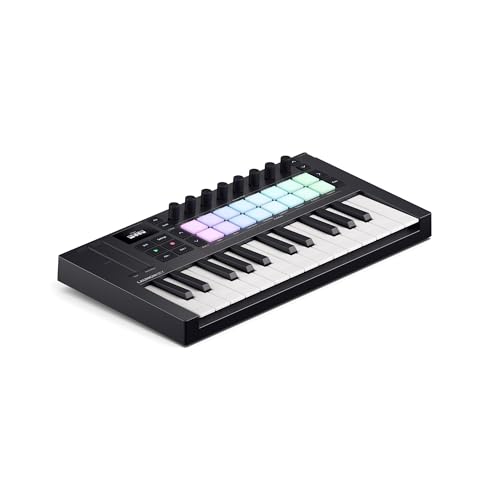
- 16 FSR pads with polyphonic aftertouch
- Strong integration with major DAWs
- Scale, chord, and arp creative modes
Best For: DAW users who want expressive pads and quick workflows
Ultra-Portable Choice
Arturia MicroLab Mk3 Universal MIDI Controller, White

- Lightweight, USB-powered, and portable
- 25 slim keys with upgraded keybed
- Includes 500 presets and Ableton Live Lite
Best For: Mobile musicians and very small studio spaces
Advanced Compact Studio Controller
Akai MPK Mini Plus 37-Key MIDI Keyboard

- 37-key mini keybed with three full octaves
- 8 RGB pads, 8 knobs, and DAW transport controls
- CV/Gate, MIDI I/O, and 64-step sequencer
Best For: Producers wanting compact control plus sequencing and hardware integration
Basic Desktop Starter
25-Key Compact MIDI Keyboard Controller

- 25-key layout for small desktop setups
- ABS construction for everyday handling
- Compact size suits practice and arranging
Best For: Beginners needing a simple, space-saving MIDI keyboard
Portable Mini Performance Controller
M-AUDIO Keystation Mini 32 MK3

- 32 velocity-sensitive mini keys with selectable curves
- Plug-and-play USB with no external power needed
- Includes MPC Beats software and Melodics lessons
Best For: Mobile producers and laptop users who want a simple, expressive controller
Flagship Compact Creator Controller
Akai MPK Mini IV 25-Key USB-C MIDI Keyboard Controller

- 25 mini velocity-sensitive keys with USB-C connectivity
- 8 MPC pads, 8 knobs, and a color screen for hands-on control
- Chord/Scale modes plus arpeggiator for quick idea building
Best For: Beat makers and traveling producers who want a feature-rich compact controller
Beginner-Friendly Portable Pick
Donner Mini MIDI Keyboard N-25 25-Key Controller

- 25 velocity-sensitive mini keys in a compact body
- Easy-to-use arpeggiator, sustain, octave, and tap tempo
- Includes 40 teaching courses and USB plug-and-play support
Best For: Beginners who want a simple, portable controller with learning support
Minimal Studio Travel Companion
Akai LPK25 25-Key USB MIDI Keyboard Controller

- Slim 25-key controller with responsive mini keys
- Octave buttons, sustain, and arpeggiator for essentials
- USB-powered plug-and-play setup for Mac or PC
Best For: Producers and songwriters who want a slim, no-fuss controller for quick ideas
Beat-Maker Starter Pick – Akai MPK Mini MK3 25-Key USB MIDI Keyboard Controller
If you want compact midi controllers that are built for beat making and quick studio ideas, the Akai MPK Mini MK3 is an easy place to start. It combines 25 velocity-sensitive mini keys with 8 MPC-style pads, 8 assignable knobs, and a built-in arpeggiator, so you can sketch melodies, trigger drums, and tweak virtual instruments without a lot of setup.
Best For: Beat makers, beginner producers, and anyone who wants a portable controller with pads and hands-on DAW control.
Pros:
- 8 backlit velocity-sensitive MPC-style pads with Note Repeat and Full Level
- 8 360-degree knobs for mapping to plugins, synths, and mixing controls
- 4-way thumbstick plus built-in arpeggiator for pitch, modulation, and pattern creation
- Includes MPC Beats, virtual instruments, and sound content to get started fast
Cons:
- Mini keys may feel small for players who prefer a larger keyboard
- Best suited to compact control rather than a full-size piano-style workflow
This is a strong all-around compact controller if your priority is hands-on beat programming and a lightweight footprint. The included software bundle adds value, and the pad-and-knob layout makes it especially useful for producers who want immediate control in a small package.
Hands-On Workflow Pick – Arturia MiniLab 3 Universal MIDI Controller, Deep Black
For buyers comparing compact midi controllers, the Arturia MiniLab 3 stands out as a workflow-focused option. It pairs 25 premium velocity-sensitive keys with 8 rotary encoders, 4 sliders, touchstrips, and built-in arp, hold, and chord modes, giving you plenty of hands-on control in a desktop-friendly design.
Best For: Producers who want an intuitive controller with pads, faders, and expressive control for software instruments.
Pros:
- 25 mini keys with synth action and velocity sensitivity
- 8 rotary encoders and 4 sliders for mixing and instrument control
- Built-in arp plus hold and chord modes for fast idea building
- Includes Arturia Analog Lab and Ableton Live Lite support
Cons:
- Fewer performance pads than pad-heavy controllers
- Designed for compact control, not a full-size keyboard feel
MiniLab 3 is a practical choice if you want a small controller that still feels complete for software production. Its mix of encoders, sliders, and musical modes makes it especially useful when you want to stay in a flow state without reaching for the mouse.
DAW Integration Pick – Novation Launchkey Mini 25 MK4 USB MIDI Keyboard Controller
If you need compact midi controllers that are especially strong for DAW work, the Novation Launchkey Mini 25 MK4 is built around integration and performance. It adds 16 FSR pads with polyphonic aftertouch, scale and chord modes, and a powerful arpeggiator, so it can handle beat launching, sequencing, and chord triggering in a very small footprint.
Best For: Ableton and other DAW users who want a portable controller with expressive pads and creative performance tools.
Pros:
- 16 responsive FSR pads with polyphonic aftertouch
- Works with major DAWs including Ableton Live, Logic, Cubase, FL Studio, and more
- Scale Mode, chord triggering, and arpeggiator for fast music creation
- Includes Ableton Live Lite, Cubase LE, sounds, and Melodics lessons
Cons:
- Mini format limits key size compared with larger controllers
- Best value comes from users who plan to use its DAW integration features
The Launchkey Mini 25 MK4 is a smart pick if your priority is making music quickly inside a DAW. Its pad response and creative modes make it feel performance-oriented, while the bundled software helps round out the package for new and experienced users alike.
Ultra-Portable Choice – Arturia MicroLab Mk3 Universal MIDI Controller, White
The Arturia MicroLab Mk3 is aimed at musicians who want compact midi controllers that are easy to carry and simple to use. It keeps the setup minimal with 25 slim keys, two touch strips, and four buttons, while still offering USB-C plug-and-play convenience and a bundle that includes 500 curated presets from Analog Lab Intro and Ableton Live Lite.
Best For: Mobile musicians and small-studio users who want a lightweight controller with an easy setup.
Pros:
- Small, lightweight, and USB-powered for portable use
- Upgraded slim keybed designed for a responsive playing feel
- Two touch strips and four buttons for simple control
- Includes 500 presets from Analog Lab Intro and Ableton Live Lite
Cons:
- Very minimal control layout compared with pad- and knob-heavy models
- Best suited to simple input rather than deep hands-on mixing
MicroLab Mk3 makes sense if portability and immediacy matter more than extra controls. It is the most stripped-back option here, but that simplicity is exactly what makes it appealing for quick sketches, travel setups, and tight desk spaces.
Advanced Compact Studio Controller – Akai MPK Mini Plus 37-Key MIDI Keyboard
The Akai Professional MPK Mini Plus is one of the more capable compact midi controllers for producers who want more than a basic keys-and-pads layout. Its 37-key mini keybed gives you three full octaves, while the pads, knobs, sequencer, and DAW transport controls make it practical for sketching ideas, performing, and controlling a studio setup.
Best For: Producers who want a compact controller with deeper creative control, sequencing, and external hardware connectivity.
Pros:
- 37-key dynamic keybed offers more range than smaller mini controllers.
- 8 RGB MPC pads and 8 assignable knobs support beat-making and hands-on control.
- Built-in 64-step sequencer lets you compose without a computer.
- CV/Gate and MIDI I/O expand integration with modular gear and sound modules.
Cons:
- More feature-rich than a simple starter controller, so it may be more than some beginners need.
- USB MIDI controller design is still compact, but larger than 25-key or 32-key options.
If you want compact midi controllers with real production flexibility, this model stands out for combining key range, pads, sequencing, and hardware connectivity in one portable unit. It is a strong fit when you need a controller that can handle ideas at the desk and integrate into a broader studio setup.
Basic Desktop Starter – 25-Key Compact MIDI Keyboard Controller
This 25-key option is a straightforward choice among compact midi controllers for everyday desktop music use. It is designed for practice, composition preparation, recording setups, and arranging work, with a compact profile that fits easily on a desk or in a small studio space.
Best For: Beginners or casual users who want a simple, space-saving MIDI keyboard for desktop music tasks.
Pros:
- 25-key layout keeps the controller small and easy to place on a desk.
- ABS construction is built for regular handling and storage.
- Compact dimensions make it convenient for home studios and practice areas.
- Simple black finish blends into most workspaces.
Cons:
- Limited to 25 keys, so extended two-handed playing will be constrained.
- Lacks the extra controls and production features found on more advanced controllers.
For buyers who mainly need a compact midi controller for basic creative workflows, this model keeps things simple and practical. It is less about performance features and more about providing a tidy, low-profile keyboard for everyday music tasks.
Portable Mini Performance Controller – M-AUDIO Keystation Mini 32 MK3
The M-AUDIO Keystation Mini 32 MK3 is a portable pick in the compact midi controllers category for users who want a lightweight USB controller with a bit more range. Its 32 velocity-sensitive mini keys, octave controls, pitch and modulation buttons, and included software make it a practical fit for laptop-based music production.
Best For: Mobile producers and laptop users who want a compact controller with expressive basics and easy plug-and-play use.
Pros:
- 32 miniature velocity-sensitive keys provide more range than a 25-key controller.
- Pitch bend, modulation buttons, octave controls, volume knob, and sustain button add expression.
- Plug-and-play USB connection requires no extra drivers or external power supply.
- Includes MPC Beats software and Melodics lessons for production and learning support.
Cons:
- Mini keys may not appeal to players who prefer a larger piano-style feel.
- Fewer onboard performance controls than more advanced compact controllers.
This controller is a strong fit if portability and simplicity matter most. It gives you the core essentials for writing and beat making without adding bulk, making it a practical travel-friendly option for compact midi controllers.
Flagship Compact Creator Controller – Akai MPK Mini IV 25-Key USB-C MIDI Keyboard Controller
If you’re comparing compact midi controllers for portable music production, the Akai MPK Mini IV stands out as a packed, modern option with 25 velocity-sensitive mini keys, 8 MPC pads, and hands-on control through knobs and a color screen. It is built for beat making, songwriting, and quick DAW navigation without forcing you back to the mouse.
Best For: Beat makers, traveling producers, and creators who want a feature-rich compact controller with deep software and DAW integration.
Pros:
- 8 velocity- and pressure-sensitive MPC pads with RGB feedback for finger drumming
- 8 assignable 360° knobs plus a full-color screen and push/turn encoder for live control
- Chord, Scale, and advanced arpeggiator functions for fast idea building
- USB-C connection with full-size MIDI Out and plug-and-play setup
Cons:
- More feature-heavy than a bare-bones starter keyboard
- May be more controller than some casual players need
Overall, this is the most fully loaded option in the group if you want a compact controller that can handle sketching beats, controlling DAWs, and performing away from the desk. The included software bundle and mapped workflow add a lot of value for users who want to get productive quickly.
Beginner-Friendly Portable Pick – Donner Mini MIDI Keyboard N-25 25-Key Controller
For shoppers focused on compact midi controllers that are easy to learn, the Donner N-25 keeps things simple with 25 velocity-sensitive mini keys, a light-up interface, and essential production tools. It is designed for straightforward USB-MIDI use with Mac, PC, iOS, and mobile setups, making it a practical entry point for first-time players.
Best For: Beginners who want an affordable, travel-friendly controller with teaching courses and simple hands-on controls.
Pros:
- 25 compact velocity-sensitive keys in a lightweight portable design
- Beginner-friendly layout with arpeggiator, sustain, octave, and tap tempo
- Works with Mac, PC, iOS, iPhone, iPad, and smartphone apps via OTG adapter
- Includes 40 teaching courses plus software for getting started
Cons:
- Fewer advanced performance controls than higher-end compact controllers
- No dedicated pads or screen for deeper workflow control
The N-25 makes sense if you want a compact keyboard that prioritizes simplicity, portability, and learning support over extra production features. It covers the basics well and is especially appealing for new users who want a low-friction way to start making music.
Minimal Studio Travel Companion – Akai LPK25 25-Key USB MIDI Keyboard Controller
If you want compact midi controllers that stay out of the way, the Akai LPK25 is built for simple writing, sketching, and travel use. It pairs 25 responsive mini keys with octave controls, a sustain button, and an arpeggiator, giving you the essentials without adding much bulk.
Best For: Producers and songwriters who want a slim, no-fuss 25-key controller for quick ideas and mobile setups.
Pros:
- Very compact 25-key layout with responsive mini keys
- Dedicated octave up/down buttons and sustain for expressive playing
- Built-in arpeggiator and clock for creative control
- USB-powered, plug-and-play setup for Mac or PC
Cons:
- Limited control surface compared with pad-heavy or knob-heavy models
- Designed for essentials, so it may feel basic for advanced performers
The LPK25 is a strong pick when portability and simplicity matter more than extra controls. It is especially useful as a travel keyboard or a lightweight companion to a larger studio setup.
How We Picked These Compact Midi Controllers
We looked for Compact Midi Controllers that balance size, playability, software compatibility, and real-world workflow. Priority went to models with dependable USB connectivity, sensible control layouts, velocity-sensitive keys where available, and enough features to support composing, beat making, and live sketching.
We also considered key count, portability, build quality, and how well each model fits different user types, from first-time buyers to producers who need a travel-friendly secondary controller.
Quick Comparison
Most Compact Midi Controllers fall into a few clear categories: ultra-portable 25-key models for tight spaces, 32-key options for a little more range, and 37-key controllers for players who want fewer octave shifts. Some lean toward pads and knobs for beat production, while others keep the layout simple for piano-style input and DAW control.
If you mostly trigger drums and sketch melodies, a lighter 25-key model may be enough. If you play two-handed parts more often, the extra keys on a 32- or 37-key board can make a noticeable difference.
Key Buying Factors for Compact Midi Controllers
Key Count and Playing Style
Choose based on how you create. A 25-key controller is easy to carry and works well for beats, basslines, and short melodic ideas. A 32- or 37-key layout gives you more range before you need to shift octaves.
Controls and Workflow
Knobs, pads, pitch and modulation controls, and transport buttons can make a controller much more useful in production. If you want faster beat programming or DAW navigation, look for a model with more hands-on control.
Feel and Responsiveness
Mini keys vary a lot in touch and travel. Velocity-sensitive keys are especially helpful for expressive playing, even on small boards. If possible, prioritize a layout that feels stable and predictable under your fingers.
Connectivity and Compatibility
Most Compact Midi Controllers connect over USB and work with major DAWs, but it still helps to confirm compatibility with your computer or mobile setup. Some newer models may offer USB-C, while others rely on standard USB connections.
Who Should Buy Which Compact Midi Controllers?
Beginners usually do well with a straightforward 25-key controller that’s easy to learn and affordable. Beat makers and DAW users may prefer a model with pads and extra knobs. If you need a controller for travel or limited desk space, prioritize the smallest footprint and simplest setup.
Players who want more melodic range should look at 32- or 37-key options, especially if they dislike frequent octave switching. For the best all-around fit, match the controller’s features to your workflow instead of choosing only by price or size.