If you want more expressive control from your setup, midi controllers with aftertouch can make a big difference. They let you add pressure-based modulation after the initial key or pad strike, which can bring parts to life.
Below, we’ve rounded up 10 strong options for players, producers, and performers, from compact portable controllers to full-size weighted keyboards and sequencing-focused rigs.
Best 10 Midi Controllers with Aftertouch Picks for 2026
Ultra-Portable Pro Pick
ESI Xkey 37 Polyphonic Aftertouch Controller

- Polyphonic aftertouch support
- 37 full-size velocity-sensitive keys
- USB-C plus 5-pin DIN via Xcable
Best For: mobile musicians and laptop producers
Sequencer Power Pick
Arturia KeyStep Pro Chroma 37-Key Sequencer

- 37-key controller with aftertouch
- 4-track polyphonic and 16-track drum sequencers
- USB/MIDI/CV connectivity for studio setups
Best For: producers who want sequencing and performance control
Weighted Studio Pick
Studiologic SL73 MK2 73-Key Aftertouch Keyboard
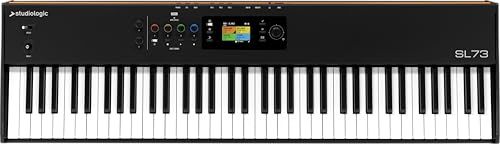
- 73 weighted hammer-action keys
- Aftertouch with MIDI 2.0 and USB-C
- Built-in audio interface and DAW controls
Best For: pianists and studio setups
Portable Pad Performer
Mini Wireless MIDI Pad Controller with Aftertouch

- 16 RGB velocity-sensitive pads
- Bluetooth MIDI plus USB MIDI
- Up to 15 hours of battery life
Best For: beatmakers and DJs who want wireless expressive pads
All-in-One Sequencer Pick
Arturia KeyStep Pro 37-Key Controller

- 37-key aftertouch keyboard with velocity sensitivity
- 4 polyphonic tracks and 16-track drum sequencing
- CV, MIDI, and USB connections for hybrid setups
Best For: Players who want an aftertouch keyboard with deep sequencing and broad connectivity.
Portable Pad Controller Pick
Mini Wireless MIDI Controller Pad

- 16 RGB velocity pads with aftertouch
- Bluetooth MIDI, USB MIDI, and 15-hour battery
- App-based customization for mapping and lighting
Best For: Mobile beat makers, DJs, and beginners who want a portable pad controller with aftertouch.
Keyboard Control Workhorse
Samson Graphite 49 Key MIDI Controller

- 49-key semi-weighted keyboard with aftertouch
- 9 faders, 8 encoders, and 16 buttons
- USB and traditional MIDI Out for flexible connectivity
Best For: Keyboard players who want aftertouch plus faders, knobs, and pads for studio control.
Creative DAW Controller
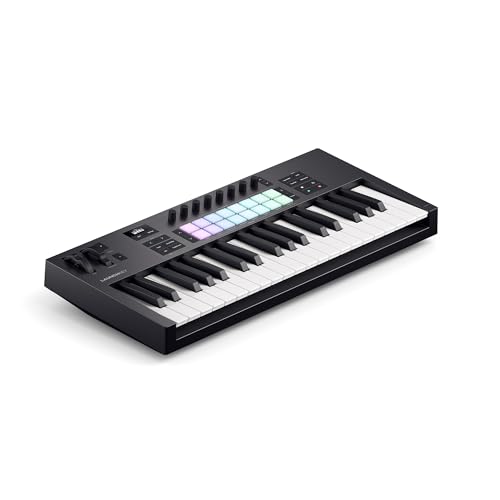
- 37 synth-action keys with 16 FSR pads
- Pads include polyphonic aftertouch
- Works with major DAWs and NKS
Best For: Compact composing, clip launching, and beat-making workflow
49-Key Aftertouch Workstation

- 49 semi-weighted keys with aftertouch
- 16 RGB pads plus 8 knobs and 9 faders
- NKS, Smart Chord, Smart Scale, and arpeggiator
Best For: Players wanting a full-featured 49-key controller for production
Portable Wireless Creator
25-Key Wireless MIDI Controller

- Wireless MIDI with rechargeable battery
- 8 RGB pads support aftertouch
- Smart Scale, Smart Chord, and OLED control
Best For: Mobile production and beginners who want portable expressive control
Ultra-Portable Pro Pick – ESI Xkey 37 Polyphonic Aftertouch Controller
If you want a mobile-friendly option in midi controllers with aftertouch, the ESI Xkey 37 stands out for its ultra-thin aluminum build, full-size keys, and polyphonic aftertouch support. It is designed for compact setups where low weight, USB-C plug-and-play convenience, and expressive playing matter more than a crowded control surface.
Best For: mobile musicians, laptop producers, and players who want a slim 37-key controller with expressive aftertouch.
Pros:
- Polyphonic aftertouch with configurable behavior via the Xkey Plus app
- 37 full-size, velocity-sensitive keys in a very slim 0.6-inch aluminum body
- USB-C plug-and-play support across Mac, PC, iOS, Linux, Android, and more
- Included Xcable adds 5-pin DIN MIDI plus expression and sustain pedal connections
Cons:
- No built-in knobs, faders, or pads for broader hands-on control
- Compact 37-key layout may feel limited for players wanting a larger range
The Xkey 37 is a strong fit if portability is the priority and you still want expressive aftertouch performance. Its connectivity and low-profile design make it especially practical for travel, mobile composing, and minimalist studio rigs.
Sequencer Power Pick – Arturia KeyStep Pro Chroma 37-Key Sequencer
Among midi controllers with aftertouch, the Arturia KeyStep Pro Chroma is aimed at users who want performance control and sequencing in one compact unit. Its 37-key layout, aftertouch-equipped keyboard, and built-in polyphonic and drum sequencers make it a practical choice for studio workflows that need both playing and programming.
Best For: producers and performers who want an aftertouch keyboard with deep sequencing features.
Pros:
- 37-key USB/MIDI/CV controller with aftertouch
- 4-track polyphonic sequencer plus 16-track drum sequencer
- Works with Ableton Live and Windows/macOS setups
- Includes power supply and USB cable
Cons:
- Heavier than compact travel controllers at 2.7 kg
- May be more controller than needed if you only want a basic keyboard
The KeyStep Pro Chroma makes sense if you want aftertouch plus sequencing in the same device. It is better suited to production-focused users than to buyers looking for the lightest possible keyboard.
Weighted Studio Pick – Studiologic SL73 MK2 73-Key Aftertouch Keyboard
If you are comparing midi controllers with aftertouch for a piano-style feel, the Studiologic SL73 MK2 is built around 73 weighted hammer-action keys and a premium TP/110 action. It adds aftertouch, USB-C connectivity, MIDI 2.0 compatibility, and DAW controls, making it a serious studio master keyboard rather than a lightweight sketchpad.
Best For: pianists and studio users who want weighted keys with aftertouch and modern DAW integration.
Pros:
- 73 weighted hammer-action keys with aftertouch for expressive playing
- USB-C, MIDI 2.0 support, and an integrated audio interface
- Dedicated transport controls for DAW workflows
- Full integration with Numa Player through SL Link
Cons:
- Large and heavy at 11.2 kg, so it is not travel-friendly
- No onboard sounds, so it depends on external software or gear
The SL73 MK2 is a strong fit for players who want a piano-like controller with aftertouch and modern studio features. It is best treated as the centerpiece of a fixed setup rather than a portable controller.
Portable Pad Performer – Mini Wireless MIDI Pad Controller with Aftertouch
For beatmakers looking at midi controllers with aftertouch, this mini wireless pad controller focuses on finger drumming and mobile production instead of keys. It combines 16 RGB velocity-sensitive pads with aftertouch, Bluetooth and USB MIDI, and a rechargeable battery, making it a flexible pick for portable sessions and compact DJ setups.
Best For: beatmakers, DJs, and mobile creators who want expressive pads with wireless control.
Pros:
- 16 velocity-sensitive RGB pads with aftertouch
- Bluetooth MIDI and USB MIDI support for flexible connection options
- Built-in rechargeable battery rated for up to 15 hours
- App-based customization for pad mapping, velocity curves, and backlight settings
Cons:
- Pad controller only, so it is not a keyboard-based solution
- Small format may be limiting for users wanting a larger performance surface
This controller is a practical option if your workflow centers on pads, samples, and live triggering. Its wireless design and aftertouch response make it especially useful for mobile beat production and on-the-go performances.
All-in-One Sequencer Pick – Arturia KeyStep Pro 37-Key Controller
If you want midi controllers with aftertouch that do more than trigger notes, the Arturia KeyStep Pro is built for hands-on composing and live control. It combines a MIDI keyboard, sequencer, and arpeggiator, so it suits players who want one compact unit to drive hardware, software, and modular gear from a single surface.
Best For: Performers and producers who want an aftertouch keyboard with deep sequencing and broad connectivity.
Pros:
- 37 slim keys with aftertouch and velocity sensitivity
- 4 polyphonic sequencer tracks plus a 16-track drum sequencer
- Strong hardware integration with CV, Gate, Mod, MIDI, and USB outputs
- Includes Chord Mode, Quick Edit, Time Shift, and touch strip looper tools
Cons:
- More complex than a simple keyboard controller
- 37-key layout may feel small for players who want a larger keybed
The KeyStep Pro makes the most sense if sequencing is as important to you as playing. Its feature set is unusually broad for a controller with aftertouch, and the connectivity makes it a practical hub for mixed hardware and software setups.
Portable Pad Controller Pick – Mini Wireless MIDI Controller Pad
For beatmakers looking for midi controllers with aftertouch in a compact, go-anywhere format, this mini wireless pad controller is focused on portability and expressive pad performance. It supports Bluetooth MIDI and USB MIDI, making it a flexible option for mobile production, live triggering, and quick practice sessions without a cable-heavy setup.
Best For: Mobile beat makers, DJs, and beginners who want a portable pad controller with aftertouch.
Pros:
- 16 RGB velocity pads with aftertouch for expressive triggering
- Bluetooth MIDI and USB MIDI support for wireless or wired use
- Built-in rechargeable battery rated for up to 15 hours
- Customizable mapping, velocity curves, and lighting through PC or mobile app
Cons:
- Pad-based design is less suited to keyboard-style playing
- Best fit is for beats, samples, and control rather than full piano performance
This controller stands out for creators who prioritize portability over a traditional keybed. If your workflow centers on finger drumming, sample triggering, and mobile sessions, the aftertouch pads and app customization add useful flexibility.
Keyboard Control Workhorse – Samson Graphite 49 Key MIDI Controller
Samson Graphite 49 Key USB MIDI DJ Keyboard Controller w/Aftertouch/Fader/Pads
Check Price On AmazonIf you’re comparing midi controllers with aftertouch for DAW control and virtual instruments, the Samson Graphite 49 offers a more traditional keyboard-first approach. Its semi-weighted 49-key layout, aftertouch, and hands-on controls make it a practical choice for players who want a balanced controller for composing, mixing, and sample triggering.
Best For: Keyboard players who want aftertouch plus faders, knobs, and pads for studio control.
Pros:
- 49-key semi-weighted keyboard with aftertouch
- 9 programmable faders, 8 encoders, and 16 buttons for control
- 4 velocity-sensitive trigger pads with 2 banks
- USB and traditional MIDI Out connections
Cons:
- Fewer pads than some beat-focused controllers
- Bulkier than mini or ultra-portable options
For users who want a controller that feels more like a central studio keyboard, the Graphite 49 is well-rounded and straightforward. It gives you aftertouch plus enough physical controls to manage instruments and DAW parameters without overcomplicating the layout.
Creative DAW Controller – Novation Launchkey 37 MK4
If you want midi controllers with aftertouch that lean hard into writing and performing, the Launchkey 37 MK4 is built around DAW workflow. Its 37 synth-action keys, 16 FSR pads with polyphonic aftertouch, and scale/chord tools make it easy to sketch ideas, launch clips, and build parts quickly across major DAWs.
Best For: Producers who want a compact controller for composing, beat making, and DAW hands-on control.
Pros:
- 16 responsive FSR pads with polyphonic aftertouch for drumming, clip launching, and sequencing
- Seamless integration with Ableton Live, Logic, Cubase, Reason, Reaper, FL Studio, and Ardour
- Scale Mode, Chord modes, and arpeggiator help speed up songwriting
- NKS-ready support adds hands-on control for Native Instruments software
Cons:
- Only 37 keys, so it may feel compact for players who want a wider range
- Focuses more on controller workflow than traditional piano-style features
The Launchkey 37 MK4 is a strong pick if your priority is creative control rather than just keyboard feel. It stands out for its polyphonic aftertouch pads and broad DAW compatibility, making it a practical centerpiece for modern production.
49-Key Aftertouch Workstation – M-AUDIO Oxygen Pro 49
For buyers comparing midi controllers with aftertouch, the M-AUDIO Oxygen Pro 49 offers a more traditional full-size layout with plenty of hands-on control. Its 49 semi-weighted keys with aftertouch, 16 RGB pads, faders, knobs, and DAW auto-mapping make it a flexible choice for virtual instruments, beat production, and mixing tasks.
Best For: Players who want a 49-key controller with aftertouch, pads, and deep DAW control.
Pros:
- 49 semi-weighted keys with aftertouch and assignable zones
- 16 RGB velocity-sensitive pads for beat production, clip launching, and triggering sounds
- 8 knobs and 9 faders provide broad tactile control
- NKS integration plus Smart Chord, Smart Scale, and arpeggiator expand workflow options
Cons:
- Larger footprint than compact controllers
- Windows-focused notes may matter to buyers looking for a different platform setup
The Oxygen Pro 49 is a practical all-rounder if you want aftertouch on the keys and enough physical controls to manage instruments, effects, and DAW functions from one surface. It balances performance features with production-focused tools in a familiar 49-key format.
Portable Wireless Creator – 25-Key Wireless MIDI Controller
If portability matters as much as expression, this wireless controller brings several features that fit midi controllers with aftertouch-style performance workflows. It combines 25 velocity-sensitive mini keys, 8 RGB drum pads that support aftertouch, and onboard creative tools like Smart Scale, Smart Chord, and arpeggiator functions for fast sketching on the go.
Best For: Mobile producers and beginners who want a lightweight wireless controller with expressive pads.
Pros:
- Wireless MIDI connectivity with a built-in rechargeable battery for portable use
- 8 RGB drum pads support aftertouch and pressure-sensitive performance
- Smart Scale, Smart Chord, and Tonic Mode help beginners play more confidently
- OLED screen, assignable knobs, transport buttons, and MIDI clock sync improve onboard control
Cons:
- 25 keys limit two-handed playing and deeper keyboard parts
- Battery life is listed at up to 5 hours, which may be short for longer sessions
This controller is a good fit if you value portability and quick idea capture over a larger keybed. Its wireless design, aftertouch-capable pads, and easy-to-use creative features make it especially appealing for travel, practice, and casual production.
How We Picked the Best Midi Controllers with Aftertouch
We focused on controllers that offer useful aftertouch implementation, solid build quality, and features that matter in real-world use. That includes keyboard feel, pad response, connectivity, DAW integration, sequencing tools, portability, and value across different studio and stage workflows.
Because Midi Controllers with Aftertouch vary widely, we prioritized models that clearly serve specific buyer needs rather than trying to be all-purpose. Some are best for expressive lead playing, while others emphasize performance pads, hybrid sequencing, or weighted piano-style action.
Quick Comparison
In broad terms, the list splits into a few categories: compact controllers for travel and tight desks, 37-key options for hands-on composition, 49-key models for a wider playing range, and 73-key weighted boards for pianists who want a more traditional feel. If you perform live, pad-based and performance-focused models may be more appealing. If you produce mostly in the box, DAW integration and sequencing features may matter more than key count.
Key Buying Factors for Midi Controllers with Aftertouch
Channel Vs. Polyphonic Aftertouch
Channel aftertouch sends one pressure value across the whole keyboard, while polyphonic aftertouch can respond per note. Polyphonic is more expressive, but it’s less common and usually more expensive. Decide based on whether you need nuanced performance control or just a practical pressure layer for modulation.
Key Feel and Size
Choose a keybed that matches your style. Synth-action keys are better for quick playing and portability, semi-weighted models balance expression and speed, and hammer-action boards suit piano players. Also consider whether 25, 37, 49, or 73 keys fits your workflow and desk space.
Pads, Sequencing, and DAW Control
Many buyers want more than keys. If you make beats or perform live, look for velocity-sensitive pads, transport controls, arp tools, and built-in sequencing. These extras can make a controller far more useful than aftertouch alone.
Connectivity and Compatibility
USB-C, traditional USB-MIDI, CV/Gate, Bluetooth, and mobile support all expand where you can use the controller. Make sure your DAW, hardware synths, or mobile setup can actually take advantage of the features you’re paying for.
Who Should Buy Which Midi Controllers with Aftertouch?
Choose a compact model if portability is your top priority. Go with a 37-key controller if you want a balance of playability and desk-friendly size. Pick a 49-key model if you want more range for chords and two-handed parts. If you’re a pianist or want the most realistic feel, a weighted 73-key board is the strongest fit. And if beat-making or live performance is your main use case, prioritize pad layouts, sequencing, and hands-on controls over raw key count.
In short, the best Midi Controllers with Aftertouch are the ones that match your playing style, setup, and creative goals—not just the spec sheet.