If you need fast, stable, low-latency recording, rackmount Thunderbolt audio interfaces are a smart upgrade for modern studios. They combine serious I/O with the bandwidth needed for high-track-count sessions, monitoring, and expansion.
In this roundup, we focus on options that make sense for project studios, hybrid setups, and professional racks—so you can choose the right interface for your workflow, not just the biggest spec sheet.
Best 10 Rackmount Thunderbolt Audio Interfaces Picks for 2026
Best for Thunderbolt 4 Connectivity
MOTU 16A Thunderbolt 4/USB4 Audio Interface

- 32 x 34 routing with 16 analog I/O and optical expansion
- Thunderbolt 4/USB4 support with ultra-low latency
- 64-channel DSP mixer with EQ, compression, gate, and reverb
Best For: Engineers and studios that need a rack-friendly interface with modern connectivity and lots of I/O.
Best for Portable UAD Tracking
Universal Audio Apollo Solo Heritage

- Desktop Apollo with Thunderbolt and UAD SOLO Core processing
- Heritage Edition includes a premium plug-in bundle
- Great headphone amp and Unison modeling for solo recording
Best For: Solo creators who want Apollo tone and low-latency tracking in a compact desktop interface.
Best for Thunderbolt 4 Workflows
MOTU 848 28x32 Thunderbolt 4/USB4 Interface
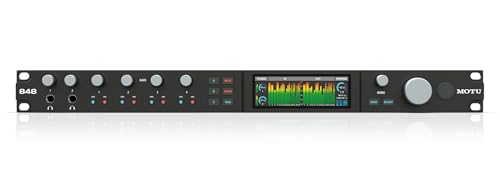
- 28x32 I/O with 12x12 analog channels and dual optical banks
- Thunderbolt 4/USB4 connectivity with low-latency drivers
- AVB networking, onboard mixing, and 32-bit effects
Best For: Project and professional studios needing a high-channel-count rack interface with modern connectivity and expansion.
Best Thunderbolt Expansion
Universal Audio Thunderbolt 3 Option Card

- Adds Thunderbolt 3 to supported Apollo rack interfaces
- Two USB-C ports simplify daisy-chaining
- Delivers 40 Gbps bandwidth and 15W bus power
Best For: Apollo rack owners upgrading an existing setup to Thunderbolt 3.
Best for High-Channel I/O
MOTU 10pre 26x28 Thunderbolt 4/USB4 Interface
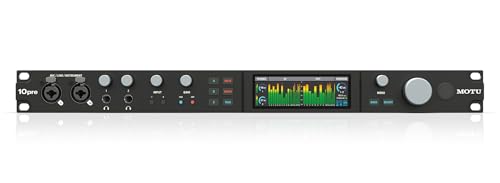
- 10 combo mic/line/instrument inputs
- 26-in/28-out routing with expansion options
- Thunderbolt 4/USB4 and low-latency drivers
Best For: Hybrid studios and bands that need a rackmount interface with lots of inputs and modern connectivity.
Best for Pro Home Studios
Universal Audio Apollo x4 Gen 2
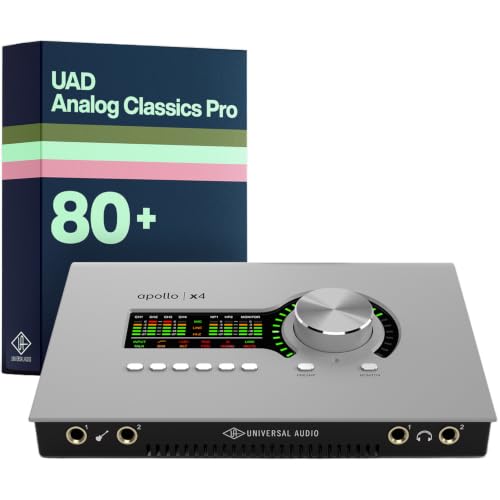
- Flagship conversion with low-distortion, high-detail sound
- Four Unison preamps for realistic analog-style tracking
- QUAD Core DSP and monitoring tools streamline recording
Best For: Producers and home-studio engineers who want premium Apollo sound in a compact Thunderbolt interface.
Best for Low-Latency Recording
Zoom TAC-2R Two-Channel Thunderbolt Interface

- Thunderbolt audio interface with ultra-low latency
- 24-bit/192 kHz recording and playback support
- Bus-powered with MIDI I/O for flexible setups
Best For: Users who want a compact two-channel Thunderbolt interface for fast recording and playback.
Best Desktop DSP Power
Apollo Twin X QUAD Gen 2 Studio
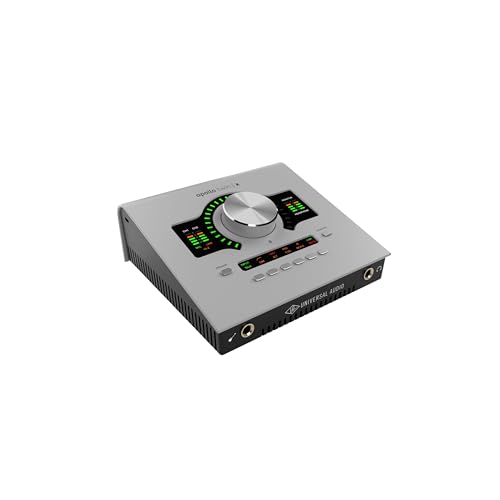
- Highest-resolution Apollo conversion with low distortion
- Dual Unison preamps for realtime analog-style tracking
- QUAD Core DSP and monitor correction for flexible mixing
Best For: Desktop studios and creators who want premium UA sound with onboard DSP.
Best DSP Accelerator
Universal Audio UAD 2 Satellite OCTO

- 8-core DSP for demanding UAD plug-in mixes
- Thunderbolt 3 with dual ports for daisy-chaining
- Great add-on for existing studio interfaces
Best For: Engineers who need more UAD processing without replacing their current interface.
Best for DSP-Driven Tracking
Apollo Twin X DUO Gen 2 Studio+

- Dual Unison preamps for realtime tone shaping
- DUO Core DSP for low-latency UAD plug-ins
- Monitor correction and bass management improve playback
Best For: Producers and vocal recordists who want premium desktop tracking with onboard DSP.
Best for Thunderbolt 4 Connectivity – MOTU 16A Thunderbolt 4/USB4 Audio Interface
If you want one of the most future-ready rackmount thunderbolt audio interfaces, the MOTU 16A stands out with Thunderbolt 4/USB4 connectivity, 32 x 34 channel routing, and strong onboard mixing. It’s built for users who need lots of I/O, low latency, and the flexibility to work across Mac, Windows, and iOS.
Best For: Engineers, producers, and studios that need a rack-friendly interface with modern Thunderbolt 4 connectivity, extensive I/O, and built-in DSP mixing.
Pros:
- 32 inputs and 34 outputs with 16 TRS analog I/O plus optical expansion
- Thunderbolt 4/USB4 connection with very low latency performance
- Built-in 64-channel mixing, EQ, compression, gate, and reverb
- High-end ESS Sabre32 converters with up to 192 kHz support
Cons:
- Overkill if you only need a simple 2-channel interface
- Rack-style connectivity and DSP features may be more than casual users need
- Lightning iPad use requires a separate adapter kit
For buyers comparing rackmount thunderbolt audio interfaces, the MOTU 16A is a strong choice when channel count, latency, and modern computer connectivity matter more than compact simplicity. Its combination of Thunderbolt 4, flexible I/O, and onboard processing makes it especially compelling for professional studio workflows.
Best for Portable UAD Tracking – Universal Audio Apollo Solo Heritage
If you want a compact interface that still brings serious studio tone, the Universal Audio Apollo Solo Heritage Edition is a strong fit. It’s not a rackmount model, but for creators comparing rackmount thunderbolt audio interfaces, it stands out for its Thunderbolt connectivity, UAD processing, and polished monitoring features in a desktop footprint.
Best For: Solo producers, vocalists, and guitarists who want Apollo sound quality and low-latency UAD effects in a small desktop setup.
Pros:
- UAD SOLO Core Processing lets you track with classic compressors, EQs, tape, and amp models at near-zero latency.
- Includes the Heritage Edition plug-in bundle for extra value right out of the box.
- Unison preamp modeling and a strong headphone amp make it useful for detailed tracking and monitoring.
- Works with major DAWs and can run through LUNA on Mac for a tight Apollo workflow.
Cons:
- Only one mic preamp, so it’s not ideal for recording multiple sources at once.
- Desktop format may not suit buyers specifically looking for rackmount thunderbolt audio interfaces.
- Single-core UAD processing is less expandable than larger Apollo models.
For a compact Apollo with real plug-in power, this is a smart pick if you value sound quality and simplicity over rack size. It won’t replace larger rackmount thunderbolt audio interfaces for multi-channel studios, but it delivers a very capable personal-recording setup.
Best for Thunderbolt 4 Workflows – MOTU 848 28×32 Thunderbolt 4/USB4 Interface
If you’re comparing rackmount thunderbolt audio interfaces for a modern studio, the MOTU 848 stands out for its Thunderbolt 4/USB4 connectivity, low-latency performance, and deep routing flexibility. It’s a strong fit when you need lots of I/O, onboard mixing, and network expansion in one rack unit.
Best For: Project and professional studios that want a high-channel-count rack interface with Thunderbolt 4, AVB networking, and flexible onboard mixing.
Pros:
- 28×32 I/O with 12×12 analog channels, dual optical banks, and dual headphone outs
- Thunderbolt 4/USB4 support with very low latency and broad computer compatibility
- ESS Sabre32 conversion plus 32-bit effects and 64-channel/32-bus mixing
- AVB networking and CueMix Pro routing make expansion and monitor setups easy
Cons:
- More interface than many small home studios need
- Advanced feature set can take time to learn
- Best value only if you’ll use the routing, networking, and extra I/O
For buyers who want a future-ready rackmount option, the MOTU 848 is one of the more capable rackmount thunderbolt audio interfaces thanks to its mix of speed, channel count, and studio-oriented features.
Best Thunderbolt Expansion – Universal Audio Thunderbolt 3 Option Card
If you already own an Apollo rack unit, this expansion card is the straightforward way to bring modern Thunderbolt 3 connectivity to rackmount thunderbolt audio interfaces. It adds faster USB-C-based I/O, makes daisy-chaining easier, and keeps your rack setup ready for high-bandwidth studio peripherals.
Best For: Apollo rack owners who want to upgrade to Thunderbolt 3 without replacing their interface.
Pros:
- Adds two Thunderbolt 3 USB-C ports for chaining Apollos or other devices
- Supports up to 40 Gbps for demanding audio and video workflows
- Provides 15W bus power to compatible downstream peripherals
- User-installable upgrade for supported Apollo rack interfaces
Cons:
- Requires a compatible Apollo rackmount interface
- Not a full audio interface on its own
- Limited to systems running supported macOS or Windows versions
For studios that want to extend the life and connectivity of Apollo-based rackmount thunderbolt audio interfaces, this option card is a practical upgrade rather than a standalone purchase. It is most compelling when you need modern Thunderbolt 3 speeds and cleaner daisy-chaining in an existing rack rig.
Best for High-Channel I/O – MOTU 10pre 26×28 Thunderbolt 4/USB4 Interface
MOTU 10pre 26x28 Thunderbolt 4/USB4 audio interface for Mac, Windows and iOS with 10 mic inputs
Check Price On AmazonIf you need one of the most capable rackmount thunderbolt audio interfaces for a serious studio, the MOTU 10pre 26×28 is built around lots of clean I/O, fast connectivity, and low-latency performance. With 10 mic/line/instrument inputs, 26 inputs and 28 outputs total, and support for Mac, Windows, and iPad setups, it suits engineers who want a flexible centerpiece rather than a basic interface.
Best For: Hybrid studios, bands, and producers who need plenty of mic inputs, hardware routing, and modern Thunderbolt 4/USB4 connectivity.
Pros:
- 10 combo mic/line/instrument inputs with remote control and phantom power
- High-end ESS converters with up to 192 kHz support and strong dynamic range
- Thunderbolt 4/USB4 connectivity plus a second TB port for expansion
- Low-latency MOTU drivers make it a good fit for tracking and mixing
Cons:
- More interface than many solo creators actually need
- Rackmount form factor is less portable than compact desktop units
- Best features make the most sense in a full studio workflow
For buyers comparing rackmount thunderbolt audio interfaces, this model stands out for its channel count, flexible routing, and professional-grade monitoring features. It is a strong pick when you want one box that can handle recording, expansion, and day-to-day studio control without feeling constrained.
Best for Pro Home Studios – Universal Audio Apollo x4 Gen 2
Universal Audio Apollo x4 Gen 2 with UAD Analog Classics Pro Thunderbolt 3 Audio Interface
Check Price On AmazonIf you want one of the most capable rackmount thunderbolt audio interfaces for a serious project studio, the Apollo x4 Gen 2 Studio + Edition delivers flagship-level conversion, four Unison preamps, and real-time UAD processing in a compact desktop-friendly format. It is built for creators who want classic console-style tone on the way in, without giving up modern speed or monitoring tools.
Best For: Producers, engineers, and multi-instrument recordists who want premium Apollo sound and DSP power for tracking vocals, guitars, and full sessions.
Pros:
- Next-generation conversion with very wide dynamic range and low distortion
- Four Unison preamps for tracking through emulations of Neve, API, Avalon, and more
- QUAD Core DSP supports real-time monitoring with 200+ UAD plug-ins
- Apollo Monitor Correction and Auto-Gain improve workflow and headphone mixes
Cons:
- More expensive than entry-level interfaces
- Desktop unit, so it is not a true rackmount form factor
- Best features depend on the UAD ecosystem and included software
This is a strong pick if you want top-tier sound quality and tracking flexibility rather than the cheapest channel count. Among rackmount thunderbolt audio interfaces, it stands out for its analog-style workflow, DSP power, and polished monitoring tools.
Best for Low-Latency Recording – Zoom TAC-2R Two-Channel Thunderbolt Interface
If you want one of the more streamlined rackmount thunderbolt audio interfaces for fast, clean recording, the Zoom TAC-2R is built around two-channel capture, Thunderbolt connectivity, and very low-latency performance. It’s a practical fit for musicians and podcasters who need high-resolution audio without a complicated desktop footprint.
Best For: Home studios, mobile recording rigs, and users who value simple 2-in/2-out Thunderbolt audio with MIDI support.
Pros:
- Thunderbolt connection for fast, low-latency monitoring and playback
- Supports up to 24-bit/192 kHz recording and playback
- Bus-powered design removes the need for an AC adapter
- MIDI I/O adds flexibility for hybrid studio setups
Cons:
- Only two inputs and two outputs, so it’s not ideal for larger sessions
- Thunderbolt-only connectivity limits compatibility with some computers
Overall, the TAC-2R makes sense if you want a compact interface that prioritizes speed, simplicity, and solid audio quality over channel count. Among rackmount thunderbolt audio interfaces, it stands out as a focused two-channel option for lean recording workflows.
Best Desktop DSP Power – Apollo Twin X QUAD Gen 2 Studio
Universal Audio Apollo Twin X QUAD Gen 2 with UAD Analog Classics Pro Thunderbolt 3 Audio Interface
Check Price On AmazonIf you want a compact interface with serious processing power, the Apollo Twin X QUAD Gen 2 stands out among rackmount thunderbolt audio interfaces alternatives for desktop studios. It combines UA’s highest-resolution conversion, dual Unison mic preamps, and onboard QUAD Core DSP so you can track through classic emulations with low latency.
Best For: Producers, vocalists, and project studios that want premium conversion, real-time plugin tracking, and a compact desktop setup.
Pros:
- High-end conversion with very wide dynamic range and low distortion
- Unison preamps let you record through authentic UA-style analog emulations
- QUAD Core DSP supports realtime UAD plugin workflows while tracking
- Monitor correction and Auto-Gain add practical setup and mix benefits
Cons:
- Not a rackmount unit, so it may not suit rack-based studios
- Premium pricing puts it beyond basic interface budgets
- Best features rely on the UA ecosystem and compatible software
For creators who care more about sound quality and plugin workflow than rack space, this is one of the most compelling choices in the broader rackmount thunderbolt audio interfaces category. It’s especially strong if you want UA’s signature sound in a desktop format without sacrificing processing headroom.
Best DSP Accelerator – Universal Audio UAD 2 Satellite OCTO
Universal Audio UAD 2 Satellite OCTO Core Thunderbolt 3 DSP Interface MAC or PC
Check Price On AmazonIf you need extra plug-in power rather than another input-heavy interface, the Universal Audio UAD-2 Satellite OCTO is a smart fit for rackmount thunderbolt audio interfaces workflows. It adds dedicated DSP over Thunderbolt 3, helping modern Mac and Windows 10 rigs run larger mixes and more UAD plug-ins without overloading the computer.
Best For: Producers and engineers who already have an interface and want more UAD plug-in processing for mix sessions.
Pros:
- Eight Shark DSP cores on the OCTO model for heavy plug-in sessions
- Thunderbolt 3 with dual ports for easy daisy-chaining
- Works with major DAWs and a large UAD plug-in library
- Backward compatible with older Thunderbolt 1 and 2 UA setups
Cons:
- Not a full audio interface, so it does not add mic pres or I/O
- Thunderbolt cable is not included
- Requires compatible system and UAD software setup
For rackmount thunderbolt audio interfaces buyers who care most about processing power, this is more of a mix-boosting companion than a standalone front end. It makes the most sense in professional UAD-based studios that want low-latency plug-in headroom and simple Thunderbolt expansion.
Best for DSP-Driven Tracking – Apollo Twin X DUO Gen 2 Studio+
Universal Audio Apollo Twin X DUO Gen 2 with UAD Analog Classics Pro Thunderbolt 3 Audio Interface
Check Price On AmazonIf you want a desktop interface that feels more like a polished recording chain than a simple I/O box, the Apollo Twin X DUO Gen 2 Studio+ is a strong pick for rackmount thunderbolt audio interfaces buyers who value premium conversion and realtime plug-in processing. Its dual Unison preamps and included UAD ecosystem make it easy to capture finished-sounding tracks on the way in.
Best For: Producers, home-studio owners, and vocal recordists who want UA sound quality, onboard DSP, and monitor correction in a compact Thunderbolt interface.
Pros:
- Dual Unison preamps let you track through classic emulations in realtime.
- DUO Core DSP supports low-latency use of UAD plug-ins while recording.
- Apollo Monitor Correction and bass management help improve monitoring accuracy.
- Auto-Gain speeds up setup when you need to move fast.
Cons:
- Not a rackmount unit, so it may not suit hardware-heavy studio installs.
- Best value depends on whether you’ll actually use the bundled UAD ecosystem.
- More of a premium desktop solution than a simple, basic interface.
For buyers comparing rackmount thunderbolt audio interfaces, this Apollo stands out less for rack integration and more for its premium desktop workflow, realtime tonal shaping, and mixing tools that help a small studio sound more finished from day one.
How We Picked the Best Rackmount Thunderbolt Audio Interfaces
We prioritized audio interfaces with Thunderbolt 3, Thunderbolt 4, or USB4 connectivity, practical rack-friendly form factors, strong input/output counts, and features that matter in real sessions such as monitor control, onboard DSP, and flexible routing. We also considered cross-platform support, since many Rackmount Thunderbolt Audio Interfaces need to work across Mac, Windows, and sometimes iOS.
Quick Comparison
For large-format recording, the MOTU 16A, MOTU 848, and MOTU 10pre stand out for higher I/O counts and rack-ready utility. If you want premium software integration and onboard processing, Universal Audio’s Apollo line is the strongest fit. For smaller setups, the Apollo Solo, Apollo Twin X DUO, and Apollo Twin X QUAD are better choices when desk space matters more than rack size. The Zoom TAC-2R remains a simple two-channel option, while the UAD-2 Satellite OCTO is best viewed as a DSP expansion companion rather than a primary interface.
Key Buying Factors for Rackmount Thunderbolt Audio Interfaces
I/O Count and Expansion
Match the interface to your session size. Solo artists and overdub rigs can live with 2 channels, but drum tracking, band recording, and outboard-heavy studios usually need more analog inputs and outputs.
Connectivity and Platform Support
Thunderbolt 4 and USB4 add flexibility, while Thunderbolt 3 remains common and effective. Check whether the unit is optimized for Mac only or supports Windows too, especially if your studio is mixed-platform.
Latency, Monitoring, and DSP
Low-latency direct monitoring is essential, but onboard DSP can be a major advantage for tracking with compression, EQ, or amp models without stressing your computer.
Physical Layout and Rack Use
Even among Rackmount Thunderbolt Audio Interfaces, front-panel control, clear metering, and easy cable access can make daily use far smoother. Consider whether you want a true rack unit or a desktop interface that fits in a rack space.
Who Should Buy Which Rackmount Thunderbolt Audio Interfaces?
Choose a high-channel-count MOTU model if you need straightforward multitrack recording and broad system compatibility. Pick an Apollo interface if you want strong hardware/software integration and DSP-assisted tracking. Choose the Apollo Solo or Twin X models for smaller production rooms, portable rigs, or songwriter setups. Add the UAD-2 Satellite OCTO if you already have an interface and want more UAD processing power rather than more I/O. If you only need a simple stereo or two-channel solution, the Zoom TAC-2R can still be enough for basic recording tasks.
In short, the best choice depends on whether you value channel count, DSP, portability, or expansion. For most buyers, the right rackmount Thunderbolt audio interface is the one that matches your workflow today and still leaves headroom for tomorrow.