Finding stage monitors for apartments means balancing vocal clarity and useful volume against limited space, shared walls, and the risk of overwhelming a small room. The right monitor can make rehearsals, home recording, and casual performances easier without requiring a full-size PA setup.
This roundup includes compact personal monitors, powered wedges, and passive speaker options across several price and performance levels. Use the buying guide below to match speaker size, power, connectivity, and placement to your apartment setup.
Best 10 Stage Monitors for Apartments Picks for 2026
Small-Space Vocal Monitor
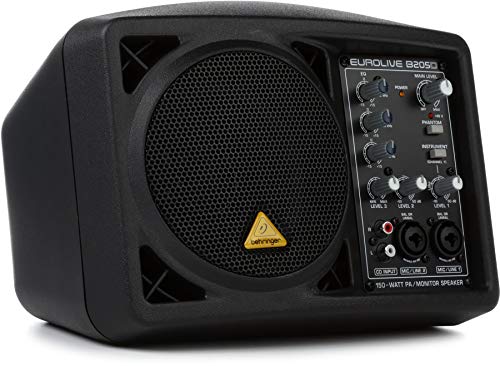
- Compact 7.05-pound active monitor
- Three-channel mixer with three-band EQ
- Phantom power and instrument input
Best For: Apartment vocals, keyboards, and home recording
Traditional Floor Wedge

- 10-inch two-way wedge monitor
- 150 watts RMS, 300 watts peak
- XLR, 1/4-inch, and Speakon connections
Best For: Rehearsal spaces with room for a full-size floor wedge
Flexible Bluetooth Monitor

- 350-watt powered eight-inch speaker
- Bluetooth and True Wireless Stereo
- Two-channel mixer with wedge configuration
Best For: Flexible apartment practice, playback, and small gigs
Personal Room Monitor

- Compact 150-watt personal PA
- 5.25-inch full-range driver
- Tabletop or pole-mount use
Best For: Apartment vocals, meetings, and small-room practice
Powerful Floor Monitor

- 10-inch woofer and 1-inch compression tweeter
- 150W RMS / 300W peak at 8 ohms
- Parallel 1/4-inch jacks for daisy chaining
Best For: Apartment musicians with an amplifier and room for a full-size floor monitor
Compact Personal Monitor

- Dual 5-inch NEOLITE drivers
- 200-watt continuous power rating
- Volume control with tabletop or mountable placement
Best For: Space-conscious home performers needing close-range personal monitoring
Powered Feedback-Control Monitor

- 250-watt powered monitor with Class-D amplification
- 12-inch woofer and 3-inch tweeter
- Feedback filter, limiter, and multiple wired inputs
Best For: Apartment setups needing a powered monitor with flexible connections
Best Apartment PA Pair
Compact 10-Inch Powered Monitors

- Two powered monitors included
- 300W amplification per speaker
- XLR, 1/4-inch, and 1/8-inch inputs
Best For: Apartment rehearsal spaces and small stereo monitoring setups
Best Small-Space Personal Monitor

- Compact 3-inch monitor
- 25W output for personal monitoring
- Stand/wall mount included
Best For: Desktop, wall-mounted, and close-range apartment monitoring
Best High-Power Passive Monitor

- 15-inch woofer with titanium driver
- 1400W peak rating
- 1/4-inch and Speakon connections
Best For: Large rehearsal spaces using a separate amplifier
Small-Space Vocal Monitor – Behringer Eurolive B205D
The Behringer Eurolive B205D is a compact active monitor worth considering when shopping for stage monitors for apartments. Its 7.05-pound design combines a 150-watt amplifier, full-range driver, and built-in three-channel mixer in a footprint suited to tabletop use, home recording, and close-range monitoring.
Best For: Apartment musicians, vocalists, keyboard players, and home recording setups that need multiple inputs without a large floor wedge.
Pros:
- Compact 8.66 x 11.42 x 7.28-inch cabinet with a lightweight 7.05-pound design
- Built-in three-channel mixer with three-band EQ
- Two microphone preamps with phantom power plus an instrument-ready input
- 150-watt Class-D amplification and a full-range neodymium driver
Cons:
- Single 5.25-inch driver is intended for compact monitoring rather than deep bass
- Its 150-watt output may be less suitable for larger venues than full-size monitor wedges
For apartment practice and home recording, the B205D stands out for its integrated mixing and unusually small footprint. It is a practical choice when flexibility and easy placement matter more than room-filling low end.
Traditional Floor Wedge – Seismic Audio SA-10MT
Seismic Audio - SA-10MTSingle - 10" Floor / Stage Monitor Wedge Style with Titanium Horn
Check Price On AmazonThe Seismic Audio SA-10MTSingle is a conventional floor-wedge monitor with a 10-inch woofer and titanium horn. Among stage monitors for apartments, it is best suited to users who want a familiar stage-monitor shape and wired connectivity, provided they have enough floor space for its 22-pound cabinet.
Best For: Apartment rehearsal spaces, small performance setups, and musicians who prefer a stage-ready wedge with XLR, 1/4-inch, and Speakon connections.
Pros:
- 10-inch two-way speaker with a titanium compression horn
- Rated at 150 watts RMS and 300 watts peak
- Floor-mount wedge design for angled monitoring
- Offers XLR, 1/4-inch, and Speakon wired connectivity
Cons:
- 22-pound weight and 14 x 18 x 13.5-inch dimensions take more apartment space
- No built-in mixer or wireless connectivity is listed
- Not water resistant
The SA-10MTSingle delivers the physical format and driver layout of a traditional stage wedge, but it is less convenient for compact rooms than an active mini monitor. Check your available floor area and amplification requirements before choosing it for apartment use.
Flexible Bluetooth Monitor – ALTO TX408
The ALTO TX408 brings 350 watts of bi-amplified power, Bluetooth, and an eight-inch driver to the search for stage monitors for apartments. Its wedge-monitor configuration can work for practice or small gigs, while the built-in mixer and wireless streaming add flexibility for music playback and microphone use.
Best For: Apartment musicians, DJs, presenters, and small-event users who want a powered monitor with Bluetooth and two-source operation.
Pros:
- 350-watt bi-amplified system with an eight-inch LF driver
- Bluetooth streaming and True Wireless Stereo support
- Built-in two-channel mixer for microphone, line-level, and Bluetooth inputs
- Wedge-monitor configuration, ergonomic handles, and a 36mm pole socket
Cons:
- Larger and heavier than compact personal monitors at 16.61 inches high and 5.9 kg
- Its higher power may be excessive for quiet apartment practice
- Not water resistant
The TX408 is the most feature-rich option here for users who need both monitoring and playback. It offers useful connectivity and coverage, but apartment buyers should consider its larger cabinet and 350-watt output relative to their room size.
Personal Room Monitor – Mackie SRM150
The Mackie SRM150 is a compact personal PA designed for one microphone plus music in small rooms. For stage monitors for apartments, its one-hand-carry design, tabletop or pole-mount options, and 150-watt Class-D power make it a practical choice for vocals, presentations, and close-range practice rather than full-band playback.
Best For: Apartment vocal practice, classrooms, meetings, busking, and small-room setups using one microphone and a music source.
Pros:
- Compact 5.25-inch full-range driver and 150-watt Class-D amplifier
- Designed for one mic plus music in small rooms
- Can be used on a tabletop or mounted on a pole
- Built-in limiter helps protect the driver at high volume
Cons:
- Not intended to function as a full-band PA
- 100 Hz to 17.5 kHz response means bass-heavy music sounds lighter
- Its compact system provides less low-end output than a larger monitor
The SRM150 is a sensible apartment option when vocal clarity, portability, and simple operation are the priorities. Its limited low-frequency response and single-microphone focus make it less suitable for bass-heavy music or larger ensemble monitoring.
Powerful Floor Monitor – Sound Town METIS-10M
The Sound Town METIS-10M is a practical choice for apartments where you need a dedicated floor monitor for rehearsals or small live setups. Its passive design uses a 10-inch woofer and 1-inch compression tweeter, while the carpeted cabinet and recessed handle make repositioning easier.
Best For: Apartment musicians who need a traditional passive stage monitor with strong power handling and daisy-chain flexibility.
Pros:
- 150W RMS and 300W peak power handling at 8 ohms
- 10-inch woofer paired with a 1-inch compression tweeter
- Parallel 1/4-inch jacks support easy daisy chaining
- Metal grille, reinforced corners, and recessed handle add practical durability
Cons:
- Passive operation requires a separate amplifier
- The 10-inch floor cabinet may be more speaker than a compact apartment practice space needs
- It is not waterproof
Choose the METIS-10M if you already have compatible amplification and want a conventional floor monitor with useful connection and portability features. Its larger cabinet and passive setup are worth accounting for when planning an apartment rig.
Compact Personal Monitor – Galaxy Audio HS7
The Galaxy Audio HS7 is one of the more apartment-friendly stage monitors for apartments because its two 5-inch drivers and tabletop format suit personal listening near a desk, rehearsal area, or small performance setup. A built-in volume control keeps basic adjustments simple.
Best For: Singers, instrumentalists, and home performers who want a compact passive personal monitor for close-range use.
Pros:
- Compact two-driver design with dual 5-inch NEOLITE drivers
- 200-watt continuous power rating
- 150Hz–18kHz frequency response
- Includes rubber feet and a stand/wall-mount bracket
Cons:
- 16-ohm impedance requires amplifier compatibility
- Its 150Hz lower frequency rating is less suited to pronounced low-end monitoring
- It is not waterproof
The HS7 makes the most sense when apartment space is limited and you want a personal monitor rather than a large floor wedge. Its compact size, included mounting accessories, and volume control support flexible placement.
Powered Feedback-Control Monitor – Behringer EUROLIVE F1220D
The Behringer EUROLIVE F1220D is a powered monitor option for apartment musicians who want amplification built into the speaker. Its 12-inch woofer, 3-inch tweeter, feedback filter, and integrated limiter provide a feature-rich setup for rehearsals, playback, or live-style monitoring.
Best For: Apartment users who need a powered monitor with flexible wired inputs and tools for managing feedback.
Pros:
- Built-in Class-D amplification with a 250-watt rating
- 12-inch woofer and 3-inch tweeter deliver a full-size monitor configuration
- Adjustable feedback filter and integrated limiter support system control
- Accepts XLR, 1/4-inch, RCA, and Speakon connections
Cons:
- The 23.6-pound cabinet is relatively substantial for an apartment
- Its 18-by-18-by-12.25-inch dimensions require dedicated floor or tabletop space
- It is not waterproof
The F1220D is a strong fit if you value an all-in-one powered design and broad wired connectivity. Before choosing it for an apartment, make sure its larger cabinet and higher output are appropriate for your available space and listening environment.
Best Apartment PA Pair – Compact 10-Inch Powered Monitors
For shoppers comparing stage monitors for apartments, the Sound Town METIS-10MPW pair offers a practical two-speaker setup with built-in amplification. Its wedge design, onboard EQ, and multiple wired inputs make it suitable when you need room-filling monitoring without adding separate power amplifiers.
Best For: Apartment rehearsal spaces, small live setups, and users who want a powered stereo monitor pair.
Pros:
- Includes two powered 10-inch stage monitors.
- Integrated 300W amplification in each speaker simplifies setup.
- Offers XLR, 1/4-inch, and 1/8-inch MP3 inputs, plus XLR outputs for daisy chaining.
- Built-in three-band EQ and low-profile wedge cabinets support flexible placement and tuning.
Cons:
- The 10-inch cabinets may take more floor space than compact personal monitors.
- They are corded and have no wireless communication technology.
- They are not water resistant.
This is the most complete option here for a small apartment performance or rehearsal rig, especially if you need two monitors and do not already own an amplifier. Measure your available floor space before buying.
Best Small-Space Personal Monitor – Galaxy Audio Nano Spot
Among stage monitors for apartments, the Galaxy Audio NSPA stands out for its compact 3-inch format and included stand/wall-mount hardware. Its 25-watt output is better suited to personal or near-field monitoring than high-volume room coverage, making it easier to accommodate in a limited space.
Best For: Personal vocal monitoring, desktop use, and apartment setups where wall or stand mounting is helpful.
Pros:
- Compact 3-inch monitor with a listed 25-watt output.
- Includes a stand/wall bracket mount kit, power supply, and rubber feet.
- Its small enclosure is easier to place in a bedroom, office, or practice corner.
- Offers a 150Hz–17kHz frequency response.
Cons:
- Lower output and a smaller driver are less suitable for full-room or stage-level sound.
- The supplied frequency response starts at 150Hz, so deep bass coverage is limited.
- It is a single monitor rather than a stereo pair.
The NSPA is the most apartment-friendly choice when footprint and personal monitoring matter more than maximum volume. It is a sensible fit for close listening, but larger powered monitors will provide broader coverage.
Best High-Power Passive Monitor – Rockville 15-Inch Floor Wedge
The Rockville RSM15P is a large passive floor monitor for buyers who already have compatible amplification and want substantial output. While it can serve as one of the stage monitors for apartments, its 15-inch cabinet and 54.9-pound weight make it better suited to spacious rooms, dedicated rehearsal areas, or event use than compact living spaces.
Best For: High-output rehearsal or DJ systems with an existing amplifier, mixer, and adequate floor space.
Pros:
- 15-inch woofer and 1.75-inch titanium compression driver support powerful two-way audio.
- Rated for 1400 watts peak output.
- 70-by-50-degree horn coverage is designed for broad, even dispersion.
- Provides dual 1/4-inch and Speakon input/output connections.
Cons:
- It is passive, so a separate amplifier is required.
- The 54.9-pound cabinet and 19-by-19-by-28-inch dimensions are difficult to justify in a small apartment.
- It has no stated warranty in the supplied details.
This monitor offers the most headroom in the group, but it is not the easiest apartment solution. Choose it only if you need its larger output and already have the amplification and room to position it safely.
How We Picked These Stage Monitors for Apartments
We focused on monitor designs that can provide clear vocals and instruments at close range while remaining practical in a residential room. The selection includes compact personal monitors for desks or small practice areas, powered wedges that simplify setup, and passive models for buyers who already own an amplifier or PA mixer.
We also considered speaker size, rated power, portability, controls, feedback-management features, and placement flexibility. In an apartment, maximum output matters less than intelligibility, usable volume control, and the ability to keep sound directed toward the performer.
Quick Comparison
| Type | Best For | Main Advantage | Watch For |
|---|---|---|---|
| Personal monitor | Vocalists, desks, small rehearsal spaces | Compact and easy to position | Limited low-end and coverage |
| Powered wedge | Small PA systems and floor monitoring | Built-in amplification | Can be louder and larger than needed |
| Passive wedge | Existing PA setups | Flexible system integration | Requires a suitable amplifier |
Key Buying Factors for Stage Monitors for Apartments
Size and Placement
Eight- to 10-inch speakers are often a practical middle ground for apartment rehearsal. Smaller personal monitors take up less room and work well at close range, while 12- to 15-inch wedges may offer more headroom but can be unnecessarily bulky. Place a wedge on the floor and angle it toward ear level rather than pointing it directly at nearby walls.
Powered or Passive Design
Powered monitors are usually the simplest choice because the amplifier is built in. They reduce equipment count and setup complexity, but you will need access to a power outlet. Passive monitors can be useful when you already have an amplifier, powered mixer, or complete PA system, but verify impedance and power compatibility before connecting them.
Volume, Clarity, and Feedback
Look for independent volume controls, useful input options, and features such as feedback filters when available. Apartment users should prioritize clean, controlled monitoring over maximum loudness. A monitor that sounds clear at moderate volume is generally more useful than one designed primarily for large venues.
Connectivity and Noise Control
Check whether the monitor accepts microphone-level, line-level, or instrument sources that match your mixer and equipment. Keep cables short and organized, use balanced connections where possible, and avoid placing the speaker directly against a shared wall or corner, where bass buildup can become a problem.
Who Should Buy Which Stage Monitors for Apartments?
Choose a compact personal monitor if you need close-range vocal monitoring, practice at a desk, or have very limited floor space. A powered eight- or 10-inch wedge is better for singers, musicians, and small home PA systems that need more coverage and a familiar stage-monitor angle.
Choose a passive wedge if you already own compatible amplification and want to build around existing equipment. Larger 12- or 15-inch models make the most sense for buyers who also rehearse in larger rooms or need additional headroom beyond typical apartment use. For most residential setups, start with the smallest monitor that delivers clear sound at your normal practice volume.