If you want a JOYO Analog Delay JF-33 review that cuts through the marketing, the short version is this: it is a budget-friendly delay pedal aimed at players who want a mild, mellow repeat rather than a flashy effect.
It is built around a true-bypass, all-metal design and a simple no-drama workflow.
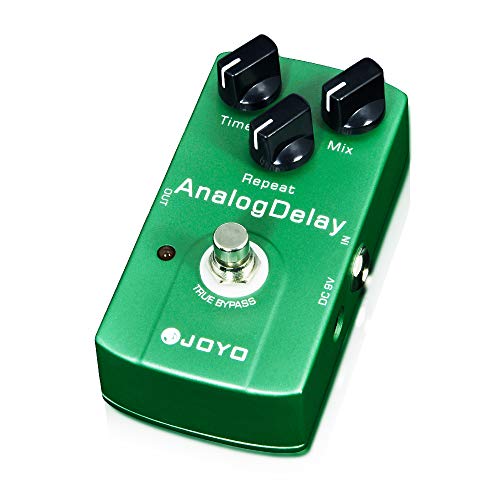
JOYO Analog Delay Review Summary
The JOYO Analog Delay makes sense for guitarists who want a straightforward delay pedal that stays out of the way and keeps the focus on the guitar.
The listing frames it as an affordable way to get soft, musical delay tones, and the hardware choices support that goal: true bypass, a whole aluminium-alloy housing, a stoving varnish finish, and a small LED indicator.
This is a good fit if you value simple operation, compact board-friendly construction, and a delay sound described by the manufacturer as mild and mellow.
It is less compelling if you need deep feature control, multiple delay modes, or studio-style precision from the pedal itself.
Review Scorecard
| Category | Score | Why it earns that score |
|---|---|---|
| Tone character | 8/10 | The product is explicitly positioned around a mild, mellow delay voice that suits subtle ambient use. |
| Build quality | 8/10 | Aluminium-alloy housing and a finished outer coat suggest a practical stage-ready enclosure. |
| Simplicity | 9/10 | The listing emphasizes a direct, easy-to-use pedal rather than a feature-heavy interface. |
| Transparency | 8/10 | True bypass is a clear plus for players who want to minimize tone loss when the effect is off. |
| Value focus | 8/10 | The product is marketed as a favorably priced entry into delay effects. |
| Power/setup friendliness | 6/10 | The listing recommends an extra JOYO adapter or another reliable supply that matches current needs. |
Key Features and Specifications of JOYO Analog Delay
The JOYO Analog Delay is described as a digital circuit delay pedal that aims for an analog-style feel.
That distinction matters: the listing is not promising a big multi-mode delay workstation, but a focused pedal for players who want a softer echo character.
Key evidence from the product record:
- True bypass for transparent signal handling when the pedal is disengaged.
- Whole aluminium-alloy housing for a durable, straightforward enclosure.
- Stoving varnish finish for a more finished outer surface.
- Small LED flash indicator to show working state.
- The brand positions it as part of JOYO’s budget-pedal lineup.
- The listing recommends checking your connection carefully before playing.
- The listing also recommends using a proper power adapter or another reliable supply that meets the pedal’s working current requirement.
The most important practical takeaway is that this is a compact, no-nonsense delay pedal whose value comes from keeping the signal path simple while delivering a gentle delay voice.
If you are shopping for knobs, presets, or multiple tap-tempo options, this is probably not the right branch of the category.
Pros and Cons of JOYO Analog Delay
Pros
- True bypass helps preserve your core guitar tone when the effect is off.
- Metal housing gives it a sturdier, more credible pedalboard feel than a plastic alternative.
- Mild and mellow delay character is useful for rhythm thickening, lead support, and low-key ambience.
- Simple layout should be easy for players who want fast setup and minimal menu-diving.
- Budget-minded positioning makes it accessible as a first delay or a backup pedal.
Cons
- The listing does not describe advanced controls, presets, or multiple delay types.
- The pedal is aimed at a particular tone style, so players wanting sharp repeats or experimental textures may look elsewhere.
- Power requirements deserve attention, since the manufacturer suggests using a suitable adapter rather than assuming any supply will do.
- The product information is light on technical specs, so buyers have to judge it more by intended use than by detailed engineering data.
Who Should Buy JOYO Analog Delay?
The JOYO Analog Delay is a strong match for players who want a simple delay with a soft character and who care more about feel than feature density.
It is especially sensible for guitarists building a practical budget board, beginners who want one delay sound that is easy to understand, or working players who need a spare pedal that does one job reliably.
It also suits people who prefer true bypass and a sturdy housing over lightweight novelty features.
If your priorities are transparent bypass, easy setup, and a delay voice that the manufacturer describes as mild and mellow, this belongs on your shortlist.
You should probably skip it if you need a digital delay with deep editing, multiple memory slots, or highly specialized rhythmic patterns.
Players chasing studio-sounding versatility, tempo-synced complexity, or modern ambient layering will likely prefer a more feature-rich pedal.
Delay Character and Practical Use
Mild Repeats for Support Playing
The core selling point is the tone direction.
The product is not pitched as a dramatic echo machine; it is meant to give you a softer delay trail that supports the main note instead of overpowering it.
That makes it attractive for classic lead reinforcement and understated ambience.
True Bypass on a Budget Board
True bypass is one of the most useful practical details here.
For players who care about preserving their dry signal when the effect is off, that is a real advantage.
On a small pedalboard, a pedal like this can serve as an easy on/off utility rather than a source of tonal anxiety.
Build That Looks Ready for Real Use
The aluminium-alloy shell and stoving varnish finish matter because budget pedals can sometimes feel fragile.
This one is presented as a practical metal-bodied unit with a simple status LED, which is exactly the kind of construction many players want for rehearsal rooms, home practice, and grab-and-go rigs.
Setup Matters More Than Flash
The listing’s guidance about using a proper power adapter is worth taking seriously.
That does not make the pedal difficult, but it does mean you should think about your supply before you blame the pedal for unwanted noise or inconsistent behavior.
In other words, this is a pedal that rewards correct basics more than it rewards improvising the power chain.
Alternatives to JOYO Analog Delay
If you are comparing the JOYO Analog Delay with other Amazon-available delay options, start with a few obvious peers.
A Boss delay pedal is the most common step up if you want a more established pro lineup and broader pedalboard familiarity.
If you want another budget-friendly compact choice, a Behringer delay pedal can be a useful comparison point for players who care mostly about cost-conscious utility.
For guitarists who want a more traditional analog-delay flavor, a TC Electronic analog delay pedal is worth checking as a tonal benchmark.
For players who want more ambient flexibility, a Mooer delay pedal may offer a different balance of compact size and broader sound-shaping options.
Is JOYO Analog Delay Worth It?
The JOYO Analog Delay is worth it if you want a simple, affordable delay pedal with a mellow voice and a true-bypass design.
It is not the most flexible delay you can buy, but it does not try to be.
For players who value a sturdy metal enclosure, low-fuss operation, and a musical delay that stays subtle, this looks like a sensible buy.
If you need extensive control or multiple delay flavors, keep shopping.
If you mainly want one dependable delay sound for everyday guitar use, the JOYO Analog Delay is a credible choice.