Choosing an audio mixer for beginners can feel complicated when product listings combine channel counts, effects, Bluetooth, USB recording, and phantom power. The right choice depends less on having the most features and more on matching the mixer to your microphone, instruments, computer, and workflow.
We selected ten accessible options ranging from compact analog mixers to gaming-focused audio interfaces. Use the guide below to compare essential features and identify the best fit for your first setup.
Best 10 Audio Mixer for Beginners Picks for 2026
Feature-Rich Starter
6-Channel Bluetooth Audio Mixer

- Six inputs for microphones and instruments
- Bluetooth and USB playback support
- 48V phantom power and 16 DSP effects
Best For: Karaoke, small performances, streaming, and home recording
Clean and Simple

- Six-channel analog mixing layout
- D-PRE preamps with EQ and filters
- One-knob compressors and rugged chassis
Best For: Small performances, lectures, recording, and basic mixing
Streaming Starter
FIFINE Ampligame SC3 Gaming Mixer

- Separate controls for mic, music, and monitoring
- USB-C computer connection for Mac and Windows
- Mute, voice effects, and RGB controls
Best For: Beginner streamers, gamers, podcasters, and creators
Compact Analog Pick

- Five-channel compact analog design
- Phantom-powered mic/line input
- Stereo inputs plus RCA playback and recording
Best For: Desktop setups, rehearsal, playback, and basic mixing
Versatile Starter Console
FULUODE CT-80S 8-Channel Mixer

- Eight channels with 48V phantom power
- Bluetooth, USB playback, and recording
- Slim design for karaoke and small events
Best For: Beginners who need multiple inputs and built-in playback
Compact Routing Pick
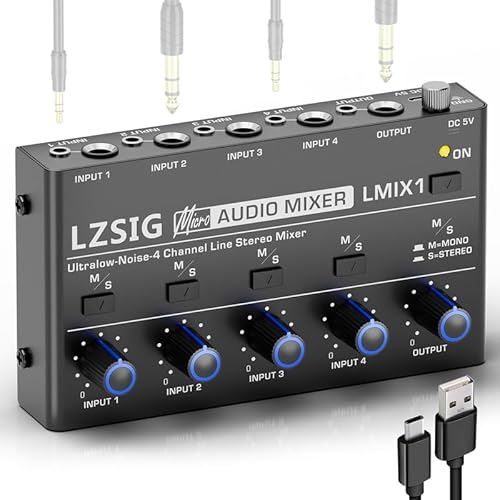
- Four inputs into one mono or stereo output
- Accepts 3.5mm and 6.35mm connections
- Compact, low-noise line mixing design
Best For: Beginners building a simple desktop or instrument sub-mix
Feature-Rich Learning Board
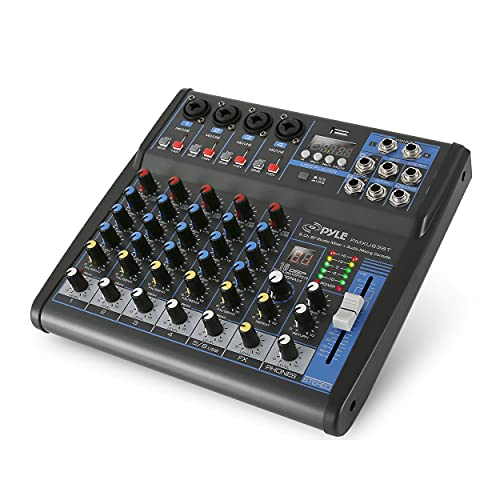
- Six channels with XLR and 1/4-inch inputs
- Bluetooth, USB, MP3, and flash-drive playback
- 3-band EQ, phantom power, and DSP effects
Best For: Beginners learning live mixing with microphones and streaming
Best Plug-and-Play Pick

- USB-B PC recording with no extra software required
- Bluetooth and USB-drive playback support
- 48V phantom power, EQ, echo, and headphone monitoring
Best For: Flexible beginner podcasting, streaming, and home audio setups
Best Control-Focused Option

- Six channels with faders and three-band EQ
- USB, Bluetooth, MP3 playback, and DSP effects
- Control Room output and independent headphone control
Best For: Beginners who want room to learn detailed mixing
Best for Gaming and Streaming
PUPGSIS 4-Channel Streaming Mixer

- Supports up to three microphone inputs
- Voice changer, sound pads, and reverb presets
- Zero-latency monitoring, mute control, and Bluetooth 5.3
Best For: Gaming, livestreaming, and interactive creator content
Feature-Rich Starter – 6-Channel Bluetooth Audio Mixer
For beginners seeking an audio mixer for beginners that can handle microphones, instruments, karaoke, or simple playback, this six-channel board offers a broad set of controls. It combines Bluetooth, USB playback, phantom power, three-band EQ, and built-in DSP effects in one traditional analog mixer.
Best For: Beginners who want flexible connectivity for karaoke, small performances, streaming, or home recording.
Pros:
- Six channels include four XLR/1/4-inch inputs and stereo channels.
- Built-in Bluetooth and USB support music playback and mixing.
- Offers 48V phantom power, three-band EQ, and 16 DSP effects.
Cons:
- It is a traditional analog mixer and may require more hands-on setup than a simple USB controller.
- The manufacturer lists a 90-day warranty.
- USB, Bluetooth, and phantom-power operation may require careful control selection.
This is a versatile entry point when you want more than basic volume control. Its channel count and effects give beginners room to experiment, while the compact console layout supports a variety of small audio setups.
Clean and Simple – Yamaha MG06 Compact Mixer
The Yamaha MG06 is a straightforward choice for shoppers comparing an audio mixer for beginners. Its six-channel analog design focuses on clean signal handling, practical EQ, high-pass filtering, and easy one-knob compression rather than built-in digital features.
Best For: Beginners who prefer a durable analog mixer for small performances, lectures, recording, or basic instrument and microphone mixing.
Pros:
- Six-channel layout provides room for several audio sources.
- D-PRE preamps, three-band EQ, and high-pass filters support sound shaping.
- One-knob compressors simplify control of vocals and instruments.
- Rugged powder-coated metal chassis is designed for regular handling.
Cons:
- It has no USB connectivity.
- Digital playback, Bluetooth, and built-in effects are not listed.
- As an analog mixer, it requires separate equipment for computer-based recording.
The MG06 is a good fit when reliability and uncomplicated controls matter more than extra features. It keeps the learning curve focused on core mixing skills and provides XLR outputs for compatible audio equipment.
Streaming Starter – FIFINE Ampligame SC3 Gaming Mixer
Designed around streaming and gaming, the FIFINE Ampligame SC3 is an audio mixer for beginners who want direct control over a microphone, music, headphones, and line output. Its front-facing controls, USB-C computer connection, mute and monitor buttons, and built-in effects make it approachable for online content creation.
Best For: New streamers, gamers, podcasters, and creators using Mac or Windows with an XLR microphone.
Pros:
- Individual controls manage microphone, line-in, headphone, and line-out levels.
- Front mute and monitor buttons support quick streaming adjustments.
- Includes voice effects, auto-tune changes, and customizable sound buttons.
- Plug-and-play support works with Mac OS, Windows, OBS, Twitch, YouTube, and TikTok setups.
Cons:
- The XLR cable is not included.
- It is not compatible with USB microphones.
- Its feature set is aimed at streaming rather than multi-channel live mixing.
The SC3 is especially appealing if your priority is convenient computer-based streaming rather than traditional band mixing. Its controls are easy to reach, but buyers should plan on having an XLR microphone and suitable cable.
Compact Analog Pick – Mackie Mix5 Compact Mixer
The Mackie Mix5 is a compact audio mixer for beginners who need a simple analog setup without a large control surface. It provides one mic/line input with phantom power, two stereo 1/4-inch line inputs, RCA playback and recording connections, and main left/right outputs.
Best For: Beginners building a small desktop, playback, rehearsal, or basic microphone-and-stereo-source setup.
Pros:
- Small five-channel design is easy to place on a desk or portable setup.
- Includes a mic/line input with phantom power for a studio condenser microphone.
- Two stereo 1/4-inch inputs accommodate additional line-level sources.
- RCA inputs and outputs support playback or recording connections.
Cons:
- It offers only one mic/line input.
- Its EQ is limited to two bands.
- No USB connectivity or built-in digital effects are listed.
The Mix5 keeps the essentials accessible and avoids unnecessary complexity. Choose it when you want a small, low-noise analog mixer for a few sources; choose a more feature-rich model if you need multiple microphones or computer integration.
Versatile Starter Console – FULUODE CT-80S 8-Channel Mixer
For beginners who want room to grow, this audio mixer for beginners combines eight channels with Bluetooth, USB playback and recording, reverb, and 48V phantom power. Its slim design suits home karaoke, small performances, school events, conferences, and studio-style setups.
Best For: Beginners needing multiple inputs and built-in playback features for karaoke, live music, or small events.
Pros:
- Eight channels support wired or wireless microphones, instruments, and other sources.
- Includes Bluetooth 5.0, MP3/USB input, USB recording, and an LED display.
- Offers 48V phantom power and reverb for compatible microphones and vocal applications.
- Ultra-thin 1.57-inch design helps conserve space.
Cons:
- The product uses a 110V American plug, which may require additional consideration outside compatible regions.
- Its larger feature set may be more than a beginner needs for a simple one- or two-source setup.
The CT-80S is a practical choice if you want a beginner-friendly mixer that can handle several sources now while leaving flexibility for future setups.
Compact Routing Pick – LZSIG 4-Channel Mini Mixer
This LZSIG model is a straightforward audio mixer for beginners who mainly need to combine several line-level sources. Its four inputs, compact footprint, mono/stereo switching, and support for both 3.5mm and 6.35mm connections make it useful for basic audio routing.
Best For: Beginners sub-mixing keyboards, electronic drums, guitars, computers, CD players, or gaming consoles into one output.
Pros:
- Combines up to four audio sources into a single stereo or mono output.
- Supports both 3.5mm and 6.35mm TRS/TS cables.
- Compact design fits easily into smaller desktop or portable setups.
- Uses low-noise components and includes a USB-C cable.
Cons:
- The power adapter is sold separately.
- This line mixer is intended for routing sources rather than a full microphone-focused mixing setup.
Choose the LZSIG when simplicity and size matter most. It is especially appropriate for combining electronic instruments and consumer audio devices without needing a larger console.
Feature-Rich Learning Board – Pyle PMXU63BT 6-Channel Mixer
The Pyle PMXU63BT gives beginners a broad introduction to live and studio-style mixing. This audio mixer for beginners includes six channels, Bluetooth streaming, USB and MP3 playback, 3-band EQ, 48V phantom power, and built-in DSP effects for band practice, karaoke, recording, or small performances.
Best For: Beginners who want microphone inputs, wireless music streaming, basic EQ, and effects in one console.
Pros:
- Six channels accept XLR and unbalanced 1/4-inch inputs.
- Bluetooth, USB, flash-drive, and MP3 functions support playback and mixing.
- Provides 48V phantom power, 3-band EQ, peak indicators, and 16-bit DSP effects.
- Steel chassis and sealed rotary controls are suited to repeated use.
Cons:
- The broader controls and features may require more learning than a basic line mixer.
- It is a corded console rather than a minimal portable mixer.
The PMXU63BT is a strong all-around learning platform for beginners who expect to work with microphones and live audio, not just combine a few playback sources.
Best Plug-and-Play Pick – Aveek 5-Channel Audio Mixer
If you want an audio mixer for beginners that supports microphones, instruments, computer audio, and simple recording, the Aveek 5 Channel Audio Mixer is a versatile starting point. It combines USB-B PC recording, Bluetooth streaming, USB-drive playback, phantom power, and straightforward EQ controls in a compact console.
Best For: Beginners building a flexible setup for podcasting, livestreaming, small performances, meetings, or home recording.
Pros:
- Offers XLR, 1/4-inch, RCA, USB, and Bluetooth connectivity for varied sources.
- Built-in recording chip supports plug-and-play PC recording without extra software.
- Includes 48V phantom power, headphone monitoring, gain controls, EQ, echo, and delay.
- Supports MP3 playback and recording through a USB drive.
Cons:
- Bluetooth, USB, and 4/5-channel functions cannot be used simultaneously.
- Bluetooth output-device connections are not supported; outputs are intended for active equipment.
- Its channel EQ is limited to two bands.
The Aveek is a strong beginner-friendly choice when connectivity and built-in recording features matter most. Its operating limitations are worth noting, but the combination of inputs, phantom power, effects, and monitoring gives new users room to grow.
Best Control-Focused Option – Pyle PMX406ST 6-Channel Mixer
The Pyle PMX406ST is an audio mixer for beginners who want more hands-on control than a basic knob-only board provides. Its six channels, per-channel faders, three-band EQ, USB recording, Bluetooth, MP3 playback, and built-in DSP effects make it suitable for learning more detailed mixing workflows.
Best For: Home studio users, podcasters, musicians, streamers, karaoke setups, and small venues that need six channels and dedicated monitoring controls.
Pros:
- Provides six channels with per-channel faders and independent gain and EQ controls.
- Channels 1 and 2 include XLR combo inputs, +48V phantom power, and Hi-Z switching.
- Includes USB PC recording/playback, Bluetooth streaming, and a built-in MP3 player.
- Offers DSP effects, a Control Room output, independent headphone volume, and PEAK LEDs.
Cons:
- It has a larger feature set that may take beginners longer to learn.
- Only the first two channels are specified with XLR combo inputs and Hi-Z switching.
- The supplied details do not identify supported software updates.
Choose the Pyle if you want a beginner mixer with a more traditional, adjustable signal path. The faders, three-band EQ, control-room output, and effects provide useful learning tools while keeping the unit compact.
Best for Gaming and Streaming – PUPGSIS 4-Channel Streaming Mixer
For beginners focused on gaming, livestreaming, or interactive content, the PUPGSIS audio mixer emphasizes quick controls and creative effects. It combines XLR and 3.5mm microphone support, 48V phantom power, voice changing, sound pads, Bluetooth 5.3, RGB lighting, and zero-latency monitoring in a streamer-oriented interface.
Best For: Gamers, Twitch and YouTube streamers, podcasters, and small creator teams using multiple microphone inputs.
Pros:
- Supports up to three microphone inputs, including XLR, headset, and second-mic connections.
- Includes six voice-changing modes, four customizable sound pads, and three reverb presets.
- Four faders independently control microphones, Aux/Bluetooth, and line output.
- Provides one-touch mute, zero-latency monitoring, Bluetooth 5.3, and adjustable RGB lighting.
Cons:
- Its feature set is geared toward gaming and streaming rather than traditional studio mixing.
- The supplied notes do not specify detailed recording-interface software support.
- RGB lighting and voice effects may be unnecessary for users seeking a minimal audio setup.
The PUPGSIS stands out when fast-access streaming features matter more than conventional mixer depth. Its faders, mute control, monitoring, sound pads, and voice effects make it approachable for interactive content, while phantom power supports an XLR microphone upgrade.
How We Picked the Best Audio Mixer for Beginners
We focused on mixers that are approachable for first-time users while covering common needs such as podcasting, livestreaming, music practice, home recording, gaming, and small DJ setups. The selection includes compact models with four to six channels, USB or PC recording features, Bluetooth playback, built-in effects, and microphone inputs.
We also considered practical setup factors: clear controls, useful connectivity, manageable size, and features that provide value without requiring advanced audio knowledge. Specifications can vary by listing and configuration, so verify the included cables, input types, software compatibility, and power requirements before buying.
Quick Comparison
| Best For | Look For | Shortlist Types |
|---|---|---|
| Basic recording | USB output, XLR input, simple level controls | Yamaha, Mackie, Aveek |
| Streaming and gaming | Headphone monitoring, easy volume control, voice features | FIFINE, PUPGSIS |
| Small DJ or karaoke setups | Bluetooth, MP3 playback, reverb, multiple inputs | Pyle, FULUODE, six-channel multifunction models |
| Minimal desktop setups | Small footprint and low-noise operation | LZSIG, Mackie |
Key Buying Factors for an Audio Mixer for Beginners
Inputs and Channel Layout
Count the sources you expect to connect at the same time. A microphone, guitar, and computer may need only a few inputs, while a band, podcast with multiple guests, or karaoke system benefits from additional channels. XLR inputs suit microphones, while combo or line inputs add flexibility for instruments and playback devices.
USB Recording and Computer Compatibility
If you plan to record or stream through a computer, choose a mixer with a USB interface or clearly documented PC recording support. Check whether the USB connection sends the complete stereo mix or offers separate channel routing. A mixer with no USB can still work with an additional audio interface, but that adds cost and complexity.
Phantom Power and Microphone Support
Condenser microphones often require +48V phantom power. Dynamic microphones generally do not, but phantom power should be used carefully with incompatible equipment. Confirm that the mixer supplies phantom power to the appropriate microphone inputs and that your microphone connector matches.
Monitoring, Effects, and Playback
Headphone monitoring helps you hear levels before they reach an audience. Reverb and other DSP effects can be useful for vocals or casual performance, but they are not essential for clean recording. Bluetooth and MP3 playback are convenient for background music, practice, and karaoke; they should not replace checking the mixer’s core input and output quality.
Who Should Buy Which Audio Mixer for Beginners?
Choose a compact analog mixer if you want straightforward controls for instruments, microphones, or small live setups. Yamaha and Mackie are sensible starting points for buyers who prioritize simple operation and established mixer layouts.
Choose a gaming-focused mixer if your main goal is streaming, voice chat, or game audio. FIFINE and PUPGSIS-style interfaces emphasize fast access to microphone and headphone controls rather than traditional live-sound expansion.
Choose a multifunction Bluetooth mixer if you need MP3 playback, wireless audio, reverb, or several inputs for karaoke and casual DJ use. Pyle, FULUODE, and similar six-channel models offer broader features, though their controls may take longer to learn.
Choose a tiny low-noise mixer for a basic desktop routing task with limited sources. A four-channel mini model can be convenient, but check its output format and whether it provides the microphone features your setup requires. For any first purchase, leave some channel and connection headroom so you do not outgrow the mixer immediately.