The best compact audio mixers make it easier to combine microphones, instruments, playback devices, and computers without taking over your desk or gig bag.
We selected 10 compact models spanning straightforward analog mixing, USB recording, streaming controls, effects, and small-scale sub-mixing, so you can match features to your setup instead of paying for channels you will not use.
Best 10 Compact Audio Mixers Picks for 2026
Balanced Analog Control

- Six-channel analog mixer with D-PRE preamps
- Three-band EQ, high-pass filters, and compressors
- Rugged metal chassis; no USB
Best For: Small live setups, lectures, and analog recording
Connected Feature Set

- Bluetooth, USB, and built-in MP3 playback
- DSP effects and three-band EQ on every channel
- Faders, control-room output, and phantom power
Best For: Streaming, podcasting, karaoke, and home studios
Ultra-Compact Essentials

- Four-channel desktop mixer weighing 2.5 pounds
- Two Onyx mic preamps with phantom power
- Four line inputs and 1/4-inch/RCA main outputs
Best For: Podcasts, broadcasts, and small desktop studios
Streaming-Ready Expansion

- Eight-input analog mixer with USB audio
- Mixes PC and gaming sound into streaming output
- Analog EQ for hands-on control
Best For: Streaming, podcasting, and multi-source recording
Simple Analog Control

- Five-channel compact design
- Phantom power and two-band EQ
- RCA playback and recording connections
Best For: Basic home recording and playback setups
Streaming Control Center

- XLR input with 48V phantom power
- Independent mic, line, headphone, and output controls
- Built-in effects and RGB lighting
Best For: Gaming, livestreaming, and creator setups
Compact Mixer With Effects

- Six inputs with two microphone preamps
- Four dedicated stereo line channels
- Built-in digital effects and EQ
Best For: Small live, rehearsal, and recording setups
Best Connected Option

- Three XLR inputs with 48V phantom power
- USB computer and USB-drive recording
- Bluetooth, EQ, effects, and headphone monitoring
Best For: Streaming, podcasting, small events, and versatile home recording
Best Simple Sub-Mixer

- Four independent volume controls
- Stereo/mono switching for flexible routing
- DC 5V design in a compact enclosure
Best For: Combining keyboards, guitars, bass, and other line-level sources
Best Small Footprint
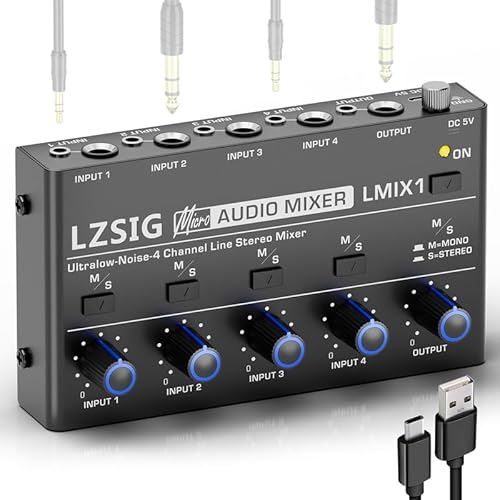
- Four-source stereo or mono sub-mixing
- Accepts 3.5mm and 6.35mm TS/TRS cables
- Low-noise design in a compact enclosure
Best For: Compact instrument, computer, gaming, and playback-device setups
Balanced Analog Control – Yamaha MG06
The Yamaha MG06 is a straightforward choice for shoppers comparing compact audio mixers without needing USB recording or wireless playback. Its six-channel analog layout combines D-PRE preamps, three-band EQ, high-pass filters, and one-knob compressors in a rugged metal chassis.
Best For: Small live setups, lectures, performances, and analog recording rigs.
Pros:
- Six-channel design with studio-grade D-PRE preamps.
- Three-band EQ and high-pass filters provide useful tone and noise control.
- One-knob compressors simplify dynamics control for vocals and instruments.
- Rugged, impact-resistant powder-coated metal chassis.
Cons:
- No USB connectivity or built-in digital playback features.
- Analog-only operation may require extra equipment for computer recording.
The MG06 suits buyers who value dependable hands-on mixing and clear preamp performance over connectivity features. Its compact footprint and durable construction make it practical when the signal path is primarily analog.
Connected Feature Set – Pyle PMX406ST
The Pyle PMX406ST packs an unusually broad feature set into a small six-channel unit, making it a flexible option among compact audio mixers. It supports Bluetooth playback, USB computer recording and playback, a built-in MP3 player, DSP effects, phantom power, and per-channel faders.
Best For: Home studios, streaming, podcasting, karaoke, small venues, and houses of worship.
Pros:
- Bluetooth, USB audio interface, and built-in MP3 playback in one mixer.
- Dual XLR/mic/line combo inputs with individual +48V phantom power and Hi-Z switching.
- DSP effects, three-band EQ on every channel, and peak LED monitoring.
- Dedicated control-room output, headphone volume control, and per-channel faders.
Cons:
- Its larger feature set may be more than needed for a basic analog setup.
- Only the first two channels are specified with individual phantom-power activation.
The PMX406ST is the strongest fit when one compact mixer needs to cover recording, playback, live sound, and content creation. Its combination of digital connections and hands-on controls reduces the need for separate accessories.
Ultra-Compact Essentials – Mackie 402VLZ4
The Mackie 402VLZ4 is designed for buyers who want a small, focused mixer for podcasts, broadcasts, or simple studio work. This four-channel model provides two Onyx mic preamps with phantom power, four line inputs, and main outputs on both 1/4-inch and RCA connections.
Best For: Podcasts, broadcast setups, small studios, and compact desktop rigs.
Pros:
- Ultra-compact four-channel design weighs 2.5 pounds.
- Two Onyx mic preamps offer high headroom, low noise, and improved RF rejection.
- Four line inputs expand the available sources beyond the two mic inputs.
- Includes an external power adapter and provides 1/4-inch and RCA main outputs.
Cons:
- Fewer channels than the six- and eight-input alternatives.
- Uses an external power adapter rather than a built-in power-cord socket.
- No USB connectivity is listed.
The 402VLZ4 keeps the controls and connections focused, which can be an advantage for voice-oriented or small desktop systems. Choose it when portability and Onyx preamp performance matter more than extensive channel capacity or computer integration.
Streaming-Ready Expansion – Behringer XENYX 802S
Behringer XENYX 802S Premium Analog 8-Input Mixer with USB Streaming Interface
Check Price On AmazonThe Behringer XENYX 802S adds computer connectivity to an eight-input analog mixer, making it a practical candidate for streaming, podcasting, and recording. It combines analog mixing and equalization with stereo USB audio and direct mixing of PC or gaming sound into the streaming output.
Best For: Streamers, podcasters, and recording users who need multiple inputs plus USB integration.
Pros:
- Eight-input format provides more capacity than the four- and six-channel options.
- Stereo USB audio interface connects to a computer or mobile device.
- Supports direct mixing of PC and gaming sounds into the streaming output.
- Analog mixing and equalization maintain hands-on control of the mix.
Cons:
- The supplied notes do not specify Bluetooth, built-in effects, or phantom-power details.
- Its listed dimensions suggest it may be less portable than the smallest models.
The XENYX 802S is a sensible middle ground for users who need more inputs while keeping an analog workflow. Its USB interface is especially useful for streaming and computer-based recording, while the eight-input layout leaves room for additional sources.
Simple Analog Control – Mackie Mix5
The Mackie Mix5 is a straightforward choice among compact audio mixers for basic microphone, playback, and recording setups. Its five-channel layout, low-noise performance, and small footprint suit users who want essential analog controls without extra effects or complex features.
Best For: Home recording, small playback systems, and simple microphone setups.
Pros:
- Five-channel design with one mic/line input and two stereo 1/4-inch line inputs.
- Two-band EQ provides clean, precise tone shaping.
- Includes phantom power for studio condenser microphones.
- Dedicated stereo RCA inputs and outputs support playback or recording.
Cons:
- Provides only one mic/line input.
- Does not include built-in digital effects or USB connectivity in the supplied specifications.
The Mix5 is best when you value compact size and uncomplicated signal routing. It offers the core connections needed for a modest setup, but users who need multiple microphone channels or integrated computer connectivity may want a more feature-rich mixer.
Streaming Control Center – FIFINE Ampligame SC3
The FIFINE Ampligame SC3 takes a streaming-focused approach to compact audio mixers. It combines an XLR microphone input, individual channel controls, mute and monitor buttons, sound effects, voice changing, and RGB lighting for creators managing game, music, and chat audio.
Best For: Beginner livestreamers, gaming creators, and two-PC streaming setups.
Pros:
- XLR microphone input with built-in 48V phantom power for compatible condenser microphones.
- Independent controls for microphone, line-in, headphone, and line-out levels.
- Four customizable sound-effect buttons, six voice-changing modes, and 12 auto-tune changes.
- Plug-and-play support for Mac OS and Windows, with front-mounted mute and monitor controls.
Cons:
- Not compatible with USB microphones.
- XLR cable is not included.
- Its feature set is geared toward streaming rather than a traditional multi-microphone mix.
The SC3 is a strong fit for creators who want hands-on control over a single microphone and computer-based audio. Its effects and routing features add flexibility, while the USB-C computer connection and headset interface keep the setup accessible for streaming beginners.
Compact Mixer With Effects – Yamaha MG06X
The Yamaha MG06X is a practical option among compact audio mixers when you need multiple inputs and onboard effects in a small analog unit. It provides two microphone preamps, four dedicated stereo line channels, EQ, and digital effects for more adaptable live or recording setups.
Best For: Small live sound systems, rehearsals, and compact recording rigs needing effects.
Pros:
- Six-input configuration with two microphone preamps.
- Four dedicated stereo line channels accommodate multiple stereo sources.
- Built-in digital effects add processing without requiring separate equipment.
- Compact dimensions of 5.9 by 7.9 by 2.4 inches.
Cons:
- Limited to two microphone preamp inputs.
- Supplied specifications do not identify a USB audio interface despite listing USB connectivity technology.
- Power comes from a corded electric supply.
The MG06X balances portability with useful channel capacity and onboard processing. Choose it over a simpler mixer when digital effects and multiple stereo sources matter, while keeping in mind that it remains a compact six-input design.
Best Connected Option – Aveek 5-Channel USB Mixer
For shoppers comparing compact audio mixers, the Aveek 5-channel model stands out when you need microphone inputs, instrument or stereo connections, and computer recording in one small setup. It includes USB-B PC recording, USB-drive playback and recording, Bluetooth streaming, 48V phantom power, headphone monitoring, and basic effects for flexible home or small-event use.
Best For: Live streaming, podcasting, small performances, meetings, and users who want multiple input types plus PC recording.
Pros:
- Three XLR inputs with switchable 48V phantom power for condenser microphones.
- Supports USB-B computer recording, USB-drive playback and recording, and Bluetooth streaming.
- Includes gain, two-band EQ, echo and delay controls, LED level monitoring, and headphone monitoring.
- Offers RCA and 6.35mm stereo inputs and outputs for varied equipment connections.
Cons:
- Bluetooth, USB, and 4/5-channel functions cannot be used simultaneously.
- Bluetooth is intended for operation within about 15 feet.
- Outputs are designed for active speakers or powered amplification rather than passive speakers directly.
This is the most feature-rich choice of the three for buyers who need a compact audio mixer with microphones, recording, streaming, and effects. Its simultaneous-use limitation is worth considering if you expect to combine every digital function at once.
Best Simple Sub-Mixer – Moukey 4-Channel Line Mixer
The Moukey MAMX1 is a straightforward pick among compact audio mixers for combining four line-level sources into a single output. Its independent channel volume controls, DC 5V power design, and stereo/mono switching suit keyboards, guitars, bass, drum sets, and other small setups where simple routing matters more than microphone features or onboard effects.
Best For: Sub-mixing keyboards, instruments, and other line-level sources in small club, bar, rehearsal, or recording setups.
Pros:
- Four channels with separate volume controls for basic level adjustment.
- Can operate as a stereo mixer or combine four mono inputs into one mono output.
- Compact 4.37-by-6.18-by-1.97-inch design with DC 5V power.
- Designed for low-noise operation and simple setup.
Cons:
- TRS/TS cables are not included.
- It is intended for line-level sub-mixing and does not list XLR microphone inputs, phantom power, recording, or effects.
- The recommended external power supply should have CE or UL certification and be kept away from interference sources.
Choose this Moukey when you need an uncomplicated way to gather several instrument or line signals and control their levels independently. It is less suitable for users seeking a full-featured mixer with microphone preamps or computer connectivity.
Best Small Footprint – LZSIG 4-Channel Line Mixer
The LZSIG is a compact audio mixer for routing several electronic instruments or playback devices into one stereo or mono output. It supports both 3.5mm and 6.35mm TS/TRS connections, includes mono/stereo switching, and uses a low-noise design aimed at clean sub-mixing for drums, keyboards, guitars, computers, CD players, and gaming consoles.
Best For: Small audio setups that need flexible 3.5mm and 6.35mm source connections with a compact sub-mixer footprint.
Pros:
- Mixes up to four audio sources into a single stereo or mono output.
- Accepts both 3.5mm and 6.35mm TS/TRS cables without adapters.
- Provides mono/stereo switching for different routing needs.
- Uses a low-noise power-management and op-amp design for clean output.
Cons:
- The power adapter is sold separately.
- It is a line mixer without listed XLR inputs, phantom power, USB recording, Bluetooth, or built-in effects.
- Users should use a CE- or UL-certified power supply and keep the unit away from other electronics to reduce interference.
The LZSIG makes sense when physical size and connection flexibility are priorities. It offers more input-cable versatility than a basic line mixer, but buyers needing microphone processing or digital recording should look at a fuller-featured model.
How We Picked the Best Compact Audio Mixers
We compared these Compact Audio Mixers by looking at channel count, input types, preamp and output flexibility, USB or computer connectivity, onboard effects, phantom-power support, controls, footprint, and likely use case. A small mixer should be easy to connect and operate, but it also needs the right inputs for your microphones, instruments, headphones, speakers, or recording device.
Because the selected products cover several categories, we did not treat the most feature-rich mixer as automatically superior. A simple line mixer can be the better choice for combining sources, while a USB-equipped model is more useful for recording, streaming, or online calls.
Quick Comparison
- For dependable everyday mixing: Yamaha MG06 and Mackie Mix5 offer focused analog layouts and practical control.
- For effects or expanded connectivity: Yamaha MG06X, Behringer XENYX 802S, and the Pyle mixer add useful extras for recording or small performances.
- For USB recording and streaming: Behringer, Pyle, Aveek, and FIFINE models are the most relevant options, depending on whether you need traditional mixer controls or gaming-focused convenience.
- For simple sub-mixing: Moukey and LZSIG models suit basic line-level source combining where microphone preamps and advanced routing are not priorities.
Key Buying Factors for Compact Audio Mixers
Inputs and Channel Layout
Count the sources you will connect at the same time, not just the number of advertised channels. XLR inputs are important for microphones, while 1/4-inch line inputs suit keyboards, interfaces, phones, and other line-level gear. Stereo channels can save space for playback devices, but they may offer less flexibility than separate mono channels.
USB, Bluetooth, and Recording Features
USB connectivity can send a mixed signal to a computer for recording, streaming, or conferencing. Confirm what the USB connection actually supports before buying: some models provide basic playback or recording, while others include more useful streaming-oriented routing. Bluetooth and MP3 playback are convenient for background audio, but they should not replace the wired inputs you need for core sources.
Phantom Power, Effects, and Monitoring
If you use condenser microphones, check for +48V phantom power and verify how it is applied. Built-in effects can be valuable for vocals or small live setups, but they add complexity. Also look for a headphone output, level meters, monitor controls, and an appropriate main output for your speakers or interface.
Size and Power Requirements
Compact does not always mean battery-powered. Check whether the mixer uses an included adapter, USB power, or another supply. For a desk, prioritize accessible controls and low noise; for mobile use, weigh portability against connector durability and the number of controls you need.
Who Should Buy Which Compact Audio Mixers?
Choose the Yamaha MG06 or Mackie Mix5 if you want a compact, straightforward analog mixer for rehearsal, small presentations, instruments, or a basic home setup.
Choose the Yamaha MG06X if you want the MG06-style format with onboard effects. Consider the Behringer XENYX 802S or Pyle model when USB connectivity, additional routing, playback, or phantom power matters more than the smallest footprint.
Choose the FIFINE Ampligame SC3 for a gaming or streaming desk where quick access to level controls and creator-focused operation is more important than conventional live-sound expansion. Choose Aveek for an affordable USB-oriented desktop setup, while Moukey or LZSIG makes more sense for basic line-level sub-mixing with minimal controls.