The best audio mixers with USB interface combine hands-on level control with convenient computer connectivity, making them useful for podcasting, livestreaming, recording, and small live performances.
This roundup compares 10 options ranging from compact USB mixers for beginners to feature-rich digital consoles with multiple inputs, effects, and wireless control.
Best 10 Audio Mixers with USB Interface Picks for 2026
Best Digital Mixer
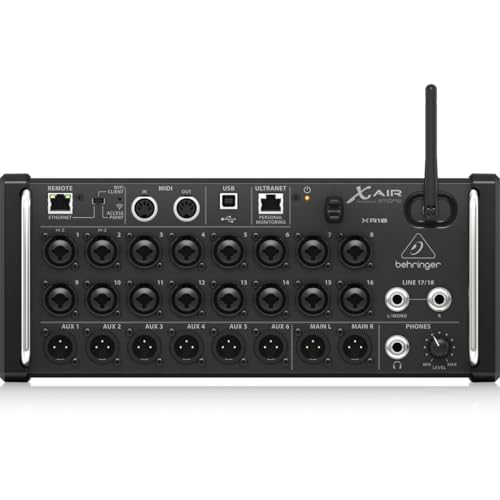
- 18 channels with 12 buses
- 16 programmable MIDAS mic preamps
- 18 x 18 bidirectional USB interface
Best For: Live bands, studios, and tablet-controlled mixing
Best for Streaming

- Six-channel streaming mixer
- LOOPBACK, DSP effects, and mute button
- Includes Cubase AI and WaveLab Cast
Best For: Streamers, podcasters, and content creators
Best Analog Value

- 12-input analog mixer
- Four mic preamps and one-knob compressors
- Stereo USB/audio interface
Best For: Home recording, podcasting, and live mixing
Best Budget DJ Mixer

- Eight-channel mixer with Bluetooth
- USB MP3 playback and DSP effects
- +48V phantom power and steel chassis
Best For: DJs, karaoke, and basic live performance
Best Analog Streaming Mixer

- Eight analog inputs with equalization
- Stereo USB connection for computer or mobile
- Direct PC and gaming-audio mixing
Best For: Streaming, podcasting, and recording with analog control
Best Compact Bluetooth Mixer

- Eight mono/stereo-switching inputs
- Bluetooth 5.x and USB-C sound card
- Compact solid metal chassis
Best For: Portable music, podcasting, and content creation
Best Mixer for Expanded Analog Control

- 12-input, 2/2-bus analog design
- XENYX preamps and compressors
- USB/audio interface with British-style EQ
Best For: Home studios and multi-source analog setups
Versatile 6-Channel Pick

- Four XLR inputs with switchable +48V phantom power
- USB, Bluetooth, and U-disk playback support
- 3-band EQ and 16 built-in DSP effects
Best For: Karaoke, small performances, streaming, and flexible source mixing
Feature-Rich Studio Choice
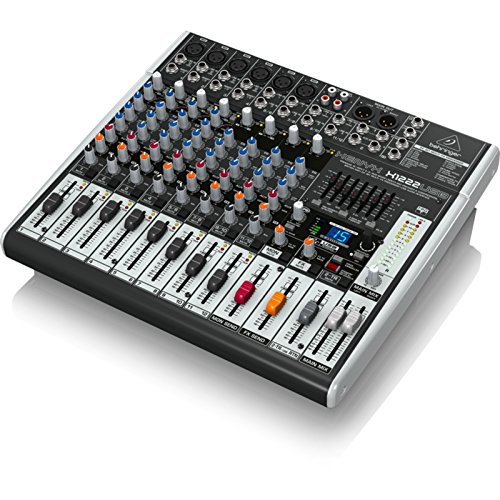
- 16-input, 2/2-bus analog mixing layout
- Four mic preamps and one-knob compressors
- 24-bit processor with 16 editable effects
Best For: Home studios, live sound, and larger multi-input setups
Compact Desktop Pick
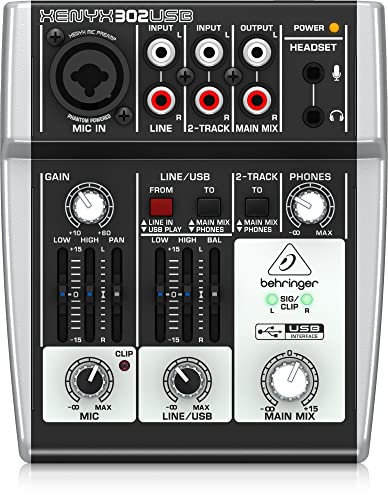
- Five-input design for basic mixing tasks
- Built-in USB audio interface for computer connection
- USB or adapter power in a 13.44-ounce body
Best For: Podcasting, streaming, voice recording, and compact desktops
Best Digital Mixer – Behringer X AIR XR18
The Behringer X AIR XR18 is a powerful option for buyers seeking audio mixers with usb interface capability for live sound or studio work. It combines tablet control, 18 inputs, programmable MIDAS preamps, built-in Wi-Fi, and an 18 x 18 bidirectional USB interface for direct recording.
Best For: Live bands, studio setups, and users who want extensive digital routing with tablet-based control.
Pros:
- 18-channel digital mixer with 12 buses
- Sixteen programmable MIDAS-designed mic preamps
- Built-in tri-mode Wi-Fi router eliminates the need for an external router
- 18 x 18 bidirectional USB interface supports direct recording
Cons:
- Control is designed around an iPad or Android tablet rather than a traditional mixer surface
- Its extensive routing and digital features may be more than a small setup requires
The XR18 stands out when channel count, flexible digital control, and multichannel USB recording matter more than a compact, hands-on layout.
Best for Streaming – Yamaha AG06MK2
The Yamaha AG06MK2 is a compact choice among audio mixers with usb interface features, built specifically for live streaming and simple production workflows. It offers six channels, two phantom-powered microphone inputs, DSP effects, LOOPBACK, a mute button, and control through Windows, Mac, or iOS.
Best For: Streamers, podcasters, and creators who need an easy-to-manage mixer with USB connectivity and loopback audio.
Pros:
- LOOPBACK function supports live-streaming workflows
- Two phantom-powered microphone inputs accommodate condenser microphones
- AG Controller provides detailed DSP control on Windows, Mac, and iOS
- Includes Cubase AI and WaveLab Cast software
Cons:
- Six channels provide less expansion than larger mixers
- Its feature set is oriented toward streaming rather than large live setups
For creators who value straightforward streaming features, included software, and a compact footprint, the AG06MK2 is a practical USB mixer solution.
Best Analog Value – Behringer XENYX X1204USB
The Behringer XENYX X1204USB is a flexible analog option for shoppers comparing audio mixers with usb interface connectivity. Its 12-input design includes four XENYX phantom-powered mic preamps, one-knob compressors, British-style EQ, built-in effects, and a stereo USB/audio interface for computer recording.
Best For: Home recording, podcasting, and live setups that prefer hands-on analog controls with basic computer connectivity.
Pros:
- Four XENYX mic preamps with phantom power
- Four easy-to-use studio-grade compressors
- Built-in 24-bit multi-effects processor
- Includes recording software, plug-ins, and a low-latency driver
Cons:
- USB connectivity is described as a stereo interface rather than multichannel USB recording
- Analog controls offer less remote flexibility than a tablet-controlled digital mixer
The X1204USB makes sense for users who want tactile mixing, vocal compression, and computer recording without moving to a fully digital console.
Best Budget DJ Mixer – Pyle PMXU83BT
The Pyle PMXU83BT is a compact, budget-focused pick for audio mixers with usb interface functionality. It provides eight channels, Bluetooth streaming, USB MP3 playback, XLR and 1/4-inch inputs, +48V phantom power, DSP effects, and a steel chassis suited to live gigs, karaoke, and DJ-style use.
Best For: DJs, karaoke users, and performers who want Bluetooth playback alongside wired microphone and line inputs.
Pros:
- Bluetooth supports wireless streaming from a smartphone
- Eight channels with XLR and unbalanced 1/4-inch inputs
- Includes +48V phantom power, DSP processing, and USB MP3 playback
- Rugged steel chassis with sealed rotary controls
Cons:
- The supplied notes do not specify multichannel USB recording capability
- Its 16-bit DSP and 20 kHz frequency specification are more basic than those of advanced digital mixers
Choose the PMXU83BT when wireless playback, straightforward channel control, and a durable low-cost format are higher priorities than advanced USB production features.
Best Analog Streaming Mixer – Behringer XENYX 802S
Behringer XENYX 802S Premium Analog 8-Input Mixer with USB Streaming Interface
Check Price On AmazonThe Behringer XENYX 802S is a practical choice among audio mixers with USB interface for streaming, podcasting, and recording. Its eight-input analog layout combines mixing and equalization with stereo USB connectivity for a computer or mobile device.
Best For: Streamers, podcasters, and home users who want analog mixing with direct PC or gaming-audio integration.
Pros:
- Eight-input analog mixer with equalization controls
- Stereo USB audio interface connects to a computer or mobile device
- Supports direct mixing of PC and gaming sounds into the streaming output
- Designed with an ultra-low-noise analog circuit
Cons:
- Requires corded electric power
- Its analog-focused design may be less convenient for users seeking extensive digital controls
The XENYX 802S stands out when straightforward analog control and USB stereo connectivity matter more than advanced digital processing. It offers a focused setup for combining microphones, instruments, and computer audio in streaming or recording workflows.
Best Compact Bluetooth Mixer – Pyle PMAX8
The Pyle PMAX8 is a compact option among audio mixers with USB interface, pairing eight mono/stereo-switching inputs with Bluetooth and a built-in USB-C sound card. Its solid metal chassis and low-noise design suit musicians and creators who need a portable corded mixer.
Best For: Musicians, podcasters, and content creators who want Bluetooth playback and USB recording in a small mixer.
Pros:
- Eight inputs support mono/stereo switching
- Built-in USB-C sound card supports PC playback and recording
- Bluetooth 5.x connectivity offers wireless streaming up to 50 feet
- Solid metal chassis provides a durable, portable build
Cons:
- Requires corded electric power
- Provides TRS output connectivity rather than the broader output selection found on some mixers
Choose the PMAX8 if flexible input modes and wireless audio are priorities. Its compact construction and USB-C sound card make it a convenient fit for straightforward live, recording, or content-creation setups.
Best Mixer for Expanded Analog Control – Behringer XENYX 1204USB
The Behringer XENYX 1204USB is a larger-format choice among audio mixers with USB interface, combining a 12-input, 2/2-bus analog design with XENYX microphone preamps, compressors, and USB/audio connectivity. Its low-noise circuitry and British-style three-band EQ target detailed, musical sound shaping.
Best For: Home studios, small production setups, and users who need more analog routing and tone-shaping options.
Pros:
- 12-input, 2/2-bus mixer design
- Includes XENYX microphone preamps and compressors
- British-style three-band EQ provides warm, musical sound shaping
- USB/audio interface connectivity for computer-based workflows
Cons:
- Requires corded electric power
- Larger and heavier than a compact mini mixer, with an 8.4-pound listed weight
The 1204USB is the strongest fit here for users who want a more feature-rich analog console. Its additional input capacity, preamps, compressors, and EQ make it better suited to multi-source setups than a basic compact mixer.
Versatile 6-Channel Pick – Bluetooth DSP USB Mixer
This 6-channel console is a flexible option among audio mixers with USB interface, combining four XLR inputs, stereo inputs, Bluetooth playback, USB media support, and onboard effects. It is suited to users who want hands-on control for karaoke, small live setups, streaming, or basic recording.
Best For: Karaoke, small performances, streaming, and users who need Bluetooth and USB playback.
Pros:
- Four XLR inputs support microphones and instruments, with switchable +48V phantom power.
- USB interface supports playback and recording, while Bluetooth enables wireless music streaming.
- Offers 3-band EQ, individual faders, and 16 DSP effects including reverb and delay.
Cons:
- As a traditional analog mixer, it requires manual setup and operation.
- The included manufacturer warranty is listed as 90 days.
Choose this model if connectivity and built-in effects matter more than a highly compact footprint. Its multiple inputs and straightforward controls provide useful flexibility for mixed audio sources.
Feature-Rich Studio Choice – XENYX X1222USB Mixer
The Behringer XENYX X1222USB is a larger choice among audio mixers with USB interface, offering a 16-input, 2/2-bus layout, four XENYX microphone preamps, compressors, British-style EQ, and a 24-bit multi-effects processor. It is designed for users who need broader hands-on mixing control.
Best For: Home studios, live sound, vocal setups, and larger multi-input mixes.
Pros:
- Four phantom-powered XENYX mic preamps support condenser microphone setups.
- Four one-knob compressors provide accessible vocal and instrument control.
- Includes a 24-bit effects processor with 16 editable presets and USB audio connectivity.
Cons:
- Its larger design is less convenient for highly portable setups.
- The supplied specifications list four channels despite the product’s 16-input designation, so buyers should verify the intended routing layout.
This is the strongest fit here for buyers who want extensive analog controls and processing in one console. Its input capacity and feature set are better suited to complex sessions than minimalist desktop mixing.
Compact Desktop Pick – XENYX 302USB Mini Mixer
The Behringer XENYX 302USB is a compact entry point among audio mixers with USB interface. Its five-input design, built-in USB audio interface, XENYX mic preamp, and USB or adapter power make it practical for podcasting, streaming, recording, and small home-studio tasks.
Best For: Desktop podcasting, simple streaming, voice recording, and space-limited workstations.
Pros:
- Ultra-compact body measures 5.4 by 4.5 by 1.8 inches and weighs 13.44 ounces.
- USB audio interface connects directly to a computer and can power the mixer.
- Includes a phantom-powered XENYX mic preamp and British-style 2-band EQ.
Cons:
- Its five-input format is less suitable for complex multi-microphone mixes.
- It provides fewer tone-shaping controls than larger mixers, with a 2-band EQ.
Consider the 302USB when desk space and simple computer connectivity are the priorities. It delivers the core controls needed for a basic voice or stereo setup without the size of a full-format console.
How We Picked the Best Audio Mixers with USB Interface
We focused on mixers that provide USB audio connectivity alongside practical mixing controls. The lineup covers compact podcast and streaming mixers, traditional analog consoles, DJ-friendly models, and digital mixers suited to more complex live or recording workflows.
Our comparison emphasizes input capacity, microphone preamp features, phantom power, USB functionality, built-in effects, monitoring options, portability, and ease of use. Because needs vary widely, the best choice depends on how many sources you connect and whether you prioritize simplicity, flexibility, or advanced routing.
Quick Comparison
| Best For | What to Prioritize |
|---|---|
| Podcasting and solo streaming | Simple USB connection, headphone monitoring, and a suitable mic preamp |
| Small bands and live events | More microphone inputs, channel EQ, phantom power, and durable controls |
| DJ and casual entertainment | Bluetooth, USB playback, effects, and convenient stereo inputs |
| Home recording | Low noise, reliable USB drivers, flexible routing, and quality preamps |
| Complex live setups | High channel count, programmable processing, scene recall, and remote control |
Key Buying Factors for Audio Mixers with USB Interface
Inputs and Channel Layout
Count the microphones, instruments, playback devices, and stereo sources you expect to use at once. A small mixer may be ideal for one or two people, while bands and multi-person shows need additional mic channels and line inputs. Check whether channels are mono, stereo, or switchable.
USB Recording and Streaming Features
USB connectivity does not work identically on every mixer. Some models send a simple stereo mix to a computer, while others offer more flexible multichannel recording or loopback functions. Confirm compatibility with your operating system and preferred streaming or recording software.
Preamps, Phantom Power, and Monitoring
Microphone preamps should provide enough clean gain for your microphones without excessive noise. If you use condenser microphones or active direct boxes, look for +48V phantom power. A dedicated headphone output, level control, and separate monitor or control-room outputs make troubleshooting much easier.
Effects, EQ, and Routing
Built-in reverb, compression, and other effects can simplify live sound and streaming, but they are not equally adjustable on every model. Consider whether you need basic tone shaping or advanced routing, subgroups, buses, and scene-based control.
Analog Versus Digital Design
Analog mixers are usually faster to learn and provide direct physical control. Digital mixers can offer deeper processing, recallable settings, remote operation, and more routing options, but they may require an app or more setup time.
Who Should Buy Which Audio Mixers with USB Interface?
Choose a compact USB mixer if you want a straightforward setup for podcasting, voice recording, or solo streaming. Look for a traditional analog model when you need several microphones, tactile controls, and reliable live operation. DJ and entertainment users should favor Bluetooth, stereo playback inputs, and built-in effects.
For home studios, prioritize quiet preamps, dependable computer integration, and monitoring flexibility over an excessive number of inputs. Choose a digital mixer such as the XR18 when you manage larger live setups, need extensive processing, or want to control the mix remotely from a tablet.
Before buying, verify the included cables, software requirements, physical dimensions, power arrangement, and whether the USB connection supports the exact recording or streaming workflow you plan to use.