Finding reliable stage monitors under $200 can make rehearsals and live performances easier without pushing your sound budget too far. This roundup covers passive wedges, powered PA monitors, and compact personal monitors for different setups.
We compared the selected models by speaker format, power requirements, portability, monitoring style, and practical value so you can choose a monitor that fits your stage, room, and equipment.
Best 10 Stage Monitors Under 200 Picks for 2026
Best Value Passive Monitor
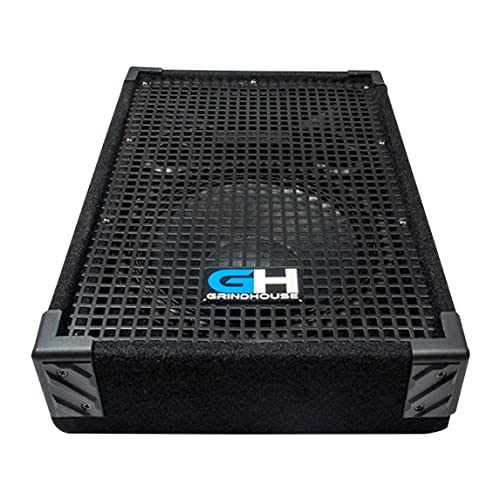
- 300W RMS, 600W peak handling
- 10-inch wedge with 1-inch tweeter
- Passive wired design for PA and DJ rigs
Best For: Budget buyers with an external amplifier
Best Powered Option

- 350W powered 8-inch speaker
- Built-in mixer and Bluetooth
- Wedge and pole-mount positioning
Best For: Small gigs, presentations, and compact DJ setups
Best Titanium Horn Design

- 10-inch 2-way passive floor wedge
- Titanium compression horn driver
- 150W RMS, 300W peak handling
Best For: Live performers using compatible PA amplification
Best Two-Speaker Package

- Includes two 8-inch PA speakers
- 400W peak handling per speaker
- Floor-monitor and pole-mount positioning
Best For: DJs and small events needing a matched pair
Compact Personal Pick

- Two 5-inch drivers
- 200W continuous rating
- Volume control and mounting options
Best For: Compact personal monitoring on a tabletop or stand
High-Output Floor Monitor
Sound Town METIS-10M 10-Inch Monitor

- 10-inch woofer and compression tweeter
- 300W peak handling
- Daisy-chainable 1/4-inch inputs
Best For: Live performances requiring a larger passive floor monitor
Ultra-Compact Choice

- 3-inch ceramic driver
- 25W output
- Wall/stand bracket included
Best For: Discreet close-range monitoring in small spaces
Powerful Passive Pick
Rockville RSM12P 12-Inch Floor Monitor

- 1,000 watts peak and 250 watts RMS
- 70-by-50-degree horn coverage
- XLR and 1/4-inch connections
Best For: Live performers using an amplifier or powered mixer
Compact Powered Choice
Gemini AS-2108P 8-Inch PA Monitor

- 300-watt powered speaker
- 11-pound portable ABS cabinet
- XLR, 1/4-inch, RCA, and AUX inputs
Best For: Rehearsals, small venues, and mobile performers
Maximum Output Pick
Rockville RSM15P 15-Inch Floor Monitor

- 1,400 watts peak power
- 15-inch woofer with titanium compression driver
- 1/4-inch and Speakon connections
Best For: DJs, bands, and PA systems needing a larger passive wedge
Best Value Passive Monitor – Grindhouse GH10M
If you need stage monitors under 200 for a PA, DJ setup, studio, live-sound rig, or karaoke system, the Grindhouse GH10M offers a straightforward passive wedge design with a 10-inch driver and 300 watts RMS of handling. It connects through 1/4-inch TS or speaker-wire terminals and requires an external amplifier.
Best For: Budget-conscious users who already have an amplifier and want a conventional 10-inch floor monitor.
Pros:
- 300 watts RMS and 600 watts peak power handling.
- 10-inch monitor format with a 1-inch tweeter.
- Wedge floor design suited to PA, DJ, live-sound, and karaoke use.
- Metal enclosure with wired connectivity.
Cons:
- Passive design needs a separate amplifier.
- No wireless connectivity or water resistance.
- Sold as a single unit.
The GH10M is a practical choice when you want solid power handling without built-in electronics. Its passive format makes it best suited to users who already understand their amplifier and speaker-wiring requirements.
Best Powered Option – ALTO TX408
The ALTO TX408 stands out among stage monitors under 200 for buyers who want an all-in-one powered speaker. Its 8-inch driver, 350-watt bi-amplified system, built-in mixer, Bluetooth, and wedge-monitor positioning make it convenient for small gigs, presentations, home studios, and DJ use.
Best For: Performers and presenters who want powered stage monitoring with Bluetooth and simple onboard mixing.
Pros:
- 350 watts of bi-amplified Class-D power.
- Built-in two-channel mixer for microphone, line, and Bluetooth inputs.
- Bluetooth and True Wireless Stereo support.
- 8-inch LF driver, 1-inch titanium HF driver, and 90° × 60° coverage.
Cons:
- Not waterproof or water resistant.
- Smaller 8-inch woofer than the 10-inch passive options here.
- Requires corded power.
With amplification and mixing built in, the TX408 minimizes setup complexity. It is particularly appealing when portability, wireless playback, and flexible inputs matter more than using a separate amplifier system.
Best Titanium Horn Design – Seismic Audio SA-10MTSingle
Seismic Audio - SA-10MTSingle - 10" Floor / Stage Monitor Wedge Style with Titanium Horn
Check Price On AmazonFor shoppers comparing stage monitors under 200, the Seismic Audio SA-10MTSingle provides a traditional 10-inch, 2-way floor wedge with a titanium compression horn. Its 150-watt RMS rating, 300-watt peak handling, and 8-ohm impedance make it a suitable match for compatible PA amplification.
Best For: Live performers and small PA users who prefer a rugged passive wedge with a titanium horn.
Pros:
- 10-inch woofer with a 40-ounce magnet and 2-inch voice coil.
- Titanium compression horn driver for high-frequency output.
- 150 watts RMS and 300 watts peak handling.
- Stage-ready floor-wedge construction with a one-year manufacturer warranty.
Cons:
- Passive speaker requires an external amplifier.
- Heavier than the compact powered option at 22 pounds.
- No wireless connectivity or water resistance.
The SA-10MTSingle emphasizes a familiar, amplifier-driven stage-monitor setup. Its titanium horn and 10-inch woofer make it a sensible option for users prioritizing conventional live-sound hardware over wireless features.
Best Two-Speaker Package – Rockville SPG88 8-inch Pair
The Rockville SPG88 package is a useful value consideration for stage monitors under 200 because it includes two 8-inch PA speakers. Each cabinet offers 100 watts RMS, 200 watts program power, and 400 watts peak handling, while the asymmetrical design allows floor-monitor positioning as well as pole mounting.
Best For: DJs and small live-event setups that need a pair of flexible 8-inch cabinets.
Pros:
- Two-speaker package with 800 watts total stated peak handling.
- Asymmetrical trapezoidal cabinets can serve as floor monitors.
- 35mm pole sockets provide another positioning option.
- ABS construction with 1.35-inch titanium high-frequency compression drivers.
Cons:
- Each speaker is rated at 100 watts RMS, lower than the single-speaker alternatives.
- Passive speakers require compatible amplification.
- Wireless Bluetooth is listed, but the speakers use a corded power setup and wired signal path.
The SPG88 package makes sense when coverage from two cabinets is more valuable than maximum output from one monitor. Its ABS enclosures and dual mounting options also suit mobile DJ and event setups.
Compact Personal Pick – Galaxy Audio HS7 Hot Spot
If you need stage monitors under 200 for close-range vocal or instrument monitoring, the Galaxy Audio HS7 offers a compact passive design with two 5-inch drivers, a volume control, and a 200-watt continuous power rating. Its tabletop mounting and included stand adaptor give you flexible placement options.
Best For: Performers and presenters who want a compact personal monitor for tabletop, stand, or wall-adjacent placement.
Pros:
- Two 5-inch NEOLITE drivers in a compact cabinet
- 200 watts continuous power rating
- Built-in volume control
- Includes rubber feet, stand adaptor, and mounting bracket
Cons:
- 150Hz–18kHz response offers less low-end extension than larger monitors
- Passive design requires a suitable amplifier
The HS7 is a practical personal-monitor solution when portability and placement flexibility matter more than deep bass. Its 16-ohm impedance should be matched with an appropriate amplifier.
High-Output Floor Monitor – Sound Town METIS-10M 10-Inch Monitor
For buyers comparing stage monitors under 200 for live sound, the Sound Town METIS-10M provides a larger 10-inch woofer, 1-inch compression tweeter, and 150W RMS/300W peak handling. Its floor-standing cabinet is built for practical setup and transport.
Best For: Bands, DJs, churches, and live performers needing a substantial passive floor monitor with straightforward daisy-chaining.
Pros:
- 10-inch woofer with 1-inch compression tweeter
- 150W RMS and 300W peak power handling at 8 ohms
- Parallel 1/4-inch jacks support daisy chaining
- Metal grille, reinforced corners, carpet finish, and side handle
Cons:
- Larger and less compact than personal monitors
- Passive design requires an external amplifier
- Listed frequency response does not specify low-frequency extension
The METIS-10M is the strongest fit here when you want fuller stage coverage and rugged floor-monitor construction. Confirm amplifier compatibility with its 8-ohm impedance before setup.
Ultra-Compact Choice – Galaxy Audio NSPA Nano Spot
The Galaxy Audio NSPA is a space-saving option for stage monitors under 200, using a 3-inch ceramic driver and 25-watt output in a compact enclosure. It includes a wall/stand bracket, power supply, and rubber feet for flexible personal-monitor placement.
Best For: Small performance spaces, presenters, restaurants, and users who need discreet near-field monitoring rather than high stage volume.
Pros:
- Very compact 3-inch monitor design
- 25-watt output with 150Hz–17kHz response
- Includes wall/stand mounting hardware and power supply
- Bass Boost feature and adjustable power levels
Cons:
- Limited low-end extension compared with larger monitors
- 25 watts is better suited to personal or close-range monitoring
- Wired power is required
The NSPA makes sense when minimal size and flexible mounting are priorities. Its small driver and 25-watt output are best matched to close listening positions, not loud full-stage coverage.
Powerful Passive Pick – Rockville RSM12P 12-Inch Floor Monitor
If you need stage monitors under 200 for live sound, playback, or instrument amplification, the Rockville RSM12P offers a high-output passive design with a 12-inch woofer and 1-inch titanium horn driver. Its wedge cabinet is built for floor placement, while the pole-mount option adds flexibility for use as a main speaker.
Best For: Bands, performers, and small live-sound setups that already have an amplifier or powered mixing board.
Pros:
- Handles up to 1,000 watts peak power with a 250-watt RMS rating.
- 70-by-50-degree horn coverage helps distribute sound across the stage.
- Rugged MDF cabinet, steel grille, and aviation-grade carpet support regular transport.
- XLR and 1/4-inch connectivity works with mixers, guitars, and keyboards.
Cons:
- Passive design requires a separate amplifier or powered mixer.
- It is not waterproof.
- The supplied details list no warranty.
The RSM12P is a practical choice when you want a full-size passive wedge with broad coverage and flexible connections. Confirm that your amplifier matches its 8-ohm impedance and power requirements before buying.
Compact Powered Choice – Gemini AS-2108P 8-Inch PA Monitor
For shoppers comparing stage monitors under 200, the Gemini AS-2108P is a compact powered option that avoids the need for a separate amplifier. Its 8-inch woofer, 300-watt output, onboard EQ, and multiple wired inputs make it useful for rehearsals, small venues, church services, and mobile performances.
Best For: Solo performers, rehearsal spaces, small live events, and anyone wanting a lightweight, self-contained monitor.
Pros:
- Built-in amplification delivers up to 300 watts.
- Two channels accept XLR/1/4-inch mic or line inputs, with RCA and AUX connectivity.
- At 11 pounds, it is easy to carry using the integrated top handle.
- Onboard bass and treble controls allow quick tone adjustments.
Cons:
- The 8-inch woofer has less low-frequency reach than larger monitors.
- It has no Bluetooth or other wireless communication.
- The supplied frequency-response detail lists 60 Hz, so it may not suit bass-heavy monitoring needs.
The AS-2108P stands out for convenience: connect a source directly, adjust the EQ, and place it on the floor or a pole. Its wired-only design favors dependable, zero-latency connections over wireless features.
Maximum Output Pick – Rockville RSM15P 15-Inch Floor Monitor
The Rockville RSM15P is a large passive wedge for buyers seeking stage monitors under 200 with substantial output potential. A 15-inch woofer, 1.75-inch titanium compression driver, and 1,400-watt peak rating make it suited to live music, DJ, and PA applications where stronger low-end presence is useful.
Best For: DJs, bands, and event setups with a suitable amplifier that need a larger passive monitor cabinet.
Pros:
- 15-inch woofer and 1.75-inch titanium compression driver support powerful, balanced sound.
- 70-by-50-degree horn coverage helps provide even stage coverage.
- Dual 1/4-inch and Speakon input/output connectors integrate with pro audio systems.
- Angled wedge design, handles, steel grille, and carpet finish support stage use and transport.
Cons:
- At 54.9 pounds, it is considerably heavier than a compact powered monitor.
- Passive operation requires separate amplification.
- The supplied details list no warranty, and the cabinet is not waterproof.
The RSM15P is the high-output option of this group, but its size and weight make it better suited to fixed or well-equipped event setups than lightweight solo rigs. Match the amplifier carefully to its 8-ohm load.
How We Picked the Best Stage Monitors Under 200
We focused on the features that matter most for affordable monitoring: speaker size, powered versus passive design, cabinet format, portability, and control options. The selection includes traditional wedge monitors for performers, powered speakers for simpler setups, and personal monitors for close-range vocal or instrument monitoring.
Because prices and availability can change, treat published wattage as a comparison point rather than a guarantee of usable volume. Amplifier matching, speaker sensitivity, placement, and room acoustics all affect real-world performance.
Quick Comparison
| Monitor type | Best for | Main advantage | What to check |
|---|---|---|---|
| Powered wedge | Small live rigs and rehearsals | Built-in amplification | Power access, inputs, and controls |
| Passive wedge | Existing PA systems | Flexible amplifier matching | Impedance and amplifier output |
| Personal monitor | Individual performers | Compact, close-range monitoring | Connection type and coverage |
| 8-inch monitor | Speech, vocals, and smaller rooms | Lightweight and focused | Low-frequency reach |
| 10- or 12-inch monitor | General live sound | More full-range output | Size, weight, and floor space |
Key Buying Factors for Stage Monitors Under 200
Powered or Passive Design
Powered monitors are usually the simplest choice because the amplifier is built in. They need AC power but can connect directly to a mixer or source. Passive monitors require a suitable external amplifier, so confirm impedance and power compatibility before buying.
Speaker Size and Frequency Balance
Eight-inch models are often easier to transport and can work well for vocals, speech, and compact stages. Ten- and 12-inch cabinets generally provide a fuller low-mid response for instruments and broader live mixes. A larger woofer does not automatically mean better clarity, so consider the type of sound you need to hear.
Inputs, Controls, and Connections
Check whether the monitor accepts the outputs your mixer provides, such as XLR, quarter-inch, or other line-level connections. Powered models may include volume controls, EQ, or microphone inputs. Personal monitors can use different connection methods, making compatibility especially important.
Placement and Durability
A wedge cabinet should angle sound toward the performer without blocking foot space. Look for a stable enclosure, protective grille, manageable weight, and a shape suited to repeated setup and teardown. For permanent installations, size and mounting options may matter more than portability.
Who Should Buy Which Stage Monitors Under 200?
Choose a Powered Wedge for Simple Setups
Pick a powered model if you want fewer separate components for rehearsals, small venues, worship spaces, or mobile DJ work. It is a practical fit when AC power is available near the stage.
Choose a Passive Wedge for an Existing PA
Passive monitors make sense when you already own an amplifier or powered mixer and want consistent system matching. They can also be useful when several monitor mixes share an installed amplification setup.
Choose a Personal Monitor for Focused Listening
Compact personal monitors suit singers, presenters, keyboard players, and other performers who need a nearby reference rather than high-volume coverage across the entire stage.
Choose a Larger Cabinet for More Full-Range Output
A 10- or 12-inch monitor is typically the better starting point for bands and performers who need vocals plus noticeable instrument content. For tight spaces, speech-focused use, or easier transport, an 8-inch option may be sufficient.