The best desktop computers for programming combine responsive processors, sufficient memory, fast storage, and reliable connectivity for editors, compilers, containers, virtual machines, and multiple displays.
We selected 10 current desktop PCs across compact, small-form-factor, and tower designs to help developers match performance, expandability, and budget to their workflow.
Best 10 Desktop Computers for Programming Picks for 2026
Top-Tier Business Pick

- 20-core Core Ultra 7 processor with up to 5.3 GHz turbo
- 32GB DDR5 RAM and 1TB PCIe NVMe SSD
- Supports up to four 4K monitors
Best For: Multitasking developers building multi-monitor workstations
Compact Workspace Pick
- Slim 7.7-pound desktop for space-conscious setups
- Supports up to four FHD or two 4K displays
- Tool-less access makes upgrades more convenient
Best For: Students and home developers with limited desk space
Integrated Graphics Pick
- Ryzen 7 8700G processor with 32GB DDR5 memory
- 1TB PCIe Gen4 NVMe SSD for projects and applications
- Radeon 780M graphics add general-purpose versatility
Best For: Developers who also want capable integrated graphics
Business Value Pick

- 14-core, 20-thread processor with up to 5.0 GHz speed
- Windows 11 Pro and hardware TPM security
- Includes wireless keyboard and mouse
Best For: Professional developers seeking a business-focused setup
Balanced Coding Workhorse

- 10-core Intel Core i7-13620H processor
- 16GB DDR5 RAM and 1TB PCIe SSD
- Wi-Fi 6, USB-C, HDMI, and DisplayPort
Best For: Programming, schoolwork, and office multitasking
Eco-Conscious Everyday Pick
- Six-core Ryzen 5 8500G processor
- 16GB DDR5 memory with SSD and external storage
- Supports up to four displays
Best For: Students, beginner programmers, and home offices
High-Memory Pro Workstation

- 16-core Intel Core i9-12900K processor
- 32GB DDR5 RAM and 1TB NVMe SSD
- Windows 11 Pro with dual-4K display support
Best For: Professional development and intensive multitasking
Best Value Workstation

- 8-core i7-9700 processor up to 4.7GHz
- 32GB RAM with 1TB NVMe SSD
- Dual-display support and Wi-Fi 6E
Best For: Programming and multitasking on a renewed business desktop
Best High-Performance Pick

- 20-core processor up to 5.3GHz
- 32GB fast DDR5-5600 memory
- Dual 4K display support with USB-C
Best For: Heavy development workloads and demanding multitasking
Best Compact Office Option

- Compact small-form-factor chassis
- 32GB RAM and 1TB SSD
- Dual 4K display support with Windows 11 Pro
Best For: Light programming, study, and home-office productivity
Top-Tier Business Pick – HP OmniDesk M03 Core Ultra 7
For desktop computers for programming, the HP OmniDesk M03 offers substantial multitasking headroom with a 20-core Intel Core Ultra 7 processor, 32GB of DDR5 memory, and a 1TB NVMe SSD. Windows 11 Pro, Wi-Fi 6, and support for up to four monitors make it well suited to development work alongside productivity applications.
Best For: Developers who need strong multitasking performance, substantial connectivity, and a multi-monitor workstation.
Pros:
- 20-core processor with speeds up to 5.3 GHz supports demanding multitasking.
- 32GB DDR5 RAM and a 1TB PCIe NVMe SSD provide responsive application loading and workspace capacity.
- Supports up to four 4K monitors and includes Windows 11 Pro, Wi-Fi 6, keyboard, and mouse.
Cons:
- The supplied details describe integrated Intel graphics, so this is not primarily a dedicated-GPU programming or graphics workstation.
- The upgraded configuration has separate coverage details for the RAM and SSD.
Choose this HP when your programming setup involves multiple IDEs, browsers, containers, or displays. Its memory, processor, and port selection make it the most expandable-feeling option in this group, though buyers should review the warranty terms for the upgraded components.
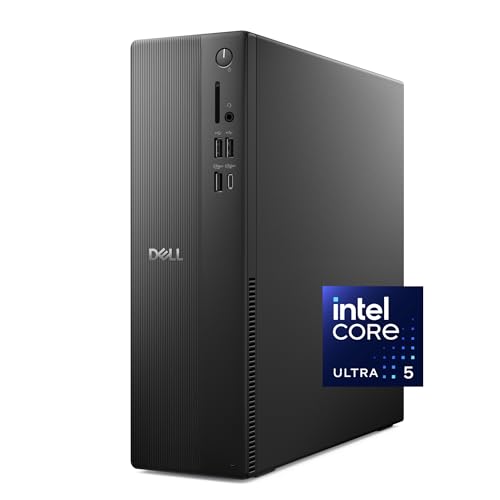
Compact Workspace Pick – Dell Slim Core Ultra 5
The Dell Slim Desktop is a practical choice among desktop computers for programming when desk space matters. Its Intel Core Ultra 5 processor, 512GB SSD, compact chassis, and support for up to four FHD monitors create a straightforward setup for coding, study, and everyday work.
Best For: Students, home developers, and office users who want a compact programming desktop with easy access for upgrades.
Pros:
- Slim 7.7-pound design fits smaller workspaces.
- Tool-less entry and a removable side panel simplify access to internal components.
- Can connect up to four FHD monitors or two 4K displays, with Wi-Fi 6 and Bluetooth included.
Cons:
- Windows 11 Home is less business-oriented than the Pro editions on some alternatives.
- The 512GB SSD and integrated Intel UHD Graphics 730 are more modest for large projects or graphics-heavy workloads.
This Dell emphasizes convenience rather than maximum configuration. It is a sensible pick for programming fundamentals, web development, and general software work, especially if you value a small footprint and straightforward upgrade access.
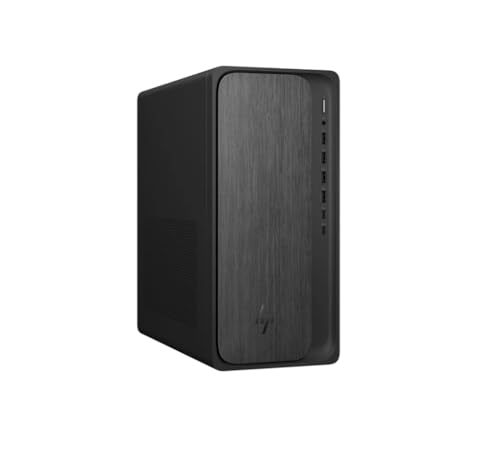
Integrated Graphics Pick – HP OmniDesk Ryzen 7 8700G
For desktop computers for programming that can also handle light graphics work, the HP OmniDesk pairs an AMD Ryzen 7 8700G with Radeon 780M graphics, 32GB of DDR5 memory, and a 1TB PCIe Gen4 NVMe SSD. The included keyboard and mouse make it a ready-to-use Windows 11 Home system.
Best For: Developers who want a capable general-purpose desktop with stronger integrated graphics for occasional gaming or visual work.
Pros:
- Ryzen 7 8700G provides eight cores and a 4.2 GHz listed processor speed.
- 32GB DDR5 memory and a 1TB Gen4 NVMe SSD suit multitasking and sizable development environments.
- Radeon 780M integrated graphics add versatility beyond basic office and coding tasks.
Cons:
- Windows 11 Home lacks the business-management features associated with Windows 11 Pro.
- The supplied specifications list HDMI as the video output interface, which may limit display flexibility depending on your monitors.
This HP is a balanced option for coding plus everyday entertainment or graphics use. Its 32GB memory and fast SSD are helpful for development tools, while the Radeon 780M graphics provide extra flexibility without requiring a separate graphics card.
Business Value Pick – Dell Pro i5-14500 Desktop
The Dell Pro Business Desktop is a strong value-oriented entry among desktop computers for programming, combining a 14-core Intel Core i5-14500, 16GB of DDR5 RAM, and a 512GB PCIe SSD. Windows 11 Pro, TPM security, and a quiet design make it a practical fit for professional or home-office development.
Best For: Programmers who want a business-focused Windows 11 Pro desktop with a fast modern processor and included accessories.
Pros:
- 14 cores and 20 threads with speeds up to 5.0 GHz support demanding multitasking.
- Windows 11 Pro and a hardware TPM chip add business-oriented security and management features.
- Includes a wireless keyboard and mouse, Wi-Fi 6, Bluetooth, HDMI, DisplayPort, and multiple USB ports.
Cons:
- 16GB RAM and 512GB storage provide less headroom than the 32GB/1TB alternatives.
- Integrated Intel UHD Graphics 770 is intended for general display use rather than dedicated graphics workloads.
This Dell makes sense when processor responsiveness and business features matter more than maximum memory or storage. It should handle common IDEs, browsers, databases, and office tools well, with room to expand memory according to the supplied specifications.
Balanced Coding Workhorse – ASUS V500 Mini Tower
For shoppers comparing desktop computers for programming, the ASUS V500 offers a practical mix of processing power, fast storage, and compact-tower convenience. Its 10-core Intel Core i7-13620H, 16GB of DDR5 memory, and 1TB SSD are well suited to coding tools, browser-heavy workflows, and everyday multitasking.
Best For: Students, programmers, home offices, and general productivity users who want a compact Windows desktop with generous storage.
Pros:
- 10-core, 16-thread Intel Core i7 processor with speeds up to 4.9GHz.
- Fast PCIe SSD storage and 16GB DDR5 RAM support responsive multitasking.
- Useful connectivity, including USB-C, multiple USB-A ports, Ethernet, Wi-Fi 6, Bluetooth 5.4, HDMI, and DisplayPort.
- Includes a wired keyboard, mouse, and 180W 80+ Bronze power supply.
Cons:
- Integrated Intel UHD Graphics are better suited to everyday visuals than demanding graphics work.
- Windows 11 Home lacks the business-focused features included with Windows 11 Pro.
The ASUS V500 is a sensible programming desktop for users who prioritize CPU responsiveness and storage over dedicated graphics. Its compact 15L design and included accessories also make it easy to put into service quickly.
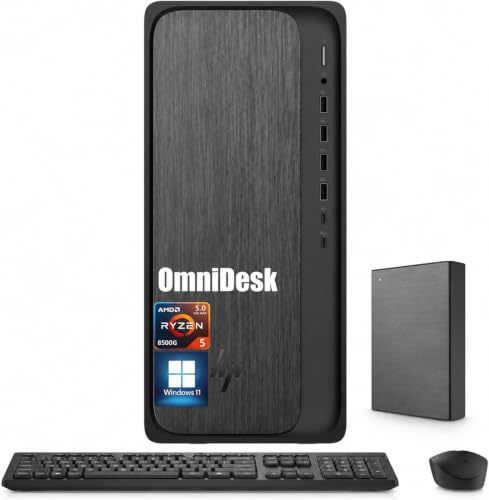
Eco-Conscious Everyday Pick – HP OmniDesk Business Tower
The HP OmniDesk is a straightforward option among desktop computers for programming, combining a six-core Ryzen processor with 16GB of DDR5 memory and Windows 11. It is designed for everyday work, coding practice, browser research, and family use rather than specialized graphics-heavy development.
Best For: Students, beginner programmers, home offices, and business users seeking a modern, energy-conscious desktop with wireless peripherals.
Pros:
- AMD Ryzen 5 8500G reaches speeds up to 5GHz and provides six processing cores.
- 16GB DDR5 memory supports everyday multitasking across applications and browser tabs.
- Wi-Fi 6, Bluetooth 5.4, USB-C, and support for up to four displays offer flexible connectivity.
- Includes a wireless keyboard and mouse, plus EPEAT Gold and ENERGY STAR certifications.
Cons:
- Integrated Radeon 740M graphics are intended for light gaming and everyday visuals, not demanding GPU workloads.
- The listed storage is split between a 512GB SSD and a 512GB external drive rather than one internal 1TB SSD.
- Memory is listed as capped at 16GB, limiting future expansion.
The HP OmniDesk makes the most sense for coding fundamentals, office tasks, and general home use. Its four-display support is appealing for multi-window workflows, while the fixed memory capacity is worth considering before purchase.
High-Memory Pro Workstation – Dell Core i9 Tower
For demanding development environments and intensive multitasking, this Dell tower stands out among desktop computers for programming with a 16-core, 24-thread Intel Core i9-12900K and 32GB of DDR5 RAM. Its 1TB NVMe SSD and Windows 11 Pro configuration are well suited to professional applications, data-heavy work, and large project files.
Best For: Professional programmers, business users, developers running multiple applications, and users who need substantial memory for demanding workflows.
Pros:
- Powerful Core i9-12900K processor reaches up to 5.2GHz with 16 cores and 24 threads.
- 32GB DDR5 RAM and a 1TB NVMe SSD provide strong multitasking and fast application loading.
- Windows 11 Pro, Wi-Fi, Bluetooth, Ethernet, USB-C, HDMI, and DisplayPort support professional setups.
- Supports dual 4K monitors and includes a wired Dell keyboard and mouse.
Cons:
- Integrated Intel UHD Graphics 770 are not intended for demanding 3D or GPU-accelerated workloads.
- Its compact tower includes a wired rather than wireless keyboard and mouse.
- The powerful processor may be more than needed for basic coding and office tasks.
The Dell is the strongest fit here for users who compile, analyze data, or keep many development tools active at once. Its 32GB starting memory, Pro operating system, and dual-4K support make it a more professional-oriented choice, provided integrated graphics meet your needs.
Best Value Workstation – Dell OptiPlex 7070 SFF
For shoppers comparing desktop computers for programming, the renewed Dell OptiPlex 7070 offers a practical balance of processing power, memory, and storage. Its 8-core Intel Core i7-9700, 32GB of DDR4 RAM, and 1TB NVMe SSD are well suited to coding, multitasking, and everyday development work.
Best For: Programmers who want a capable Windows 11 Pro workstation with generous memory and fast storage in a compact business-oriented tower.
Pros:
- 8-core Intel Core i7-9700 processor reaching up to 4.7GHz
- 32GB DDR4 RAM and a new 1TB NVMe M.2 SSD
- Supports two displays and includes Wi-Fi 6E, wireless keyboard, and mouse
- Windows 11 Pro and nine total USB ports
Cons:
- Renewed product with a listed 90-day warranty
- Integrated Intel UHD Graphics 630 is not intended for demanding graphics work
- Small-form-factor expansion may be more limited than a full tower
The OptiPlex 7070 is a sensible choice when programming performance, RAM capacity, and fast project loading matter more than gaming graphics. Its older processor is still substantial for development workflows, while the compact design and dual-display support keep it practical for an office or home setup.
Best High-Performance Pick – Dell Core Ultra 7 Tower
Among desktop computers for programming, this Dell tower stands out for heavy multitasking. The Intel Core Ultra 7 265 combines 20 cores, 20 threads, and speeds up to 5.3GHz with 32GB of DDR5 memory, making it a strong fit for development tools, virtualized workloads, and multiple applications running together.
Best For: Developers and professionals who need modern processing performance, fast DDR5 memory, and a broad selection of ports for a multi-display workspace.
Pros:
- 20-core Intel Core Ultra 7 265 with up to 5.3GHz speeds
- 32GB DDR5 RAM running at 5600MHz
- Supports two external 4K displays through HDMI and DisplayPort
- Includes USB-C, SD reader, Wi-Fi, Bluetooth, and a 1TB PCIe SSD
Cons:
- Uses integrated graphics rather than a dedicated graphics card
- Windows 11 Home may offer fewer business features than Windows 11 Pro
- Listed RAM maximum is 32GB, limiting memory expansion
This is the most performance-focused option in the group for CPU-heavy programming and demanding multitasking. Its 4K dual-monitor support and modern connectivity add flexibility, while the included wired keyboard and mouse make it ready for a new workstation.
Best Compact Office Option – HP ProDesk SFF
For straightforward programming and office tasks, the HP ProDesk SFF is a compact option with 32GB of RAM, a 1TB SSD, and Windows 11 Pro. Its small-form-factor chassis saves desk space, while HDMI and DisplayPort support allow a dual-screen setup for code, documentation, and testing.
Best For: Students, entry-level programmers, and home-office users who prioritize a compact Windows Pro desktop for everyday development and productivity.
Pros:
- Compact 10.6-by-3.9-by-12.1-inch small-form-factor design
- 32GB DDR4 RAM and 1TB SSD for responsive everyday use
- Supports two 4K displays through HDMI and DisplayPort
- Includes Wi-Fi, Bluetooth, USB connectivity, keyboard, and mouse
Cons:
- Intel Celeron G5905 is less powerful than the processors in the other two systems
- Integrated Intel UHD Graphics 610 is suited to basic visual workloads
- Listed configuration uses DDR4 memory rather than newer DDR5
The ProDesk is best viewed as an economical, space-saving development machine rather than a high-end compilation or virtualization workstation. Its generous RAM and SSD help everyday responsiveness, but the entry-level processor makes it better suited to lighter coding workloads.
How We Picked the Best Desktop Computers for Programming
We focused on the specifications that have the greatest effect on everyday development: processor generation and core count, RAM capacity, SSD storage, display support, wireless connectivity, and upgrade potential. The selection includes Intel Core Ultra, Core i5, Core i7, Core i9, and AMD Ryzen systems, covering everything from general web development to heavier local builds and virtualized environments.
We also considered practical details such as operating system compatibility, chassis size, included accessories, and whether a system can support multiple 4K monitors. Business-oriented desktops can be particularly useful for programming because they often emphasize dependable connectivity, serviceability, and straightforward office integration.
Quick Comparison
| Best For | What to Prioritize | Recommended Configuration |
|---|---|---|
| Web and app development | Balanced CPU, fast SSD, comfortable multitasking | Core Ultra 5 or Ryzen 7, 16GB–32GB RAM, 512GB–1TB SSD |
| Large codebases and compiling | More cores, sustained cooling, ample memory | Core Ultra 7, Core i9, or Ryzen 7 with 32GB RAM |
| Containers and virtual machines | High thread count and upgradeable memory | 32GB RAM or more, with room to expand |
| Multi-monitor workstations | Display outputs and graphics compatibility | Dual- or 4K-display support with appropriate HDMI or DisplayPort outputs |
| Small offices and home desks | Compact dimensions, low clutter, wireless connectivity | SFF or mini-tower desktop with Wi-Fi and Bluetooth |
Key Buying Factors for Desktop Computers for Programming
Processor
CPU performance affects compile times, local servers, emulators, and multitasking. Core count matters for parallel builds and virtual machines, while newer architectures can improve efficiency and responsiveness. A modern midrange processor is sufficient for most developers; choose a higher-end chip for demanding workloads.
Memory and Storage
Choose at least 16GB of RAM for a typical development setup, but 32GB is a better long-term target if you use Docker, virtual machines, Android Studio, databases, or several IDEs. An NVMe SSD makes booting, indexing, dependency installation, and project loading noticeably faster. A 1TB drive gives more room for SDKs, repositories, containers, and local assets.
Ports, Displays, and Upgrades
Check the exact HDMI and DisplayPort outputs rather than assuming every desktop supports the same monitor arrangement. Towers generally offer better upgrade access, while SFF systems save space but may limit graphics-card and storage choices. Also confirm whether additional RAM, storage, or a discrete GPU can be installed later.
Operating System and Connectivity
Windows 11 works with most mainstream development tools, Linux distributions, WSL, and virtualization platforms. Wi-Fi 6, Bluetooth, Ethernet, and a useful selection of USB ports reduce desk clutter and simplify access to development hardware.
Who Should Buy Which Desktop Computers for Programming?
Choose a compact Dell or HP business desktop if you mainly build websites, business applications, scripts, and light-to-moderate projects. A 16GB system can work, but 32GB provides more comfortable multitasking.
Pick a Ryzen 7 or Core Ultra 7 desktop when you routinely compile large projects, run containers, use emulators, or keep multiple development services active. These systems offer a strong balance of responsiveness and useful parallel performance.
Choose a Core i9 or similarly high-core-count tower for demanding local workloads, frequent virtual machines, large codebases, or development that benefits from maximum CPU throughput. A tower is also the better choice if you expect to add memory, storage, or a graphics card.
Finally, prioritize display outputs and chassis expandability if your programming setup includes two or more monitors. Before buying, verify the listed ports, RAM layout, storage configuration, warranty, and upgrade limits against your specific tools and workflow.