Choosing the right DMX controller can make event lighting easier to program, faster to adjust, and more reliable during a live show. The best option depends on your fixture count, control method, venue size, and whether you need wired, wireless, standalone, or software-based operation.
We selected 10 controllers covering common event setups, including DJ lighting, moving heads, fog machines, stage fixtures, and compact dimming systems. Use the guide below to narrow the choices by capacity, portability, connectivity, and ease of use.
Best 10 Dmx Controllers for Events Picks for 2026
Wireless Freedom
Donner DMX512 Wireless Controller

- Seven receivers included
- Selectable wireless network IDs
- Rechargeable receiver design
Best For: Cable-free DMX512 lighting distribution
Programmable Show Control
CHAUVET DJ OBEY40 DMX Controller

- Controls up to 12 fixtures
- Stores up to 240 scenes
- Includes chase, fog, and strobe controls
Best For: Programmed stage performances and recurring shows
DJ-Integrated Lighting
SoundSwitch Control One DMX Controller

- Two DMX universes
- Tactile pads, encoders, and touch strip
- Supports audio-synced lighting
Best For: DJ sets and live music lighting control
Standalone Multi-Universe Control

- Supports up to four universes
- Four DMX output sockets
- Backlit buttons and four encoders
Best For: Standalone multi-universe event lighting rigs
Flexible Event Control

- 384-channel DMX512 control for up to 12 intelligent lights
- 2.4G wireless and 3-pin XLR wired operation
- 30 banks and 240 programmable static scenes
Best For: DJs, weddings, bars, and indoor stage events
Rack-Ready Event Lighting
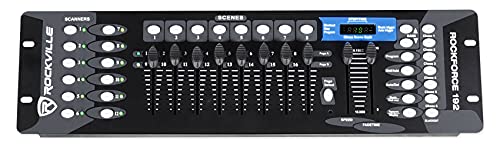
- 192 channels across 12 scanners
- 23 scene banks plus programmable chases
- Sound-activated effects with DMX-512 compatibility
Best For: DJs and venues running lighting and fog systems
Cable-Free Event Links

- One transmitter and two receivers included
- Up to 1,000-foot stated range with 2.4G transmission
- Seven group IDs and 126-channel frequency hopping
Best For: Mobile event setups needing wireless DMX connections
Versatile Event Control

- Controls up to 12 fixtures
- Stores up to 240 scenes
- Voice control with 3-pin output
Best For: DJs, weddings, churches, and multi-fixture events
Compact Small-Stage Choice
MAD OWL 12-Channel DMX Controller

- Controls up to 12 DMX512 channels
- Portable aluminum construction
- Standard 3-pin XLR output
Best For: Small stages and travel-friendly lighting setups
Best Simple Pick

- Controls 12 fixtures with 16 channels each
- Stores 240 scenes and 40 steps per scene
- Adjustable transition timing and voice control
Best For: Programmed stage shows and detailed event lighting sequences
Wireless Freedom – Donner DMX512 Wireless Controller
For events where cable runs are inconvenient, the Donner DMX512 wireless kit provides a practical way to connect compatible DMX512 lighting fixtures. Its transmitter supports seven receivers, making it suitable for distributed stage, party, bar, or disco lighting setups.
Best For: Wireless DMX512 lighting layouts that need multiple receivers and extended range.
Pros:
- Includes one transmitter and seven receivers.
- Offers seven selectable wireless network IDs to help separate systems.
- Automatic frequency hopping and a stated 500-meter visible-distance range support reliable operation.
- Receivers include rechargeable batteries.
Cons:
- Only works with devices marked DMX512.
- The transmitter does not have a built-in battery.
- It is a wireless transmission kit rather than a full hands-on lighting console.
This is a strong choice for dmx controllers for events when minimizing signal cables matters more than adding onboard scene programming or fader-based fixture control.
Programmable Show Control – CHAUVET DJ OBEY40 DMX Controller
The CHAUVET DJ OBEY40 is a traditional console-style option for dmx controllers for events, with controls for up to 12 fixtures and 192 total DMX channels. Its scene banks, chases, fog control, and strobe control suit programmed performances and repeatable show operation.
Best For: Operators managing several intelligent fixtures with stored scenes and chases.
Pros:
- Controls up to 12 fixtures with up to 16 channels each.
- Stores up to 240 scenes across 30 banks.
- Provides six chase sets and supports fog and strobe control.
- Includes MIDI compatibility and reversible sliders.
Cons:
- Its 6.7-pound metal construction may be less convenient for highly mobile setups.
- The supplied notes do not indicate wireless DMX operation.
- Programming is more console-oriented than plug-and-play software control.
Choose the OBEY40 when your event workflow benefits from physical controls and prepared lighting looks rather than computer-based automation.
DJ-Integrated Lighting – SoundSwitch Control One DMX Controller
The SoundSwitch Control One is designed for DJs and performers who want tactile lighting control alongside music playback. With two DMX universes, dual USB connections, performance pads, encoders, and SoundSwitch software integration, it fits software-driven dmx controllers for events.
Best For: DJs, live performers, and music-based shows that need real-time lighting adjustments.
Pros:
- Provides two DMX universe inputs and outputs with a thru option.
- Dual USB supports smoother DJ transitions.
- Touch strip, encoders, and RGB pads offer hands-on control.
- Supports intensity, color, strobe, moving heads, gobos, and other lighting effects.
Cons:
- Its full workflow depends on SoundSwitch software for many integrations.
- Some rekordbox setups require an AlphaTheta controller or compatible player, PRO DJ LINK Bridge, and a laptop.
- It is centered on DJ and audio-synced operation rather than a conventional standalone console.
This controller is particularly compelling when lighting should respond to DJ sets, live audio, or DAW sources while still allowing quick manual effect changes.
Standalone Multi-Universe Control – ADJ WMX1 Mk2 DMX Controller
The ADJ WMX1 Mk2 offers a compact standalone approach for dmx controllers for events, with 37 backlit silicone buttons, four rotary encoders, and support for up to four universes. Its four output sockets make it suited to setups that need multiple DMX outputs without relying on a computer.
Best For: Standalone event rigs requiring several DMX universes and direct physical controls.
Pros:
- Supports up to four DMX universes.
- Includes four output sockets for flexible connections.
- Provides 37 backlit buttons for operation in dim venues.
- Four rotary encoders support parameter adjustment.
Cons:
- The supplied notes do not list built-in wireless DMX functionality.
- Specific fixture capacity, scene storage, and chase features are not provided.
- Its feature set may require additional research for complex programming needs.
With its standalone design and multi-universe output, the WMX1 Mk2 is worth considering when a physical controller is preferred and the event setup extends beyond a single DMX universe.
Flexible Event Control – 384-Channel DMX Controller
For shoppers comparing dmx controllers for events, this DMX512 console stands out for combining wired 3-pin XLR and 2.4G wireless operation. Its 384-channel capacity, sound activation, MIDI support, and programmable scene storage make it adaptable for weddings, DJ sets, bars, and indoor stages.
Best For: DJs, wedding setups, and event venues that need flexible wired or wireless lighting control.
Pros:
- Controls up to 384 channels and 12 intelligent lights.
- Supports both 2.4G wireless and traditional 3-pin XLR wired connections.
- Stores 30 banks and 240 preset static scenes for quick show recall.
- Offers sound-activated, auto, manual, and MIDI control modes.
Cons:
- Requires a 9V battery.
- Its feature set may take time for beginners to learn fully.
This is a strong all-around choice when an event lighting rig may change between venues or layouts. The dual-mode connectivity and generous scene storage provide useful flexibility without requiring complicated installation.
Rack-Ready Event Lighting – Rockville ROCKFORCE 192
Among dmx controllers for events, the Rockville ROCKFORCE 192 is a practical rack-format option for managing lighting and fog systems. It provides 192 channels across 12 scanners, programmable scenes and chases, plus a built-in microphone for music-synchronized effects.
Best For: DJs, event planners, and venues using compatible DMX-512 lighting and fog equipment.
Pros:
- Controls 192 channels across 12 scanners with 16 channels each.
- Programs 23 banks of 8 scenes and six chases of 240 scenes.
- Built-in microphone enables sound-activated lighting effects.
- Metal-and-plastic 3U rack design suits organized event setups.
Cons:
- It has less channel capacity than the 384-channel controller in this roundup.
- Its 22-inch width may require dedicated rack or table space.
- Compatibility depends on the connected equipment supporting DMX-512.
The ROCKFORCE 192 makes sense for users who want structured scene and chase programming in a rack-oriented console. Its straightforward LED interface and sound trigger balance repeatable control with quick event operation.
Cable-Free Event Links – JERRAY Wireless DMX Set
For event lighting teams seeking dmx controllers for events with faster setup, this JERRAY kit provides one 2.4G transmitter and two receivers. It is designed for wireless DMX512 signal transmission, with seven selectable group IDs and automatic frequency hopping for separate lighting rigs.
Best For: Mobile DJs, weddings, and stage events where reducing XLR cable runs is a priority.
Pros:
- Includes one transmitter, two receivers, and three power adapters.
- Offers a stated range of up to 1,000 feet.
- Uses 126-channel automatic frequency hopping to help resist interference.
- Supports seven independent group IDs for separate lighting rigs.
Cons:
- It is a wireless transmitter-and-receiver set, not a full lighting programming console.
- Each unit requires a power adapter; the system is not battery-powered.
- It may require additional equipment to create and program DMX scenes.
This kit is best viewed as a wireless DMX link for simplifying venue layouts rather than as a standalone console. The included adapters and multiple group IDs are useful when several lighting zones need dependable, cable-free communication.
Versatile Event Control – CO-Z 192 DMX Controller
The CO-Z 192 DMX controller is a practical choice for DJs, weddings, church gatherings, and other events that need multiple lighting fixtures and programmed scenes. It supports up to 12 intelligent lights with up to 16 channels each, along with up to 240 scenes.
Best For: Event setups needing broad fixture support, scene programming, and accessible controls.
Pros:
- Controls up to 12 fixtures and 240 scenes.
- Supports up to 192 channels across intelligent lights.
- Includes a 3-pin connection for compatible fog machines and lighting equipment.
- Voice control and clearly separated control sections help simplify operation.
Cons:
- Its larger 19.1-inch-wide console may be less convenient for highly portable setups.
- It is corded electric and does not offer a battery-powered operating option in the supplied details.
For buyers comparing DMX controllers for events, this model offers a useful balance of scene capacity, fixture support, and beginner-friendly controls. Its 1-year warranty and upgraded control hardware add practical reassurance for regular use.
Compact Small-Stage Choice – MAD OWL 12-Channel DMX Controller
The MAD OWL 12-channel controller is designed for straightforward lighting control on small stages and mobile setups. Its compact aluminum construction, six sub-control faders, and main control fader make it a portable option among DMX controllers for events.
Best For: Small-stage lighting systems using DMX512 fixtures with no more than 12 channels.
Pros:
- Controls up to 12 DMX512 channels.
- Compact 7.09-inch design is convenient for travel and quick installation.
- Smooth faders and a one-key black-field function support simple operation.
- Uses a standard 3-pin XLR DMX output.
Cons:
- It cannot be used with stage lighting equipment requiring more than 12 channels.
- Its channel capacity is more limited than 192-channel event consoles.
- The supplied details describe basic dimming control rather than extensive scene programming.
This controller makes the most sense when portability and uncomplicated manual control matter more than advanced programming. Confirm that every fixture in your event setup stays within the 12-channel limit before buying.
Best Simple Pick – 192-Channel DMX Stage Console
This 192-channel DMX512 console is built for event lighting setups that need detailed scene programming and adjustable transitions. It can manage up to 12 fixtures, store up to 240 scenes, and connect to compatible professional equipment through a 3-core XLR output.
Best For: DJs, stage users, and event operators who want extensive scene programming and timed lighting transitions.
Pros:
- Controls up to 12 intelligent lights with up to 16 channels each.
- Stores up to 240 scenes with up to 40 steps per scene.
- Offers adjustable pause and graduation speeds for customized transitions.
- Includes voice control and a 3-core XLR DMX512 output.
Cons:
- The console is better suited to programmed setups than very basic lighting control.
- Its 192-channel capacity is organized around a maximum of 12 fixtures.
- The supplied details do not specify a compact or battery-powered design.
Among DMX controllers for events, this model stands out for scene depth and timing flexibility. It is a strong fit when you want repeatable lighting sequences, while its organized controls and voice operation can help reduce the learning curve.
How We Picked the Best Dmx Controllers for Events
We evaluated these Dmx Controllers for Events based on channel capacity, fixture compatibility, programming features, control method, portability, and likely use case. We also considered whether each model suits beginners, mobile DJs, small venues, or more demanding stage setups.
Channel count is an important starting point, but it does not tell the whole story. A controller with 192 channels may be sufficient for simple fixtures, while moving heads and advanced effects can use many channels per unit. Wireless range, MIDI or sound activation, fog-machine support, onboard scenes, and software integration can be equally important.
Quick Comparison
| Controller Type | Best For | Main Advantage |
|---|---|---|
| Wireless DMX systems | Mobile events and hard-to-cable venues | Faster setup with fewer signal cables |
| 192-channel consoles | DJs, parties, and small venues | Simple hands-on fixture control |
| 384-channel controllers | Larger fixture collections | More room for complex programming |
| Software-linked controllers | Computer-based lighting rigs | Flexible show design and automation |
| Compact dimmer controllers | Small stages and basic fixtures | Low cost and straightforward operation |
Key Buying Factors for Dmx Controllers for Events
Channel Capacity
Count the DMX channels required by every fixture, not just the number of lights. Leave extra capacity for future additions, especially if you plan to add moving heads, pixel effects, or fixtures with multiple operating modes.
Wired Versus Wireless DMX
Wireless systems can reduce setup time and help in venues where cable runs are inconvenient. Wired DMX remains a dependable choice for permanent installations, longer runs, and environments where radio interference may be a concern. Confirm transmitter and receiver compatibility before expanding a wireless system.
Programming and Trigger Options
Look for scenes, chases, banks, faders, and fixture-address controls that match your workflow. Sound activation is useful for unattended party lighting, while MIDI, computer integration, or time-based control can benefit more structured performances.
Fixture and Fog-Machine Support
Check the controller’s addressing method and whether it supports the fixture types you use. If fog or haze is part of the show, verify that the controller has suitable dedicated controls or enough assignable channels.
Portability and Reliability
Mobile operators should prioritize a durable enclosure, readable controls, manageable size, and dependable power options. For installed systems, rack compatibility and clear labeling may matter more than compactness.
Who Should Buy Which Dmx Controllers for Events?
Mobile DJs and party entertainers: A 192-channel console or wireless DMX kit offers practical control without an unnecessarily complex setup.
Small venues and event spaces: Choose a controller with enough spare channels for venue expansion, plus straightforward scene and chase programming.
Stage productions and larger rigs: Consider higher channel capacity, software integration, MIDI support, or a system that can scale across multiple fixtures and operators.
Beginners and occasional users: A compact controller with physical faders and simple scene storage is often easier to learn than a computer-heavy solution.
Wireless installations: Prioritize compatible transmitters and receivers, stable signal performance, and a clear plan for addressing every fixture before the event begins.