The right DMX controller can turn a basic mobile DJ setup into a coordinated light show without adding unnecessary complexity. The products in this roundup cover compact hardware consoles, wireless DMX kits, and computer-based systems for everything from small parties to larger events.
When choosing among DMX controllers for mobile DJs, consider how many fixtures you need to control, whether you want wireless operation, and how much programming time your setup allows. The guide below explains the practical differences so you can choose a controller that fits your workflow and budget.
Best 10 Dmx Controllers for Mobile Djs Picks for 2026
Best App-Based Pick

- 256-channel tablet-based DMX control
- 15,000+ fixture library
- 50 presets and 21 automatic effects
Best For: Mobile DJs wanting wireless, app-based lighting control
Best Hardware Chase Controller

- Controls up to 8 intelligent lights
- 96 DMX channels
- Six chases with up to 999 steps each
Best For: DJs who prefer dedicated physical chase controls
Best Laptop-Based Budget Option

- Lightweight USB-to-DMX dongle
- 256 live channels
- No internet connection required
Best For: Mobile performers using a compatible laptop
Best Traditional Fader Board
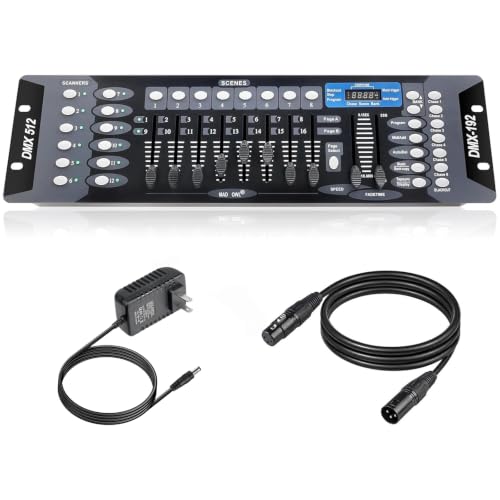
- 192 channels for up to 12 fixtures
- 23 banks of programmable scenes
- Six chases with up to 240 steps
Best For: DJs wanting hands-on fader and button control
Best Wireless Software Hub

- Dual-mode Wi-Fi for wireless programming and triggering
- Two DMX universes plus one ArtNet universe
- Compatible with mobile and desktop platforms
Best For: Mobile DJs using ShowXpress software
Best Traditional Console
CO-Z 192-Channel DMX Controller

- Controls up to 12 fixtures with 16 channels each
- Stores up to 240 lighting scenes
- Physical controls and voice scene switching
Best For: Mobile DJs who prefer hands-on console control
Best Cable-Free Link
JERRAY Wireless DMX 3-Piece Set

- One transmitter and two receivers for wireless DMX
- Seven group IDs with automatic frequency hopping
- Claimed 1,000-foot range for flexible venue layouts
Best For: Mobile DJs needing faster wireless fixture connections
Best Overall

- Controls up to 24 fixtures with 384 channels
- Stores 240 scenes and six programmable chases
- Adds MIDI and music-triggered lighting modes
Best For: Mobile DJs with larger, programmable lighting rigs
Best for Beginners

- Controls 12 fixtures across 192 channels
- Offers sound-activated, automatic, and manual modes
- Includes cable, power cord, manual, and two-year warranty
Best For: Beginners handling small DJ and event lighting rigs
Best Compact Option
192-Channel Stage Light Controller
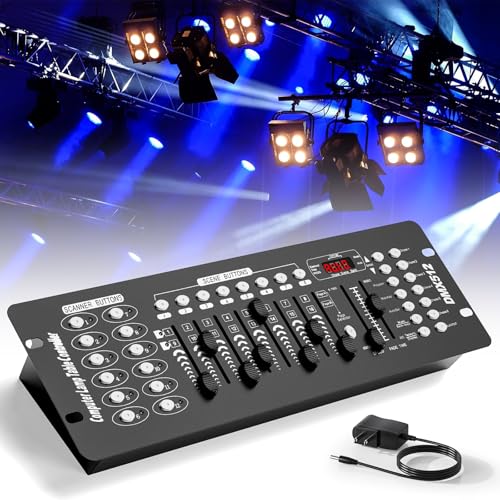
- Controls 12 devices across 192 channels
- Stores 240 scenes with six programmable chases
- Includes manual sliders and automatic speed/fade controls
Best For: Small parties and beginner 3-pin DMX setups
Best App-Based Pick – ADJ MyDMX Go
For mobile DJs seeking flexible dmx controllers for mobile djs, the ADJ MyDMX Go combines tablet-based control with wireless operation and a broad fixture library. Its app-based design avoids traditional programming while offering manual displays, presets, and automatic effects.
Best For: Mobile DJs who want app-based control, quick setup, and compatibility with a wide range of lighting fixtures.
Pros:
- Controls up to 256 DMX channels from an iPad or Android tablet.
- Supports more than 15,000 fixtures, helping accommodate mixed lighting systems.
- Includes 50 user presets and 21 automatic effects.
- Compact interface includes O-Clamp brackets for truss mounting.
Cons:
- Requires a compatible tablet for app-based operation.
- Its feature set may be more than needed for very simple lighting rigs.
The MyDMX Go is a strong choice when portability and fast, visual control matter more than hands-on faders. It is especially practical for DJs who regularly work with different fixtures and venues.
Best Hardware Chase Controller – CHAUVET DJ Obey 10
The CHAUVET DJ Obey 10 is a conventional hardware option among dmx controllers for mobile djs, providing direct control of intelligent lights without relying on a tablet or computer. It supports up to eight fixtures with up to 12 channels each and focuses on programmable chases.
Best For: DJs who prefer physical controls and need multiple programmable chase sequences for intelligent lighting.
Pros:
- Controls up to eight intelligent lights.
- Provides 96 DMX channels of control.
- Offers six chase sets with up to 999 steps each.
- Supports sequential linking of chases.
Cons:
- Does not offer the app-based workflow of newer tablet controllers.
- Its 22.2-inch width may require more booth or case space.
Choose the Obey 10 if tactile operation and extensive chase programming are priorities. Its layout is better suited to DJs who want a dedicated lighting console rather than software-based control.
Best Laptop-Based Budget Option – ADJ MyDMX Buddy
The ADJ MyDMX Buddy is a compact USB-to-DMX dongle for mobile DJs who already carry a Windows computer or Mac. Used with MyDMX 2.0 software, it provides laptop-based lighting control without requiring an internet connection or a separate full-size console.
Best For: Mobile performers who want lightweight computer-based DMX control and already have a compatible laptop.
Pros:
- Weighs only 2.72 ounces for easy transport.
- Provides 256 live channels and 12 DMX channels in standalone mode.
- Connects directly to a computer through USB and to the DMX run.
- Works with MyDMX 2.0 software for scenes and steps.
Cons:
- Requires a compatible computer and MyDMX 2.0 software.
- Its listed operating-system support is limited to older Windows and macOS versions.
The MyDMX Buddy makes sense for DJs who want to minimize hardware while keeping computer-based control. Confirm your laptop and operating system meet the listed requirements before choosing it for regular gigs.
Best Traditional Fader Board – 192-Channel DMX Controller
This 192-channel DMX board is a straightforward choice among dmx controllers for mobile djs who prefer physical faders and buttons. It controls up to 12 fixtures with 16 channels or fewer and includes a DMX cable for connection to compatible lighting equipment.
Best For: DJs and small performance setups that need hands-on scene programming and chase control for multiple fixtures.
Pros:
- Provides 192 channels across up to 12 fixtures.
- Includes 23 banks with eight programmable scenes each.
- Supports six programmable chases with up to 240 steps.
- Includes a 6.6-foot DMX cable.
Cons:
- Supports fixtures with 16 channels or fewer.
- Its 22.44-inch width may be bulky for very small mobile booths.
This controller suits users who value direct, real-time adjustments over app convenience. Its scene banks and chase capacity provide useful programming depth for compact DJ lighting systems.
Best Wireless Software Hub – ShowXpress Xpress 1024W
For mobile DJs who want software-based lighting control, the CHAUVET DJ Xpress 1024W combines dual-mode Wi-Fi with ShowXpress compatibility. It supports two DMX universes plus one additional ArtNet universe, making it a flexible choice for larger or expandable setups.
Best For: Mobile DJs and event operators using ShowXpress on Windows, Mac, Linux, iOS, or Android devices.
Pros:
- Built-in Wi-Fi supports both network and access-point modes.
- Controls two DMX universes and adds one ArtNet universe.
- Works with the ShowXpress Live Mobile app for remote scene triggering.
- Isolated 3-pin XLR outputs include hot-swappable reconnection and protection features.
Cons:
- Requires compatible ShowXpress software or the Live Mobile app for operation.
- Its software-based workflow may be less appealing to DJs who prefer physical faders.
The Xpress 1024W is a strong pick when wireless access, mobile control, and future universe expansion matter more than a traditional console layout.
Best Traditional Console – CO-Z 192-Channel DMX Controller
The CO-Z 192 DMX controller is a straightforward console-style option for mobile DJs who prefer hands-on controls. Its layout supports up to 12 intelligent lights with as many as 16 channels each, along with up to 240 programmable scenes.
Best For: DJs and small event operators who want physical controls for conventional DMX lighting setups.
Pros:
- Controls up to 12 fixtures with up to 16 channels each.
- Supports up to 240 scenes for more involved shows.
- Includes dedicated selection, scene, channel, speed, and function controls.
- Voice control is available for switching among lighting scenes.
Cons:
- It is a corded, hardware-based controller rather than a wireless mobile solution.
- The 192-channel capacity is more limited than higher-universe systems.
- Its physical console format may require more transport space than a compact interface.
Choose the CO-Z when immediate tactile control is a priority and your mobile DJ rig uses a manageable number of DMX fixtures.
Best Cable-Free Link – JERRAY Wireless DMX 3-Piece Set
The JERRAY wireless DMX set helps mobile DJs reduce cable runs between a lighting controller and fixtures. With one transmitter, two receivers, seven selectable group IDs, and a claimed 1,000-foot range, it is designed for quick setups involving moving heads, PAR lights, and other DMX fixtures.
Best For: Mobile DJs, weddings, and event crews that need wireless DMX connections between separated lighting fixtures.
Pros:
- Wireless 2.4G DMX transmission reduces XLR cable clutter and setup time.
- Automatic frequency hopping is designed to resist interference and signal delay.
- Seven independent group IDs allow separate lighting rigs in one venue.
- Includes one transmitter, two receivers, and three power adapters.
Cons:
- Units require power adapters and do not have built-in batteries.
- This is a wireless transmitter-and-receiver system, not a standalone DMX programming console.
- The supplied set includes only two receivers, limiting the number of wireless fixture endpoints without expansion.
The JERRAY set is best viewed as a wireless infrastructure upgrade: pair it with an existing DMX controller when faster, cleaner fixture connections are the main goal.
Best Overall – Rockville ROCKFORCE 384
For mobile DJs who need broad fixture coverage and hands-on programming, the Rockville ROCKFORCE 384 is a versatile choice among DMX controllers for mobile djs. It controls up to 24 intelligent lights with 16 channels each, while its MIDI, music mode, and programmable scenes support more involved shows.
Best For: Mobile DJs running larger lighting rigs with moving heads, fog effects, and custom scene programming.
Pros:
- Controls up to 24 fixtures across 384 channels.
- Stores 240 scenes in 30 banks and includes six programmable chases.
- Offers MIDI control, music-triggered operation, manual override, and power-failure memory.
- Durable metal housing includes an LED display and gooseneck lamp.
Cons:
- Its larger 20.71-inch width may require more transport or setup space.
- The extensive controls may be more than beginners need for small events.
The ROCKFORCE 384 stands out when fixture count, programming depth, and live control matter more than compactness. Its 3-pin XLR connections and universal 110-240V power support make it practical for varied mobile setups.
Best for Beginners – 192 DMX Controller
This 192-channel console is a straightforward option for mobile DJs learning DMX control. Its organized seven-section layout, built-in microphone, and support for up to 12 fixtures make it approachable for parties, weddings, clubs, and smaller stage setups.
Best For: Beginners and mobile DJs who want simple manual, automatic, and sound-activated control.
Pros:
- Controls up to 12 fixtures with 16 channels each.
- Stores up to 240 programmable scenes.
- Built-in microphone supports beat-synchronized sound activation.
- Includes a DMX cable, power cord, manual, and two-year manufacturer warranty.
Cons:
- Its 192-channel capacity is lower than the Rockville controller in this roundup.
- The ABS and aluminum construction may feel less substantial than a full metal console.
With clearly separated controls and multiple operating modes, this controller prioritizes ease of use over maximum fixture capacity. It is a sensible starting point for DJs building their first DMX workflow.
Best Compact Option – 192-Channel Stage Light Controller
For mobile DJs seeking a basic console for small gatherings, this 192-channel model provides essential programming without an oversized feature set. It supports 12 devices, 240 scenes, manual channel sliders, and 3-pin connections for common stage fixtures.
Best For: Small parties, music shows, and beginner setups using compatible 3-pin DMX lights.
Pros:
- Controls up to 12 devices with 16 channels each.
- Supports 23 banks of eight programmable scenes and six chases.
- Includes manual sliders plus speed and fade controls for automatic programs.
- Works with fog machines, moving heads, par lights, and other 3-pin equipment.
Cons:
- Provides fewer channels and fixture slots than the 384-channel option.
- After-sale coverage is listed as a 30-day return and repair support, with warranty details varying in the supplied notes.
- The compact dimensions listed may not reflect a conventional console footprint.
This controller covers the core functions needed for straightforward event lighting and offers useful scene capacity for its channel count. It is best suited to smaller rigs where simple programming and 3-pin compatibility are the priorities.
How We Picked the Best Dmx Controllers for Mobile Djs
We selected products across the main categories used by mobile entertainers: standalone 192-channel consoles, higher-capacity controllers, USB or app-based systems, and wireless DMX solutions. We considered channel capacity, portability, fixture compatibility, programming flexibility, connection options, software requirements, and ease of use. Because mobile DJ rigs vary widely, the list includes both straightforward controllers for basic scenes and more advanced systems for moving heads, multiple universes, and computer-driven shows.
Before buying, verify the connector type, DMX channel count, fixture profiles, and included accessories. Some controllers are best suited to conventional fixtures, while others are designed for software-managed lighting or wireless expansion.
Quick Comparison
| Controller type | Best for | Main advantage |
|---|---|---|
| Standalone 192-channel board | Small parties and simple rigs | Low-cost, direct control |
| 384-channel console | Growing fixture collections | More programming capacity |
| App or USB controller | Computer-based mobile shows | Flexible scenes and effects |
| Wireless DMX system | Clean, cable-free installations | Faster setup and fewer signal cables |
| Multi-universe controller | Large or complex productions | Higher fixture and data capacity |
Key Buying Factors for Dmx Controllers for Mobile Djs
Channel and Universe Capacity
A 192-channel controller can handle a modest number of simple fixtures, but moving heads and effect lights may use many channels each. Choose extra capacity if you expect your rig to grow. Multi-universe products are more suitable for larger lighting systems.
Programming Workflow
Standalone boards offer immediate hands-on control and do not require a laptop. Software and app-based controllers can provide fixture libraries, timelines, automation, and more detailed effects, but they require compatible hardware and a reliable device.
Wired Versus Wireless Operation
Wired DMX remains dependable and is often preferable for permanent or high-priority connections. Wireless transmitters and receivers can reduce cable runs and speed up venue setup, but check range, interference handling, power requirements, and whether the system uses compatible wireless DMX protocols.
Portability and Durability
Mobile DJs should consider weight, case compatibility, connector placement, and how quickly the controller can be deployed. A compact board may be easier to transport, while a larger console can provide better access to faders and controls.
Who Should Buy Which Dmx Controllers for Mobile Djs?
Choose a basic 192-channel console if you run a small number of PAR lights, strobes, or simple fixtures and want an affordable controller with no computer. A 384-channel model is a better fit for DJs adding more fixtures or fog and effect lighting.
Choose an app- or USB-based controller if you already use a laptop or tablet and want more programmable scenes, fixture control, or automation. Wireless DMX kits suit venues where cable runs are inconvenient, while multi-universe systems are the better choice for larger productions or rapidly expanding rigs.
For most mobile DJs, the best option is the controller that matches the current fixture count while leaving reasonable room for growth. Prioritize dependable connections and a workflow you can operate confidently during a live event over features you are unlikely to use.