Finding the right DMX controller for a small venue means balancing control, portability, setup time, and budget. The best option should make everyday lighting cues easy to trigger without overwhelming operators with unnecessary complexity.
This roundup covers compact consoles, wireless and wired controllers, app-based systems, and software-integrated options for DJs, churches, rehearsal spaces, bars, and small stages.
Best 10 Dmx Controllers for Small Venues Picks for 2026
Best Overall

- Four-universe, 1,024-channel standalone control
- Touchscreen, buttons, MIDI, and BPM syncing
- Includes Decksaver protection for transport
Best For: Mobile DJs, event crews, churches, and small clubs
Best for Simple Cue Playback
Pknight 5-Button Scene Recorder

- Five physical buttons for quick cue recall
- Up to 10 press-and-release scene actions
- Records DMX512, Art-Net, and sACN
Best For: Fixed venues with repeatable lighting shows
Best Compact Wireless Option
Mini 512-Channel DMX Controller

- 2.4G wireless and standard DMX512 support
- Six banks with eight programmable scenes
- Compact design with manual and auto modes
Best For: Mobile parties, weddings, bars, and small lighting rigs
Best for DJ Software Integration

- Two DMX universes with install-friendly thru option
- Tactile strip, encoders, and RGB performance pads
- Works with SoundSwitch and compatible DJ hardware
Best For: DJs syncing lighting with software and live music
Best App-Based Option
ADJ MyDMX Go Wireless DMX Controller

- 256-channel control through iPad or Android tablets
- 15,000-plus fixture library with presets and effects
- Supports Wi-Fi, USB, and two lighting universes
Best For: Tablet-focused users seeking quick, low-programming setup
Best Value Manual Console
192-Channel DMX Lighting Controller
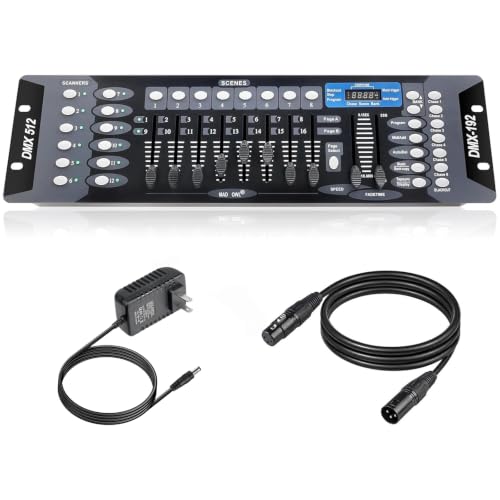
- Controls 12 fixtures with 192 channels
- Offers 23 banks and six programmable chases
- Includes a 6.6-foot DMX cable
Best For: Budget-conscious users wanting wired fader-and-button control
Best Compact 12-Channel Pick

- Controls up to 12 DMX512 channels
- Compact aluminum design for travel
- Standard 3-pin XLR DMX output
Best For: Small stages using simple, low-channel DMX fixtures
Best Wireless Feature Set

- 384 channels for up to 12 intelligent lights
- 2.4G wireless and wired DMX modes
- Stores 240 preset static scenes
Best For: Small venues needing wireless flexibility and programmed shows
Best Scene-Programming Value

- Controls up to 12 fixtures
- Stores up to 240 scenes
- Supports voice control and timed transitions
Best For: Small shows needing programmable scenes and fixture flexibility
Best Overall – ADJ WMX1 MK2 WolfMix Bundle
For buyers comparing DMX controllers for small venues, the ADJ WMX1 MK2 is a particularly complete option when you want standalone control without carrying a laptop. Its touchscreen, physical buttons, broad fixture library, and included Decksaver cover suit mobile and installed lighting setups.
Best For: Mobile DJs, churches, event technicians, and small bars or clubs that need flexible standalone control.
Pros:
- Controls up to four DMX universes with 1,024 channels and supports up to 680 fixtures.
- Combines a 4.3-inch touchscreen with 37 backlit buttons for hands-on operation.
- Includes a protective Decksaver cover and supports MIDI, audio input, and BPM-synced shows.
- Offers more than 3,500 built-in fixture profiles, with additional profiles available through WTOOLS.
Cons:
- Its advanced feature set may be more than a very simple venue setup requires.
- The controller is designed for external power and connected lighting equipment rather than battery-powered operation.
The WMX1 MK2 is the strongest all-around pick here for venues that expect their lighting system to grow. The compact footprint and rugged construction add practical value for repeated transport and setup.
Best for Simple Cue Playback – Pknight 5-Button Scene Recorder
Among DMX controllers for small venues, the Pknight takes a different approach: it records prepared cues so nontechnical staff can recall them with physical buttons. That makes it useful when repeatable lighting looks matter more than live programming.
Best For: Fixed installations, bars, churches, clubs, exhibitions, weddings, and small stages with recurring cue sequences.
Pros:
- Five tactile buttons provide direct operation without navigating a complex console.
- Each button can trigger one scene on press and another on release, providing up to 10 actions.
- Records DMX512, Art-Net, and sACN signals for compatibility with different workflows.
- Supports standalone playback without keeping the original console, computer, or software connected.
Cons:
- It is focused on cue recall rather than broad live programming or detailed manual control.
- Its relatively large 5.61-pound package may be less convenient for highly mobile setups.
The Pknight is best viewed as a playback appliance rather than a full lighting desk. It can simplify daily operation after a lighting designer has prepared and recorded the scenes.
Best Compact Wireless Option – Mini 512-Channel DMX Controller
If portability and wireless operation are priorities, this mini unit is a straightforward choice among DMX controllers for small venues. It supports standard DMX512 alongside 2.4G wireless transmission, with manual dimming and automatic scene playback for basic event lighting.
Best For: Parties, weddings, DJs, clubs, bars, and small lighting projects using compatible stage, par, or moving-head fixtures.
Pros:
- Supports 512 channels with both 2.4G wireless transmission and standard DMX512.
- Offers manual control, automatic scene looping, and 0–100% master dimming.
- Provides six banks with eight programmable scenes, plus record and blackout functions.
- Compact, lightweight construction is convenient for mobile events.
Cons:
- Requires an external 9–12V DC adapter because it has no built-in battery.
- Its feature set is oriented toward smaller, simpler lighting projects rather than complex multi-universe rigs.
This controller makes sense when you want a small footprint and basic wireless flexibility without stepping up to a larger console. Confirm wireless compatibility with your fixtures before building a complete system.
Best for DJ Software Integration – SoundSwitch Control One
For DJs who want lighting tied closely to their performance workflow, the SoundSwitch Control One is a strong candidate among DMX controllers for small venues. It provides tactile control for SoundSwitch software, supports two DMX universes, and can work directly with compatible Engine DJ hardware.
Best For: DJs and small venues using SoundSwitch, Engine DJ devices, compatible AlphaTheta equipment, or computer-based music systems.
Pros:
- Provides two DMX universe inputs and outputs with a thru option for installations.
- Offers a touch strip, smooth encoders, and RGB performance pads for hands-on adjustments.
- Can sync lighting through live audio BPM detection from external audio sources.
- Supports effects such as color, brightness, strobe, moving heads, and gobos.
Cons:
- Its 1:1 control design depends on SoundSwitch software for the main workflow.
- Some AlphaTheta rekordbox and PRO DJ LINK Bridge uses require a laptop running SoundSwitch.
- It is less suitable if you want a fully standalone controller independent of a software ecosystem.
Control One is most compelling for performance-focused DJs already using SoundSwitch-compatible equipment. Its compact 1.76-pound design and tactile controls make live lighting adjustments more immediate than mouse-based operation.
Best All-Around Manual Control – MINGJIE 192-Channel DMX512 Controller
For small venues needing hands-on control, the MINGJIE DMX512 Controller offers 192 channels for managing up to 12 intelligent fixtures. Its faders, scene storage, sound-activated mode, and chase programming make it a practical choice for DJs, clubs, parties, and small stage productions.
Best For: DJs and small venues that want physical fader control with programmable scenes and chases.
Pros:
- Controls up to 12 fixtures across 192 DMX channels.
- Stores 240 scenes in 30 banks and supports six chases.
- Includes a 4-foot, 3-pin DMX cable and supports 100–240V input.
- Rugged alloy chassis is designed for heat dissipation and repeated use.
Cons:
- Manual console layout may require more setup than an app-based controller.
- Its 192-channel capacity may be limiting for larger, more complex rigs.
The MINGJIE is a straightforward fit when tactile controls matter more than wireless operation. It offers useful programming capacity without moving into a larger console format, making it a balanced option for small-venue lighting systems.
Best App-Based Option – ADJ MyDMX Go Wireless DMX Controller
The ADJ MyDMX Go takes a different approach to DMX controllers for small venues, using an iPad or Android tablet instead of a traditional control surface. Its 256-channel app, fixture library, automatic effects, and wireless connectivity can simplify setup for compact mobile rigs and venues that prefer visual control.
Best For: Tablet-focused users who want quick lighting effects with minimal programming.
Pros:
- Provides 256-channel control through an iPad or Android tablet.
- Offers a library of more than 15,000 fixtures.
- Includes 50 user presets and 21 automatic effects.
- Supports Wi-Fi and USB operation and can connect to two lighting universes.
Cons:
- Requires a compatible iPad or Android tablet for app-based operation.
- Some additional upgrades are available separately.
- Tablet control may be less tactile than dedicated faders for live adjustments.
MyDMX Go is well suited to operators who value portability and fast visual setup. The broad fixture library and preset-driven workflow can reduce programming time, while the compact interface is easy to integrate into a small lighting system.
Best Value Manual Console – 192-Channel DMX Lighting Controller
This 192-channel DMX board is a practical option for small venues that need conventional fader-and-button control. It can operate up to 12 fixtures with 16 channels or fewer, while its programmable banks, scenes, and chases support repeatable lighting shows for DJ, stage, and club use.
Best For: Budget-conscious operators who want a traditional console with scene and chase programming.
Pros:
- Controls up to 12 fixtures with 192 total channels.
- Provides 23 banks of eight programmable scenes.
- Supports 240-step scenes across six programmable chases.
- Includes a 6.6-foot DMX cable for compatible equipment.
Cons:
- Fixtures are limited to 16 channels or fewer.
- It uses a traditional manual interface rather than app-based control.
- The rack-mount design and approximately 22.44-inch length may need dedicated space.
For straightforward small-venue lighting, this controller delivers substantial scene-storage capacity in a familiar format. It is a sensible choice when reliable wired operation and programmable sequences are priorities.
Best Compact 12-Channel Pick – MAD OWL 12-Channel DMX Dimmer
For small venues using a limited number of DMX fixtures, the MAD OWL offers a straightforward, portable way to manage up to 12 DMX512 channels. Its compact aluminum design and simple fader layout make it a practical option when you want basic hands-on control without a larger lighting console.
Best For: Small stages and simple lighting setups with fixtures using 12 or fewer channels.
Pros:
- Controls up to 12 DMX512 channels with six sub-control faders and one master fader.
- Compact, lightweight design is convenient for travel and quick installation.
- Uses a standard 3-pin XLR DMX output for connection to compatible equipment.
- One-key blackout function provides a quick way to darken the setup.
Cons:
- Not suitable for stage lighting equipment requiring more than 12 channels.
- Designed for basic dimming control rather than advanced scene programming.
The MAD OWL is a sensible choice among DMX controllers for small venues when portability and uncomplicated manual control matter most. Check your fixtures’ channel requirements before buying.
Best Wireless Feature Set – DMX512 384-Channel Controller
For small venues that need more programming flexibility, this 384-channel console combines wired and 2.4G wireless DMX operation with sound activation and MIDI support. It can control up to 12 intelligent lights while offering scene storage for repeatable shows.
Best For: Weddings, bars, discos, churches, banquet halls, and indoor stages needing wireless or programmable control.
Pros:
- Provides 384 DMX512 channels and supports up to 12 intelligent lights.
- Offers both 2.4G wireless transmission and traditional 3-pin XLR wired connection.
- Includes sound-activated, automatic, manual, and MIDI control modes.
- Stores 30 banks and 240 preset static scenes, with scene copy, insert, and delete functions.
Cons:
- Its broader feature set may require more setup than a basic manual controller.
- Wireless operation requires compatible equipment and may not suit every installation.
This is one of the more flexible DMX controllers for small venues in the lineup, particularly if you want scene recall, rhythm-based effects, or fewer cables. Its capacity also leaves room for more complex lighting arrangements.
Best Scene-Programming Value – 192-Channel DMX Console
This 192-channel DMX console suits small venues that want more control than a basic dimmer but do not need an especially large system. It supports up to 12 fixtures with up to 16 channels each, plus scene programming, voice control, and a 3-pin DMX output.
Best For: DJs, clubs, weddings, churches, and small stage setups using multiple programmable fixtures.
Pros:
- Controls up to 12 intelligent lights with up to 16 channels per fixture.
- Supports up to 240 scenes and up to 40 steps per scene.
- Adjustable pause and fade times allow customized lighting transitions.
- Includes voice control and a 3-pin XLR DMX512 output for compatible equipment.
Cons:
- The console’s multiple control sections may take time for new users to learn.
- Its 192-channel capacity is lower than the 384-channel model in this roundup.
Choose this controller if scene creation and repeatable transitions are more important than wireless operation. It provides a useful middle ground for DMX controllers for small venues, with dedicated controls and support for varied 3-pin lighting equipment.
How We Picked the Best Dmx Controllers for Small Venues
We focused on the features that matter most in compact performance spaces: channel capacity, scene and cue control, wireless flexibility, manual operation, software integration, portability, and ease of setup. The selection includes simple 12- and 192-channel boards as well as more advanced 384- and 512-channel systems.
We also considered how each controller fits a real venue workflow. A mobile DJ may prioritize fast access to scenes and sound-active modes, while a church or small theater may need repeatable cues, reliable connections, and an interface that volunteers can learn quickly.
Quick Comparison
| Controller type | Best for | Main advantage |
|---|---|---|
| Compact manual console | Basic fixtures and small rigs | Low cost and straightforward operation |
| Scene or cue controller | Repeatable shows | Fast access to saved lighting states |
| Wireless DMX controller | Mobile setups | Less cabling between controller and fixtures |
| App or software-based system | Flexible programming | Visual control and expandable features |
| Standalone advanced console | Frequent performers and larger rigs | More hands-on control and programming depth |
Key Buying Factors for Dmx Controllers for Small Venues
Channel Capacity and Fixture Count
Check how many DMX channels your fixtures actually use, not just how many fixtures you own. A basic light may need a few channels, while moving heads and pixel fixtures can require many more. Leave room for future expansion rather than choosing a controller that will immediately operate at its limit.
Scenes, Chases, and Cue Access
Scenes store complete lighting looks, while chases create repeating sequences. If the operator needs to change looks during a performance, dedicated buttons or faders can be more useful than a low-cost controller with extensive but difficult programming options.
Wired Versus Wireless Operation
Wireless DMX can reduce cable runs and speed up temporary installations, but it still requires compatible transmitters, receivers, clear signal paths, and dependable power. Wired DMX remains the safest choice when maximum reliability and predictable troubleshooting matter most.
Operating Method and Learning Curve
Standalone consoles work without a computer and are often practical for mobile use. App- and software-based systems can offer clearer visual programming, but they depend on a compatible device and may require more preparation before a show.
Portability and Venue Conditions
Measure the available operating space and consider whether the controller will travel regularly. Compact units suit booths and small tables, while larger consoles may be easier to operate but harder to transport and protect.
Who Should Buy Which Dmx Controllers for Small Venues?
Choose a compact 192-channel or 12-channel controller if you run a small number of conventional fixtures and want simple manual control at a low price.
Choose a scene recorder or cue-focused controller if volunteers, performers, or event staff need reliable access to preset looks with minimal programming.
Choose a wireless model if your lighting rig moves frequently or cable runs are inconvenient, provided all fixtures support the required wireless setup.
Choose an app-based or software-integrated controller if you value visual editing, flexible show design, and future expansion more than completely standalone operation.
Choose a higher-capacity standalone console if you regularly control moving heads, LED fixtures, or multiple lighting zones and want dedicated hands-on access during live events.