Video editors often need fast access to multiple project drives, backups, and archive disks without installing each one inside a computer. The best hard drive docking stations for video editing make that workflow easier while keeping storage flexible and accessible.
This roundup compares 10 multi-bay enclosures and docking stations covering SATA HDDs, SSDs, NVMe drives, USB-C connectivity, drive cloning, and high-capacity workflows.
Best 10 Hard Drive Docking Stations for Video Editing Picks for 2026
Best High-Capacity Pick

- Four SATA bays for 3.5-inch or 2.5-inch drives
- Up to 10Gbps USB-C transfer speed
- Cooling fans and optional 4K HDMI output
Best For: Large desktop video-editing storage setups
Best for Drive Cloning

- Two M.2 NVMe bays plus one SATA bay
- Standalone one-touch cloning
- 10Gbps USB connection across major operating systems
Best For: Drive migration, cloning, and mixed NVMe/SATA workflows
Best Maximum-Capacity Enclosure
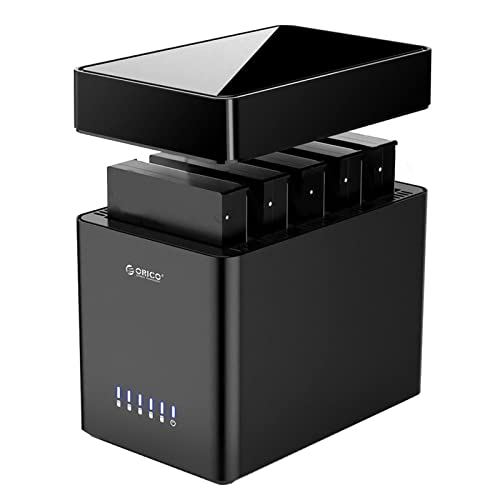
- Five bays for 2.5-inch or 3.5-inch SATA drives
- Up to 110TB total capacity
- Tool-free design with fan-assisted cooling
Best For: Large media libraries and storage expansion
Best Plug-and-Play Quad Dock

- Four tray-less SATA drive bays
- Hot-swappable, independently powered bays
- Dual fans and two-year warranty
Best For: Frequent SATA drive swapping and workstation backups
Versatile Clone Station

- Dual bays support 2.5-inch and 3.5-inch SATA drives
- Offline cloning without a computer
- USB 3.0 with UASP and up to 44TB support
Best For: SATA-based editing and drive duplication
High-Capacity Media Hub

- Four bays combine two NVMe and two SATA drives
- USB-C 10Gbps for large media transfers
- Individual power switches and up to 48TB capacity
Best For: Mixed NVMe/SATA editing workstations
Simple Dual-Bay Cloner
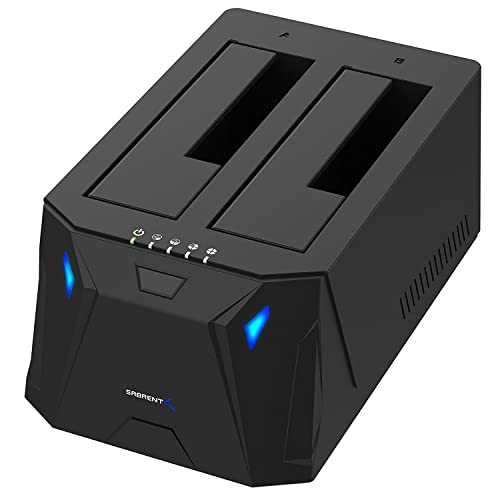
- Reads 2.5-inch and 3.5-inch SATA drives
- Plug-and-play with no drivers required
- USB 3.0 transfers and offline cloning
Best For: Basic SATA transfers and drive duplication
Best for Offline Cloning

- Two bays for 2.5-inch and 3.5-inch SATA drives
- Offline cloning without a computer
- USB 3.0 up to 5Gbps with cooling features
Best For: Editors managing and cloning bare SATA drives
Best USB-C Pick

- Independent access to two SATA drives
- Offline cloning at up to 60MBps
- Tool-free bays with USB-C connectivity
Best For: USB-C editing setups using bare SATA drives
Best for Extra Connectivity

- Two SATA bays with up to 48TB total capacity
- Offline cloning with progress indicators
- Three USB 3.0 Type-A hub ports
Best For: Editors needing SATA cloning and extra USB-A ports
Best High-Capacity Pick – WAVLINK 4-Bay USB-C Enclosure
For video editors who need substantial working and archive space, this WAVLINK enclosure is one of the more versatile hard drive docking stations for video editing. It accepts four 3.5-inch or 2.5-inch SATA HDDs or SSDs and connects over USB-C at up to 10Gbps, making it suitable for moving large media files. Note that 2.5-inch drives require separate mounting brackets.
Best For: Editors building a large, multi-drive desktop media workspace with USB-C connectivity and optional 4K display output.
Pros:
- Four SATA bays support 3.5-inch and 2.5-inch drives, with capacity up to 128TB according to the supplied specifications.
- USB 3.2 Type-C supports up to 10Gbps for transferring large project files.
- Built-in temperature-controlled fans and an aluminum shell help with cooling.
- Independent bay power switches and hot-swapping streamline drive changes.
Cons:
- 2.5-inch drives need additional mounting brackets, which are not included.
- HDMI video output requires a host USB-C port that supports video output and a USB-C-to-C connection.
Its combination of four bays, faster USB-C connectivity, cooling, and HDMI support makes it a strong all-around choice for editors managing multiple drives. It is best suited to a permanent workstation rather than a highly portable setup.
Best for Drive Cloning – Vantec JX Triple-Bay Dock
Vantec JX, USB 3.2 Gen 2x1, Triple Bay Dock (Dual M2, SATA) with Clone Function (NST-DM12C31)
Check Price On AmazonThe Vantec JX stands out among hard drive docking stations for video editing when cloning, backup, or drive migration is part of the workflow. It combines two M.2 NVMe slots with one SATA bay for a 2.5-inch or 3.5-inch drive, and it supports standalone sector-to-sector duplication without requiring a computer connection.
Best For: Editors and technicians who regularly clone project drives, migrate storage, or work across NVMe and SATA media.
Pros:
- Supports two M.2 NVMe drives plus one 2.5-inch or 3.5-inch SATA HDD or SSD.
- One-touch standalone cloning simplifies drive duplication.
- USB 3.2 Gen 2×1 provides up to 10Gbps when used as a triple-bay dock.
- Works with macOS, Windows, and Linux without requiring dock drivers.
Cons:
- Sector-to-sector cloning requires the target drive to have at least as many sectors as the source.
- Actual cloning speed can vary by the installed media.
- It offers three storage positions rather than the four or five bays provided by some alternatives.
Its standout feature is flexibility: the dock can function as a fast external storage station or a dedicated cloning tool. For editors who simply need maximum simultaneous SATA capacity, a larger multi-bay enclosure may be a better fit.
Best Maximum-Capacity Enclosure – ORICO 5-Bay HDD Enclosure
This ORICO enclosure is designed for editors who prioritize the number of installed drives and overall storage capacity. As one of the larger hard drive docking stations for video editing, it houses up to five 2.5-inch or 3.5-inch SATA HDDs or SSDs and supports up to 110TB of total storage, while its USB 3.0 connection provides up to 5Gbps.
Best For: Home studios and editors expanding a large media library for footage, backups, photos, or 4K movies.
Pros:
- Five bays support both 2.5-inch and 3.5-inch SATA drives.
- Supports up to 110TB total capacity, with single drives up to 22TB according to the supplied notes.
- Tool-free magnetic cover design makes drive installation straightforward.
- A 60mm fan, honeycomb ventilation, and drive status indicators support ongoing operation.
Cons:
- USB 3.0 tops out at 5Gbps, slower than the 10Gbps USB-C options in this roundup.
- The supplied notes state that on Linux, only one drive can be read at a time in multi-drive enclosures.
- The enclosure uses a relatively large plastic chassis.
Five bays and broad capacity support make this a practical storage-expansion choice, especially for an editing archive. Its slower USB connection means it is more compelling for backup and library access than for the fastest possible active-project transfers.
Best Plug-and-Play Quad Dock – StarTech.com 4-Bay SATA Dock
The StarTech.com SDOCK4U33 is a straightforward option for editors who need quick access to several SATA drives. It supports up to four 2.5-inch or 3.5-inch HDDs or SSDs, uses a tray-less top-loading design, and connects over USB 3.2 Gen 1 at up to 5Gbps for file backup, imaging, and data transfer.
Best For: Video editors and IT-focused users who want tool-free, hot-swappable access to multiple SATA drives.
Pros:
- Four bays accept 2.5-inch and 3.5-inch SATA HDDs and SSDs of any capacity.
- Tool-less top-loading design supports quick hot-swapping.
- Independently powered SATA controllers allow one bay to be changed without interrupting other bays.
- Dual 40mm fans help maintain drive temperatures, and the unit includes a two-year warranty.
Cons:
- USB 3.2 Gen 1 provides up to 5Gbps rather than 10Gbps.
- The separate IDE adapter is sold separately.
- It uses a sizable desktop enclosure compared with smaller single-drive docks.
This dock favors dependable, convenient drive handling over cutting-edge interface speed. It is a sensible choice for editors who frequently swap SATA media, perform backups, or manage several project drives from one workstation.
Versatile Clone Station – ORICO Dual-Bay SATA Dock
The ORICO Dual Bay Hard Drive Docking Station is a practical choice among hard drive docking stations for video editing when you need quick access to both 2.5-inch and 3.5-inch SATA HDDs or SSDs. Its dual-bay design, USB 3.0 connectivity, UASP support, and offline cloning function suit file transfers, backups, and drive duplication.
Best For: Editors and creators working with SATA drives who also want a simple offline cloning tool.
Pros:
- Supports two 2.5-inch or 3.5-inch SATA I/II/III drives, with up to 44TB total capacity.
- USB 3.0 and UASP support provide transfer speeds of up to 5Gbps.
- Offline cloning works without connecting to a computer, provided the target drive is larger than the source.
- Compatible with Windows, Mac, Linux, iPadOS, Android, and several host devices.
Cons:
- It does not support NVMe M.2 drives.
- Offline cloning requires the target disk to be larger than the source.
- The dock will not power on without a hard drive inserted.
Choose this ORICO model if your workflow centers on SATA media and you value drive duplication as much as direct file access. Its USB 3.0 interface is useful for everyday editing transfers, though it is not the fastest option for newer USB-C or NVMe-based workflows.
High-Capacity Media Hub – ICY BOX 4-Bay NVMe/SATA Dock
The ICY BOX 4-Bay Dock stands out among hard drive docking stations for video editing by combining two NVMe M.2 slots with two SATA bays. Its USB-C 10Gbps connection and support for up to 48TB make it suited to editors managing multiple media drives, backups, or large libraries from one desktop dock.
Best For: Video editors who use both NVMe and SATA storage and need four independently managed drive bays.
Pros:
- Connects up to two NVMe M.2 drives and two SATA drives simultaneously.
- USB-C 10Gbps connectivity supports fast transfers for large media files.
- Supports up to 48TB total raw capacity and presents each drive individually.
- Tool-free design and independent power switches simplify drive changes and management.
Cons:
- It provides data transfer only and does not include an offline cloning function.
- Actual performance depends on the installed drives and host connection.
- It requires a compatible USB-C or USB-A connection and supplied cable.
This is the most flexible option of the three for mixed-drive editing setups. The four-bay layout and 10Gbps USB-C interface are well matched to large projects, while individual switches let you control drives without shutting down the entire dock.
Simple Dual-Bay Cloner – SABRENT USB 3.0 Dock
The SABRENT EC-HD2B is a straightforward choice among hard drive docking stations for video editing when you need a plug-and-play way to read or duplicate standard SATA drives. It supports 2.5-inch and 3.5-inch HDDs or SSDs, offers USB 3.0 transfers up to 5Gbps, and includes offline cloning.
Best For: Editors who want an uncomplicated dual-bay SATA dock for transfers, backups, and drive cloning.
Pros:
- Supports standard 2.5-inch and 3.5-inch SATA hard drives and SSDs.
- Dual-bay design allows two drives to be connected at once.
- Plug-and-play operation requires no drivers.
- Offers USB 3.0 transfer speeds up to 5Gbps and offline cloning up to 60Mbps.
Cons:
- Drive support is listed up to 10TB per drive, with 20TB total capacity in the details.
- It does not support NVMe M.2 drives.
- Offline cloning is substantially slower than the dock’s maximum USB transfer rate.
The EC-HD2B makes sense for a basic SATA workflow where ease of use matters more than newer interfaces or maximum capacity. It is a capable reader and cloner for common desktop and laptop drives, but NVMe users should consider a different dock.
Best for Offline Cloning – UGREEN Dual-Bay SATA Dock
For shoppers comparing hard drive docking stations for video editing, the UGREEN CM198 offers two SATA bays, USB 3.0 connectivity, and offline cloning without a computer. It accepts both 2.5-inch and 3.5-inch SATA HDDs and SSDs, with support for up to 32TB per bay.
Best For: Video editors who need a straightforward dual-drive dock with offline cloning and broad SATA compatibility.
Pros:
- Supports two 2.5-inch or 3.5-inch SATA drives simultaneously.
- Offline cloning works without connecting to a computer, with the target drive required to be equal to or larger than the source.
- USB 3.0 provides up to 5Gbps transfer bandwidth and includes a 1-meter USB-B to USB-C cable.
- Surround cooling, a dust cover, and anti-slip pads add practical protection.
Cons:
- Limited to SATA drives; the supplied notes do not indicate support for M.2 or NVMe drives.
- Actual transfer speeds depend on the installed drives and USB connection.
The UGREEN is a practical choice for editing workflows that involve moving footage between bare SATA drives or creating a direct clone. Its dual-bay layout and protective features make it more versatile than a single-drive reader, though USB 3.0 remains the performance ceiling.
Best USB-C Pick – SABRENT Dual-Bay Drive Cloner
The SABRENT EC-CH2B is a compact option among hard drive docking stations for video editing, with two independent SATA bays and a USB-C connection. It can read and write to both installed drives through a computer, or clone one drive to another without a computer.
Best For: Editors using USB-C computers who want simple two-drive access and an offline cloning button.
Pros:
- Reads and writes two SATA drives simultaneously as separate drives when connected to a computer.
- Offline 1-to-1 cloning requires no computer and runs at up to 60MBps.
- Tool-free, hot-swappable bays accept bare 2.5-inch and 3.5-inch SATA HDDs and SSDs.
- Plug-and-play operation supports Windows and Mac without additional drivers.
Cons:
- Does not support IDE/PATA, Molex-powered drives, M.2, or NVMe drives.
- The included cable is USB-C on the dock end, so a computer without USB-C may require a separate cable.
- Drives are not included.
Choose the SABRENT when USB-C convenience and independent access to two SATA drives matter more than specialized editing features. It is easy to deploy, but users should verify their computer ports and drive format before ordering.
Best for Extra Connectivity – MAIWO Dual-Bay Hub Dock
The MAIWO K3082H combines a dual-bay SATA dock with three USB 3.0 Type-A ports, making it a useful choice among hard drive docking stations for video editing. It supports 2.5-inch and 3.5-inch SATA HDDs and SSDs, offline cloning, and up to 48TB total capacity according to the supplied product notes.
Best For: Video editors who need a SATA cloning dock plus extra USB-A ports for peripherals or flash drives.
Pros:
- Supports two SATA drives with up to 24TB per bay and 48TB total capacity.
- Offline cloning requires no computer and includes 25%, 50%, 75%, and 100% progress indicators.
- Three USB 3.0 Type-A hub ports add connectivity for flash drives and other devices.
- Independent 12V/3A power supply supports stable operation, while one hub port provides 2.4A phone charging.
Cons:
- Uses a USB-B to USB-A data cable, which may be less convenient for newer USB-C-only computers.
- The supplied notes specify SATA support but do not indicate compatibility with M.2 or NVMe drives.
- USB 3.0 bandwidth is shared with connected hub devices during use.
The MAIWO stands out when a workstation needs both drive access and additional USB-A connectivity. Its cloning indicators and high stated capacity are helpful for backup tasks, while the USB 3.0 interface is best suited to practical file-transfer workflows rather than maximum-speed editing storage.
How We Picked the Best Hard Drive Docking Stations for Video Editing
We focused on docks and enclosures that support the storage formats commonly used in editing workflows, including 2.5-inch SATA SSDs, 3.5-inch hard drives, and, where applicable, M.2 NVMe drives. We also considered connection speed, bay count, capacity limits, cooling, cloning features, and practical compatibility with modern computers.
A dock can be useful for ingesting footage, moving project files, creating local backups, or switching between archive drives. However, advertised interface speeds are theoretical maximums; actual performance depends on the drive, computer port, cable, file sizes, and enclosure controller.
Quick Comparison
- Best for several SATA drives: Four- and five-bay enclosures provide convenient access to larger editing libraries and backup sets.
- Best for mixed storage: Hybrid models supporting SATA and NVMe drives suit editors working across older archives and newer high-speed SSDs.
- Best for simple drive swapping: Dual-bay docks are compact and convenient for rotating source, cache, and backup drives.
- Best for cloning: Dedicated offline cloning models can copy one drive to another without requiring editing software or a computer.
- Best for modern laptops: USB-C and USB 3.2 Gen 2 models are preferable when the host computer supports the required standard.
Key Buying Factors
Drive Compatibility and Bay Layout
Check whether the dock accepts 2.5-inch drives, 3.5-inch drives, M.2 NVMe modules, or a combination. Editors using several bare drives should verify whether bays can operate simultaneously and whether the enclosure supports independent disks rather than requiring RAID.
Connection Speed
USB 3.0 is adequate for many hard drives, while USB 3.2 Gen 2 or 10Gbps USB-C is a better match for SATA SSDs and fast transfers. NVMe drives may require a high-speed USB connection to avoid limiting their potential performance.
Cooling and Sustained Workloads
Long video transfers can generate heat, especially in multi-drive enclosures. Look for active cooling, temperature-controlled fans, ventilation, and a design that leaves adequate space around installed drives.
Capacity, Power, and Reliability
Confirm the stated maximum capacity and power requirements before buying. Multiple 3.5-inch drives need more power than portable SSDs, so a stable included adapter is important. For valuable footage, use the dock as part of a backup strategy rather than treating it as a substitute for redundant storage.
Cloning and Extra Ports
Hardware cloning is useful for drive replacement and offline duplication, but it generally copies one disk to another and may erase the destination. USB hub ports can also be helpful, though they share bandwidth with the main connection.
Who Should Buy Which Hard Drive Docking Stations for Video Editing?
Choose a multi-bay enclosure if you regularly work with several SATA drives and want a more organized desktop setup. Choose a dual-bay dock if you mainly swap drives, duplicate backups, or need a compact accessory for a laptop workstation. A hybrid SATA/NVMe model is the most flexible choice for editors managing both legacy footage and newer solid-state media.
Before ordering, match the dock’s connector and speed to your computer, confirm the supported drive types, and decide whether you need independent drive access, cloning, or simply temporary storage access. For active editing, keep current projects on fast, reliable storage and maintain separate backups of irreplaceable footage.