Choosing the right SDI converter for dual displays depends on more than connector type. Resolution support, signal direction, scaling, audio handling, and output distribution all affect whether a converter works smoothly in a studio, control room, classroom, or home theater.
We’ve gathered 10 options spanning compact HDMI-to-SDI adapters, bidirectional converters, distribution amplifiers, and advanced broadcast units. Use the guide below to narrow your choices by workflow, display requirements, and budget.
Best 10 Sdi Converters for Dual Displays Picks for 2026
Flexible Signal Routing
Decimator MD-LX HDMI/SDI Converter

- Bidirectional HDMI and SDI conversion
- Auto-select routing for flexible setups
- Supports 3G Level A and B
Best For: Mixed HDMI/SDI production workflows
Broadcast-Grade Conversion

- Handles SD through Ultra HD SDI formats
- Supports dual-link 3G/6G UHD workflows
- Includes reclocked SDI loop outputs
Best For: Broadcast and television production
Monitored HDMI-to-SDI Conversion

- Built-in 2.7-inch monitoring screen
- Includes scaler and resolution display
- Embeds audio and shows level meters
Best For: Portable production monitoring setups
Multi-Output SDI Distribution
Blackmagic Mini Converter SDI Distribution

- Splits one SDI input to eight outputs
- Reclocks distributed SDI signals
- Supports embedded audio and ancillary data
Best For: Multi-device SDI signal distribution
Most Versatile
SC2040 Bidirectional SDI/HDMI Converter

- Bidirectional SDI/HDMI conversion with scaling
- 24 routing and conversion modes
- Optional fiber extension up to 20 km
Best For: Multi-format production and signal-management setups
Best Plug-and-Play Value

- Two BNC SDI outputs
- Supports 720p and 1080p
- Driver-free plug-and-play setup
Best For: Basic HDMI-to-two-SDI display connections
Best for Distribution

- One HDMI or 3G-SDI input
- Four SDI and four HDMI outputs
- Supports up to 1080p60
Best For: Mixed-format multi-display signal distribution
Best Dual-Display HDMI-to-SDI Pick

- Splits one HDMI source to two SDI displays
- Supports input formats through 1080p at 60Hz
- Offers long-distance 3G-, HD-, and SD-SDI runs
Best For: Camera and home-theater dual-display setups
Best Format-Friendly Option
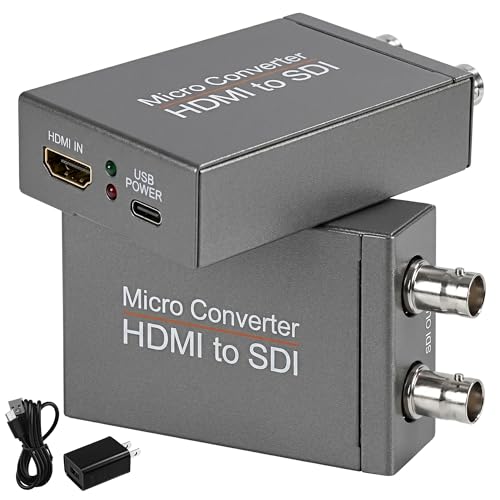
- Feeds two SDI screens from one HDMI source
- Auto-detects common formats and frame rates
- Supports 100m 3G-SDI and longer HD/SD-SDI runs
Best For: Laptop, camera, and switcher connections
Best Plug-and-Play Build
Dual-Output HDMI-to-SDI Adapter

- Distributes HDMI to two SDI displays
- Supports 1080p and common lower resolutions
- Uses a metal housing with driver-free operation
Best For: Studio, home-theater, and live-event installations
Flexible Signal Routing – Decimator MD-LX HDMI/SDI Converter
The Decimator MD-LX is a practical pick for anyone comparing sdi converters for dual displays and needing flexible HDMI-to-SDI or SDI-to-HDMI routing. Its auto-select behavior supports several input/output combinations, while 3G Level A and B compatibility adds useful format flexibility.
Best For: Live events, broadcast studios, post-production, and professional video setups using HDMI and SDI equipment.
Pros:
- Supports bidirectional HDMI-to-SDI and SDI-to-HDMI conversion.
- Can route an active input to all outputs or use both conversion paths when inputs are active.
- Supports 3G Level A and Level B conversion.
- Compact, lightweight design at about 300 g.
Cons:
- No warranty is listed in the supplied details.
- Power plug is specified as Type I, which may require regional compatibility checking.
Choose the MD-LX when adaptable signal direction matters more than specialized scaling or distribution. It is a compact option for mixed HDMI and SDI workflows, but buyers should confirm power-plug compatibility and their exact output-routing needs.
Broadcast-Grade Conversion – Blackmagic Teranex Express
The Blackmagic Design Teranex Express is aimed at demanding broadcast workflows rather than simple consumer display conversion. For sdi converters for dual displays, its dual-link-capable SDI inputs and outputs, broad SD-to-Ultra HD support, and reclocked loops provide substantial routing and format-conversion flexibility.
Best For: Broadcast equipment and television production requiring SD, HD, 2K, 3G, 6G, or 12G SDI handling.
Pros:
- Supports SD, HD, 2K, 3G, 6G, and 12G SDI formats across specified inputs and outputs.
- Dual-link operation is available for certain 4:2:2 3G or 6G UHD workflows.
- Provides reclocked SDI loop outputs.
- Includes a built-in power supply and a one-year limited warranty.
Cons:
- At about 1.7 kg, it is substantially less portable than compact converters.
- Its broadcast-oriented feature set may be excessive for basic dual-display use.
- The supplied details list one HDMI connector type, so buyers should verify the exact display interfaces required.
The Teranex Express makes the most sense when format conversion and SDI signal integrity are central requirements. It is a powerful, larger investment for professional facilities, but likely more than needed for straightforward HDMI display expansion.
Monitored HDMI-to-SDI Conversion – ez-HSV+ HDMI-to-SDI Converter
The ez-HSV+ is a useful option when monitoring is part of the conversion workflow. Among sdi converters for dual displays, it stands out with a built-in 2.7-inch TFT screen, scaler functionality, resolution readouts, and audio-level monitoring for easier setup checks.
Best For: Camera, monitor, and production setups that need HDMI-to-SDI conversion with on-device video and audio monitoring.
Pros:
- Includes a 2.7-inch TFT LCD for monitoring incoming video and source resolution.
- Provides scaler functionality for added signal-management flexibility.
- Supports external audio embedding and displays an audio-level meter.
- Accepts 5V to 18V input and includes replaceable plug types for flexible powering.
Cons:
- The supplied product title identifies it specifically as an HDMI-to-SDI converter, limiting directionality.
- The small 2.7-inch screen is intended for monitoring rather than full-size viewing.
- The supplied notes do not specify supported video resolutions.
This converter is a strong fit when quick source and audio checks can save setup time. Verify the required formats and confirm that HDMI-to-SDI direction is sufficient before choosing it for a dual-display system.
Multi-Output SDI Distribution – Blackmagic Mini Converter SDI Distribution
The Blackmagic Design Mini Converter SDI Distribution is designed to split one SDI source across multiple destinations, making it relevant when a dual-display workflow also needs additional SDI outputs. It provides eight reclocked outputs and automatically switches among supported SD, HD, and 3G SDI formats.
Best For: Broadcast, live-event, and production systems that need one SDI signal distributed to several SDI devices.
Pros:
- Distributes one SD/HD/3G-SDI input to eight reclocked SDI outputs.
- Supports automatic switching across a broad range of SD and HD formats.
- Handles ASI, ancillary data, and embedded audio.
- Includes a redundant SDI input for mission-critical applications.
Cons:
- It is an SDI distribution amplifier, not a general HDMI-to-SDI converter.
- The supplied details identify coaxial interfacing, so HDMI display compatibility requires additional equipment.
- It requires a 12V minimum supply voltage.
Pick this model when the main challenge is duplicating an SDI feed across multiple pieces of gear. It can support more than two destinations, but it is not the right standalone choice if your displays accept HDMI or require format conversion.
Most Versatile – SC2040 Bidirectional SDI/HDMI Converter
For buyers comparing sdi converters for dual displays, the AVMATRIX SC2040 stands out as a flexible signal hub. It supports bidirectional 3G-SDI and HDMI conversion, scaling, frame-rate conversion, and independent source selection for each output.
Best For: Multi-format production setups that need routing, scaling, testing, or optional fiber extension in one compact unit.
Pros:
- Supports bidirectional 3G-SDI/HDMI conversion with up/down scaling and frame-rate conversion.
- Offers 24 conversion and routing modes, including splitter, fiber-extender, and test-pattern functions.
- Includes 23 test patterns and an audio tone for signal verification and display calibration.
- Optional 3G Video SFP support can extend signals up to 20 km over single-mode LC simplex fiber.
Cons:
- The optional SFP fiber module is not included.
- Its broad feature set may be more than needed for simple HDMI-to-SDI conversion.
The SC2040 is the strongest all-around choice here when dual-display work involves mixed inputs, scaling, testing, or future fiber expansion. It includes a 12V power adapter and a one-year warranty.
Best Plug-and-Play Value – HDMI to Dual 3G-SDI Scaler
This compact HDMI-to-SDI scaler is a straightforward option for sdi converters for dual displays. It converts an HDMI signal with audio to SDI and provides two BNC SDI outputs for sending the source to SDI displays or longer-distance connections.
Best For: Users who need a simple HDMI source connection to two SDI outputs without installing drivers.
Pros:
- Provides two BNC 3G-SDI, HD-SDI, or SD-SDI output ports.
- Supports 720p and 1080p formats.
- Plug-and-play design requires no drivers and is described as portable.
- Converts HDMI signals with audio for SDI display and transmission applications.
Cons:
- It is designed for HDMI-to-SDI conversion rather than bidirectional operation.
- The supplied notes do not specify a maximum transmission distance or detailed scaling modes.
If your main goal is to feed two SDI destinations from one HDMI source, this converter keeps the setup simple. Its dual BNC outputs and driver-free operation make it a practical fit for basic display and transmission workflows.
Best for Distribution – SD2080 2×8 SDI/HDMI Splitter
For larger multi-display systems, the AVMATRIX SD2080 is a distribution-focused choice among sdi converters for dual displays. It accepts either HDMI or 3G-SDI and distributes the signal across four 3G-SDI and four HDMI outputs, with input switching through DIP switches.
Best For: Installations that need to distribute one camera, computer, console, or other source to several SDI and HDMI displays.
Pros:
- Accepts 1x HDMI or 1x 3G-SDI input with automatic input detection.
- Provides four 3G-SDI and four HDMI outputs for broad signal distribution.
- Supports input and output signals up to 1080p60.
- Includes a 12V 2A power supply and two mounting brackets.
Cons:
- Its eight-output design may be excessive for a simple two-display setup.
- Input selection is handled through DIP switches rather than a stated front-panel control.
The SD2080 is the most capable option for expanding beyond two screens. Its combination of SDI and HDMI outputs makes it useful when a venue or production system includes mixed display types.
Best Dual-Display HDMI-to-SDI Pick – Metal 3G-SDI Converter
For buyers comparing sdi converters for dual displays, this HDMI-to-SDI model is designed to send one HDMI source to two SDI displays. It supports up to 1080p input formats and offers long cable-distance options across 3G-SDI, HD-SDI, and standard-definition SDI connections.
Best For: Home theater, camera, and other setups that need one HDMI source distributed to two SDI displays.
Pros:
- Provides dual SDI outputs from a single HDMI input.
- Supports HDMI resolutions from 480i through 1080p at up to 60Hz, depending on the format.
- Supports transmission distances up to 100m for 3G-SDI, 200m for HD-SDI, and 300m for SDI.
- Metal housing, heat dissipation, and plug-and-play operation support practical installation.
Cons:
- Converts HDMI to SDI only; it does not convert SDI back to HDMI.
- The supplied notes do not indicate support for resolutions above 1080p.
Its combination of dual outputs, broad input-format support, and durable metal construction makes it a straightforward choice when a simple HDMI-to-two-SDI workflow is the priority.
Best Format-Friendly Option – 2-Way HDMI-to-SDI Converter
This option is worth considering among sdi converters for dual displays if you want one HDMI source feeding two SDI screens with automatic support for common video formats. It handles 720p, 1080i, and 1080p signals and is sized for use with laptops, monitors, cameras, or switchers.
Best For: Users connecting a laptop, camera, or switcher to two SDI screens with minimal setup.
Pros:
- Feeds two SDI screens simultaneously from one HDMI source.
- Supports 3G-SDI for 1080p and HD-SDI for 720p or 1080i formats.
- Auto-detects listed frame rates from 480i/p through 1080p at 60Hz.
- Supports SDI cable distances up to 100m for 3G-SDI, 200m for HD-SDI, and 300m for SD-SDI.
Cons:
- It is a one-way HDMI-to-SDI converter, not an SDI-to-HDMI device.
- The specified maximum supply voltage is 5V DC, so power compatibility should be checked.
Automatic format handling and dual SDI output make this a practical pick for mixed-source environments, especially when fast connections and uncomplicated operation matter.
Best Plug-and-Play Build – Dual-Output HDMI-to-SDI Adapter
For a durable choice among sdi converters for dual displays, this adapter distributes an HDMI signal to two SDI displays while supporting 1080p Full HD transmission. Its broad HDMI input compatibility and metal housing suit studio, home-theater, and live-event installations.
Best For: Buyers who want a simple dual-output converter with a robust housing and long SDI cable options.
Pros:
- Delivers one HDMI input to two SDI displays with zero-latency operation as described.
- Supports common formats from 480i through 1080p at up to 60Hz.
- Offers transmission distances up to 100m with 3G-SDI, 200m with HD-SDI, and 300m with SD-SDI.
- Metal construction and an intelligent chip enable plug-and-play use without drivers.
Cons:
- Supports HDMI-to-SDI conversion only and cannot convert SDI to HDMI.
- Its listed compatibility is centered on HDMI sources and SDI displays, so other connection types are not specified.
This model emphasizes easy installation and physical durability, making it a sensible fit where dual SDI distribution, Full HD support, and longer cable runs are more important than advanced format conversion.
How We Picked the Best Sdi Converters for Dual Displays
We evaluated these converters by looking at the features that matter most when one video source must serve two displays or travel between HDMI and SDI equipment. Key considerations included supported video formats, conversion direction, scaling, SDI output count, signal distribution, audio support, monitoring features, and suitability for professional or home use.
We also separated simple format converters from distribution-focused hardware. A bidirectional model may be ideal for flexible camera and monitor connections, while a splitter or distribution converter is better when the same signal must reach multiple destinations reliably.
Quick Comparison
| Type | Best For | Important Feature |
|---|---|---|
| Bidirectional HDMI/SDI converter | Flexible source and display connections | Converts in either direction |
| HDMI-to-SDI converter | Sending HDMI sources over SDI cabling | One or two SDI outputs |
| SDI distribution converter | Feeding multiple displays or destinations | Multiple reclocked outputs |
| Scaler converter | Mixed-resolution systems | Format or resolution conversion |
| Broadcast up/down converter | Professional production environments | Broad format and signal support |
Key Buying Factors for Sdi Converters for Dual Displays
Conversion Direction and Inputs
Confirm whether you need HDMI-to-SDI, SDI-to-HDMI, or both. A bidirectional converter offers more flexibility, but a dedicated converter can be simpler and less expensive when your signal path never changes.
Output Count and Distribution
For two displays, look for dual SDI outputs or a dedicated distribution amplifier. Check whether the outputs are independent, mirrored, and properly reclocked. A model with several outputs may be worthwhile if you plan to add monitors, recorders, or a switcher later.
Resolution, Frame Rate, and Scaling
Match the converter to the highest resolution and frame rate in your system. Basic 3G-SDI models commonly target HD formats, while more advanced equipment may support 6G-SDI, 12G-SDI, Ultra HD, or multiple standards. Built-in scaling helps when the source and displays use different resolutions, but it should not be assumed unless clearly specified.
Audio and Monitoring
If your workflow carries embedded audio, verify support for the required audio channels and embedding direction. A front-panel display or status indicators can simplify setup by showing input format, lock status, or output conditions.
Cabling and Reliability
SDI is designed for longer cable runs than typical HDMI connections, but cable quality and signal rate still matter. Use appropriately rated coaxial SDI cable, keep connections secure, and choose a converter with adequate cooling and stable power for continuous operation.
Who Should Buy Which Sdi Converters for Dual Displays?
Choose a compact bidirectional converter if you need a portable solution for cameras, monitors, laptops, and mixed HDMI/SDI equipment. Select an HDMI-to-SDI model with dual outputs when one HDMI source must feed two SDI-connected displays or downstream devices.
A distribution-focused unit is the better choice for studios, classrooms, venues, and control rooms that need consistent signal delivery to several destinations. Buyers working with mixed resolutions should prioritize a scaler, while broadcast professionals handling multiple standards or Ultra HD workflows should consider a higher-end up/down converter.
Before purchasing, map the entire signal chain: source output, cable length, converter input, display formats, audio needs, and any future devices. This prevents choosing a converter that has the right connectors but lacks the required bandwidth, scaling, or output capacity.