Connecting professional SDI video equipment to a projector can be straightforward when you choose a converter that matches your signal type, resolution, audio needs, and available inputs. The right adapter can turn an SDI camera or switcher feed into a projector-ready HDMI, DisplayPort, VGA, or composite signal.
We selected 10 SDI converter options for different setups, from compact 3G-SDI adapters to more capable 12G bidirectional models. Use the guide below to compare compatibility, connectivity, reliability, and the features that matter most before buying.
Best 10 Sdi Converters for Projectors Picks for 2026
Best Bidirectional Pick
Blackmagic Micro Converter SDI/HDMI 12G

- Bidirectional SDI and HDMI 2.0 conversion
- Compact design for projector and display setups
- Universal 5V power supply included
Best For: Flexible SDI/HDMI projector installations
Best DisplayPort Option
ACHAVE SDI to DisplayPort Converter

- SDI to DisplayPort conversion up to 1080p/60Hz
- SDI loop-out for another device
- USB Type-C powered metal enclosure
Best For: SDI systems using DisplayPort projectors
Best LUT-Enabled Choice
Blackmagic Micro Converter SDI to HDMI 12G
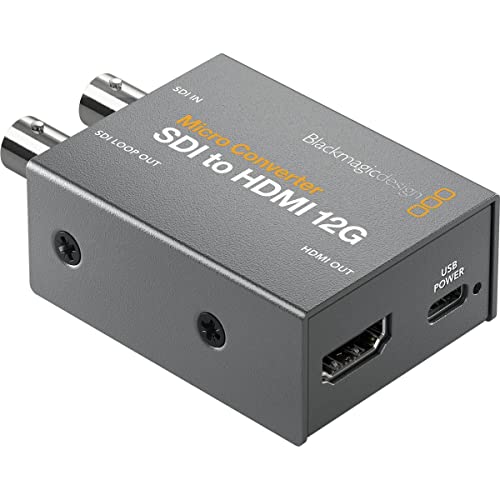
- 33-point 3D LUT for display calibration
- SDI loop output can carry the LUT
- Compact, robust metal construction
Best For: Calibrated SDI-to-HDMI projector workflows
Best Multi-Output Value
SDI to VGA, CVBS/AV and SDI Converter
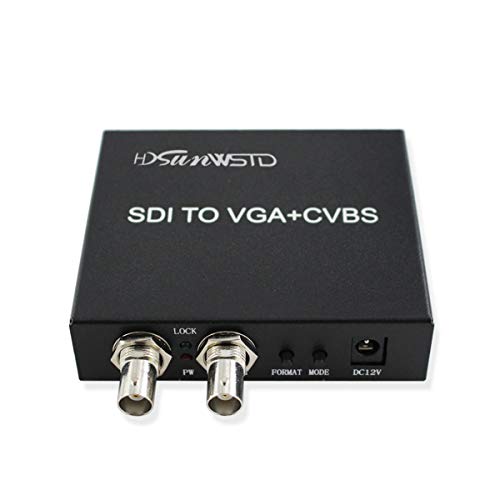
- Supports SD-, HD-, and 3G-SDI input
- Outputs VGA, AV/CVBS, and SDI
- Useful for mixed legacy display systems
Best For: VGA or composite projector installations
Compact Bidirectional Pick
Blackmagic Micro Converter BiDirectional SDI/HDMI 3G

- Bidirectional SDI/HDMI conversion
- Multi-speed 3G-SDI support
- AC power supply included
Best For: Flexible portable SDI and HDMI setups
Loop-Out Value Pick
SDI to HDMI Converter with SDI Loop Out

- Accepts 3G-, HD-, and SD-SDI
- HDMI output up to 1080p60
- Adds an SDI loop output
Best For: Projectors needing HDMI output and SDI pass-through
Long-Run Audio Pick
Anber-Tech SDI to HDMI Audio De-embedder
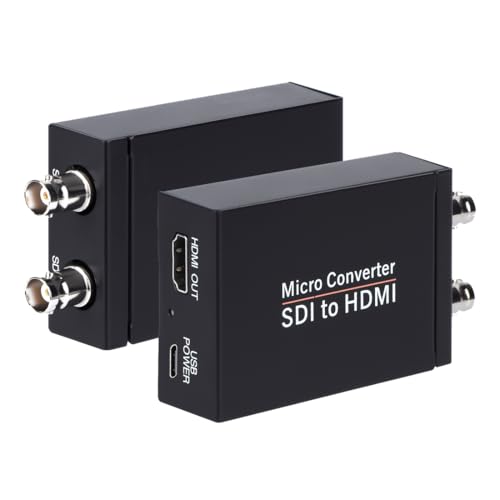
- Supports 3G-, HD-, and SD-SDI
- Includes HDMI output and SDI loopout
- Handles eight channels of 48 kHz audio
Best For: Long SDI runs with embedded-audio needs
Best Plug-and-Play Pick
SDI to HDMI Converter with Loop Out

- Converts 3G/HD/SD-SDI to HDMI
- Supports up to 1080p at 60Hz
- Includes HDMI cable and power adapter
Best For: Simple SDI camera-to-projector setups
Best Two-Way Option
Bidirectional HDMI/SDI Converter

- Converts HDMI to SDI and SDI to HDMI
- Supports adaptive 1080p input
- Designed for stable, long-distance SDI transmission
Best For: Flexible projector and production signal routing
Best Budget 1080p Choice
SDI to HDMI Converter with Loop Out

- Converts SDI sources to HDMI projectors
- Supports 1080p full-HD output
- Includes SDI loop-out and plug-and-play setup
Best For: Dedicated 1080p SDI-to-projector connections
Best Bidirectional Pick – Blackmagic Micro Converter SDI/HDMI 12G
For buyers comparing sdi converters for projectors, this Blackmagic Design model stands out when you need bidirectional SDI and HDMI 2.0 conversion in a compact unit. It includes one SDI input, one HDMI input, and a 5V universal power supply with international socket adapters.
Best For: Projector and display setups that need flexible SDI-to-HDMI or HDMI-to-SDI connectivity.
Pros:
- Supports SDI and HDMI 2.0 connections.
- Automatically matches the HDMI video input on the SDI output.
- Includes a universal 5V power supply with international adapters.
Cons:
- Only one SDI video input is provided.
- Its compact conversion design may be more capability than needed for a simple one-way setup.
This is a versatile choice when a projector installation may require signal conversion in either direction and international power compatibility is useful.
Best DisplayPort Option – ACHAVE SDI to DisplayPort Converter
This ACHAVE converter is a practical option among sdi converters for projectors when the projector or display uses DisplayPort. It converts SD-, HD-, and 3G-SDI to DisplayPort at up to 1080p/60Hz and adds an SDI loop output for sending the signal to another device.
Best For: SDI camera or broadcast systems feeding a DisplayPort projector while retaining an SDI connection for recording or distribution.
Pros:
- Converts SD-SDI, HD-SDI, and 3G-SDI to DisplayPort.
- Supports up to 1080p at 60Hz.
- Provides an SDI loop-out alongside the DisplayPort output.
- Uses USB Type-C power in a compact metallic enclosure.
Cons:
- Conversion is one-way from SDI to DisplayPort.
- Output is limited to 1080p/60Hz.
Choose this model when DisplayPort compatibility and signal pass-through matter more than bidirectional conversion or higher-resolution output.
Best LUT-Enabled Choice – Blackmagic Micro Converter SDI to HDMI 12G
Blackmagic Design Micro Converter SDI to HDMI 12G (no Power Supply) BMD-CONVCMIC/SH12G
Check Price On AmazonFor sdi converters for projectors that prioritize monitor and image calibration, this Blackmagic Design SDI-to-HDMI 12G model adds a 33-point 3D LUT. It can apply color calibration to a projector, monitor, or television and output the LUT through the SDI loop output.
Best For: Professional display workflows where SDI-to-HDMI conversion and projector color calibration are important.
Pros:
- Includes a 33-point 3D LUT for color calibration.
- Can output the 3D LUT from the SDI loop output.
- Uses broadcast technology in a compact, robust metal body.
Cons:
- It is designed for SDI-to-HDMI conversion rather than bidirectional operation.
- The supplied notes identify a single channel and a 5V supply requirement.
This is a focused choice for users who need a compact SDI-to-HDMI converter with calibration features rather than a general-purpose multi-direction converter.
Best Multi-Output Value – SDI to VGA, CVBS/AV and SDI Converter
This multi-output unit is useful when comparing sdi converters for projectors across mixed display systems. It accepts SD-SDI, HD-SDI, and 3G-SDI, then provides VGA, AV/CVBS, and SDI outputs, allowing one source to feed different compatible displays or equipment.
Best For: Installations using VGA or composite projectors alongside SDI displays or other SDI equipment.
Pros:
- Accepts SD-SDI, HD-SDI, and 3G-SDI input signals.
- Provides VGA, AV, and SDI outputs.
- Can be connected with other units to extend signals over long distances.
- Includes a North American Type B power adapter.
Cons:
- It does not list HDMI output; the display outputs are VGA and AV/CVBS.
- Only one SDI input is provided.
- The supplied power adapter is intended for North American outlets.
This converter makes the most sense for legacy or mixed AV environments where a projector may use VGA or composite video and signal distribution is also required.
Compact Bidirectional Pick – Blackmagic Micro Converter BiDirectional SDI/HDMI 3G
The Blackmagic Micro Converter is a compact option for users comparing SDI converters for projectors and other display setups. Its bidirectional SDI/HDMI design supports conversion in either direction, while the included AC power supply simplifies installation.
Best For: Users who need a small, flexible converter for cameras, monitors, or projector systems.
Pros:
- Supports bidirectional SDI-to-HDMI and HDMI-to-SDI conversion.
- Provides multi-speed support for 3G-SDI workflows.
- Includes an AC power supply.
Cons:
- Only one SDI and one HDMI connection are listed.
- The supplied notes do not specify a maximum output resolution.
This is the most versatile choice of the three when you may need to change signal direction between an HDMI source, SDI equipment, and a projector. Its compact design and included power supply also suit portable setups.
Loop-Out Value Pick – SDI to HDMI Converter with SDI Loop Out
This SDI-to-HDMI adapter is a practical choice among SDI converters for projectors when you need to feed an HDMI projector while passing the SDI signal onward. It automatically detects 3G-SDI, HD-SDI, and SD-SDI inputs and supports HDMI output up to 1080p at 60Hz.
Best For: Projector, monitor, and TV setups that need HDMI conversion plus an SDI loop output.
Pros:
- Supports 3G-SDI, HD-SDI, and SD-SDI input signals.
- Provides both HDMI output and SDI loop output.
- Supports HDMI output up to 1080p at 60Hz with auto format detection.
- Includes a power adapter and user manual.
Cons:
- Converts SDI to HDMI only; it is not bidirectional.
- Does not accept RF, CVBS, AHD, TVI, or CVI signals as SDI inputs.
Choose this model when your projector accepts HDMI and your workflow also requires a continued SDI feed. Its listed resolution support and automatic format detection make it a straightforward option for common SDI sources.
Long-Run Audio Pick – Anber-Tech SDI to HDMI Audio De-embedder
The Anber-Tech converter combines SDI-to-HDMI conversion with audio de-embedding, making it useful for projector systems that need a compatible HDMI display feed and digital audio handling. It supports 3G-SDI, HD-SDI, and SD-SDI formats and includes an SDI loopout.
Best For: Camera-to-projector installations with long SDI cable runs and embedded audio requirements.
Pros:
- Supports 3G-SDI, HD-SDI, and SD-SDI with automatic format detection.
- Offers HDMI output and SDI loopout.
- Supports up to eight channels of 48 kHz digital audio.
- Lists long cable-run distances for 3G-SDI, HD-SDI, and SD-SDI.
Cons:
- It is not bidirectional and cannot convert HDMI to SDI.
- The listed HDMI output resolution details are less specific than the supported SDI input formats.
This model stands out when audio and cable distance matter as much as basic video conversion. The loopout and stated long-run support make it a strong fit for more distributed camera and projector installations.
Best Plug-and-Play Pick – SDI to HDMI Converter with Loop Out
For anyone comparing SDI converters for projectors, this model is a straightforward choice when the source is SDI and the display is HDMI. It accepts 3G-SDI, HD-SDI, and SD-SDI inputs, outputs up to 1080p at 60Hz, and includes an SDI loop-out for passing the signal to another device.
Best For: SDI cameras, monitors, projectors, classroom recording, live streaming, and small broadcast setups that need simple SDI-to-HDMI conversion.
Pros:
- Supports 3G-SDI, HD-SDI, and SD-SDI input formats with auto-detection.
- Provides HDMI output plus SDI loop-out, with output up to 1080p at 60Hz.
- Includes a 4-foot HDMI cable, power adapter, Type-C cable, and one-year warranty.
- Metal housing, heat dissipation, and built-in ESD protection support stable operation.
Cons:
- Converts SDI to HDMI only; it does not convert HDMI to SDI.
- Not compatible with RF, CVBS, AHD, TVI, or CVI signals.
This is a practical projector-conversion option if you already have an SDI output and want an uncomplicated 1080p HDMI feed. The included accessories make it especially convenient for a ready-to-use installation.
Best Two-Way Option – Bidirectional HDMI/SDI Converter
This bidirectional unit stands out among SDI converters for projectors because it can convert in either direction: SDI to HDMI or HDMI to SDI. Its adaptive input resolution supports up to 1920×1080, while the FPGA-based design, clock recovery circuit, and metal housing are intended to provide stable, low-latency signal handling.
Best For: Projector systems and production environments that need flexible HDMI/SDI connectivity, including broadcasting, conferencing, outdoor displays, and command centers.
Pros:
- Supports both SDI-to-HDMI and HDMI-to-SDI conversion.
- Handles adaptive input resolution up to 1080p.
- Supports 3G-SDI transmission at up to 2.970 Gbit/s and long SDI cable distances.
- Uses a durable metal housing with heat dissipation and built-in ESD protection.
Cons:
- Maximum stated resolution is 1920×1080, not 4K.
- Warranty coverage is listed as three months.
- Its extra conversion flexibility may be unnecessary for a simple SDI-only projector connection.
Choose this model when your setup may change between HDMI and SDI sources. It offers more routing flexibility than a one-way adapter, though buyers who only need SDI-to-HDMI conversion may prefer a simpler unit.
Best Budget 1080p Choice – SDI to HDMI Converter with Loop Out
This SHUITING adapter is a focused option for buyers seeking SDI converters for projectors without needing HDMI-to-SDI conversion or 4K support. It converts HD-SDI, 3G-SDI, and SD-SDI sources to HDMI for a projector, HDTV, or monitor, with synchronous audio and video transmission up to 1080p.
Best For: SDI cameras and other SDI sources feeding a 1080p projector, monitor, conference display, or broadcast screen.
Pros:
- Converts HD-SDI, 3G-SDI, and SD-SDI to HDMI.
- Supports 1920×1080 full-HD output with synchronized audio and video.
- Includes SDI loop-out for extending or passing through the SDI signal.
- Compact metal housing, heat dissipation, and plug-and-play setup simplify installation.
Cons:
- Does not support 4K resolution.
- SDI-to-HDMI only; HDMI-to-SDI conversion is not supported.
- Requires a BNC male coaxial cable and does not support RF, CVBS, AHD, TVI, or CVI signals.
This model makes sense for a dedicated 1080p projector connection where the source is confirmed to be SDI. Its loop-out and simple installation add usefulness, but buyers needing 4K or bidirectional conversion should consider another option.
How We Picked the Best Sdi Converters for Projectors
We focused on signal compatibility, output usefulness, connection reliability, and setup convenience. The selection includes SDI-to-HDMI models for common projector installations, DisplayPort and VGA options for less typical displays, and bidirectional converters for users who need greater flexibility. We also considered loop-through outputs, automatic format detection, audio handling, power requirements, and support for SD-SDI, HD-SDI, 3G-SDI, or 12G-SDI signals.
Because projector systems vary widely, no single converter is ideal for every user. Check the product specifications against your source equipment and projector before ordering.
Quick Comparison
- Best for standard projector connections: SDI-to-HDMI converters with loop-out and automatic format detection.
- Best for higher-bandwidth workflows: 12G-SDI models that can accommodate compatible UHD equipment.
- Best for flexible installations: Bidirectional SDI/HDMI converters.
- Best for computer-style displays: SDI-to-DisplayPort or SDI-to-VGA models.
- Best for embedded audio needs: Converters with audio de-embedding or stereo output support.
Key Buying Factors for Sdi Converters for Projectors
Input and Output Compatibility
Start with the projector’s available input. HDMI is the most common choice, while DisplayPort, VGA, and composite video may be required by older or specialized equipment. Confirm that the converter accepts your exact SDI standard and that its output resolution is supported by the projector.
Signal Bandwidth and Resolution
3G-SDI is generally suitable for many HD and 1080p installations. If your source is 6G-SDI or 12G-SDI, choose a converter rated for that bandwidth rather than assuming a lower-rated model will work. A converter cannot create a higher-quality signal than the source supports.
Loop-Out and Signal Distribution
An SDI loop-out lets you send the same feed to another monitor, recorder, or downstream device. This is especially useful in live production, classrooms, venues, and installations where the projector is only one display in the chain.
Audio and Power
Check whether audio is carried through HDMI, de-embedded separately, or unavailable. Also verify the included power adapter, voltage requirements, and cable length. For permanent or mobile setups, a secure power connection and strain relief can prevent intermittent operation.
Who Should Buy Which Sdi Converters for Projectors?
Choose a basic SDI-to-HDMI converter if you simply need to connect an SDI camera or switcher to an HDMI projector. Pick a loop-out model when you need to pass the SDI feed to additional equipment. Bidirectional units are better for production teams that regularly convert in both directions. Choose DisplayPort or VGA versions only when the projector or display specifically requires those inputs. For demanding broadcast and UHD workflows, prioritize a 12G-compatible converter and verify every device in the signal chain supports the intended format.