Compact SDI converters make it easier to connect professional SDI equipment with HDMI displays, cameras, recorders, and audio systems without adding bulky rack hardware.
This roundup compares 10 Blackmagic Design options across bidirectional conversion, standards conversion, distribution, audio handling, and analog output, helping you choose the right fit for your workflow.
Best 10 Compact Sdi Converters Picks for 2026
Bidirectional Conversion
Blackmagic Micro Converter BiDirect 3G

- Bidirectional SDI/HDMI conversion
- Multi-speed support
- AC power supply included
Best For: Camera and monitor workflows needing two-way conversion
Format Flexibility
Blackmagic Mini Converter UpDownCross HD

- SD and HD up/down/cross-conversion
- Automatic SD/HD/3G-SDI detection
- Two SDI outputs with re-clocking
Best For: SDI systems requiring format conversion and signal re-clocking
Color-Calibrated Monitoring
Blackmagic Micro Converter SDI to HDMI 12G
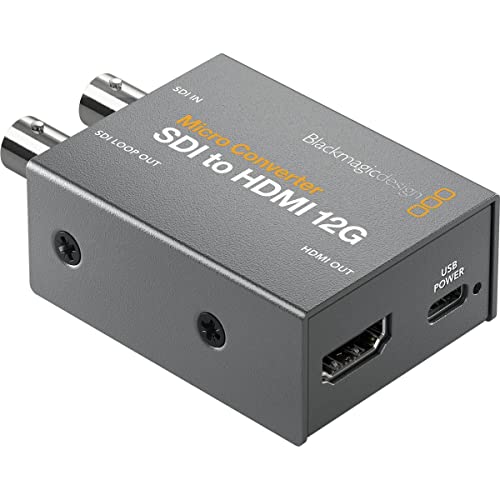
- SDI-to-HDMI conversion
- 33-point 3D LUT calibration
- Robust portable metal body
Best For: Portable monitoring with display color calibration
Multi-Output Distribution
Blackmagic Mini Converter SDI Distribution

- Eight re-clocked SDI outputs
- Automatic SD/HD/3G-SDI switching
- Supports embedded audio and ancillary data
Best For: Broadcast and live setups distributing one SDI signal to many devices
Best 12G HDMI-to-SDI Pick
Micro Converter HDMI to SDI 12G

- Two SDI outputs for signal distribution
- Supports SD through 4K and 12G rates
- Automatically matches the HDMI input
Best For: Compact HDMI-to-SDI conversion with dual SDI outputs
Best SDI Audio Extraction Value
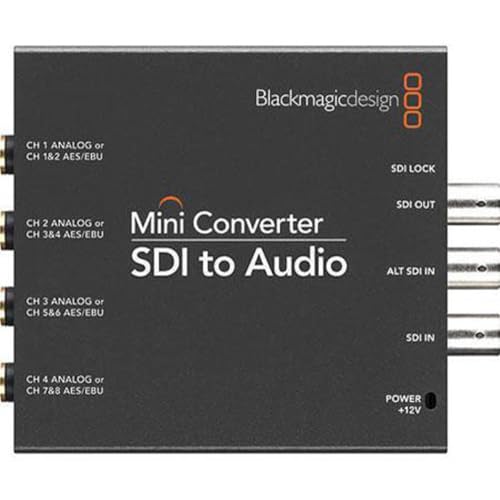
- Extracts audio from SDI signals
- Supports four audio channels
- Includes power supply and multinational adapters
Best For: SDI audio extraction and monitoring setups
Best Bidirectional 12G Converter

- Converts between SDI and HDMI
- Includes universal 5V power supply
- Works with cameras, monitors, and displays
Best For: Flexible SDI/HDMI routing in production kits
Analog Output Specialist

- Converts SDI video to analog output
- De-embeds audio to analog or AES/EBU
- Supports eight audio channels
Best For: SDI-to-analog video and audio workflows
Dual-Format Micro Converter

- Provides bidirectional SDI and HDMI conversion
- Compact micro-converter design
- Includes a two-year warranty
Best For: Camera setups needing two-way SDI/HDMI routing
HDMI-to-SDI 6G Detail Tool

- Includes HDMI and SDI interfaces
- Features HDMI Instant Lock
- Adds 3D LUTs and 10-bit processing
Best For: HDMI camera and projector workflows needing SDI
Bidirectional Conversion – Blackmagic Micro Converter BiDirect 3G
For compact SDI converters that handle more than a one-way signal path, this Blackmagic Micro Converter supports bidirectional SDI and HDMI conversion. Its small black design, included AC power supply, and multi-speed support make it a practical option for camera-to-monitor setups.
Best For: Camera and monitor workflows needing bidirectional SDI/HDMI conversion.
Pros:
- Supports bidirectional SDI and HDMI conversion
- Multi-speed support
- AC power supply included
- Compact, lightweight 300 g design
Cons:
- Listed with one SDI and HDMI connection
- Power plug type is listed as no plug despite AC power being included
- Limited warranty
This is a versatile choice when you need compact SDI conversion in either direction. Verify the included power-plug configuration and connection requirements before buying.
Format Flexibility – Blackmagic Mini Converter UpDownCross HD
This compact SDI converter is designed for format flexibility, converting and up/down/cross-converting SD and HD SDI signals. Automatic SD/HD/3G-SDI detection, SD re-clocking, and two SDI outputs make it useful for monitor and video-system integration.
Best For: Users who need automatic SDI format conversion and two reclocked outputs.
Pros:
- Converts and up/down/cross-converts SD and HD SDI formats
- Automatic SD/HD/3G-SDI detection
- Omnidirectional SD re-clocking
- Provides two SDI outputs
Cons:
- Designed around SDI format conversion rather than bidirectional SDI/HDMI conversion
- Power supply requirements span 6 to 36 volts
- Only one unit is included
Choose this model when format conversion and signal re-clocking matter more than the smallest possible footprint. Its two outputs add useful flexibility for connected SDI equipment.
Color-Calibrated Monitoring – Blackmagic Micro Converter SDI to HDMI 12G
Blackmagic Design Micro Converter SDI to HDMI 12G (no Power Supply) BMD-CONVCMIC/SH12G
Check Price On AmazonFor compact SDI converters focused on monitoring, this Micro Converter changes SDI to HDMI and adds a 33-point 3D LUT for calibrating a monitor, projector, or television. Its metal body is built for portable use, while the SDI loop output can also carry the 3D LUT.
Best For: Portable SDI-to-HDMI monitoring with display color calibration.
Pros:
- SDI-to-HDMI conversion
- 33-point 3D LUT for color calibration
- 3D LUT can be output through the SDI loop output
- Compact, robust metal body
Cons:
- Supports one channel
- Requires a 5-volt supply
- Power supply is not listed among the included components
This is a strong fit for portable monitoring where accurate display calibration is important. Confirm how you will provide its 5-volt power before adding it to a field kit.
Multi-Output Distribution – Blackmagic Mini Converter SDI Distribution
Among compact SDI converters, this Mini Converter is the choice for distributing one signal to several devices. It accepts SD, HD, and 3G-SDI automatically and provides eight re-clocked outputs, with support for ASI, ancillary data, and embedded audio.
Best For: Broadcast, live-event, and studio setups that need one SDI source sent to multiple devices.
Pros:
- Provides eight re-clocked SDI outputs
- Automatic SD, HD, and 3G-SDI input switching
- Supports ASI, ancillary data, and embedded audio
- Redundant SDI input for mission-critical use
Cons:
- Functions as a distribution amplifier rather than a format converter
- Requires a 12-volt supply
- Its eight-channel design may be more than a simple point-to-point setup needs
This model is best when signal splitting is the main requirement. Eight reclocked outputs provide substantial expansion for multi-device installations, while redundant input support adds resilience for live or broadcast work.
Best 12G HDMI-to-SDI Pick – Micro Converter HDMI to SDI 12G
Blackmagic Design Micro Converter HDMI to SDI 12G (no Power Supply) BMD-CONVCMIC/HS12G
Check Price On AmazonFor buyers comparing compact SDI converters, the Blackmagic Design Micro Converter HDMI to SDI 12G is a small, straightforward option for turning an HDMI source into SDI. It supports SD through 4K rates and provides two SDI outputs for flexible signal distribution.
Best For: HDMI-equipped cameras, computers, or mobile-oriented setups that need dual SDI outputs.
Pros:
- Supports 270Mb, 1.5G, 3G, 6G, and 12G SDI rates.
- Automatically matches the HDMI input.
- Offers two SDI video outputs.
- Supports SD, HD, 2K, Ultra HD, and 4K formats with reclocking.
Cons:
- Converts HDMI to SDI only; it does not provide bidirectional conversion.
- Requires a 5–5.25V DC power supply.
This is a strong fit when you need a compact HDMI-to-SDI bridge with broad format support and dual outputs. Its single HDMI input makes it less suitable for setups requiring multiple source connections.
Best SDI Audio Extraction Value – Mini Converter SDI to Audio
The Blackmagic Design Mini Converter SDI to Audio is designed for extracting audio from an SDI signal. Among compact SDI converters, it stands out for buyers who need an SDI-to-audio workflow rather than video-format conversion, and it includes a power supply with multinational adapters.
Best For: SDI-based monitoring or production systems that need audio extraction for compatible equipment.
Pros:
- Built specifically for SDI-to-audio conversion.
- Provides four audio channels.
- Includes a power supply with multinational adapters.
- Includes a two-year warranty description.
Cons:
- It is an audio converter, not a general HDMI-to-SDI or SDI-to-HDMI video converter.
- The listed dimensions are 5.6 by 5.6 inches, so it may not be the smallest option in every installation.
Choose this model when your priority is dependable SDI audio extraction and four-channel handling. Buyers seeking video conversion should consider a different converter type.
Best Bidirectional 12G Converter – Micro Converter SDI/HDMI 12G
For flexible signal routing in a small enclosure, the Blackmagic Design Micro Converter BiDirectional SDI/HDMI 12G handles conversion in both directions. It accepts one SDI input and one HDMI 2.0 input, with outputs that automatically match the corresponding HDMI video input.
Best For: Camera, monitor, projector, and display setups that may need either SDI-to-HDMI or HDMI-to-SDI conversion.
Pros:
- Supports bidirectional SDI and HDMI conversion.
- Includes one SDI input and HDMI 2.0 input and output connections.
- Includes a 5V universal power supply with international socket adapters.
- Works with SDI cameras, computers, pro-style HDMI monitors, projectors, and displays.
Cons:
- Provides one SDI video input rather than multiple SDI inputs.
- The supplied notes do not specify the supported SDI rate range.
This is the most versatile choice of the three when your workflow can change between SDI-to-HDMI and HDMI-to-SDI conversion. Its compact format and included international power adapters also suit mobile or varied-location production kits.
Analog Output Specialist – Mini Converter SDI To Analog
For setups needing compact SDI converters with analog output, the Blackmagic Design Mini Converter SDI To Analog provides a focused way to convert SDI video. It can also de-embed SDI audio for balanced analog or AES/EBU output.
Best For: SDI-to-analog video workflows with flexible audio output.
Pros:
- Converts SDI video signals to analog video output.
- Supports balanced analog or AES/EBU audio de-embedding.
- Offers eight audio channels and analog or digital audio output modes.
Cons:
- Its primary conversion direction is SDI to analog rather than bidirectional.
- Requires a 12–15V DC power supply.
This is a practical choice when analog video and de-embedded audio are central requirements. Its dedicated feature set makes it less suitable for HDMI conversion needs.
Dual-Format Micro Converter – Bidirectional SDI/HDMI 12G
Among compact SDI converters, the Blackmagic Design Bidirectional SDI/HDMI 12G Micro Converter stands out for two-way SDI and HDMI conversion. Its small micro-converter design suits camera-centered setups where flexible signal routing matters.
Best For: Camera workflows requiring bidirectional SDI and HDMI conversion.
Pros:
- Supports bidirectional conversion between SDI and HDMI.
- Uses a compact micro-converter form factor.
- Includes a stated two-year warranty.
Cons:
- Lists one channel.
- The supplied specifications identify HDMI as the interface but do not detail additional output formats.
This model is the most flexible option of the three for switching between SDI and HDMI sources or displays. It is especially appealing when bidirectional operation is more important than analog audio connectivity.
HDMI-to-SDI 6G Detail Tool – Mini HDMI-SDI Converter 6G
The Blackmagic Design Mini HDMI-SDI Converter 6G is a useful pick among compact SDI converters for HDMI-equipped cameras and projectors. Its listed features include HDMI Instant Lock, 33-point 3D LUTs, 10-bit video processing, and a robust design.
Best For: HDMI camera or projector workflows needing SDI connectivity and image-processing features.
Pros:
- Provides HDMI and SDI interfaces.
- Includes HDMI Instant Lock for signal stability.
- Offers 33-point 3D LUTs and 10-bit video processing.
Cons:
- The supplied notes describe HDMI-to-SDI conversion rather than bidirectional operation.
- Requires a 12V DC supply.
Choose this converter when HDMI input and on-device video processing features are priorities. Its camera and projector compatibility makes it a focused option for HDMI-to-SDI integration.
How We Picked the Best Compact Sdi Converters
We evaluated these Compact Sdi Converters by looking at their conversion direction, supported signal standards, connectivity, power requirements, and intended production role. The selection covers simple SDI-to-HDMI and HDMI-to-SDI adapters as well as more specialized tools for up/down/cross conversion, signal distribution, audio extraction, and analog output.
We also considered practical installation factors, including compact chassis designs, included or optional power supplies, connector layout, and whether a converter is best suited to field production, studio work, monitoring, or permanent system integration.
Quick Comparison
| Converter type | Best suited for | What to check |
|---|---|---|
| Bidirectional SDI/HDMI | Supported SDI speed and resolution | |
| SDI to HDMI | Connecting professional video output to consumer displays | HDMI output format and audio support |
| HDMI to SDI | Bringing computers or HDMI cameras into SDI systems | Input compatibility and cable distance |
| UpDownCross conversion | Matching different video standards | Frame-rate and resolution conversion range |
| Distribution | Sending one SDI source to multiple destinations | Number of outputs and reclocking capability |
| Audio or analog conversion | Integrating legacy or separate audio equipment | Audio format, connectors, and channel handling |
Key Buying Factors for Compact Sdi Converters
Conversion Direction and Function
Start with the signal path. An SDI-to-HDMI model is appropriate for monitoring on an HDMI display, while an HDMI-to-SDI unit is better for feeding a switcher, recorder, or SDI distribution system. Bidirectional models offer greater flexibility when your setup changes frequently.
Signal Standard and Resolution
Match the converter to your production format. 3G-SDI, 6G-SDI, and 12G-SDI support different bandwidths and maximum resolutions. A higher-speed model can provide more headroom for UHD workflows, but it may cost more than needed for an HD-only installation.
Scaling and Frame-Rate Conversion
Basic converters generally pass compatible signals through without changing them. If your source and destination use different resolutions or frame rates, choose a standards converter with the required scaling and cross-conversion features.
Audio and Output Connections
Check whether audio is embedded, de-embedded, or converted to analog. Also confirm the exact connector types and channel configuration before ordering, particularly when connecting mixers, powered speakers, legacy video equipment, or long SDI cable runs.
Power and Placement
Compact units are useful for mobile rigs and tight installations, but they still need dependable power and ventilation. Confirm whether a power supply is included and leave enough room around the converter for cable strain relief and heat dissipation.
Who Should Buy Which Compact Sdi Converters?
Choose a bidirectional SDI/HDMI converter if you need one adaptable tool for cameras, monitors, and recorders. For straightforward display monitoring, an SDI-to-HDMI model is usually the simplest choice. HDMI-to-SDI is the better match for computers, consumer cameras, or HDMI playback devices entering an SDI environment.
Choose the UpDownCross model when mismatched formats are the main problem. A Mini Converter SDI Distribution model makes more sense when one source must feed several SDI destinations. For dedicated sound integration, select the SDI-to-Audio option, while the SDI-to-Analog model is intended for systems that still rely on analog video hardware.
Finally, select the 12G models when your workflow requires higher-bandwidth UHD support, and consider 3G or 6G alternatives when your projects are limited to HD or lower-bandwidth formats. Always verify the exact resolution, frame rate, connector, and power requirements against your equipment before buying.