A good pop filter can reduce distracting plosives, protect your microphone capsule from moisture, and make spoken-word recordings sound more polished. The right design depends on your microphone, mounting setup, and recording style.
We selected 10 microphone pop filters for podcasting across metal mesh, foam, multilayer, and model-specific designs, with options for popular microphones such as the Blue Yeti, PodMic, and AT2020.
Best 10 Microphone Pop Filters for Podcasting Picks for 2026
Flexible Dual-Layer Pick

- Dual-layer screen helps manage plosives
- Adjustable 360-degree gooseneck
- Clamp fits various stands and booms
Best For: Podcasters needing flexible placement and broad compatibility
PodMic-Specific Choice

- Purpose-built for PodMic and PodMic USB
- Low-profile design for on-camera use
- High-density foam with supporting ribs
Best For: PodMic owners wanting a discreet fitted filter
Adjustable Studio Shield
Neewer Professional Pop Filter

- Dual-layer screen for plosive control
- Adjustable steel gooseneck
- Clamp and swivel mount support flexible setup
Best For: Home studios and streamers using boom or stand-mounted microphones
Compact Mic-Mounted Guard

- Curved metal screen with low obstruction
- Fits compatible 40–70 mm microphones
- Includes two extra rubber bands
Best For: FIFINE users wanting a compact microphone-mounted filter
AT2020 Foam Pair
Dual Windscreens for Podcast Mics

- Two foam covers included
- Designed for AT2020-family microphones
- Helps reduce noise and protect from dust
Best For: AT2020 podcast and voiceover setups
Three-Layer Shield
PEMOTech Universal Mic Pop Filter

- Foam, metal mesh, and etamine layers
- Fits compatible 45–61 mm microphones
- Designed to reduce pops and breath noise
Best For: Compatible vocal, podcast, and streaming microphones
Blue Yeti Foam Cover

- Designed for Blue Yeti and Yeti Pro
- High-density foam reduces wind interference
- Protects against dust and saliva
Best For: Blue Yeti podcasting and streaming setups
Yeti Foam Windshield

- Made for Blue Yeti and Yeti Pro
- May fit microphones up to 2.5 inches
- Helps reduce wind and background noise
Best For: Blue Yeti owners seeking a simple foam cover
Studio Shield
Three-Layer Universal Mic Filter
- Three layers reduce pops and breath noise
- Fits many 45–63 mm microphones
- Quick elastic-band installation
Best For: Vocalists and podcasters with compatible studio mics
Yeti Pro Shield

- Designed specifically for Blue Yeti
- Six layers target plosives and vapor
- Includes gooseneck, clip, and foam cover
Best For: Blue Yeti podcasters wanting adjustable protection
Flexible Dual-Layer Pick – Aokeo Professional Pop Filter
For creators comparing microphone pop filters for podcasting, the Aokeo Professional Pop Filter offers a flexible, broadly compatible setup. Its dual-layer screen helps disperse air pressure from plosives, while the adjustable gooseneck lets you position the filter precisely in front of your microphone.
Best For: Podcasters, singers, streamers, and actors who want adjustable placement and compatibility with various microphone stands or booms.
Pros:
- Dual-layer screen helps contain bursts of air from plosive sounds.
- 360-degree steel gooseneck supports angle and distance adjustments.
- Clamp includes a scratch-proof gripper and swivel mount for installation and removal.
- Helps reduce plosives, hissing, and lisping while also shielding the microphone from moisture.
Cons:
- The clamp-and-gooseneck design takes up more space than a compact microphone-mounted filter.
- At 6.4 ounces, it is heavier than some low-profile options.
The Aokeo is a practical choice when positioning flexibility matters more than a minimal on-camera footprint. Its universal clamp and dual-screen construction suit a range of podcasting and vocal-recording setups.
PodMic-Specific Choice – RØDE WS14 Premium Pop Filter
The RØDE WS14 is a purpose-built option among microphone pop filters for podcasting, designed specifically for the PodMic and PodMic USB. Its low-profile shape keeps the filter discreet on camera, while the dense foam construction provides a fitted alternative to larger external screens.
Best For: PodMic and PodMic USB users who want a compact, low-profile pop filter for podcast recording and video appearances.
Pros:
- Designed specifically for the RØDE PodMic and PodMic USB.
- Low-profile design supports a discreet on-camera presentation.
- High-density foam construction includes supporting ribs to help maintain its shape.
- Available in multiple colors, including black, white, red, blue, and orange.
Cons:
- Compatibility is purpose-built for PodMic models rather than broadly universal.
- It offers less placement flexibility than a separate gooseneck-mounted filter.
If you already use a PodMic, the WS14 provides a neat, integrated-looking solution without adding a large clamp or arm to the setup. It is less suitable for creators seeking one filter for multiple microphone designs.
Adjustable Studio Shield – Neewer Professional Pop Filter
The Neewer Professional Pop Filter is a straightforward choice for shoppers comparing microphone pop filters for podcasting. Its dual-layer design is intended to reduce air blasts and plosives, and the adjustable metal gooseneck makes it easy to position the screen between the speaker and microphone.
Best For: Home studios, streamers, singers, and podcasters who need a clamp-mounted filter with adjustable distance and angle.
Pros:
- Dual-layer construction helps disperse and contain plosive air pressure.
- Steel gooseneck supports adjustable angle and microphone distance.
- Rotating clamp with a scratch-proof gripper fits a variety of tubular stands and booms.
- Swivel mount simplifies installation, removal, and repositioning.
Cons:
- The filter is larger and heavier than compact microphone-mounted designs.
- Microphone is not included.
The Neewer is a versatile traditional pop-filter design for users who want control over placement. It is especially useful when a fixed microphone-mounted accessory would not provide enough adjustment range.
Compact Mic-Mounted Guard – FIFINE U1 Pop Filter
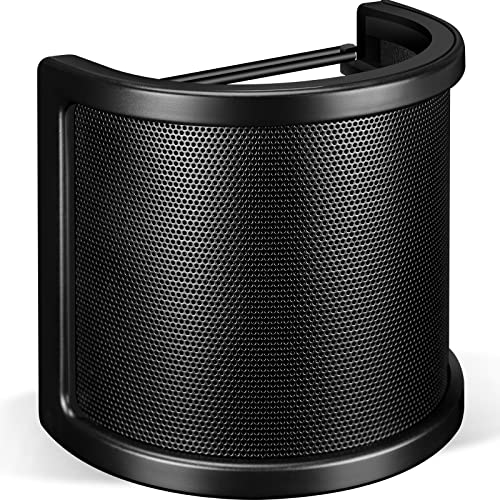
The FIFINE U1 takes a compact, microphone-mounted approach to microphone pop filters for podcasting. Its curved metal screen wraps around compatible microphones, helping reduce plosives and moisture while leaving less obstruction around the microphone and speaker’s face.
Best For: FIFINE microphone owners and podcasters who want a compact filter with minimal visual and physical obstruction.
Pros:
- Fits listed FIFINE models and microphones measuring 40–70 mm in diameter.
- Curved metal screen helps block wind, air blasts, and plosive noise.
- Rubber-lined frame and bands mount securely while helping protect the microphone from scratches.
- Includes two extra rubber bands for accommodating different microphone diameters.
Cons:
- Not suggested for dynamic microphones such as the FIFINE AM8, K688, and TANK3.
- Compatibility depends on the microphone’s diameter and the included bands.
- Microphone is not included.
The U1 is a strong fit for compact desk or boom setups where a traditional gooseneck filter would feel bulky. Check your microphone model and diameter first, particularly if you use a dynamic microphone.
AT2020 Foam Pair – Dual Windscreens for Podcast Mics
Audio-Technica AT2020 Pop Filter - 2 Windscreens for AT2020 & AT-2035 Microphones (Black)
Check Price On AmazonFor creators seeking microphone pop filters for podcasting with an AT2020-family microphone, this two-pack of foam windscreens offers a simple slip-on approach. The covers are designed for the Audio-Technica AT2020, AT2020USB, and AT2020USB+ and help reduce unwanted noise while protecting the mic from dust and moisture.
Best For: AT2020 owners who want two washable foam covers for podcasting, voiceovers, interviews, or calls.
Pros:
- Includes two foam windscreen covers.
- Designed for several Audio-Technica AT2020 models.
- Useful for podcasting, vocals, instruments, voiceovers, and field recording.
- Durable, easy-clean quilted material helps guard against dust and moisture.
Cons:
- Not a microphone; the AT2020 microphone is not included.
- Foam covers may be less targeted than a dedicated multi-layer pop shield for strong plosives.
- Compatibility is centered on the listed microphone models.
This is a practical, low-fuss option when you want a spare windscreen or protection for an AT2020 setup. Verify your exact microphone model before ordering.
Three-Layer Shield – PEMOTech Universal Mic Pop Filter
Among microphone pop filters for podcasting, the PEMOTech model is a flexible choice for compatible microphones measuring 45 to 61 mm in diameter. Its foam, metal mesh, and etamine layers are intended to reduce plosives, breath sounds, wind interference, crackles, and pops during recording.
Best For: Vocalists, podcasters, streamers, and video creators using a compatible 45–61 mm microphone.
Pros:
- Three-layer construction combines foam, metal mesh, and etamine.
- Fits many listed microphones, including AT2020, AT2035, Rode NT1A, Rode NT-USB, and MXL models.
- Elastic bands and an inner rubber ring make installation and removal straightforward.
- Metal mesh helps keep saliva away from the microphone.
Cons:
- Explicitly not designed for Blue Yeti microphones.
- Only one pop filter is included.
- Fit depends on the microphone being within the stated 45–61 mm range.
The layered design makes this a more dedicated pop-control solution than a basic foam cover, provided your microphone falls within the specified size range. Check compatibility carefully, especially if you use a Blue Yeti.
Blue Yeti Foam Cover – Mudder 50mm Windscreen
This Mudder 50mm foam cover is a straightforward pick among microphone pop filters for podcasting when you use a Blue Yeti or Blue Yeti Pro. Its high-density foam helps reduce unwanted noise and wind interference while protecting the microphone from dust and saliva for indoor or outdoor use.
Best For: Blue Yeti and Blue Yeti Pro users recording podcasts, voiceovers, interviews, or streaming content.
Pros:
- Designed for Blue Yeti and Blue Yeti Pro condenser microphones.
- High-density foam helps reduce wind interference and unwanted noise.
- Protects the microphone from dust and saliva.
- Suitable for podcasting, singing, streaming, and field recording.
Cons:
- Only one foam cover is included.
- It is designed for the listed Blue microphone models, so compatibility should be checked.
- Arrives compressed and needs time to regain its shape.
Choose this cover for simple protection and basic wind and noise reduction on a Blue Yeti-style setup. Let it expand fully after unpacking before judging the fit or appearance.
Yeti Foam Windshield – Blue Yeti Mic Cover
If you use a Blue Yeti or Yeti Pro for podcasting, this foam cover is a simple microphone pop filter for podcasting that helps reduce wind interference and unwanted noise. Its 2.5-inch fit may also suit some other large microphones, depending on the model.
Best For: Blue Yeti and Yeti Pro owners who want a straightforward foam mic cover.
Pros:
- Designed specifically for Blue Yeti and Yeti Pro microphones.
- May fit other microphones up to 2.5 inches in diameter.
- Breathable foam helps reduce wind and unwanted background noise.
Cons:
- Compatibility with other microphones depends on the microphone model and dimensions.
- Its foam-cover design may offer less positioning flexibility than a stand-mounted filter.
This is a practical, compact choice for Yeti users who want basic plosive and wind-noise control without adding a separate gooseneck assembly.
Studio Shield – Three-Layer Universal Mic Filter
For vocal recording, streaming, and podcasting, this three-layer microphone pop filter for podcasting combines foam, metal mesh, and etamine layers to reduce plosives, breath sounds, crackles, and wind interference. It fits microphones measuring approximately 45 to 63 mm in diameter.
Best For: Users with compatible studio or handheld microphones who want broad fitment and a secure cover-style filter.
Pros:
- Three-layer construction targets pops, breath sounds, wind, and crackles.
- Fits a wide range of listed microphones, including AT2020, AT2035, NT1A, MXL 770, and CAD U37.
- Elastic bands and an inner rubber ring support quick installation and removal.
- Metal mesh helps keep saliva away from the microphone.
Cons:
- Not compatible with the Blue Yeti according to the supplied notes.
- Fit depends on the microphone diameter being within the 45–63 mm range.
With its wide stated compatibility and layered construction, this filter is a versatile option for creators using supported microphones across recording, streaming, and vocal applications.
Yeti Pro Shield – Six-Layer Pop Filter Kit
Designed for the Blue Yeti, this six-layer microphone pop filter for podcasting combines a metal mesh, windproof sponge layers, an adjustable gooseneck, and a swivel clip. The package also includes a foam windscreen for added flexibility during voice recording and podcasting.
Best For: Blue Yeti users who want adjustable placement and both a pop filter and foam cover.
Pros:
- Specifically designed for the Blue Yeti microphone.
- Six-layer construction helps address plosives, dust, vapor, and saliva.
- 360-degree adjustable gooseneck supports flexible positioning.
- Includes both a pop filter and a Blue Yeti foam windscreen.
Cons:
- Its compatibility is focused on the Blue Yeti rather than a broad range of microphones.
- The separate gooseneck and clip may be more involved than a basic foam cover.
This kit is a strong fit for Yeti-based podcast setups where precise filter placement and a backup or alternative foam cover are more useful than minimal hardware.
How We Picked the Best Microphone Pop Filters for Podcasting
We compared these filters by compatibility, construction, plosive-control design, mounting method, and everyday usability. Priority went to products that clearly identify supported microphones or offer flexible placement. We also considered whether each filter is better suited to a desk-mounted USB microphone, a boom-arm setup, a handheld mic, or a dedicated studio microphone.
Materials matter, but they are not the only indicator of performance. Metal mesh and multilayer filters can provide effective airflow control while remaining easy to clean, whereas foam covers are compact and particularly convenient for compatible microphones. A secure fit and correct distance from the microphone are equally important.
Quick Comparison
| Filter type | Best for | Main advantage | Watch for |
|---|---|---|---|
| Flexible clamp-on mesh | General podcast setups | Adjustable placement | Clamp space and arm stability |
| Model-specific screen | PodMic, Blue Yeti, or AT2020 users | More reliable fit | Limited compatibility |
| Foam windscreen | Simple, portable setups | Fast installation | May alter high-frequency detail |
| Multilayer filter | Strong plosive control | Multiple barriers to bursts of air | Bulk and fit around the mic |
Key Buying Factors for Microphone Pop Filters for Podcasting
Compatibility and Fit
Check the microphone model, grille dimensions, and mounting arrangement before buying. A filter made for the PodMic or Blue Yeti may fit securely, while a universal clamp can work across several microphones but require more positioning.
Mesh, Foam, or Multilayer Construction
Mesh screens are a versatile choice for spoken voice and are usually easy to clean. Foam windscreens are lightweight and convenient, especially for microphones with a compatible slip-on cover. Multilayer designs combine materials to improve plosive reduction, though they can be thicker and less discreet.
Positioning and Adjustment
A filter should sit between your mouth and the microphone without touching the grille. Flexible goosenecks and adjustable clamps make it easier to maintain consistent placement. For most close-mic podcasting, leave a small air gap between the filter and microphone.
Cleaning and Durability
Look for a washable or replaceable screen when possible. Foam can collect moisture and should be allowed to dry fully. A sturdy clamp, threaded connection, or reinforced arm is valuable if the filter will remain attached to a frequently adjusted boom arm.
Who Should Buy Which Microphone Pop Filters for Podcasting?
Blue Yeti owners: Choose a dedicated foam cover or a flexible shield specifically listed as compatible with the Yeti. PodMic users: A model-specific RØDE filter is the simplest route to a secure fit.
AT2020 owners: The dedicated Audio-Technica option is a practical choice when you want a known fit. Streamers and beginners: A universal clamp-on metal or multilayer filter offers flexibility as your setup changes.
Handheld microphone users: Consider a slip-on multilayer cover or foam windscreen designed for the microphone’s diameter. Portable and minimalist setups: Foam is easiest to install and transport, while a mesh filter is usually preferable when maximum vocal clarity and adjustable positioning are priorities.