Tuning one string at a time works, but a polyphonic tuner can show the pitch of every open string after a single strum. That makes it easier to spot multiple tuning issues quickly before practice, recording, or a performance.
We compared clip-on and pedal-style options across accuracy, display clarity, tuning modes, durability, power, and ease of use. The lineup includes dedicated polyphonic models alongside versatile chromatic tuners for different guitars, budgets, and playing situations.
Best 10 Polyphonic Guitar Tuners Picks for 2026
Best Polyphonic Clip-On

- Tunes all six strings simultaneously
- Chromatic and highly precise strobe modes
- Bright adaptive 108-LED display
Best For: Players wanting a feature-rich clip-on tuner
Best Discreet Two-Pack
D'Addario Micro Headstock Tuner

- Compact behind-the-headstock design
- Accurate piezo vibration sensing
- Two tuners included with CR2032 batteries
Best For: Players tuning multiple stringed instruments
Best Pedalboard Polyphonic Tuner

- Polyphonic, chromatic, and strobe modes
- Built-in BONAFIDE buffer
- Tiny pedalboard-friendly format
Best For: Electric guitarists with long cable runs
Best Multi-Instrument Clip-On

- Modes for guitar, bass, ukulele, and violin
- Vibration-based tuning for varied environments
- Responsive color LCD needle display
Best For: Multi-instrumentalists needing one clip-on tuner
Best Compact Pedal Tuner
Tiny Polyphonic Tuning and Buffer

- Fast, accurate polyphonic tuning
- Multiple tuning modes
- Built-in BONAFIDE BUFFER
Best For: Compact pedalboards needing tuning and signal buffering
Best Clip-On Value
Full-Color Guitar and Bass Tuner

- Full-color display
- Guitar-and-bass frequency range
- Front- or back-of-headstock use
Best For: Players wanting a lightweight, flexible clip-on tuner
Best High-Precision Clip-On

- Accuracy as great as ±0.1 cents
- High-visibility OLED display
- Chord finder and strobe features
Best For: Guitarists seeking precise, feature-rich clip-on tuning
Color-Screen Versatility
New Bee Rechargeable Clip-On Tuner

- Color display with rotatable viewing angle
- Supports five instruments, chromatic, and open tuning
- USB-C rechargeable battery lasts up to 10 hours
Best For: Multi-instrument players wanting a compact rechargeable tuner
Precision Viewing
D’Addario Eclipse Clip-On Tuner
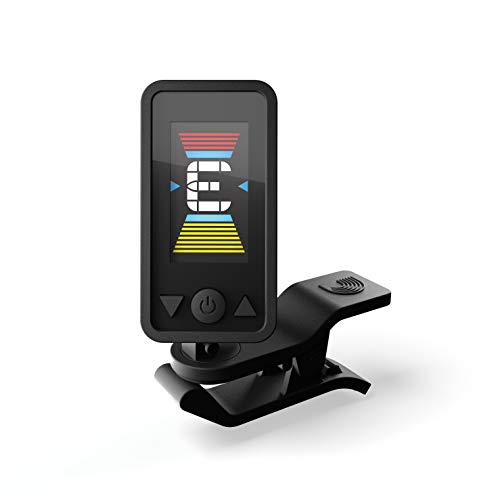
- 435–450 Hz adjustable calibration range
- Full-color screen with dual-swivel positioning
- Strong clamp for guitar, bass, and ukulele
Best For: Players seeking precise, flexible headstock tuning
Long-Run Rechargeable
D’Addario Eclipse Rechargeable Tuner

- Up to 24 hours of tuning per charge
- Adjustable 435–450 Hz calibration
- Full-color display with strong flexible clamp
Best For: Frequent guitarists and bassists wanting long battery life
Best Polyphonic Clip-On – TC Electronic POLYTUNE CLIP
The TC Electronic POLYTUNE CLIP is a strong choice for guitarists specifically shopping for polyphonic guitar tuners. Its poly tune mode checks all six strings simultaneously, while chromatic and strobe modes provide options for quick or highly precise tuning.
Best For: Guitarists who want a versatile clip-on tuner with polyphonic and ultra-accurate strobe modes.
Pros:
- Tunes all six strings simultaneously in polyphonic mode.
- Offers chromatic accuracy of ±0.5 cent and strobe accuracy of ±0.02 cent.
- Bright, adaptive 108-LED display is designed to remain readable in different clip orientations.
- Includes flat-tuning and capo modes in a durable stainless-steel clip design.
Cons:
- Its feature set may be more than needed for players seeking a basic tuner.
- Runs on battery power.
With multiple tuning modes, a readable display, and simultaneous string checking, the POLYTUNE CLIP is one of the more capable clip-on options in this roundup.
Best Discreet Two-Pack – D'Addario Micro Headstock Tuner
The D’Addario Micro Headstock Tuner is not a polyphonic tuner, but its compact design makes it a practical alternative for guitarists who prefer simple, precise single-note tuning. This two-pack is especially useful when you own multiple stringed instruments.
Best For: Players who want discreet, vibration-based tuners for more than one instrument.
Pros:
- Compact tuner hides behind the headstock and can remain attached during storage.
- Piezo transducer senses instrument vibration rather than relying on sound.
- Tri-color display shows out-of-tune, close, and in-tune status clearly.
- 360-degree swivel, adjustable padded clamp, and 410–480Hz calibration range add flexibility.
Cons:
- Does not offer simultaneous six-string polyphonic tuning.
- Small display may be less suitable for players who prefer a larger readout.
The two-pack and discreet profile are its main advantages. Choose it when compact, individual-instrument tuning matters more than polyphonic speed.
Best Pedalboard Polyphonic Tuner – TC Electronic POLYTUNE 3 MINI
The TC Electronic POLYTUNE 3 MINI combines polyphonic guitar tuners functionality with a pedalboard-friendly format. It supports polyphonic, chromatic, and strobe tuning, and its built-in BONAFIDE buffer is designed to help preserve tone through long cables and larger pedalboards.
Best For: Electric guitarists who need fast tuning and a built-in buffer on a pedalboard.
Pros:
- Polyphonic mode checks all strings at once for quick tuning.
- Also provides chromatic and strobe tuning modes.
- Built-in BONAFIDE buffer helps keep tone crisp through long cables and large pedalboards.
- Tiny pedal format saves board space.
Cons:
- Pedal format is less convenient than a clip-on tuner for unplugged instruments.
- The compact design may provide less visual space than a larger tuner.
For an electric guitarist using a pedalboard, this model offers a particularly useful combination of rapid polyphonic tuning and signal-buffering functionality.
Best Multi-Instrument Clip-On – Fender FCT-2 Clip-On Tuner
Fender FCT-2 Professional Multi-Instrument Clip-On Tuner for Guitar, Bass, Ukulele, and Violin
Check Price On AmazonThe Fender FCT-2 is a practical multi-instrument clip-on tuner for players who need dependable vibration-based tuning across several instruments. It is not a polyphonic tuner, but its dedicated instrument modes and responsive color LCD make it a flexible everyday option.
Best For: Guitarists and multi-instrumentalists who also play bass, ukulele, or violin.
Pros:
- Uses instrument vibrations, helping it work in loud or quiet environments.
- Dedicated modes cover guitar, bass, ukulele, violin, and chromatic tuning.
- Responsive color LCD needle provides clear visual feedback.
- Dual-hinge clip, B0–B7 range, A440 calibration, and included CR2032 battery support convenient setup.
Cons:
- Does not provide polyphonic tuning.
- Plastic construction may feel less premium than a metal-bodied tuner.
The FCT-2 makes the most sense when versatility across instruments is more important than checking all six guitar strings at once.
Best Compact Pedal Tuner – Tiny Polyphonic Tuning and Buffer
The TC Electronic POLYTUNE 3 NOIR is a practical choice for players who want polyphonic guitar tuners in a compact pedal format. It combines fast, accurate tuning with multiple tuning modes and a built-in BONAFIDE BUFFER, making it useful on a pedalboard where space and signal support matter.
Best For: Guitarists seeking a compact pedal tuner with multiple tuning modes and a built-in buffer.
Pros:
- Polyphonic tuning provides fast tuning checks.
- Offers multiple tuning modes.
- Includes a built-in BONAFIDE BUFFER.
- Compact design measures 1.44 x 0.79 x 0.68 inches.
Cons:
- Pedal-format operation may be less convenient than a clip-on tuner for casual use.
- Its tiny dimensions may require more deliberate foot operation.
Choose this model when you want a pedalboard-friendly tuner that adds both polyphonic tuning and a built-in buffer without taking up much room.
Best Clip-On Value – Full-Color Guitar and Bass Tuner
The Snark SN5X is a straightforward clip-on option for shoppers comparing polyphonic guitar tuners with simple headstock convenience. Its full-color display and guitar-and-bass-focused frequency range make it easy to use, while the reversible design allows placement on either the front or back of the headstock.
Best For: Guitar and bass players who want a lightweight clip-on tuner with a full-color display.
Pros:
- Full-color display is easy to read.
- Frequency range is tailored to guitar and bass.
- Can be used on the front or back of the headstock.
- Lightweight design weighs 1.58 ounces.
Cons:
- It is a chromatic clip-on tuner rather than a pedal-based tuning unit.
- The supplied notes do not indicate polyphonic tuning functionality.
This is a sensible pick for players who prioritize a light, flexible clip-on format and clear display over pedalboard features.
Best High-Precision Clip-On – OLED Polyphonic Guitar Tuner
The Korg AW-OTG-POLY is designed for guitarists who want advanced polyphonic guitar tuners with a highly visible OLED display. It offers tuning accuracy as great as ±0.1 cents, a guitar-specific chord finder, optional strobe mode, alternative-tuning animations, and practical memory and auto-power-off functions.
Best For: Guitarists who value very high tuning precision, OLED visibility, and guitar-focused tuning features.
Pros:
- Polyphonic guitar tuner with accuracy as great as ±0.1 cents.
- OLED display provides a high-visibility readout.
- Includes a guitar-specific chord finder function.
- Offers strobe mode, alternative-tuning animations, memory backup, and auto-power-off.
Cons:
- The supplied notes do not specify battery life.
- Its feature set may be more involved than necessary for basic tuning.
For players who want more than basic pitch confirmation, the AW-OTG-POLY stands out for its precision, display technology, and guitar-specific tools.
Color-Screen Versatility – New Bee Rechargeable Clip-On Tuner
For shoppers comparing polyphonic guitar tuners and other clip-on options, the New Bee combines a vivid color display with tuning support for guitar, bass, ukulele, violin, cello, and chromatic settings. Its rotatable screen and rechargeable design make it practical for home practice, studio sessions, or performance use.
Best For: Players who want one compact rechargeable tuner for several instruments and open guitar tuning.
Pros:
- High-resolution color screen is designed for clear note visibility.
- Supports five instruments, chromatic tuning, and automatic guitar open-tuning detection.
- 360° rotatable display and silicone-padded clamp allow flexible, secure placement.
- USB-C charging provides up to 10 hours of tuning per charge.
Cons:
- Its stated battery life is shorter than the 24-hour rating of the rechargeable D’Addario model below.
- It is a clip-on tuner rather than a dedicated pedal-style polyphonic tuner.
The New Bee stands out for versatility: it covers multiple instruments, offers open-tuning detection, and keeps the display easy to position. It is a strong everyday choice if portability and rechargeable convenience matter most.
Precision Viewing – D’Addario Eclipse Clip-On Tuner
The D’Addario Eclipse is a straightforward option for guitarists comparing polyphonic guitar tuners with compact headstock tuners. It offers quick, accurate tuning, a full-color vertical screen, adjustable calibration, and a clamp designed for flexible placement on guitar, bass, or ukulele headstocks.
Best For: Guitar, bass, and ukulele players who prioritize accurate tuning and flexible screen positioning.
Pros:
- Wide 435–450 Hz calibration range supports precise performance setup.
- Full-color display and dual swivels provide broad viewing flexibility.
- Strong adjustable clamp is designed to stay mounted on the headstock.
- Works with acoustic guitar, electric guitar, bass, and ukulele.
Cons:
- Uses a CR2 battery rather than offering the rechargeable design of the other listed models.
- Its supplied notes do not list open-tuning detection or support for violin and cello.
The Eclipse is a practical, conventional clip-on tuner with useful calibration control and a highly adjustable display. Choose it when broad viewing angles and standard replaceable-battery operation fit your setup.
Long-Run Rechargeable – D’Addario Eclipse Rechargeable Tuner
For players seeking polyphonic guitar tuners with less battery maintenance, this rechargeable D’Addario Eclipse offers up to 24 hours of tuning per charge. It retains the Eclipse’s full-color adjustable display, wide calibration range, and strong headstock clamp for guitar or bass use.
Best For: Guitarists and bassists who want a rechargeable clip-on tuner with extended operating time.
Pros:
- Provides up to 24 hours of tuning per charge.
- USB charging avoids regularly buying or changing batteries.
- 435–450 Hz calibration range supports precise tuning adjustments.
- Full-color vertical screen, dual swivels, and strong clamp support convenient placement.
Cons:
- The supplied notes specify guitar and bass use, with less instrument coverage than the New Bee.
- No open-tuning detection is listed in the supplied features.
The rechargeable Eclipse is the endurance-focused choice in this group. Its 24-hour runtime, adjustable viewing design, and calibration control make it especially convenient for frequent practice, rehearsals, and performances.
How We Picked the Best Polyphonic Guitar Tuners
We focused on tuners that make accurate setup fast without adding unnecessary complexity. Our comparison considers polyphonic detection, chromatic and strobe modes, screen readability, response speed, clip stability, instrument compatibility, power options, and overall value. Since not every guitarist needs a pedal or true chord-wide detection, we also included capable clip-on chromatic models that cover everyday tuning needs.
For stage use, we gave extra weight to visibility, dependable signal detection, and quick operation. For practice and travel, compact size, battery life, rechargeable power, and flexible mounting mattered more.
Quick Comparison
- Fast chord checks: Choose a true polyphonic tuner that displays all six strings after one strum.
- Maximum precision: Look for a strobe mode or fine-resolution display.
- Broad instrument support: A chromatic clip-on tuner is often the most versatile choice for guitar, bass, ukulele, and violin.
- Pedalboard integration: A compact pedal tuner can offer a clear display and buffered signal path.
- Travel convenience: Rechargeable or small headstock models reduce battery and storage hassles.
Key Buying Factors for Polyphonic Guitar Tuners
Detection and Accuracy
Polyphonic mode is useful for checking several strings at once, but single-string chromatic or strobe modes are better for final adjustments. If you regularly use alternate, open, or drop tunings, confirm that the tuner supports the notes and tuning modes you need.
Display and Viewing Angle
A large, high-contrast display is easier to read under stage lights or from a standing position. Rotatable clips and adjustable screens help when the tuner is mounted behind a headstock or on an angled instrument.
Mounting, Power, and Durability
The clip should grip firmly without damaging the finish and should detect vibration reliably. Check whether the tuner uses replaceable batteries, USB charging, or both. Rechargeable designs are convenient, while replaceable batteries can be preferable for long gigs and quick replacements.
Modes and Compatibility
Chromatic mode is the baseline, while strobe, flat, capo, and instrument-specific settings can make setup more flexible. Verify that the model fits your instrument and that its sensitivity works well with acoustic guitars, electric guitars, basses, or ukuleles.
Who Should Buy Which Polyphonic Guitar Tuners?
Choose a true polyphonic model if you want to check an entire chord quickly or tune efficiently before rehearsals and performances. Choose a compact pedal tuner if you need a permanent pedalboard solution, a prominent display, or buffered signal routing. Choose a clip-on chromatic tuner for simple, affordable tuning across multiple instruments. Choose a rechargeable model if you practice frequently and want to avoid keeping spare button batteries on hand.
For most players, the best choice balances accurate detection with a display and mounting system that suit the way you actually tune. A feature-rich tuner is only helpful if it remains easy to read and operate when you are holding the instrument.