The best pedal guitar tuners make tuning faster, quieter, and more dependable—especially when you need to mute your signal between songs or switch instruments onstage.
We compared 10 popular options across tuning accuracy, display visibility, bypass design, tuning modes, build quality, and value to help you find the right fit for your pedalboard.
Best 10 Pedal Guitar Tuners Picks for 2026
Compact Polyphonic Pick

- Tunes all strings at once in polyphonic mode
- Includes chromatic and strobe modes
- Built-in BONAFIDE buffer for long cable runs
Best For: Compact pedalboards and fast all-string tuning
Stage-Ready Standard
BOSS TU-3 Compact Chromatic Tuner

- Bright, adjustable 21-segment LED meter
- Accurate to plus or minus one cent
- Supports drop tuning and powers up to seven BOSS pedals
Best For: Stage use with guitars, basses, and varied tunings
High-Resolution Strobe Choice
Peterson StroboStomp HD Pedal Tuner

- Features a full-color display
- Works with guitar and bass guitar
- Includes 1/4-inch TS and Micro USB connectivity
Best For: Players wanting a full-color pedal tuner display
Premium Buffered Tuner

- TU-3-equivalent tuning performance
- Switchable buffer and true-bypass operation
- Blue 21-segment LED meter with Accu-Pitch
Best For: Stage rigs needing premium signal-path control
Wide-Range Pick

- Bright color LCD display
- A0–C8 range with flat tuning
- Compact metal true-bypass design
Best For: Visible, flexible tuning on stage
Value Stage Option
Monoprice Stage Right Chromatic Tuner
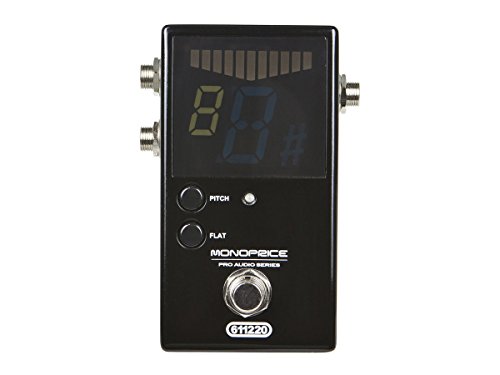
- Heavy-duty metal construction
- A0–C8 range and ±1-cent accuracy
- Normal and true-bypass outputs
Best For: Simple, affordable stage tuning
Bright Display Pick
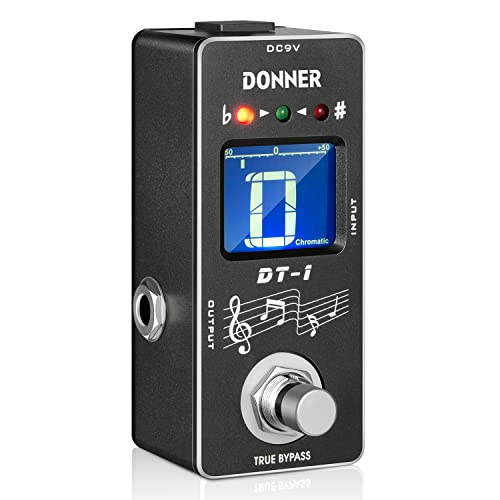
- A0–C8 chromatic tuning range
- Fast strobe mode with ±1-cent accuracy
- Mute tuning and true-bypass operation
Best For: Clear, silent tuning for guitar or bass
Robust Precision Pick

- Large 2-inch color screen
- B0-C8 tuning range with ±0.5-cent accuracy
- Rugged zinc-alloy housing
Best For: Players needing a durable, highly visible guitar or bass tuner
Compact Stage Pick

- Bright color LCD for varied lighting
- True bypass with mute functionality
- 430-450Hz pitch range and four half-flat steps
Best For: Players wanting a small, stage-friendly tuner with flat-tuning controls
Compact Polyphonic Pick – TC Electronic POLYTUNE 3 MINI
For players comparing pedal guitar tuners, the POLYTUNE 3 MINI combines fast polyphonic tuning with chromatic and strobe modes in a compact pedal. Its built-in BONAFIDE buffer is also designed to help keep tone crisp through long cables and larger pedalboards.
Best For: Guitarists who want quick all-strings-at-once tuning and a compact pedalboard footprint.
Pros:
- Polyphonic mode tunes all strings simultaneously.
- Offers polyphonic, chromatic, and strobe tuning modes.
- Built-in BONAFIDE buffer supports clear tone through long cable runs.
- Small 3.66-by-2.01-inch footprint weighs only 100 g.
Cons:
- Its compact design may provide less physical space than a full-size tuner pedal.
- Requires a 9-volt power source.
The POLYTUNE 3 MINI is a practical choice when speed, tuning flexibility, and pedalboard space matter most, especially for players who value an onboard buffer.
Stage-Ready Standard – BOSS TU-3 Compact Chromatic Tuner
The BOSS TU-3 is a durable option among pedal guitar tuners, built around a high-visibility 21-segment LED meter and tuning accuracy of plus or minus one cent. It also supports guitar and bass modes, drop tunings, automatic muting, and power distribution for additional BOSS pedals.
Best For: Gigging guitarists and bassists who need a rugged, highly visible stage tuner.
Pros:
- Tank-tough BOSS stompbox construction.
- High-brightness LED meter with adjustable brightness.
- Supports 7-string guitars, 6-string basses, and drop tunings up to six semitones.
- Automatically mutes the signal for silent tuning and can power up to seven BOSS pedals.
Cons:
- Larger and heavier than the compact POLYTUNE 3 MINI.
- Uses an 85 mA, 9-volt power requirement.
With its readable display, broad tuning support, and performance-focused features, the TU-3 is well suited to players who prioritize dependable stage operation over minimum size.
High-Resolution Strobe Choice – Peterson StroboStomp HD Pedal Tuner
The Peterson StroboStomp HD brings a full-color display to the pedal guitar tuner category. It is a digital tuner compatible with guitar and bass guitar, with 1/4-inch TS and Micro USB connectivity listed in its specifications.
Best For: Guitar and bass players who prefer a full-color display in a dedicated pedal tuner.
Pros:
- Full-color display provides a clear tuning interface.
- Compatible with both guitar and bass guitar.
- Includes 1/4-inch TS and Micro USB connectivity.
- Backed by a three-year manufacturer warranty.
Cons:
- The supplied notes do not specify additional tuning modes or accuracy figures.
- Its 13.92-ounce weight may be more than some miniature tuner pedals.
The StroboStomp HD is worth considering when display visibility and guitar-and-bass compatibility are more important than having a long list of documented features.
Premium Buffered Tuner – BOSS TU-3W Waza Craft Tuner
The BOSS TU-3W Waza Craft is a premium take on a stage-oriented pedal guitar tuner, pairing TU-3-level tuning functionality with refined signal handling. Its buffer can be switched off for true-bypass operation, giving players control over how the pedal affects the signal path.
Best For: Guitarists and bassists who want a durable stage tuner with premium buffering and true-bypass flexibility.
Pros:
- Provides tuning performance equivalent to the industry-standard TU-3.
- Refined audio circuitry is designed for pure signal pass-through.
- Buffer can be turned off for true-bypass operation.
- Uses a 21-segment blue LED meter and Accu-Pitch Sign function.
Cons:
- Heavier and larger than compact mini tuner pedals.
- Requires a 9-volt power source.
- Its premium feature set may be unnecessary for players seeking a basic tuner only.
The TU-3W makes the most sense for players who want established BOSS tuning performance but also care about signal purity and the option to choose buffered or true-bypass operation.
Wide-Range Pick – Flatsons FTN-2 Tuner Pedal
The Flatsons FTN-2 is a practical choice for players who want a pedal guitar tuner with a highly visible color display, broad tuning coverage, and true bypass. Its A0–C8 range and flat-tuning support make it suitable for guitars, basses, baritones, and extended setups.
Best For: Players who need clear stage visibility and flexible tuning for standard, drop, or flat tunings.
Pros:
- Color LCD display is designed to remain easy to read in dark or bright conditions.
- True bypass helps preserve the guitar signal when the pedal is off.
- Wide A0–C8 range, adjustable A4 calibration, and extended flat-tuning support.
- Compact metal housing measures 94 × 51 × 53mm and weighs 175.5g.
Cons:
- Requires a standard 9V DC adapter, which is not included.
- No battery operation is listed in the supplied specifications.
With its combination of broad range, fast chromatic detection, and a compact rugged enclosure, the FTN-2 is a strong fit for crowded pedalboards and players who regularly change tunings.
Value Stage Option – Monoprice Stage Right Chromatic Tuner
The Monoprice Stage Right is a straightforward pedal guitar tuner for bass and guitar players who want a durable pedal format and familiar 1/4-inch connections. It tunes across A0–C8 and is specified as accurate to within 1 cent.
Best For: Budget-conscious musicians seeking a simple stage tuner with normal and bypass outputs.
Pros:
- Heavy-duty metal construction is suited to pedalboard use.
- A0–C8 tuning range covers guitar and bass applications.
- Specified accuracy is within 1 cent.
- Offers both normal and true-bypass outputs.
Cons:
- Battery and 9VDC adapter are sold separately.
- No warranty is listed in the supplied details.
- The supplied notes do not mention a color display or strobe mode.
This model keeps the feature set focused and practical. Its broad range, metal build, and dual output options make it a sensible basic tuner for a stage-oriented setup.
Bright Display Pick – Donner DT-1 Tuner Pedal
The Donner DT-1 is a pedal guitar tuner built around quick chromatic tuning, a wide A0–C8 range, and an easy-to-see LED and mini LCD display. Its tuning mode cuts the signal while you tune, while bypass mode returns the guitar sound to the amplifier without signal loss.
Best For: Guitarists and bassists who want clear visual feedback and silent tuning in a compact pedal.
Pros:
- Wide A0–C8 tuning range supports guitar and bass.
- Fast strobe mode is specified at ±1-cent accuracy.
- Tuning mode mutes the output, while bypass mode preserves the signal.
- Adjusted LED beads and mini LCD are designed for stage and outdoor visibility.
Cons:
- Power adapter is not included.
- There is no battery compartment.
- The supplied details list a compact mini format but give varying dimensional entries.
The DT-1 is a useful option when visual readability and silent tuning matter. Its dedicated adapter-powered design is best suited to players already using a powered pedalboard.
Robust Precision Pick – STRICH Silver Compact Tuner
For players comparing pedal guitar tuners, the STRICH offers a rugged zinc-alloy housing, a large 2-inch color screen, and quick chromatic tuning. Its B0-C8 range and adjustable 430-450Hz A4 reference make it suitable for electric guitar, bass, and other instruments.
Best For: Guitarists and bassists who want a durable tuner with a large, easy-to-read display and flexible reference-pitch adjustment.
Pros:
- Large 2-inch color display is easy to read.
- Wide B0-C8 tuning range supports guitar, bass, and more.
- Adjustable A4 frequency from 430-450Hz.
- Solid zinc-alloy casing is designed for rigorous use.
Cons:
- Requires a center-negative DC 9V adapter, which is not included.
- Its compact pedal format still takes more board space than a mini tuner.
The STRICH is a practical choice when visibility and durability matter most. Confirm that your existing power supply matches its required 9V specification before adding it to your pedalboard.
Flexible Signal-Path Pick – SORAN JTU-01A Mini Tuner
The SORAN JTU-01A is one of the more flexible pedal guitar tuners for players who want both true-bypass and buffered-bypass options. Its 2.2-inch LCD, broad A0-C8 range, and support for flat tuning help make quick adjustments practical onstage or in rehearsal.
Best For: Multi-instrument players and pedalboard users who want selectable bypass behavior, a bright display, and support for alternate tuning needs.
Pros:
- Offers true-bypass and buffered-bypass modes.
- 2.2-inch LCD is designed for visibility in dark or bright conditions.
- Supports electric guitar, bass, acoustic guitar, ukulele, violin, and more.
- Provides a wide A0-C8 tuning range with ±0.1-cent precision.
Cons:
- 9V center-negative power adapter is not included.
- Manufacturer recommends a supply rated at least 100mA for stable performance.
Choose the SORAN if signal-chain flexibility is a priority. The selectable bypass modes are especially useful for players who want to preserve tone in one setup or use buffering in another.
Compact Stage Pick – LEKATO Color Display Tuner
The LEKATO is a compact option among pedal guitar tuners, combining a color LCD with mute functionality and true bypass. Its pitch adjustment from 430-450Hz and four half-flat settings give players useful control for standard and note-flat tuning.
Best For: Guitarists and bassists who need a space-saving pedal tuner with clear stage visibility and alternate pitch options.
Pros:
- High-brightness color display is designed for bright or dim settings.
- True bypass routes the original signal directly when the pedal is off.
- Supports 430-450Hz pitch calibration and four half-flat settings.
- Rugged aluminum shell and long-life footswitch suit regular use.
Cons:
- The supplied notes do not specify a tuning frequency range or included power adapter.
- Its stated tuning tolerance is less precise than the SORAN JTU-01A’s specification.
The LEKATO makes sense when pedalboard space and display visibility are more important than advanced bypass choices. Its mute and flat-tuning features add practical flexibility for rehearsals and performances.
How We Picked the Best Pedal Guitar Tuners
We focused on the features that matter during rehearsals, recording sessions, and live performances. Our comparison considers chromatic and polyphonic tuning options, display readability, tuning range, calibration controls, bypass behavior, construction, power requirements, and compatibility with guitar and bass signals.
We also separated premium features from basic functionality. A high-end strobe tuner may offer exceptional precision and more setup control, while a budget pedal can still be a smart choice if it tunes quickly, mutes reliably, and fits your board.
Quick Comparison
- Best overall versatility: TC Electronic POLYTUNE 3 MINI, with multiple tuning modes and a built-in buffer.
- Best familiar stage standard: BOSS TU-3, known for its clear display and rugged pedal format.
- Best precision-focused option: Peterson StroboStomp HD, designed for highly accurate strobe tuning.
- Best premium BOSS option: BOSS TU-3W Waza Craft, with upgraded signal-path features.
- Best value choices: Flatsons, Monoprice, Donner, STRICH, SORAN, and LEKATO models for essential pedal-tuner functionality.
Key Buying Factors for Pedal Guitar Tuners
Tuning Accuracy and Modes
Chromatic tuning is sufficient for most players, but strobe-style displays can make extremely precise adjustments easier. Polyphonic tuning is useful when you want to check every string with one strum, while drop-tuning support and adjustable A4 calibration matter for alternate tunings and ensembles using nonstandard reference pitches.
Display Visibility
A large, bright display is easier to read under stage lighting or from several feet away. Color screens can make the in-tune position more obvious, while simpler LED indicators may use less space and power.
Bypass, Buffer, and Muting
True bypass preserves a direct signal path when the tuner is off, but buffered bypass can help maintain high-frequency clarity across long cable runs or larger pedalboards. Confirm that the tuner mutes the output while active if silent stage tuning is important.
Size, Power, and Durability
Measure your available board space before choosing a mini pedal. Check whether the tuner uses a 9V adapter, batteries, or both, and leave room for power and patch cables. A sturdy enclosure and dependable footswitch are especially valuable for frequent gigging.
Who Should Buy Which Pedal Guitar Tuners?
Choose a polyphonic or feature-rich tuner if you want fast checks and flexible tuning modes. A standard BOSS-style chromatic pedal suits players who prioritize straightforward operation and proven stage usability. Pick a strobe tuner if intonation work, studio precision, or highly exact tuning is your main concern.
Budget models are appropriate for beginners, backup boards, home practice, and players who mainly need accurate chromatic tuning with a mute function. Bassists should verify the listed range and display behavior with low notes, while players with crowded boards should prioritize compact dimensions and power compatibility.