Choosing the right low-end support can make a huge difference in how accurately your mixes translate. The best studio monitor subwoofers and companion monitors help reveal bass issues without overwhelming the rest of the spectrum.
This roundup focuses on practical options for home studios, desktop setups, and near-field listening, with an emphasis on clean bass, straightforward connectivity, and easy integration.
Best 10 Studio Monitor Subwoofers Picks for 2026
Best for Desktop Control
Mackie CR8SBT 8” Powered Subwoofer

- 8" powered woofer with tuned ports for fuller bass extension
- Bluetooth support adds easy wireless streaming to your setup
- Desktop remote makes volume control simple from your desk
Best For: Creators and home-studio users who want a compact sub with desktop volume control and easy Bluetooth pairing.
Best Value Nearfields
PreSonus Eris E5 Studio Monitor

- Compact 5.25-inch woofer with controlled low end
- 80W Class AB power for nearfield monitoring
- Room-tuning controls and multiple input options
Best For: Home-studio producers who want affordable, adjustable nearfield monitors.
Best for Desktop Monitoring
Edifier MR3 Powered Studio Monitors

- Hi-Res Audio certified with a flat 52Hz to 40kHz response.
- Balanced TRS, RCA, AUX, Bluetooth, and headphone output.
- Music, Monitor, and Custom modes with app EQ control.
Best For: Creators and desktop listeners who want accurate compact monitors with flexible connections.
Best for Wide Sweet Spot
PreSonus Eris E7 XT Studio Monitor

- Wide EBM waveguide improves imaging and listening area
- 6.5-inch woofer gives tight, extended low-end response
- Acoustic tuning controls help match different rooms
Best For: Producers and home-studio users who want flexible, accurate nearfield monitoring.
Best for Small Studios

- Detailed, revealing sound for mixing and editing
- Compact design works well in home studios
- Can be expanded later with ADAM’s T10S subwoofer
Best For: Home studios and small control rooms that need accurate nearfield monitoring.
Best for Subwoofer Expansion
Edifier R1280Ts Bookshelf Speakers
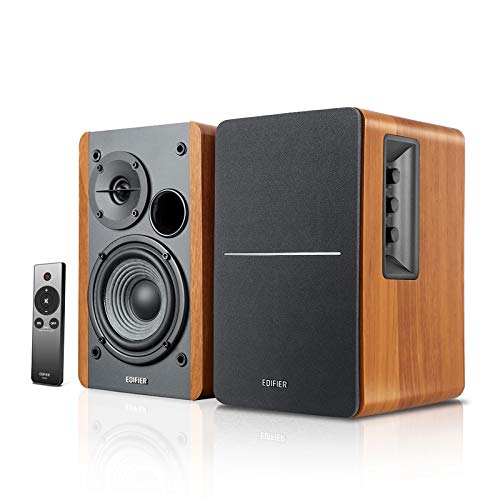
- Built-in sub-out with automatic crossover
- Dual RCA inputs for two wired sources
- Easy analog tuning with bass and treble knobs
Best For: Listeners who want powered bookshelf speakers that can easily pair with an external subwoofer.
Best for Accurate Low-End Pairing

- Detailed U-ART tweeter and waveguide for clear high-end playback
- Room-friendly rear port and DSP shelf filters
- Pairs well with the ADAM T10S subwoofer for extended bass
Best For: Producers and mixers who want a detailed monitor that can be expanded with a matched subwoofer.
Best For Near-Flat Tuning
Edifier MR4 Powered Studio Monitors
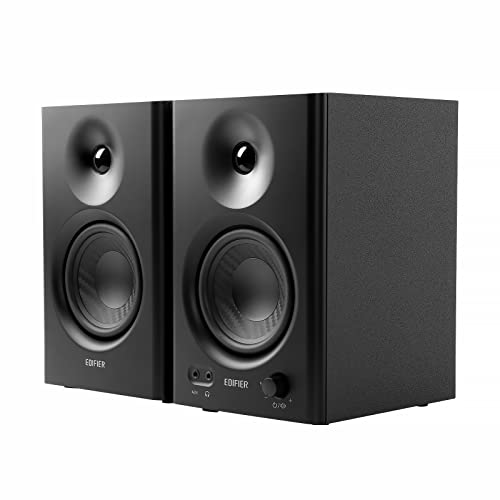
- Near-flat response for honest monitoring
- TRS, RCA, and AUX inputs for flexible hookup
- Front headphone output and dual-mode switching
Best For: Home studios, beginner producers, and desktop creators who want accurate, affordable monitoring.
Best for Small Desk Setups
PreSonus Eris 3.5BT Studio Monitors

- Compact 3.5-inch powered monitors for desktop use
- Bluetooth 5.0 and wired inputs for flexible connections
- Tuning controls help adapt sound to your room
Best For: Desktop creators and home users who want compact near-field monitors with easy connectivity.
Best for Compact Desktop Monitoring
PreSonus Eris 3.5 Studio Monitors

- Compact powered monitors with clear, accurate sound
- Flexible TRS, RCA, and front aux connectivity
- Tone controls help fit desks, bookshelves, and small rooms
Best For: Home producers and desktop listeners who want affordable near-field monitors with easy setup.
Best for Desktop Control – Mackie CR8SBT 8” Powered Subwoofer
If you want studio monitor subwoofers that add real low-end weight without making setup complicated, the Mackie CR8SBT is a strong fit. It combines an 8-inch powered woofer, Bluetooth streaming, and flexible TRS/RCA connectivity, so it can anchor a desktop studio or small listening room with minimal fuss.
Best For: Creators and home-studio users who want a compact sub with desktop volume control and easy Bluetooth pairing.
Pros:
- 8″ powered woofer with tuned ports for fuller bass extension
- Bluetooth support adds easy wireless streaming to your setup
- Desktop remote makes volume control simple from your desk
- TRS and RCA I/O plus crossover and polarity controls add flexibility
Cons:
- 8″ size may be too modest for larger rooms or bass-heavy tracking
- Bluetooth is convenient, but not ideal for critical low-latency monitoring
For buyers comparing studio monitor subwoofers, the CR8SBT stands out for convenience as much as sound. It’s a practical pick if you want tighter integration with CR series monitors, a clean desktop-friendly design, and enough control to dial in bass without overcomplicating the system.
Best Value Nearfields – PreSonus Eris E5 Studio Monitor
If you want a compact monitor that can anchor a home studio without needing a separate bass solution right away, the PreSonus Eris E5 is a practical pick for mixing, editing, and general production. It gives you a controlled low end and flexible tuning, making it easier to judge balance before you add studio monitor subwoofers to your setup.
Best For: Producers and home-studio users who want accurate nearfield monitoring with useful room-tuning controls at a sensible price.
Pros:
- 5.25-inch woven composite woofer delivers tight, usable low-end for nearfield work.
- Class AB amplification offers 80 watts of headroom and solid playback volume.
- Balanced XLR/1/4-inch and RCA inputs make it easy to connect to many rigs.
- Acoustic controls help tailor the response to your room.
Cons:
- Small woofer means it won’t replace a dedicated sub for deep bass monitoring.
- Best suited to nearfield use rather than larger rooms.
The Eris E5 stands out as a flexible entry-level monitor for buyers who care more about honest translation than big bass. If you’re comparing studio monitor subwoofers later, this speaker gives you a reliable baseline first.
Best for Desktop Monitoring – Edifier MR3 Powered Studio Monitors
The Edifier MR3 is a practical pick for anyone shopping for studio monitor subwoofers alternatives or compact monitoring speakers that can handle nearfield listening on a desk. With Hi-Res Audio certification, balanced TRS input, and multiple tuning modes, it offers a flexible, budget-friendly way to get accurate sound for music work, editing, or everyday use.
Best For: Creators and desktop listeners who want accurate, compact monitor speakers with broad connectivity and easy sound tuning.
Pros:
- Hi-Res Audio certified with a flat 52Hz to 40kHz response for more accurate monitoring.
- Useful input options including balanced TRS, RCA, AUX, Bluetooth, and headphone output.
- Music, Monitor, and Custom modes plus app-based EQ make it easy to dial in the sound.
- Compact MDF cabinet design helps reduce distortion in small studio or desk setups.
Cons:
- Not a true subwoofer, so low-end extension is limited compared with a full 2.1 setup.
- 18W x 2 output is solid for desks, but not ideal for filling a large room.
For buyers comparing studio monitor subwoofers and small monitor speakers, the MR3 stands out as a versatile nearfield option rather than a bass-heavy system. It is a strong fit if you want cleaner reference-style sound, easy connectivity, and simple tuning without moving up to a larger studio rig.
Best for Wide Sweet Spot – PreSonus Eris E7 XT Studio Monitor
PreSonus Eris E7 XT 2-Way Active Studio Monitor with EBM Waveguide (Pack of 1)
Check Price On AmazonIf you want a nearfield monitor that stays clear and controlled while doubling as a practical pick for studio monitor subwoofers setups, the PreSonus Eris E7 XT is worth a look. Its 6.5-inch woven composite woofer, silk-dome tweeter, and EBM waveguide are tuned for balanced imaging, while the acoustic controls help it adapt to real rooms instead of ideal ones.
Best For: Producers and home-studio users who want a wide listening sweet spot, flexible tuning, and reliable low-end extension.
Pros:
- EBM waveguide creates a wide, stable sweet spot for mixing and collaboration
- 6.5-inch woofer and ported cabinet deliver tight, extended bass without excess boom
- Room-tuning controls make it easier to dial in different desk and wall placements
- Includes Studio One Prime and a large plug-in bundle
Cons:
- Single monitor listing means you’ll need to buy a pair for stereo use
- Not the deepest low-end option if you need sub-bass on its own
The Eris E7 XT is a strong fit if you need accurate nearfields that can integrate cleanly with studio monitor subwoofers or stand on their own in smaller rooms. It favors clarity, placement flexibility, and practical mixing performance over flashy bass.
Best for Small Studios – ADAM Audio T5V Studio Monitor
If you want a compact nearfield monitor that helps you hear mix details clearly, the ADAM Audio T5V is a strong fit for home setups and small control rooms. It’s a practical option for buyers comparing studio monitor subwoofers because it delivers solid low-end extension on its own, while also pairing cleanly with ADAM’s T10S if you need more bass later.
Best For: Home producers, podcasters, and small-room creators who want detailed monitoring without needing a huge footprint.
Pros:
- Clear, high-resolution sound with the U-ART tweeter and HPS waveguide
- Compact beveled cabinet fits well on desks and in smaller rooms
- DSP-based shelf filters help tailor the response to your space
- Easy to expand with ADAM’s matched T10S subwoofer
Cons:
- Sold as a single monitor, so you’ll need to buy a pair separately
- 5-inch woofer won’t satisfy users who want deep sub-bass without a sub
- Rear port can be trickier to place very close to a wall
The T5V is a smart choice if you care more about accuracy and space efficiency than big bass output. For buyers browsing studio monitor subwoofers, it stands out as a monitor that’s ready to work on its own now and can scale into a fuller monitoring system later.
Best for Subwoofer Expansion – Edifier R1280Ts Bookshelf Speakers
If you want an affordable desktop speaker pair that can grow into a fuller 2.1 setup, the Edifier R1280Ts is a smart pick. It stands out among studio monitor subwoofers setups thanks to its built-in sub-out, dual RCA inputs, and simple analog controls for easy tuning.
Best For: Buyers who want powered bookshelf speakers with a dedicated subwoofer output for adding low-end support later.
Pros:
- Subwoofer line out with automatic detection and crossover activation
- Dual RCA inputs let you connect two devices without constant swapping
- 42W RMS output delivers solid everyday listening and near-field use
- Side-panel bass, treble, and volume controls make quick tuning easy
Cons:
- No Bluetooth connectivity on this version
- 4-inch woofer is fine for moderate bass, but it still benefits from a sub
Overall, the R1280Ts is a practical choice if you’re building studio monitor subwoofers on a budget and want a speaker set that leaves room for future low-end expansion. It is more about flexible connectivity and smooth integration than true studio-grade monitoring accuracy.
Best for Accurate Low-End Pairing – ADAM Audio T7V Studio Monitor
If you want a nearfield monitor that can grow with your setup, the ADAM Audio T7V is a smart choice for mix decisions, especially when paired with studio monitor subwoofers. It delivers detailed highs, a controlled midrange, and flexible tuning to help you adapt the speakers to your room.
Best For: Producers, mixers, and home studios that want a clear, accurate monitor with an easy path to tighter low-end extension.
Pros:
- U-ART tweeter and HPS waveguide provide crisp, detailed high-frequency playback
- Rear port and shelf filters help with placement and room adjustment
- Multiple analog inputs make it easy to connect common audio interfaces and devices
- Works well with the matching ADAM T10S for expanded low-end monitoring
Cons:
- Sold as a single monitor, so you must buy a second unit for stereo use
- Deep bass performance is stronger when paired with a subwoofer
This is a practical pick if you want reliable detail first and plan to add studio monitor subwoofers later for fuller low-end monitoring. The T7V keeps the focus on translation and room flexibility rather than hyped bass, which makes it useful for mixing and mastering work.
Best For Near-Flat Tuning – Edifier MR4 Powered Studio Monitors
If you want affordable speakers that behave more like honest studio monitors than bass-heavy desktop speakers, the Edifier MR4 is a smart pick. They’re a practical match for creators who may also be considering studio monitor subwoofers later, thanks to the responsive tuning, multiple inputs, and simple front-panel controls.
Best For: Home studios, beginner producers, and desk setups that need accurate monitoring without a big price tag.
Pros:
- Near-flat tuning is geared toward music production and reference listening
- 1" silk dome tweeter and 4" woofer deliver clear mids and smooth highs
- TRS, RCA, and AUX inputs make it easy to connect a wide range of gear
- Front headphone output and dual-mode switching add everyday convenience
Cons:
- 4" drivers won’t move as much low-end air as larger monitors
- Not a true substitute for dedicated studio monitor subwoofers in bass-heavy rooms
- Best suited to small- to mid-sized desktop setups rather than larger control rooms
The MR4 stands out as a sensible entry-level monitoring option: accurate enough for creative work, flexible enough for mixed-use listening, and straightforward to live with. If your setup may eventually grow with studio monitor subwoofers, these give you a clean, reliable starting point.
Best for Small Desk Setups – PreSonus Eris 3.5BT Studio Monitors
If you want compact speakers that can anchor a desktop audio setup without crowding your space, the PreSonus Eris 3.5BT is a strong pick. They deliver clear, accurate playback with enough low end for casual mixing, gaming, and everyday listening, though you’ll still want proper studio monitor subwoofers if you need true deep-bass extension.
Best For: Home studio beginners, desk-based creators, and listeners who want reliable near-field monitors with Bluetooth and flexible wired inputs.
Pros:
- Compact size fits easily on desks and in small rooms
- Clear, balanced sound with surprisingly solid bass for the size
- Bluetooth 5.0 plus TRS, RCA, and front aux inputs for easy connectivity
- High- and low-frequency controls help tailor the sound to your room
Cons:
- 3.5-inch drivers won’t replace a dedicated sub for deep bass
- Best for near-field listening, not larger room-filling playback
- Not ideal if you need loud, full-range monitoring for bigger productions
Overall, the Eris 3.5BT is a practical monitor choice for compact setups where accuracy and convenience matter more than maximum bass output. If your workflow depends on fuller low-end monitoring, pairing it with studio monitor subwoofers is the better long-term move.
Best for Compact Desktop Monitoring – PreSonus Eris 3.5 Studio Monitors
If you want an affordable near-field option that can anchor a desktop setup, the PreSonus Eris 3.5 is a practical pick. It delivers clear, balanced sound with enough low-end presence to pair well with small studio monitor subwoofers in a simple 2.1-style workspace, while still working just as well for music production, gaming, or everyday listening.
Best For: Home producers, desktop listeners, and buyers who want compact powered monitors with flexible inputs and easy room tuning.
Pros:
- Accurate near-field sound with a tight, surprisingly full low end
- 50W Class AB amplification gives solid volume for desks and small rooms
- Multiple connections, including TRS, RCA, and a front aux input
- Tone controls help tailor the sound to your room and setup
Cons:
- Not a true deep-bass solution on its own for larger rooms
- Compact size means less scale and headroom than bigger monitors
- No built-in wireless or advanced DSP features
The Eris 3.5 is a strong value choice if you need honest desktop monitoring without taking up much space. For buyers comparing studio monitor subwoofers and compact speakers, it’s a versatile foundation that can stand alone or serve as part of a small, budget-friendly setup.
How We Picked These Studio Monitor Subwoofers
We looked for products that fit real-world studio and desktop use, with an emphasis on usable low-frequency extension, clean output, and flexible inputs. We also considered whether a model is better suited to pairing with monitors or serving as part of a compact all-in-one listening setup.
Because low end is only useful if it stays controlled, we favored options with practical tuning tools such as crossover, polarity, and level controls, plus designs that make placement and integration simpler.
Quick Comparison
If you want true bass expansion, a dedicated subwoofer is the most direct upgrade. If you need a smaller footprint or a full monitor pair first, compact near-field monitors can still deliver a balanced desktop experience, but they will not replace the lowest octave the way Studio Monitor Subwoofers can.
Key Buying Factors for Studio Monitor Subwoofers
Driver Size and Low-End Extension
Larger drivers and properly tuned enclosures generally reach lower frequencies with less strain. For most small studios, the goal is not maximum volume but bass that stays tight, even, and easy to judge at moderate levels.
Crossover and Phase Controls
A good subwoofer should let you blend bass smoothly with your monitors. Adjustable crossover and polarity or phase controls help avoid muddy overlap, boomy spots, or a gap between the sub and the mains.
Inputs and Connectivity
Look for the connections that match your interface, controller, or speakers. Balanced TRS or similar pro connections are often preferable in a studio, while RCA or Bluetooth can be useful for hybrid desktop setups.
Room Size and Placement
Smaller rooms can exaggerate bass, so placement matters as much as the product itself. Compact designs are often easier to integrate near a desk, but even the best unit may need careful positioning to avoid room-induced peaks.
Who Should Buy Which Studio Monitor Subwoofers?
If your main problem is missing low end in mixes, prioritize a dedicated subwoofer with adjustable controls. If you are building a budget-conscious desktop setup, compact powered monitors may be the better first step, especially when space is limited.
For creators who switch between production, editing, and casual listening, choose gear that offers flexible connectivity and easy gain control. The best choice is the one that matches your room, your workflow, and how accurately you need to hear the bass.