Small bands need keyboards that add range without taking over the stage, rehearsal room, or budget. The best compact synthesizers can cover bass, leads, chords, textures, and experimental parts while remaining easy to transport and operate.
We’ve gathered seven portable options spanning analog, hybrid, polyphonic, cassette-sized, and microcontroller-based designs. Use the guide below to match your group’s sound, setup, and performance needs with the right type of instrument.
Best 7 Synthesizers for Small Bands Picks for 2026
Acid Bass Powerhouse

- Analog bass voice with saturation and delay
- 128 patterns plus Song Mode and arpeggiator
- MIDI, Sync, and USB-C connectivity
Best For: Hands-on acid basslines and sequenced live parts
Vector Texture Specialist

- Four-voice hybrid synthesis
- 16 vector oscillators and wavetable synthesis
- Built-in filter, sequencer, and arpeggiator
Best For: Complex compact textures and layered band parts
Portable Intro Synth

- Cassette-sized analog monophonic synth
- Built-in speaker, line out, and battery operation
- Experimental conductive-object touch controls
Best For: Beginners, mobile ideas, and playful melodic accents
Compact Sound-Design Module

- Mini synthesizer for space-saving rigs
- Alloy-steel body
- MIDI connectivity
Best For: Compact MIDI-based setups and secondary synth parts
Best Beginner Build
Synth:bit Micro:bit Keyboard Module
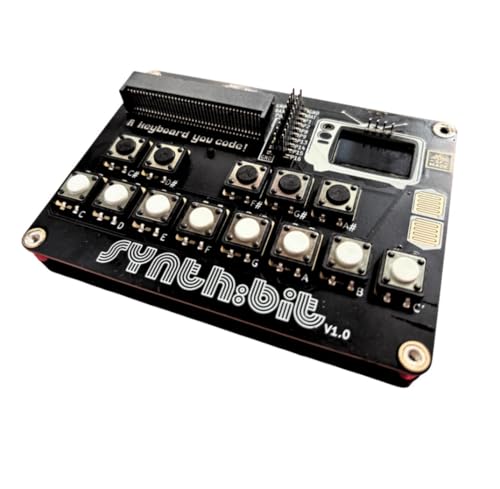
- 16-input keyboard module for Micro:bit projects
- OLED display, audio jack, and battery pack included
- Expandable through jumper pins and custom builds
Best For: Beginners and DIY music projects
Best Portable Sound Design

- Hybrid synth with vector-morphing oscillators
- Analog low-pass filter, sequencer, and arpeggiator
- Battery or USB-C powered compact format
Best For: Portable electronic setups and sequenced parts
Best Compact Analog Polyphony

- Three-voice analog polyphony
- 27 touch-sensitive keys in a compact body
- State-variable filter, sequencer, and sync I/O
Best For: Compact analog chord parts and hands-on playing
Acid Bass Powerhouse – Donner Essential B1
For small bands seeking synthesizers for small bands that can add a focused electronic foundation, the Donner Essential B1 combines an all-analog bass voice with an intuitive step sequencer. Its 128-pattern memory, Song Mode, performance pads, arpeggiator, and built-in effects make it practical for rehearsals and live pattern-based parts.
Best For: Basslines, acid-style parts, and performers who want hands-on sequencing without a complicated workflow.
Pros:
- Fully analog signal path with one VCO, VCF, and VCA.
- 128 pattern slots, Song Mode, and an eight-mode arpeggiator.
- Built-in analog saturation and delay add warmth without requiring extra effects.
- USB-C, five-pin MIDI I/O, and Sync I/O support hardware and DAW setups.
Cons:
- The straightforward one-oscillator design is focused more on bass than broad polyphonic textures.
- The supplied dimensions and weight suggest a compact unit, but the notes do not specify a built-in speaker.
The Essential B1 is a strong choice when a small band needs a dedicated, playable bass-synth role. Its limited synthesis architecture is also part of its appeal: it keeps programming direct while the sequencer and effects support performance-ready ideas.
Vector Texture Specialist – Behringer Pro VS Mini
The Behringer Pro VS Mini is a compact hybrid option for synthesizers for small bands when you want richer textures than a basic monophonic bass unit provides. Its four-voice design, 16 vector oscillators, wavetable synthesis, filter, sequencer, and arpeggiator give it a broad palette for layered parts and transitions.
Best For: Compact bands needing complex pads, evolving textures, and flexible electronic accents.
Pros:
- Four-voice hybrid architecture supports more than single-note lines.
- Sixteen vector oscillators and wavetable synthesis offer varied sound-design options.
- Includes an analog low-pass filter, sequencer, and arpeggiator.
- Filter, amplifier, and oscillator envelopes provide additional sound-shaping control.
Cons:
- The supplied notes do not detail its keyboard or hands-on control layout.
- Its compact module format may require an external controller for more expressive playing.
Choose the Pro VS Mini when versatility and layered electronic color matter more than a dedicated bass-only voice. The combination of vector oscillators, wavetable synthesis, and four-voice operation makes it a useful compact sound-design module for a small ensemble.
Portable Intro Synth – MicroKits Synth-a-Sette
The MicroKits Synth-a-Sette is an ultra-portable choice for synthesizers for small bands, especially when simplicity, experimentation, or a quick melodic layer matters. It offers a 13-key monophonic touchpad, octave-up control, optional vibrato, a built-in speaker, line output, and battery operation.
Best For: Beginners, mobile songwriting, playful melodic parts, and bands wanting an unusual educational or novelty texture.
Pros:
- Extremely compact cassette-sized design for easy transport.
- Built-in speaker, line out, batteries, and a 13-key touchpad are included.
- Conductive-touch experiments can turn fruits, forks, or other objects into a keyboard.
- Its simplified analog design is approachable for first-time users.
Cons:
- Monophonic operation limits it to one-note lines at a time.
- The simplified controls are less suited to detailed sound design or complex arrangements.
- The notes do not specify MIDI connectivity.
The Synth-a-Sette is not a full replacement for a stage workstation, but it can be a memorable addition to a small band’s toolkit. Its line out makes integration possible, while the battery-powered design and unconventional touch controls encourage quick, spontaneous ideas.
Compact Sound-Design Module – Behringer PHARA-O MINI
The Behringer PHARA-O MINI is worth considering for synthesizers for small bands when space is limited and you want a dedicated compact sound-design instrument. The supplied information identifies it as a mini synthesizer with a MIDI connector and a small alloy-steel body, making it suited to streamlined setups.
Best For: Space-conscious musicians adding a compact MIDI-connected synth to a small rig.
Pros:
- Mini format helps conserve room in compact rehearsal or performance setups.
- Alloy-steel body offers a durable-feeling construction based on the supplied materials.
- MIDI connectivity supports integration with compatible controllers or other gear.
Cons:
- The supplied notes provide few details about its synthesis engine, voices, or sequencing features.
- No built-in speaker or additional connections are specified.
- You may need other MIDI equipment to play or control it, depending on your setup.
The PHARA-O MINI is best approached as a compact, focused addition rather than a fully documented all-in-one workstation. Its main appeal here is the small form factor and MIDI connection, but buyers should confirm the available controls and sound features before choosing it for a central band role.
Best Beginner Build – Synth:bit Micro:bit Keyboard Module
For makers who want synthesizers for small bands with a strong educational and DIY angle, the Synth:bit turns a compatible Micro:bit into a 16-input keyboard. Its built-in audio output, OLED display, and battery pack make it a compact option for experimental performances and music projects.
Best For: Beginners, classroom projects, and small-band players who enjoy programming and custom hardware builds.
Pros:
- Provides a full octave-style layout with 16 inputs in a 4×4 matrix.
- Includes an audio jack, battery pack, and OLED display for portable operation and visual feedback.
- Jumper pins, breadboard compatibility, LEGO-compatible spacing, and MakeCode/Python support enable expansion.
Cons:
- Requires a Micro:bit, which is not included.
- Its beginner and project-focused design may require programming for advanced customization.
The Synth:bit is best viewed as an accessible, expandable controller-synth platform rather than a ready-to-play conventional keyboard. It is a good fit when experimentation and portability matter more than turnkey stage features.
Best Portable Sound Design – Behringer Pro VS Mini
The Behringer Pro VS Mini is a compact choice for synthesizers for small bands, especially when portability and sound-shaping flexibility are priorities. It combines four vector-morphing oscillators per voice with a low-pass filter, sequencer, and arpeggiator in a battery- or USB-powered format.
Best For: Small-band performers and electronic musicians who need portable sequencing, arpeggiation, and hybrid synthesis.
Pros:
- Offers a hybrid design with four vector-morphing oscillators per voice and an analog low-pass filter.
- Includes a 16-step sequencer and arpeggiator for rhythmic and melodic ideas.
- Compact dimensions and battery or USB-C power support portable setups.
Cons:
- The supplied specifications identify it as a module, so it may not suit players seeking a traditional full-size keyboard.
- Its listed key count and compact format may feel limited for hands-on parts requiring a wider range.
With its portable size and built-in sequencing tools, the Pro VS Mini can add animated textures without taking much space in a small-band rig. It is particularly appealing for players who value compact sound design over a conventional keyboard layout.
Best Compact Analog Polyphony – Behringer JT Mini
The Behringer JT Mini is a straightforward option for synthesizers for small bands when compact analog sound and basic polyphony are the main goals. It provides three-voice polyphony, 27 touch-sensitive keys, a state-variable filter, and a 16-step sequencer in a small desktop format.
Best For: Players who want compact analog-style chords, touch-sensitive control, and simple sequencing in a small-band setup.
Pros:
- Three-voice polyphony supports compact chords and layered parts.
- Includes 27 touch-sensitive keys for expressive hands-on playing.
- Provides a state-variable VCF, 16-step sequencer, and 3.5mm sync I/O.
Cons:
- Three voices limit larger chords and more complex polyphonic arrangements.
- The small 8.3-by-5.55-inch body may be less comfortable for extended keyboard performance.
The JT Mini balances a small footprint with useful performance controls and analog synthesis features. It makes sense for compact rigs where chord capability and direct control are more important than extensive polyphony or a full-size keyboard.
How We Picked These Synthesizers for Small Bands
We focused on instruments that make sense in a compact band setup: manageable size, practical sound-shaping controls, useful sequencing or memory features, and connectivity suited to rehearsal, recording, or live use. The selection includes dedicated bass synths, portable polyphonic models, compact experimental instruments, and educational or modular-style options.
Because “small band” can mean anything from a duo to a five-piece, we considered both musical coverage and workflow. A synth that excels at bass may be more valuable than a feature-heavy keyboard if your group has no bassist, while a polyphonic model can fill harmony and pad roles when there is no dedicated keyboardist.
Quick Comparison
- Best for sequenced bass: Donner Essential B1, with a bass-focused design, pattern memory, and onboard effects.
- Best for compact hybrid sounds: Behringer Pro VS Mini models, which combine portability with vector-style synthesis and multiple voices.
- Best for portable analog experimentation: MicroKits Synth-a-Sette and Behringer PHARA-O MINI.
- Best for learning and customization: Synth:bit, especially for micro:bit projects and hands-on sound exploration.
- Best for compact polyphony: Behringer JT Mini, with three-voice analog operation for chords and layered parts.
Key Buying Factors for Synthesizers for Small Bands
Sound Coverage
Decide which musical job the instrument must perform. Bass synths should deliver firm low end and quick pattern control. A polyphonic synth is more useful for chords, pads, and layered arrangements, while a compact monophonic model may be ideal for leads, effects, and focused bass lines.
Controls and Workflow
For live use, accessible knobs and switches matter more than a long specification list. Look for direct control over cutoff, resonance, envelope, pitch, and modulation. Pattern storage and sequencing can help one player create movement without needing a separate sequencer.
Portability and Power
Check dimensions, weight, power requirements, and whether batteries are supported. Battery operation is particularly useful for informal rehearsals, outdoor performances, and setups where power outlets are limited.
Connectivity
Confirm the available audio outputs, headphone connection, MIDI or control-voltage compatibility, and any USB or educational interfaces. A compact synth is only useful onstage if it integrates cleanly with your mixer, amplifier, effects chain, or recording setup.
Who Should Buy Which Synthesizers for Small Bands?
Choose the Donner Essential B1 if your band needs a dedicated bass voice with sequencing and effects. Consider a Pro VS Mini if portability, evolving hybrid textures, and multiple voices are priorities. The JT Mini is a better fit for players who need compact analog chords and classic synth parts.
The Synth-a-Sette and PHARA-O MINI suit musicians who value unusual character and quick experimentation over maximum range. Choose Synth:bit if learning, programming, and customization are central to the project. Before buying, prioritize the instrument’s role in your setlist, then verify its power and connection requirements against the rest of your rig.